Best of My 2013 Facebook Status Updates

20131231-140413.jpg
And when I came downstairs this morning (after a second night of being up half the night with a sick child), THIS is what I saw when I turned on the light.

December 31 – the last day of the year. Time to take a few moments to reflect on the highlights of 2013.  Some technologically forced reflections have been available for weeks to help with this task.  This, for example, appeared on my Facebook timeline:

2013

Jennifer Prestholdt

A look at your 20 biggest moments on Facebook.

Learn more.
Share Your Year.

Frankly, it looked suspiciously like 2012, but with more directives and a slightly larger font (and now in United Nations baby blue, I might add).

Year in Review
Jennifer Prestholdt
A look at your 20 biggest moments from the year including life events, highlighted posts and your popular stories.

But this Year in Review app most certainly does not accurately reflect  my “20 biggest moments from the year”.   Some of the pictures were not even from 2013!  So, in what has become an annual tradition, I’m taking charge of my Year in Review and creating my own”Best of My Facebook Status Updates”of some of the funniest moments for me in 2013.  (And if you like this post, you can also check out Best of My 2012 Facebook Status Updates and Best of My 2011 Status Updates.)

Best of My 2013 Facebook Status Updates

#25      The fifth graders are studying puberty, so the dinner conversation was interesting. It was a spectacularly unfortunate coincidence that we grilled tonight – and tubular meat products were on the menu.

#24      Some families set a place for Elijah. Our family apparently sets a place for Trouble.

Photo: Some families set a place for Elijah. Our family apparently sets a place for Trouble.

#23:

Eliza (age 8):  “Are you drinking barf?”
Me: “Yes. I threw up in the smoothie machine and added a banana. Now I’m drinking it.”
(Pause)
Eliza: “Is this called ‘sarcasm’?”

#22  I’m helping my 7th grader study for his Tom Sawyer test. So I showed him the classic Rush video. To which he responded, “Mom, this is not really helping.”

#21       In 5 minutes, I have to give a lecture on international human rights mechanisms to a class at the U of Iowa Law School. Unfortunately, I just figured out that since it is via Skype, they will all see how messy my office is. Gotta go stuff some documents in the closet and sweep some files under the rug…

#20     “When in doubt, add cheese.” This is the kind of advice I give to my daughter.

#19     Positive things about below zero weather: I stuck the tragically unchilled bottle of wine outside for 5 minutes. Now it is cold (and DE-licious!)

#18

Mom, when I grow up – if I’m a teacher – on the first day of school I’ll pull down a map of Europe and say “I see London. I see France.”And I’ll be wearing, like, really bright pink boxers or something and I’ll have my jeans low.

So then I’ll turn my back to the class and pull down another map and say, “Class, what else do you see?” And the kids that raise their hands and say, “Mr. ___, I see your…”

Well, that’s how I’ll know who the troublemakers are.

#17     Note to self:  Be careful doing laundry this week.  Very, VERY careful!
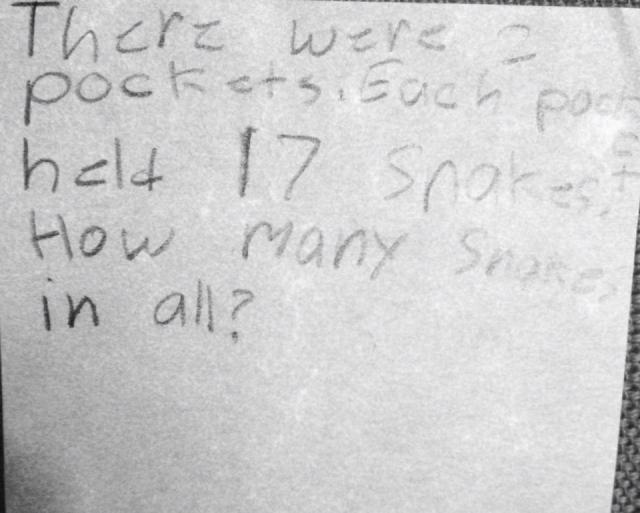
34 snakes
There were 2 pockets. Each pocket held 17 snakes. How many snakes in all?

#16    My flight out of Delhi was cancelled, so I was re-routed through Paris. Perhaps the only major airport in the world that smells of fresh-baked croissants at 6 am in the morning!

#15

“Simon, turn off the TV.”

“I can’t, Mom! Everything I need to know about life is on Dr. Who!”

#14     Home! And, as always when I return from the developing world, I am feeling so thankful for clean air, hot water, high-speed internet, urban planning and traffic control – and a democratic system of government that is not perfect, but which functions smoothly and provides us with services without corruption. Perspective is a valuable thing.

#13     Lady behind me at the grocery store:  “Girl!  You’ve either got a big family or you’re done shopping for 2013!

#12      First week back at school update:

Eliza (grade 3):  “What’s the difference between fiction and non-fiction again?”

Simon (grade 6): “Non-fiction is real. Like Facebook.”

Eliza: “So what is fiction?”

Simon: “It’s fantasy, it’s not real. Like Facebook.”

#11   The Polly Pockets were willing to sacrifice their heads for the opportunity to skydive off our back balcony.

Photo: The Polly Pockets were willing to sacrifice their heads for the opportunity to skydive off our back balcony.

#10

“Mom, do you have a name for our toilet?”
“No.” (pause) “But something tells me you might.”
“Yeah. Our toilet is named Bob.”

#9     (The next day)   I have been informed that the gender of our upstairs toilet “Bob” has been reassigned. Depending on who you ask, she is now either “Tina” or “Betsy”.

#8     Well, at the request of one of my sons, I bought ramen noodles for the first time in 25 years. Still the same price – 29 cents. The way I figure, it’s never too early to prepare them for college.

#7

 Eliza: “Hannah says that when I grow up, I should be a doctor.”
Me: “I concur.”
Eliza: “An American Girl doctor.”
Me: “I retract my previous statement.”

#6     Still life with retainer.

Photo: Still life with retainer.

#5     I could have done without these 6th grade boys and their dinner discussion. All you need to know about it is that their creation myth involves the planet “Poopiter” and explains why there is so much cosmic gas in the universe.

#4     I made the mistake of taking my 11-year-old son with me when I was shopping for bras. With having to yell so many times, “Don’t touch that!” and “Stop squishing it!”, I ended up accidentally buying a nursing bra.

#3     I sent my 13yo son to camp with two pairs of shoes.   Somehow, he managed to come home with just one.   One shoe, that is.

#2     I very much appreciated that the employees stocking shelves at the downtown Target let me participate in their “Churchill-off”. I only made it two rounds (they were still going when I went to check out) but I got to use the only two Churchill quotes that I can ever manage to remember:

        1. We make a living by what we get, but we make a life by what we give.

        2. Lady Astor: “Sir, if you were my husband, I would give you poison.”

            Churchill: “If I were your husband, I would take it.”

#1      It’s just not a holiday in our family until someone gets a pie in the face.

Photo: It's just not a holiday in our family until someone gets a pie in the face.

Thanks for reading The Human Rights Warrior!  See you in 2014!

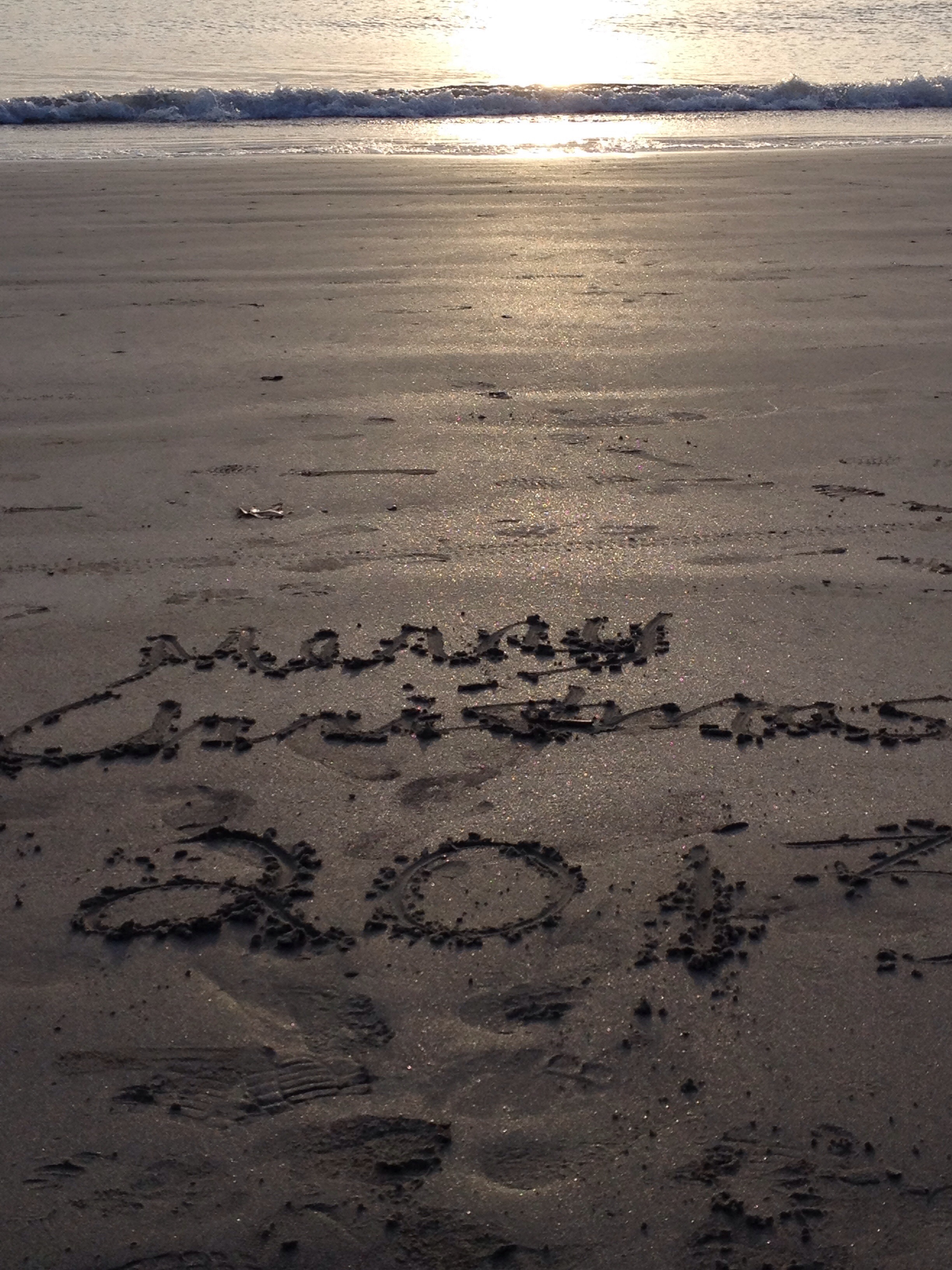
Happy New Year from Sullivan's Island, South Carolina!
Happy New Year from Sullivan’s Island, South Carolina!
Repeat The Sounding Joy

20131225-202103.jpg

Weekly Photo Challenge: One

IMG_0150
Cow in Casablanca

A single cow grazes  amidst the trash in a working class neighborhood in suburban Casablanca, Morocco.

This post is a response to the Weekly Photo Challenge theme One.

Weekly Photo Challenge: Community

douala map

As part of their Community Health initiative, a Cameroonian non-governmental organization developed this map of the city of Douala.  Douala,  a major Central African port and the commercial capital of Cameroon, is in the departement of Wouri.

The map shows the locations of  potential transmission sites for HIV/AIDS,  STDs and TB.

It was created based on information gathered through field work in the community.  Staff members use it to target their outreach and community health intervention strategies to effectively reach the most at-risk populations.

This post is a response to the Weekly Photo Challenge: Community.

Human Rights Day Activities To Do With Your Kids

This post was originally written for World Moms Blog.

IMG_1800Every December 10, people around the world celebrate Human Rights Day.  The date was chosen to honor the United Nations General Assembly‘s adoption on 10 December 1948 of the Universal Declaration of Human Rights (UDHR), the first global statement of international human rights principles.  As we have done on World Moms Blog before (see 10 Things to Do With Your Kids on Human Rights Day), we’re sharing some ideas for simple yet meaningful ways for your family to celebrate the rights and responsibilities that we all share as human beings.

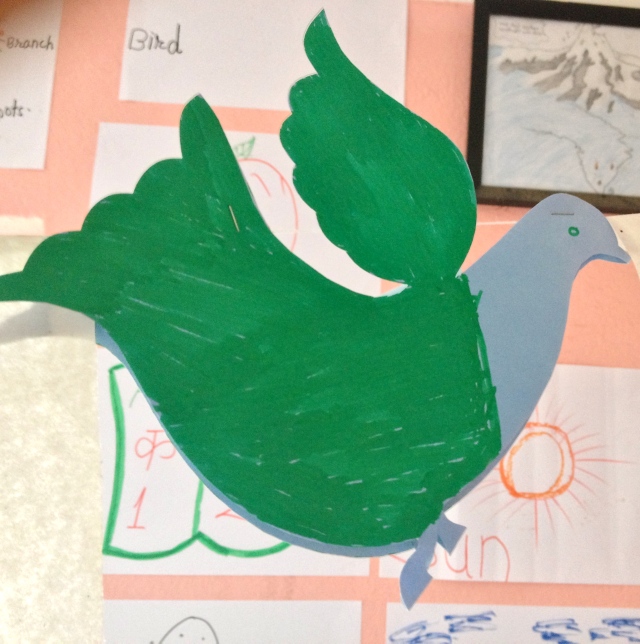
1.  Make a World Wishes Dove with your family.  Cut feathers from white paper or colored construction paper.  Have everyone in the family decorate and write their wish for the world on a feather.    Cut out the body of a dove or other bird and glue all the feathers on it.  Once decorated, your bird will be a beautiful and hopeful expression of your family’s hopes for our world.

Template for a doveImage Source
Template for a dove
Image Source
2.  Play a game that helps kids understand human rights.  Blind Trust (from ABC – Teaching Human Rights):  In pairs, have one child blindfold the other and have the sighted member of the pair lead the “blind” one about for a few minutes. Make sure the leading child is not abusing the power to lead, since the idea is to nurture trust, not to destroy it. The “leader” of the pair should try to provide as wide a variety of experiences as possible, such as hav- ing the “blind” partner feel things with his or her feet or fingers, leading with vocal directions or even playing a game. After a few minutes have the children reverse the roles and repeat the process so that the “leader” is now the led, and the “blind” partner is now the sighted one.

Once the activity is over, allow the children to talk about what happened. Discuss how they felt – not just as “blind” partners but their feelings of responsibility as “leaders” too. This can lead not only to a greater awareness of what life is like for people with sight (or hearing) disabilities, but to a discussion of the importance of trust in the whole community. This can lead in turn to a discussion of world society, how it works and how it can fail to work too.  (teaches about Universal Declaration of Human Rights article 28; Convention on the Rights of the Child articles 3, 23)

3.  Learn about how children live in other countries.  For example, you can learn what kinds of food children in East Africa grow and eat from the Lessons from Africa resource created by the British non-governmental organization Send A Cow (also check out their website http://www.cowforce.com).  You can download the  powerpoint  about typical East African food.   You can also print out some of the recipes for things like chapatis and pepper soup to make and try for yourself.

4.  Find out what kids and teens can do to help stop child labor.  The ILO’s Youth in Action against Child Labour campaign has ideas, information,  videos and other resources to help young people take action to end child labor.

5.  Play Human Rights Twister to teach about cooperation, respect and inclusion.   Make a “Twister” game in which kids spell out key human rights words using their feet and hands.  Draw a grid with 6 columns and 5 rows with marker on a  large piece of cloth (like an old sheet) or plastic (like a plastic tablecloth). You can also use chalk to draw it on the ground. Write the following letters in the grid:

(blank) W X Y Z(blank)


Q R S T U V

K L M N O P

E F G H I J

(blank space)A B C D(blank)

Ask the children to name some rights and list them on a large piece of paper or whiteboard. Underline a key word in each right from this list of rights in one word:

Dignity            Education            Equality             Food            Freedom            Home            Love (from parents)            Name

Nationality          Opinion          Participation (in decisions that affect us)          Play          Protection          Religion

When you have listed at least 3 or 4 rights, have the children spell out the key word in the human right from the list by placing their hands and feet on the  appropriate letters of the “Twister” game.  When 1 child’s hands and feet are in place and the word is not yet completed, ask another child to join in  to complete the word. If the hand or foot of another  child already covers a letter, the player just has to touch the child that is on that letter.  When a letter is too far to reach, invite another child to join in.  (This activity and dozens of others to teach about human rights values and peaceful conflict resolution are available for free download in the Canadian organization EquitasPlay It Fair Toolkit. )

6.  Make toys and play games that children play in other countries.  Many kids throughout the world live in poverty and don’t have money to buy toys and games.  They make their own toys out of recycled materials that they find.  Your kids can try making a football (soccer ball) out of recycled plastic bags or a toy car made from a plastic bottle.

http://vimeo.com/39763894

You can also  make and play the Sudanese game “Dala” (the Cow Herder Game).  In many parts of the world, games mimic everyday life; this game mimics the Sudanese practice of bull herding.  Sudanese people play it on the ground, using sticks to make the lines and pebbles or seeds as “bulls”.

7.  Ask the question “What Does a Child Need?”  Have your child lie down on a large piece of paper and trace their outline on the paper.  Ask your child(ren) to name this paper child. Discuss and decide on the mental, physical, spiritual and character qualities they want this ideal child to have as an adult (e.g. good health, sense of humour, kindness) and write these qualities inside the outline. They might also make symbols on or around the child to represent these ideal qualities (e.g. books to represent education). Talk about what human and material resources the child will need to achieve these qualities (e.g. if the child is to be healthy, it will need food and health care); write them down on the paper outside of the outline.  You can also read a simplified version of the Convention on the Rights of the Child (available in English, French, Spanish, Russian, German, etc.)  When children hear an article that guarantees a child each of the needs they have listed, they can write the number of the articles next to that item. Circle any needs identified but not covered by the Convention.

DSC_0599


8.  Read some books with strong female characters.   Non-discrimination and equality are key concepts in international human rights law.  Yet girls and women are generally not been portrayed as equals to boys and men in literature.  A Mighty Girl has compiled several great lists of girl-empowering books, including Top Read Aloud Books Starring Mighty Girls,  Top 100 Mighty Girl Picture BooksTop Graphic Novels Starring Mighty Girls, and Top Mighty Girl Books & Films on Women’s History.

9.   Get creative and enter your work in a contest with a human rights theme.   Local, regional or international contests are powerful activities for getting youth involved and learning about human rights.  Take action by entering some of the contests listed here on the Youth For Human Rights website.  (You can also learn more on the website about their educational programs, projects, awareness campaigns and human rights outreach campaigns.)

10.  Make a Human Rights Day card.  You can give the card to a friend or member of your family.  Or you can make multiple cards to decorate your house.   My eight year old daughter (that’s her self-portrait in the background) made this card for all the children of the world.

IMG_1502


ADDITIONAL RESOURCES:  You’re on your way to a great Human Rights Day!  If you are a classroom teacher or homeschooling your kids (or if you just want to dig deeper), you can find tons more ideas through the following resources:

My past posts on Human Rights Day activities:

United Nations Cyber Schoolbus – human rights activities and information about the United Nations’ work

ABC – Teaching Human Rights – practical activities in English, French, Russian, Arabic, Chinese, and Spanish from the UN Office of the High Commissioner for Human Rights

The Advocates for Human Rights’ Discover Human Rights Institute – human rights education lesson plans and curriculum

Human Rights Here and Now  – human rights lesson plans and resources

Raising Children With Roots, Rights and Responsibilities – activities for preschool and young elementary children

UNRIC’s Human Rights Education website –  great source for multimedia on human rights!

The Meaning of Mandela

Mandela memorial painted on a building in Capetown, South Africa
Mandela memorial painted on a building in Cape Town, South Africa

When Nelson Mandela died last week, I was struck by the somewhat impersonal nature of the “continuous live” media coverage.  In the United States, I heard interviews with reactions from world leaders, I saw billboards with quotes from Oprah Winfrey and Maya Angelou about what Mandela meant to them.  We now, apparently, memorialize our greatest heroes in memes, soundbites on photos which we share and share again.    But what I really wanted to know was this:

“What are the people of South Africa feeling right now? How are they mourning the loss of the father of their nation?”

As it turns out,  my brother Jeremy is in Cape Town, South Africa.  He started sending back photos of the makeshift memorials that were springing up around the city. Touching tributes, both large and small, that showed the genuine love and respect felt for this man.   Jeremy is a professor of African history, so I asked him to share his thoughts about Nelson Mandela along with his photos.  

Rocked our World
Madiba You Rocked Our World

The Meaning of Mandela

by Jeremy Prestholdt

I arrived in South Africa a few hours after Nelson Mandela’s passing. The nation had only just begun mourning, but the way in which the former president had touched the lives of all South Africans was plain. From Soweto to Sandton, Cape Town, and Qunu, the outpouring of grief and appreciation was unlike anything I’d seen. While I knew that Mandela was revered, the deep respect for him that I’ve witnessed over the past days suggests that he was far more than a popular leader: he personified the myriad aspirations of South Africans.

Nobel Peace Prize
Nobel Peace Prize

As a professor of African history I often tell Mandela’s story. For decades Mandela was vilified as a terrorist. After he traveled to Algeria for military training, many in South Africa called for his execution. Rather than hanging Mandela, the Apartheid government tried to make him irrelevant by condemning him to a life of hard labor. During his nearly three decades in prison he became an icon in the struggle against white minority rule in Africa.

Mandela’s release from prison in 1990 was a watershed in the fight against Apartheid. Yet, it was his adroitness in navigating the path to national freedom that cemented his place in the hearts of all South Africans. Unlike most political leaders, Mandela had an extraordinary ability to balance justice with reconciliation. By drawing on this skill he accomplished what many deemed impossible: he steered a deeply divided and unequal society towards peace and greater freedom. For this Mandela earned universal appreciation as well as the title Tata (father of the nation), a word now on everyone’s lips in South Africa. It’s this deep appreciation for the father of the nation that is so evident here.

Mandela Flag

Though I’ve recounted Mandela’s history many times, joining South Africans during this period of mourning and remembrance has made me rethink the conclusion to the story that I will tell in future. The new ending will not be Mandela’s presidency or his death. Rather, it will be a reflection on what Mandela means to us now. South Africans–and mourners around the world–have demonstrated that, perhaps more than any other figure of our time, Mandela represents our collective aspirations for freedom, justice, and equality. In this he is more than a South African icon. He is a global symbol of human possibility.

Cards

All photo credits to Jeremy Prestholdt

Thank you so much, Jeremy, for writing this guest post!

The Grandeur of the Acropolis

IMG_0223
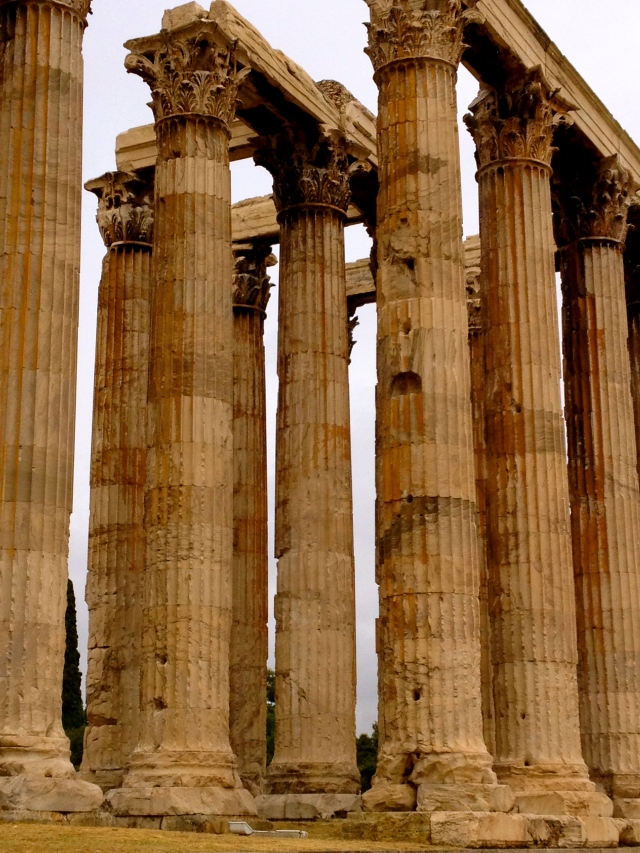
Columns of the Parthenon, which was built in the 5th century BC.

The Acropolis, perched on a rocky hilltop above the bustle of Athens, is one of the grandest historical sites that I have had to opportunity to visit.   I’m sharing a few photos from my 2012 visit in response to the Weekly Photo Challenge: Grand.  If you have never had the opportunity to experience the grandeur of the Acropolis, you can take a virtual tour here.  Happy Sunday!

IMG_0221
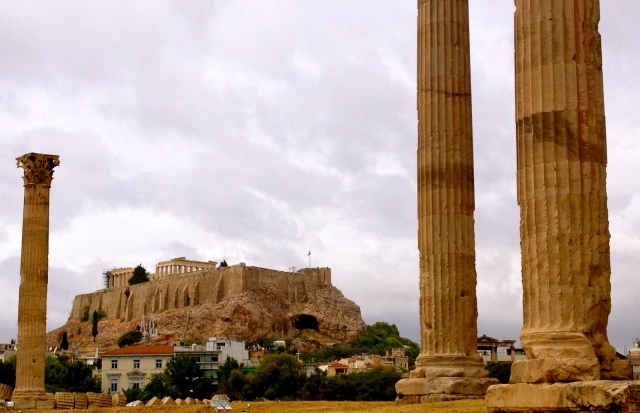
View of the Acropolis from the Temple of Olympian Zeus. Construction on this temple began in the 6th century BC.
IMG_0207
The porch of the Caryatids on the south side of the Erechtheion.


IMG_0211
The Sacred Olive Tree on the north side of the Erechteion.  It is said to be a descendant of the olive tree that Athena gave to the ancient Greeks, causing them to name their city “Athens” in her honor.  Every invader has cut it down, but every time someone has saved a sprig to replant later.

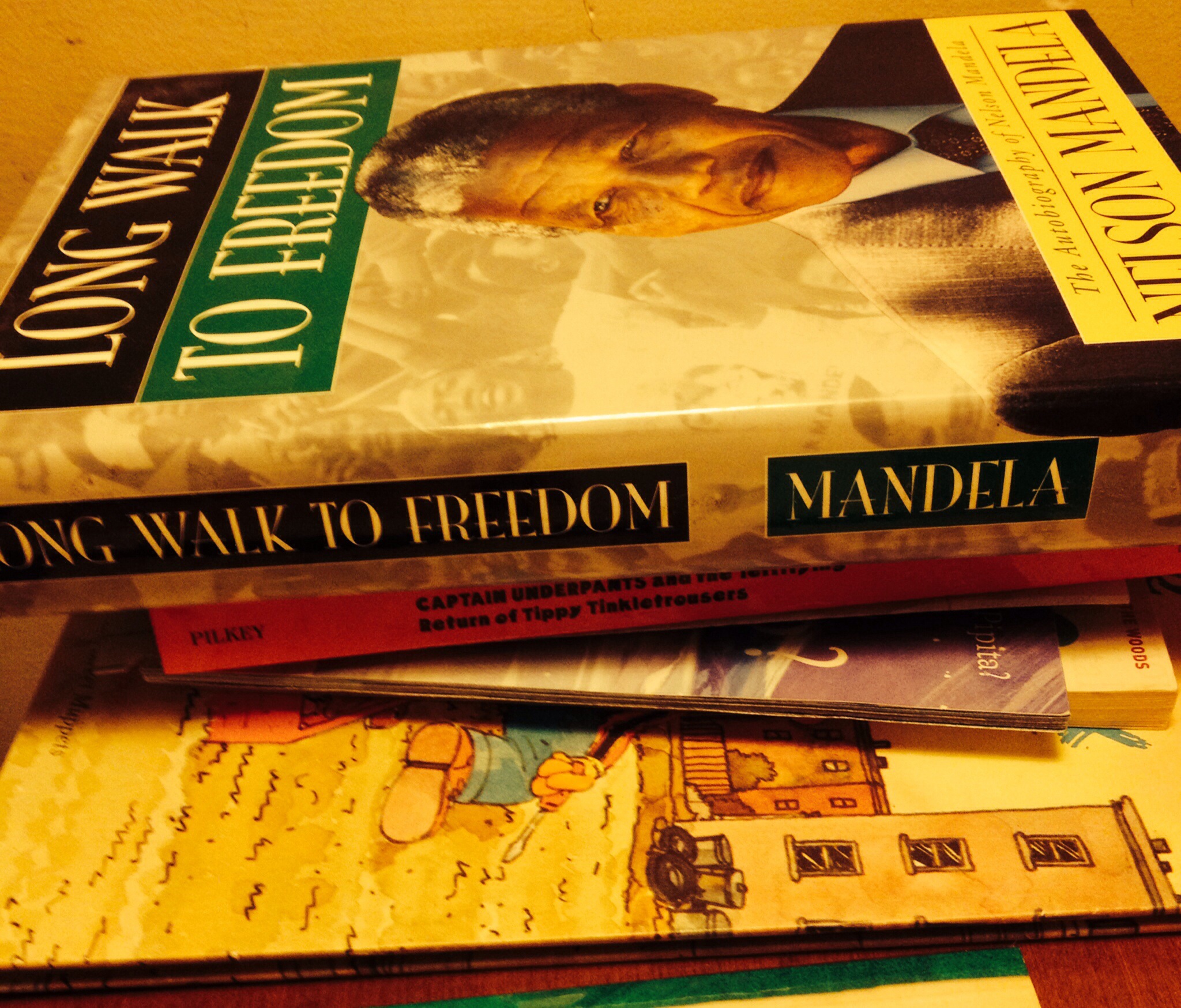
Long Walk to Freedom

20131206-105208.jpg

“No one is born hating another person because of the color of his skin, or his background, or his religion. People must learn to hate, and if they can learn to hate, they can be taught to love, for love comes more naturally to the human heart than its opposite…

Man’s goodness is a flame that can be hidden but never explained.”

 (From Long Walk to Freedom, 1995)

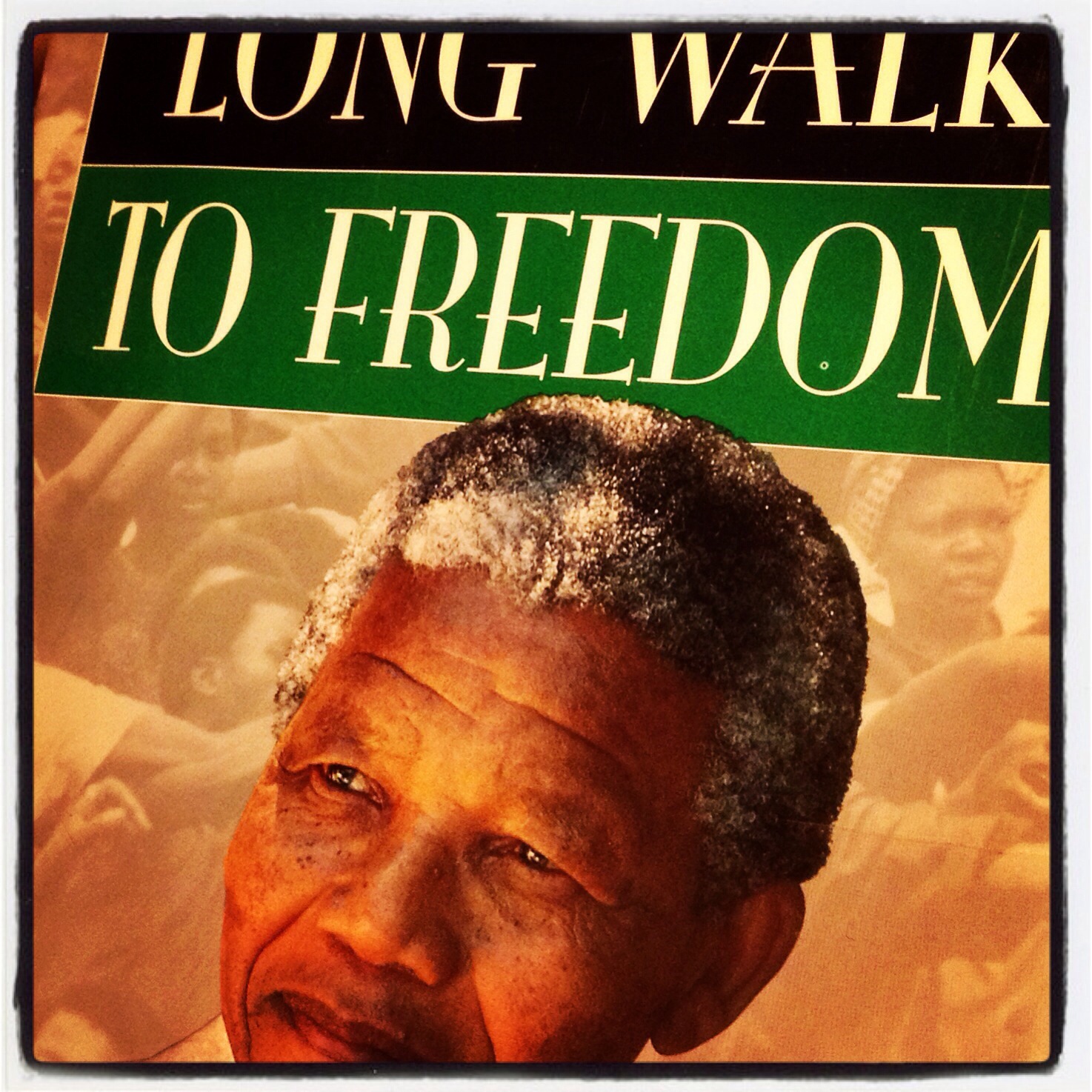
For many years, I have kept a copy of Nelson Mandela’s autobiography Long Walk to Freedom on my bedside table.  I don’t keep it there because I am in the process of reading it (I have read it twice), but because I keep the words of this great human rights hero in my heart.   I like waking up in the morning and knowing that it  is there.   Sometimes I just lay there and look at the title on the binding for a few seconds.  It helps me remember the good in this world.

Long Walk to Freedom was published in 1995, just a few years after Nelson Mandela was released from his nearly three decades of imprisonment on Robben Island and Pollsmoor Prison for leading the ANC.    I was in law school at the time.  I think that when  I first read it, I was especially looking for information from his early years about how and why he became a human rights warrior.  (Yes, Nelson Mandela was a lawyer, too.)   I love that as a child, he was called  “Rolihlahla” , which means “pulling the branch of a tree ” (i.e. “troublemaker”).

Here are a few of the things that he wrote in the book that rang true for me.

“I had no epiphany, no singular revelation, no moment of truth, but a steady accumulation of a thousand slights, a thousand indignities and a thousand unremembered moments produced in me an anger, a rebelliousness, a desire to fight the system that imprisoned my people. There was no particular day on which I said, Henceforth I will devote myself to the liberation of my people; instead, I simply found myself doing so, and could not do otherwise.”

and

“I have never cared very much for personal prizes. A person does not become a freedom fighter in the hope of winning awards.”

and

“I am fundamentally an optimist. Whether that comes from nature or nurture, I cannot say. Part of being optimistic is keeping one’s head pointed toward the sun, one’s feet moving forward. There were many dark moments when my faith in humanity was sorely tested, but I would not and could not give myself up to despair. That way lays defeat and death.”

Tonight, when I heard the news that Nelson Mandela had died, I was not surprised.   Nelson Mandela was 95 years old and had been ill for a long time.  His human body had become a painful prison from which his soul deserved freedom.    I remembered that he had written about freedom in his autobiography.  I don’t know which parts of  Long Walk to Freedom were written clandestinely on Robben Island and which were written after his release, but long-term detention must have had an impact on his views of freedom.  When Nelson Mandela talked about freedom, it was not limited to his own person.  Rather, for Nelson Mandela, freedom was inextricably linked to the freedom of other human beings.

“For to be free is not merely to cast off one’s chains, but to live in a way that respects and enhances the freedom of others.”

and

“Freedom is indivisible; the chains on any one of my people were the chains on all of them, the chains on all of my people were the chains on me.”

Freedom from imprisonment was not the end of the story for Nelson Mandela.  It was only the beginning of his work in leading South Africa towards a new, post-apartheid era.  What he says about leadership  in Long Walk to Freedom is also instructive.

“A leader. . .is like a shepherd. He stays behind the flock, letting the most nimble go out ahead, whereupon the others follow, not realizing that all along they are being directed from behind.”

and

“A Nation should not be judged by how it treats its highest citizens, but it’s lowest ones”

When Nelson Mandela wrote his autobiography, he still had many years left in his long life and many miles yet to walk.

“I can rest only for a moment, for with freedom come responsibilities, and I dare not linger, for my long walk is not yet ended.”

Your long walk is ended now and the world is a better place because of it.    Rest well, Rolihlahla!  I will keep your words in my heart and –  on my bedside table.

  While I understand that a movie based on the autobiography has just been released, I hope that others will take the time to read Long Walk to Freedom.   Nothing can inspire admiration of this great human rights leader than the words written by Nelson Mandela himself.

20131206-105223.jpg


The Festival Lights of Indra Jatra

IMG_0417

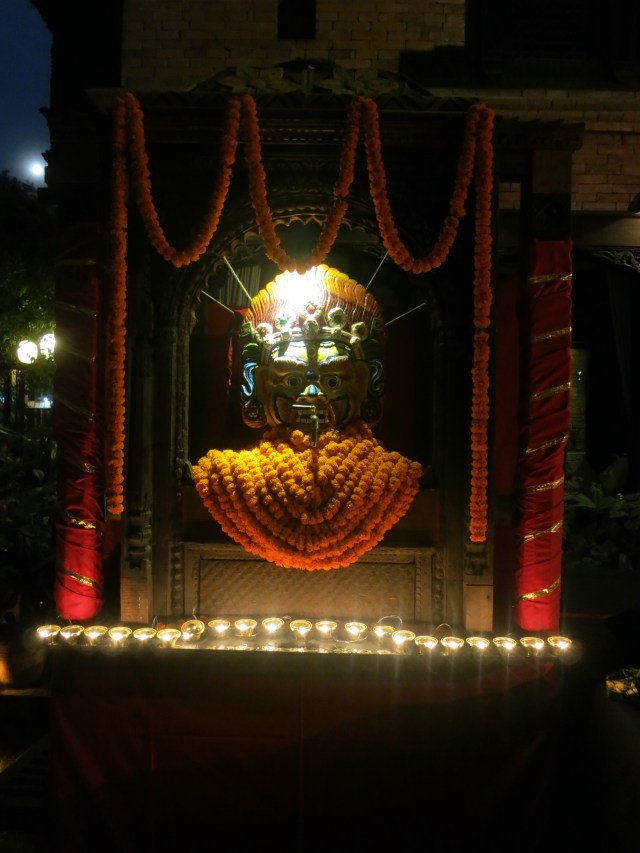
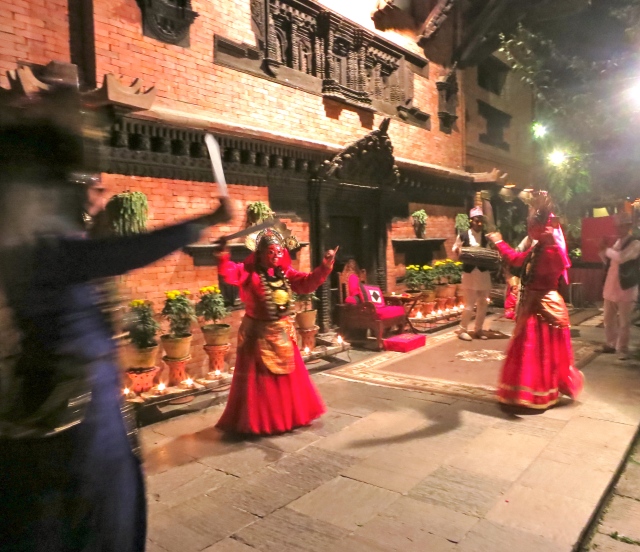
Photos from Indra Jatraa festival in Nepal that fell this year on September 18.   During Indra Jatra, thousands of people in Kathmandu pay homage to the Kumari Devi (Living Goddess).

IMG_0414
Offerings of thanks. (The swastika is an ancient Hindu symbol used to signify good fortune. The name comes the Sanskrit word svasti (sv = well; asti = is), meaning good fortune, luck and well-being.)

Some say that Indra Jatra is the day to give thanks to the lord Indra for the rain.  Or, depending on who you ask, it is a day to give thanks to the lord Indra for the end of the rainy season.

Ceremonial rice wine dispenser. Can you see the full moon in the background?

According to others, the festival is celebrated in the honor of Bahirab, who is Shiva‘s manifestation and is believed to destroy evil.

IMG_0452

No matter how you interpret the meaning of the festival, it is a beautiful celebration of traditional Nepali dance, music, and food.  The festival lights of Indra Jatra lit up the dark Kathmandu night!

This post is a response to the Weekly Photo Challenge: Let There Be Light!

Haikus With My Daughter III: Girls Rights

My heart yearns for you

To live – equal – to your full

human potential.

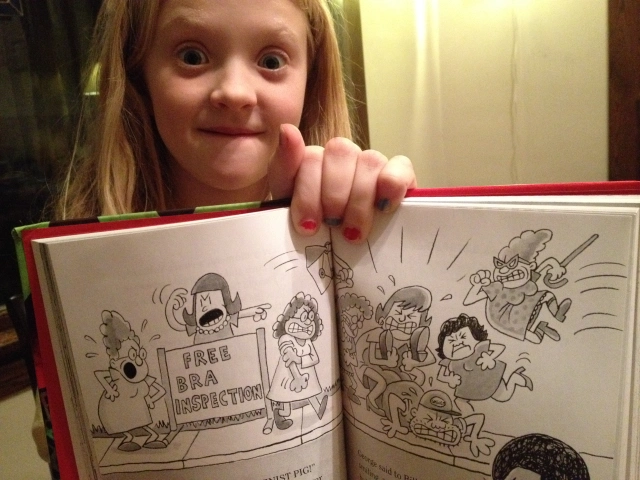
It’s a challenge to raise a daughter in a society that innundates us with countless hidden messages about how girls should look and act, who they should be.    My daughter and I have been talking about this a lot lately, with the holiday marketing of “girls toys” and “boys toys” so in our faces.   So I was pleasantly surprised this week when she found a women’s rights message hidden in Captain Underpants and The Terrifying Return of Tippy Tinkletrousers.

IMG_1964

Captain Underpants.

The bully battle begins!

(Secret feminism.)

You go, girl! You just go and go and GO!

This post, Haikus With My Daughter , Haikus With My Daughter II  and Thanksgiving are a response to the WordPress Weekly Writing Challenge.