As part of their Community Health initiative, a Cameroonian non-governmental organization developed this map of the city of Douala. Douala, a major Central African port and the commercial capital of Cameroon, is in the departement of Wouri.
The map shows the locations of potential transmission sites for HIV/AIDS, STDs and TB.
It was created based on information gathered through field work in the community. Staff members use it to target their outreach and community health intervention strategies to effectively reach the most at-risk populations.
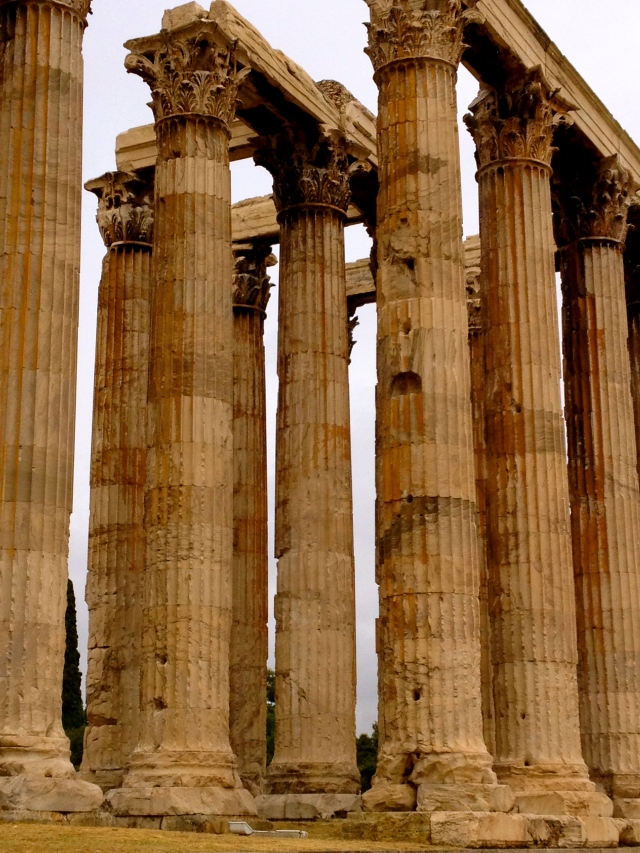
Columns of the Parthenon, which was built in the 5th century BC.
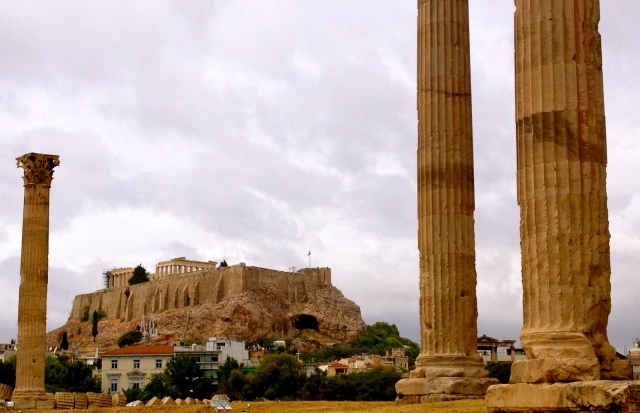
The Acropolis, perched on a rocky hilltop above the bustle of Athens, is one of the grandest historical sites that I have had to opportunity to visit. I’m sharing a few photos from my 2012 visit in response to the Weekly Photo Challenge: Grand. If you have never had the opportunity to experience the grandeur of the Acropolis, you can take a virtual tour here. Happy Sunday!
View of the Acropolis from the Temple of Olympian Zeus. Construction on this temple began in the 6th century BC.The porch of the Caryatids on the south side of the Erechtheion.
The Sacred Olive Tree on the north side of the Erechteion. It is said to be a descendant of the olive tree that Athena gave to the ancient Greeks, causing them to name their city “Athens” in her honor. Every invader has cut it down, but every time someone has saved a sprig to replant later.
Offerings of thanks. (The swastika is an ancient Hindu symbol used to signify good fortune. The name comes the Sanskrit word svasti (sv = well; asti = is), meaning good fortune, luck and well-being.)
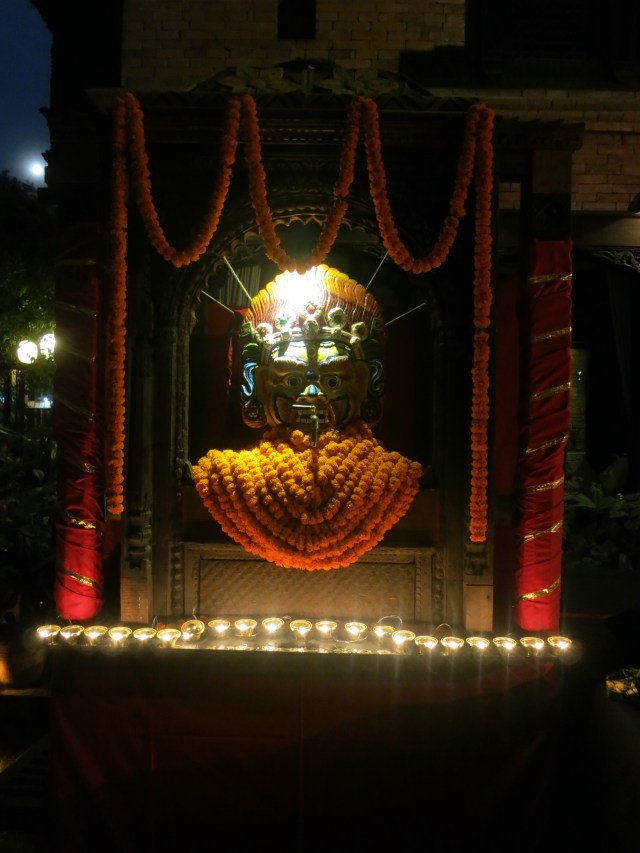
Some say that Indra Jatra is the day to give thanks to the lord Indra for the rain. Or, depending on who you ask, it is a day to give thanks to the lord Indra for the end of the rainy season.
Ceremonial rice wine dispenser. Can you see the full moon in the background?
According to others, the festival is celebrated in the honor of Bahirab, who is Shiva‘s manifestation and is believed to destroy evil.
No matter how you interpret the meaning of the festival, it is a beautiful celebration of traditional Nepali dance, music, and food. The festival lights of Indra Jatra lit up the dark Kathmandu night!
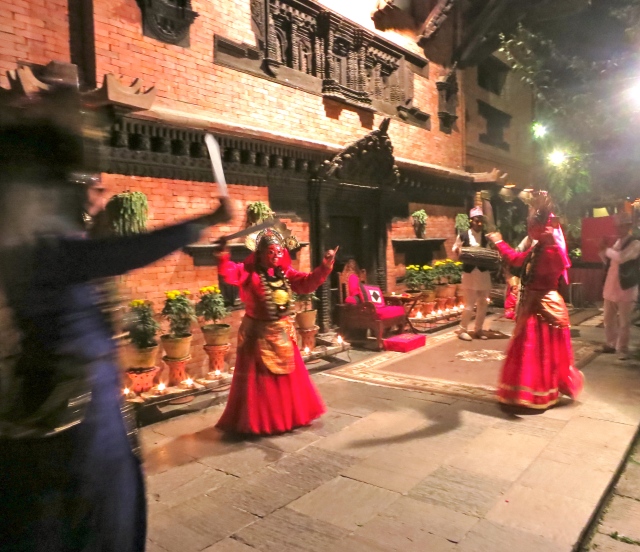
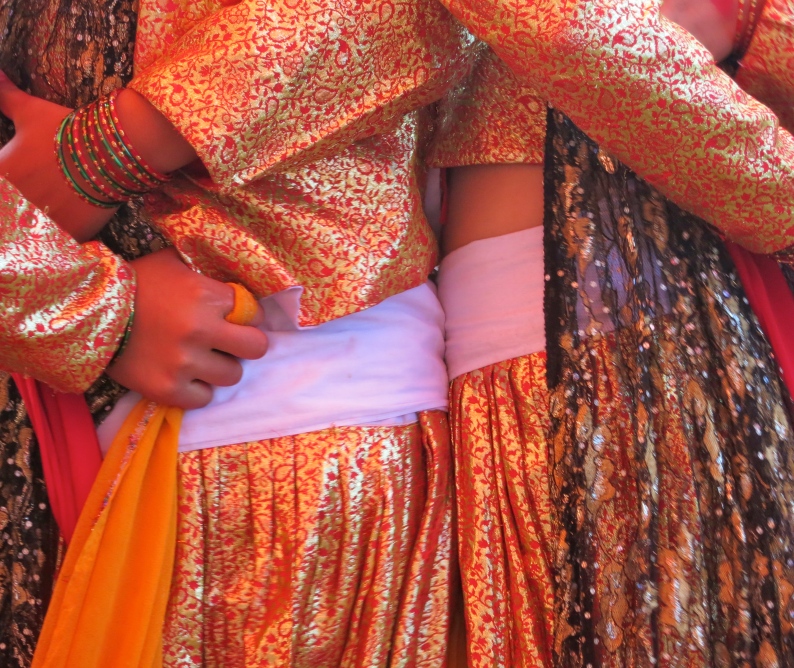
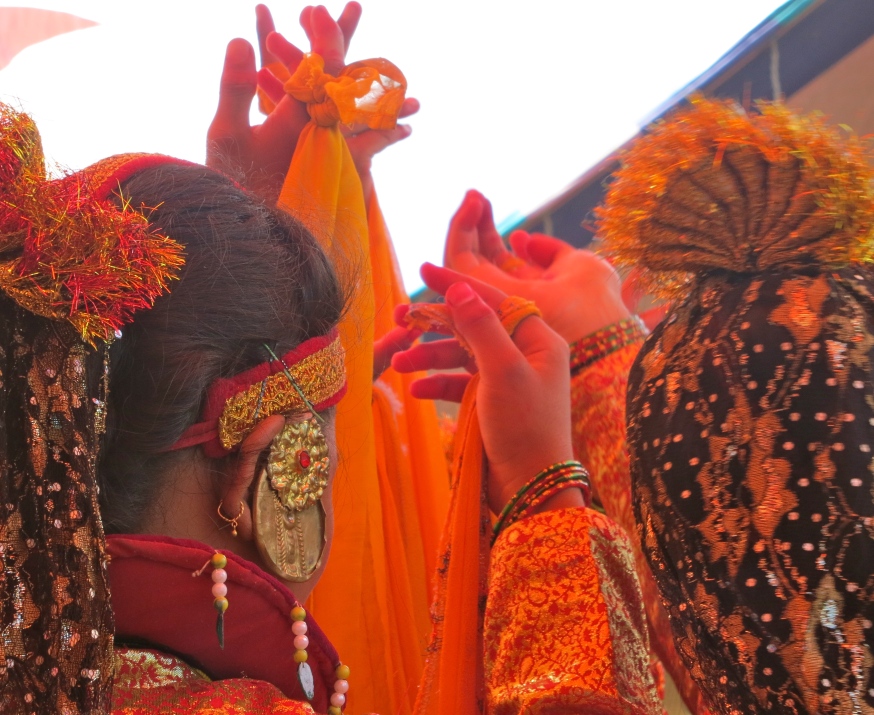
When the Weekly Photo Challenge theme Layers was announced today, I immediately thought of a series of photos I recently took in Nepal of dancers performing a traditional dance. It was mesmerizing to watch them, their colorful costumes so rich in detail and contrast, their bodies flowing gracefully through the complicated dance steps. These young Nepali dancers produced gorgeous layers of color and movement that these photographs cannot truly capture.
I couldn’t decide which photo to use for the Challenge, but I did succeed in narrowing it down to two.
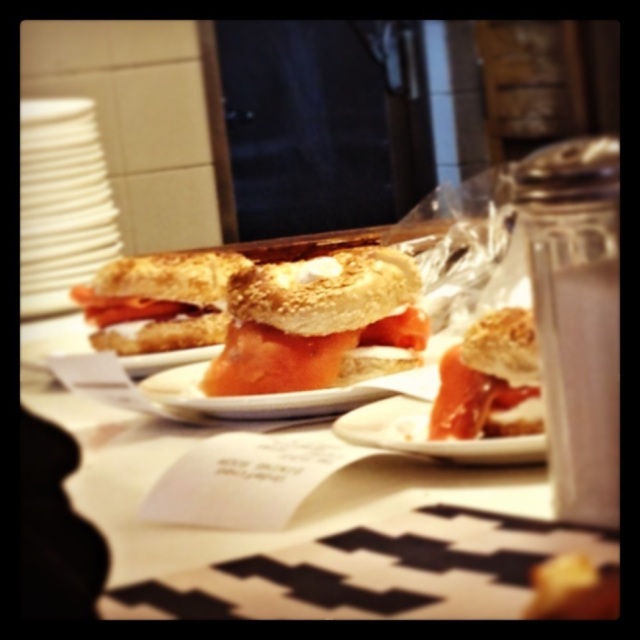
Order up! Beauty’s Specials at Beauty’s Luncheonette in Montreal
“I’ve been coming here since the beginning,” he said conspiratorially, leaning towards me from the stool next to mine.
I had noticed the white haired gentleman earlier, as he was shouldering his way through the Sunday brunch crowd at Beauty’s Luncheonette. He took a seat on the chrome-and-blue pleather stool next to me. As he carefully placed his folded Montreal Gazette on the formica countertop, he caught the server’s eye. “Hi hon!” she sang out as she filled his coffee cup.
He didn’t even have to place his order. In a matter of minutes, “the usual” was set in front of him. Side of home fries, black coffee, and a Beauty’s Russian Black Special. Most people who come to Beauty’s get the Beauty’s Special – smoked salmon, cream cheese, tomato, and onion on the infamous Montreal sesame bagel. But The Regular clearly prefers the Special on on a Russian rye bread so black that it looks like it is made of dark chocolate.
“You’ve been coming here since 1942?” I asked.
“Sure, I went to high school just down the street. I used to buy my school supplies here back when it was a stationary shop. There was always a poker game going on back in the back room.”
He pointed towards an open door behind the kitchen to a small room where they now store the mops and brooms and cleaning supplies. (You can see it in the background of the photo above.)
“They won’t tell you THAT in the history.”
He gestured vaguely towards the blue and white menu, which contains a detailed history of Beauty’s. How newlyweds Hymie and Freda Sckolnick bought the shop on the corner of Mont Royal and St. Urbain and started serving lunch to the garment workers from the factories in the neighborhood. The name “Beauty” came from Hymie’s bowling nickname. It grew so popular that the workers started bringing their families on the weekend. “And the Montreal brunch was born,” to quote the menu. Indeed, there was no mention of the poker game in the back room.
“I’m in my 80s,” he confided, “so Hymie must be into his 90s. You met him when you came in, right?”
I had indeed met Hymie. He was guarding the door when we arrived – literally standing in the inner doorway and quizzing the groups of Montreal hipsters queued up outside. Since we only had two in our party, we scored an immediate seating at the lunch counter. “I like American money,” Hymie told me as he resettled, ever vigilant, on his perch by the door.
“Hymie opened up this morning,” The Regular told me. “That’s the son, Larry.” He waved dismissively at a white-haired man with black frame glasses who was dashing about with a pot of coffee. “He just showed up now.”
We talked for a few minutes. He told me how he grew up to be a lawyer and a politician. He represented the neighborhood for a number of years before returning to private practice. He lives downtown now, but he made it very clear that he is not retired.
“What’s your practice area?” I asked. Corporate, I thought.
“Immigration,” he said. “There’s always work and it’s interesting.”
“I know,” I said. “I’m a human rights lawyer at a non-profit, but I started out practicing asylum law. We always look to Canada as the better asylum system. Even now in the debate about immigration reform, we are using Canada as the example of why we should provide counsel for indigent asylum seekers.”
“Well,” he replied, “It was a hell of a lot better before the Conservatives took over. Now I’m not sure we’re a model for anyone anymore.”
As he paid his bill and gathered up his car keys and his black leather gloves, he asked, “What are you going to do today?”
“We’re thinking of going up to the top of Mont-Royal.”
“Mount Royal? How are you going to get there? Do you have a car?”
“No, we’re planning to bike,” I said.
He looked at me for a few seconds, as if assessing whether I was truly insane. Then he moved on.
“Well, you’re going to want to go to Schwartz’s Deli, so here’s a tip. Don’t bother with the line. Go across the street to Main Deli. It’s just as good, but without the wait. We call it “smoked meat” here. There’s no such thing as “pastrami” here in Canada,” he said emphatically.
“Thanks for the tip,” I said. As a vegetarian, my interest in cured meat – whatever you call it – is minimal.
It struck me later that, based on the facts that he dropped, I could easily pin a name and full bio on this guy. It would just take a couple of quick internet searches. But I have not chosen to do that.
As he said good-bye, I felt I had been privileged with a small glimpse into not just a life, but also into a unique time and place and people in this city’s history. I saw in a flash the habits of a lifetime, traces of a distinctive community. The institution of Beauty’s Luncheonette will certainly continue, but someday in the relatively near future it will be without Hymie and the others who were there from the beginning. On this, my first visit to Montreal, The Regular had given me a rare, small gift.
He put on his long, black wool coat and headed for the door, threading his way through throngs of young people – young people of all races and backgrounds, chatting energetically and switching effortlessly between French and English. In the midst of this microcosm of contemporary Montreal, The Regular turned back, eyes twinkling, and winked at me.
“My wife is in Florida. Don’t tell her I was here.”
Growing up in south Louisiana, I couldn’t help but develop a healthy respect for the paranormal. So when I landed in Montréal last week on the Day of The Dead, my thoughts naturally turned to the eerie possibility of fantômes (French for ghosts). The early November weather was grey and damp and chilly, making it seem even more plausible that there were haunted souls lurking in this old city.
A little research proved that Montreal is indeed a city with an ample supply of ghost stories. Tourists can even go on a tour of haunted places in Vieux-Montréal (Old Montreal) with tour guides dressed as famous fantômes. I didn’t go on the tour, but in my three days of rambling around the city I did pass by several of the places where fantômes are frequently sighted.
Notre Dame Basilica, Vieux-Montréal
From what I read on Haunted North America, les fantômes de Montréal represent just about every era in the city’s rich history.The area in the St. Lawrence valley known today as Montreal was inhabited by the Algoquinto, Huron, and Iroquois peoples at least 2,000 years ago. Since at least the 14th century, humans have lived in a population center near the modest (only 780 feet tall) mountain with the grand name Mont-Royal. Previously, it was called Hochelega by the Saint Lawrence Iroquoians who had established a good-sized village here at least two centuries before the French explorer Jacques Cartier first visited the area in 1535. The city allegedly gained the name “Montreal” in 1556, when geographer Giovanni Battista Ramusio wrote the Italian “Monte Real” instead of the French “Mont-Royal” on his map of Hochelaga.
In 1611, Samuel de Champlain established a fur trading post here and Montreal soon became a center for the fur trade and base for French exploration in North America . Quebec was officially established as a French colony on May 17, 1642, with Paul Chomedey de Maisonneuve as governor.
Statues of French colonial leaders, Place d’Armes, Vieux-Montréal
Things were pretty rough in Nouvelle-France (New France) in those days. Vieux-Montréal, the oldest part of the city near the port, was the scene of numerous human rights abuses, including public hangings and torture. People have reported seeing numerous apparitions covered with burn and whip marks in this part of the city. Along the cobblestoned Rue Saint-Paul, figures have been seen disappearing in upstairs windows. There is another story of a blonde woman who was murdered and now wanders the streets. Sometimes people in the area report a general feeling of unease, a feeling of being watched – even in broad daylight.
Place Vacquelin and Place Jacques-Cartier
On Saturday morning, we walked up Avenue du Parc from downtown on our way to the Plateau neighborhood in search of the infamous Montreal bagels. We walked past Parc Jeanne-Mance, which is bordered on the east side by Avenue deL’Espanade. I read later that the apparition of a French soldier wearing a cape is often seen walking here. Montreal saw a lot of military action in the 1750s and 60s during La guerre de la Conquête (“The War of Conquest”). At least that is what most French Canadians call it; officially in Canada, it is the “Seven Years War” or the “Anglo-French rivalry” . In United States history, however, the conflict is referred to as the “French and Indian War”. Whatever you call it, this particular French soldier was likely a victim. He reportedly has a limp (and some say they have seen him with a cane) as he walks down Ave de L’Esplanade from Rue Rachel towards Avenue Duluth. Sometimes, he is seen entering a building across the street from the park. On this particular drizzly Saturday morning, however, I saw nothing in the park more creepy than some kids playing football (American football, that is, not soccer.)
Twice we walked past the severe, grey stone Hôpital Royal Victoria.France lost the war with England, of course, ceding control over all its territory east of the Mississippi River in the1763 Treaty of Paris. Quebec was under British control until 1867, when all of Canada became a self-governing British colony. “The Dominion of Canada” created a unified federation of the former British and French colonies. Canada and England maintained close ties (Canada did not become an independent country until 1982!), so it is no surprise that the hospital built in 1893 was named after the British queen Victoria. The “Royal Vic” definitely looks like the kind of place that would have its own fair share of ghosts. Indeed, hospital patients, visitors and staff have reported seeing ghosts of former patients and hearing disembodied footsteps and voices. Odd occurrences have also been reported, things like buzzers and lights going on and off in empty rooms.
Mont-Royal Cemeteryis one of the largest cemeteries in North America. Divided into three sections (Mont-Royal, Cote-Des-Neiges and Notre Dame), several hundred thousand graves are in a beautiful, serene park. The Mont-Royal section is said to be the most active, with ghosts (including a famous Algonquin warrior) reportedly wandering about in the cemetery. There is a popular scenic overlook on the serpentine road near the top of Mont-Royal. Many people have reported seeing ghostly apparitions standing at the edge of the cemetery grounds on the high rock cliffs above the overlook. Perhaps, like me and the other tourists, they are just enjoying the view of the city below. No ghosts were in evidence, however, on the sunny Sunday morning that I rode my bike past the cemetery on my way to the top of Mont-Royal.
Later that day, we passed McGill University on our way to Montreal’s Musee des Beaux-Artes. McGill reportedly has more than one ghost, including a young boy who has been known to interact with students. Apparently, there is a bulletin board on campus where people can share information about where they have spotted the McGill University Ghost(s).
Although I did not experience any eerie paranormal activity during my recent visit, it was still fun to read about les fantômes de Montréal and to take a few creepy photos. (This post is also a response to the Weekly Photo Challenge: Eerie.)






 The Human Rights Warrior
You must be logged in to post a comment.