The Human Rights Lesson

20130525-083050.jpg

I spent some time in my daughter’s classroom last week talking to the second graders about human rights.  I’ve been a guest speaker in all of my kids’ classrooms and have done this presentation (a kind of human rightsy mash-up of show-and-tell and career day) pretty much every year since my oldest was in second grade.  But this time was different.  I discovered the night before I was scheduled to speak in her class that my daughter, who just turned 8, was planning to do the presentation on human rights WITH me.

I have a more-or-less standard routine and she knew it well.  (I wrote a post called Same and Different about doing this human rights lesson in my sons’ classrooms.)  First, I do an activity that I call Same and Different.  I have several photos from West Africa that I had blown up and mounted on foamcore.  I show the kids a photo and have them point out what they see in the picture that is the same in their lives and what is different.  It always generates great discussion and often the kids see things in the photos and make connections that I never did.  Hopefully, by showing that all humans have similarities in spite of our differences, it also plants some seeds of respect and tolerance.

When I got to her classroom, my daughter brought her small plastic chair to the front of the class and set it down firmly right next to mine.  After introducing me (with the class microphone), she sat down beside me.  She had assigned herself the assistant’s job of holding the photos for all to see while I led the discussion.  A couple of times I had to remind her to hold the photo out so that all the kids could see, but overall she did a great job.

The next activity I do is to pass around a selection of items that I have picked up on my travels for work.  As we pass them around so that everyone gets a chance to touch them, we again discuss what is the same and different in our lives.  This time, I didn’t gather a thing for the activity; my daughter collected everything the night before our presentation.  A yak wool blanket from Nepal, a wooden statue of  a traditional palava hut from Liberia, coins and bills from Cameroon – all went into a bag I had brought her from Ghana.  She even added her pink beaded pointy-toed slippers from Morocco.  When I reminded her that she would have to share and let everyone touch them and try them on,  she hesitated for a moment.  In the end, though, her slippers went into the bag.

To close out the presentation, I usually read a children’s book or two about human rights.  I have a couple of favorites.  For Every Child, A Better World by Kermit the Frog is one that we own two copies of, but of course we couldn’t find either when we needed it.  I went to library to check out a copy and discovered shelved right beside it I Have the Right to Be a Child by Alain Serres.  This beautifully illustrated book presents the concept of human rights, especially those of children as set out in the UN Convention on the Rights of the Child.

When I brought the books home from the library, I asked my daughter,

“Which do you want me to read to your class?”

“I want to read them both,” she said.

She did a beautiful job of reading both books to the class.  I was so proud that I teared up, right there in front of all the second graders and their teacher.

In some ways, it is easier to talk to kids about human rights than adults.  Because children generally see things in terms of black and white, right and wrong, it is easy for them to understand that we all have rights – the right to voice our opinions, to go to school, to be free from violence.  The right to have food and shelter and clean air and water.  The thing about kids is that they have a very strong natural sense of justice (as it applies to them, at least) they understand the inequities of a world where not everyone is able to access those rights.

One girl  came up and hugged me after the human rights lesson.

“It makes me sad,” she said, “to think that not all kids have enough to eat.”

“What you are feeling is empathy,” said the teacher.  “And that’s good.”

Knowing about the problem – caring about it and wanting to do something about it – is the first step towards change.

The last thing I heard as I left the classroom was another little girl saying,

“I think I am going to write a letter to President Obama and ask him why we are not part of the Convention on the Rights of the Child.”

There are a lot of things about working in human rights that are not easy, but this was a very  good day!

More ideas for human rights activities to do with children:

10 Things to Do With Your Kids on Human Rights Day
10 More Things to Do With Your Kids on Human Rights Day

Same and Different

INTERNATIONAL DAY OF THE GIRL: Kanchi’s Story

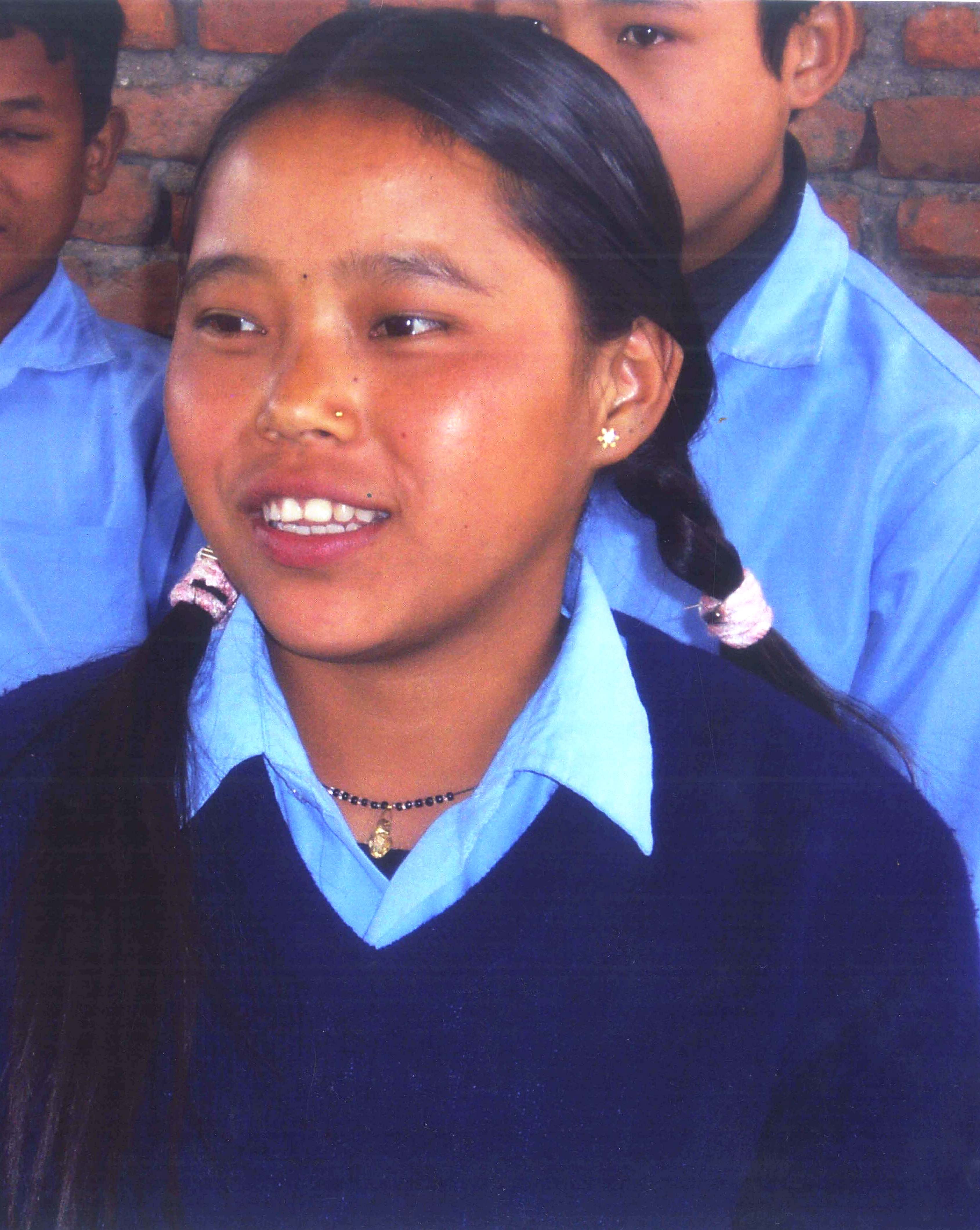
Every morning when I come into work, I am greeted by the smiling face of a young girl. Her hair is pulled neatly back into two braids, glossy black against her pink hairbands.  Her eyes, dark and alert, shine at me – I swear I can see them twinkle.

She wears the blue uniform of her school, the Sankhu-Palubari Community School in rural Nepal.  The Advocates for Human Rights supports the school to provide the right to education to the most disadvantaged kids in the area and to prevent them from becoming involved in child labor.  Photographs from the school hang on the walls of our office, reminders to us of the lives that we impact with our human rights work.

Even though I see her every day, until last month I had never met this cheerful young girl, a girl whose smile – even in a photo – comes from her core, seems to light her entire being. Until last month, I did not know that her name was Kanchi.  And I had never heard her incredible story.

*****

In 1999, Kanchi was six years old.  She lived with her family in a village in the Kathmandu Valley.  Her parents were poor farmers; they had only a little land and some cattle and they struggled to feed their family.  Kanchi was the youngest of six sisters.  She and her sisters (and also her  brother) had to help their parents in the fields and with household chores.  Kanchi’s job was also to take the cattle to the forest to graze.   Kanchi did not go to school.   There were many children in Nepal that did not go to school at that time, but girls, like Kanchi, were more likely than boys to work rather than go to school – particularly in rural areas like the Suntole district where she lived.

Kanchi was a very smart and determined little girl.  She wanted to go to school.   So when she heard that a new school was opening in the Sankhu-Palubari community – a school for kids who were not able to go to school because they couldn’t pay or were discriminated against – she was very excited.  She rushed off to tell her parents.  But her parents, who had never themselves been educated, were not as excited as Kanchi.  Why should they let her go to school?  Who would help feed the family? Why should they send her to school if she was only going to get married in a few years anyway?

Kanchi says that she cried for a month and begged her parents to let her go to school.  One day, teachers from the new school came to visit Kanchi’s parents to talk to them about the school. The teachers explained that it would help THEM if Kanchi could read and write.  They explained why it was important for all children to go to school, even girls.  They told them that all children – even the poorest, the lowest-caste, members of indigenous groups – had a right to education.

Kanchi’s older sisters, who had never had the opportunity to go to school, took her side. Instead getting an education, they had all married young and were working in the fields.  Kanchi’s sisters argued that Kanchi should go to school, take this opportunity for a life that would be different from theirs.  Finally, their parents agreed to let Kanchi go to school.

Kanchi started at the Sankhu-Palubari Community School in 1999, one of 39  students in the first kindergarten class.  To get to school, Kanchi had to walk one and a half hours each way.  There were many other obstacles along the way, too.  At various times, her parents wanted her to stop school and help them with farming.  But she stayed in school and worked hard. She told her parents,  “I want to do something different from the others.”

Kanchi liked her teachers and felt supported by them.  She felt that the best thing about the school was the teaching environment.  She stayed in school and was one of only two girls in the first class to graduate from 8th grade.  She continued on to high school and completed 12th grade at  Siddhartha College of Banepa in 2012.  The first in her family to go to school, Kanchi is also the first girl from the Sankhu-Palubari Community School to graduate from 12th grade.

I met Kanchi for the first time in September.  Almost exactly 13 years after this brave little girl started kindergarten, she is a lovely young woman who is preparing for her university entrance exams.  She plans to study agriculture  starting in January.   Her parents are proud of her and they are happy now – she has chosen the family profession – but Kanchi is interested in learning more about organic farming so she can bring techniques back to her village.  “I want to live a healthy life and give a healthy life to others,” she says.

Sitting in the principal’s office at Sankhu-Palubari Community School, I asked her what the school meant to her.  Kanchi said, “I gained from this school my life.  If I hadn’t learned to read and write, I would be a housewife.”  When asked about her sisters, she told me that they had made sure to send their own children to school.

In her free time, Kanchi likes to sing and dance and make handicrafts to decorate her room.  She likes to play with her sisters’ children.  She has a smile that lights the whole world.  She told me her nickname, Himshila.  She smiled when she told me it means “mountain snow, strong rock”.  Strong rock.  That seems just about right.

*****

October 11, 2012 is the first International Day of the Girl Child.  The United Nations has designated this day to promote the rights of girls, highlight gender inequalities and the challenges girls face, and address discrimination and abuse suffered by girls around the globe.  In many ways, the story of Kanchi and her sisters reflects the experience of girls in many countries throughout the world.  All over the world, girls are denied equal access to education, forced into child labor, married off at a young age, pressured to drop out of school because of their gender.

There are many good reasons to ensure access to education for girls like Kanchi, however. Educating girls is one of the strongest ways to improve gender equality.  It is also one the best ways to reduce poverty and promote economic growth and development.

“Investing in girls is smart,” says World Bank President, Robert Zoellick. “It is central to boosting development, breaking the cycle of intergenerational poverty, and allowing girls, and then women—50 percent of the world’s population—to lead better, fairer and more productive lives.”

The International Day of the Girl is a day to recommit ourselves to ensuring that girls like Kanchi have the chance to live their lives to their fullest possible potential.  To redouble our efforts to promote the rights of girls wherever they live in the world.   This first International Day of the Girl is also a day to honor girls like Kanchi.  A day to take the story of her success in one tiny corner of Nepal and shout it out, an inspiration for girls all around the world.  Girls like Kanchi with the strength, the bravery, the determination to change the world, but who  just need the opportunity.

Originally published on The Advocates Post.

PHOTO ESSAY: Cartooning for Peace

Cartoon by Kianoush

In May, I was in Geneva to participate in the United Nations’ Universal Periodic Review of Morocco and India.  I went for a run one day along Quai Wilson on Lake Geneva and discovered an exhibition of political cartoons. The exhibition was sponsored by Cartooning for Peace/Dessins pour la paix, an initiative conceived of by French political cartoonist Plantu and launched at the United Nations in 2006.  The goal of Cartooning for Peace is to promote better understanding and mutual respect between people of different faiths and cultures.  Cartooning for Peace also works to promote freedom of expression and to protect the rights of cartoonists.

Cartooning for Peace and the City of Geneva created the new International Prize for Editorial Cartoons to honor cartoonists for their talent, outstanding contribution and commitment to the values of tolerance, freedom and peace. On May 3, 2012  – the World Day of Press Freedom – the prize was awarded for the first time to four Iranian political cartoonists.

Cartoon by Mana Neyestani

The exhibition Dessins Pour La Paix  2012 displayed the work of the award-winning Iranian artists Mana Neyestani, Kianoush,  Firoozeh Mozaffari and Hassan Karimzade.

In addition, the exhibition included dozens of political cartoons by cartoonists around the world on the themes of freedom of expression, the Arab spring and the rights of women.

The exhibition in Geneva ran from May 3 to June 3, 2012.  The full catalogue of the cartons featured in the exhibit is now available online.

Take a stroll with me along Quai Wilson and witness the power of the cartooning for peace!

ARAB SPRING 

FREEDOM OF EXPRESSION

ET LES FEMMES? (AND THE WOMEN?)

Photo credits to Amy Bergquist

Originally posted on 8/7/12 on

The Advocates for Human Rights’  blog

The Advocates Post.

Today at the United Nations Human Rights Council

A Day at the United Nations Human Rights Council

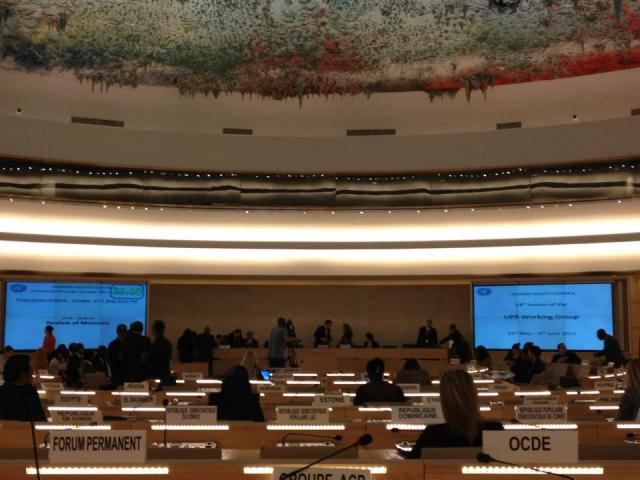
Today I am at the Human Rights Council in Geneva for the Universal Periodic Review of Morocco. (Photos are not allowed, but I snuck this one with my iPhone.) Along with colleagues from The Advocates for Human Rights and Global Rights, we have been lobbying the Human Rights Council delegates on the issues of violence against women and the death penalty/conditions of detention in Morocco.

Countries from Botswana to Bangladesh have raised the issue of women’s rights, with particularly, strong pressure coming from Belgium, Estonia, Spain, Switzerland, and Thailand to pass a comprehensive law to protect women from violence. In response to criticism of Article 475 of the Moroccan penal code (which I wrote about previously in Amina Filali and Violence Against Women), which essentially allows a man to escape prosecution for rape of a minor if he marries her, the Justice Minister noted that this law was “traditional” but currently “under study.” Shortly after he made that statement, the Netherlands and Norway made strong recommendations to revise the penal code and pass a new law to protect women from violence and ensure equality.

Argentina, Austria, France, Italy and Spain are among those countries who have called on Morocco to abolish the death penalty and commute all death sentences to life. Hungary even declared they would be “happy to share” their own recent experience in abolishing the death penalty.

The Universal Periodic Review is a new human rights mechanism, the result of recent UN reform. Morocco was one of the first countries reviewed in 2008, and is now one of the first countries to return for a second UPR review. Today I see the Moroccan government standing up before its peers -the governments of other nations – and answering questions on what they are doing to protect human rights for all in their country. It is encouraging to see the governments taking the process seriously.  At the end of the day, there was palpable relief on the face of the Minister of Justice and the other members of the delegation. Whether or not the UPR is a human rights mechanism that works in the long run, I think that the accountability I am seeing today is both good and necessary.

Justice delayed may be justice denied for Minnesota Cambodians

Skulls of Khmer Rouge victims.
Skulls of Khmer Rouge victims. (Photo credit: Wikipedia)

Justice delayed may be justice denied for Minnesota Cambodians.

Monoram Hang was just 9 years old in April 1975, when Khmer Rouge soldiers forced his family from their home in Phnom Penh. His mother, weak from giving birth two days earlier, fell to her knees and begged for permission to wait for her husband to return from work so their family could leave together. The soldiers kicked her to the ground and ordered them out at gunpoint, forcing them to join the swollen river of people leaving Cambodia’s capital. As Hang related, “At that time we walk, we don’t know where we are going, we don’t know where we end up. We just walk and walk. …  And Khmer Rouge soldiers behind us and shoot from behind and force us to go.”

Hang was lucky to survive; as many as 2 million Cambodians died in the “killing fields” of the Khmer Rouge regime. He found refuge in the United States, one of nearly 10,000 Cambodians now living in Minnesota — the country’s sixth-largest home to Cambodians. Like Hang, most witnessed genocide and endured forced migration and labor camps under the Khmer Rouge.

1990: Minnesota puts the Khmer Rouge on trial

In 1990, Hang and other survivors testified at a mock trial of the Khmer Rouge leadershipthat was held at the State Capitol in St. Paul. The Advocates for Human Rights organized the mock trial with Minnesota’s Cambodian community to give voice to the victims of Khmer Rouge atrocities. The panel of public officials serving as judges at the mock trialfound the Khmer Rouge leaders guilty of genocide. The entire Minnesota Congressional Delegation issued a statement formally recognizing members of Minnesota’s Cambodian community for their testimony and joined “the appeal to establish an international inquiry into crimes of genocide perpetrated by the Khmer Rouge between 1975-79. Well-established principles of international law require accountability and punishment for those responsible for genocide, the Khmer Rouge being no exception.”


2012: Actual justice remains elusive
The mock trial was such a positive experience for the Cambodian community that The Advocates then created the Khmer Oral History Project, enlisting volunteer attorneys to interview Hang and other members of Minnesota’s Cambodian community about their experiences under the Khmer Rouge, their life in refugee camps, and their immigration to the United States. Transcripts and video recordings of those interviews are available through the Minnesota Historical Society.

Yet more than two decades after The Advocates put the Khmer Rouge on trial in Minnesota and Minnesota lawmakers called for accountability, one — and only one — Khmer Rouge leader has actually been brought to justice. In 2010, a hybrid United Nations-Cambodian tribunal, the Extraordinary Chambers in the Courts of Cambodia (ECCC), found Kaing Guek Eav responsible for the deaths of more than 14,000 people at the notorious S-21 prison and convicted him of crimes against humanity, murder, and torture. An ECCC appeals court last month increased his sentence to life imprisonment.

For survivors like Hang, justice delayed may be justice denied. Thirty-five years after the Khmer Rouge took power, only three additional leaders, all in their 80s, are answering charges in an ECCC “mini-trial.” Additional mini-trials against the same elderly defendants will follow — if their health holds out. Proceedings against a fourth defendant have been stayed as she battles age-related dementia.

Culture of impunity

A recent dispute between U.N. and Cambodian authorities threatens to bring the ECCC’s slow progress to a grinding halt. The Cambodian government, which is bidding for a rotating seat on the U.N. Security Council for 2013–2014, has made plain that it opposesany additional charges against other defendants. International co-investigating judge Siegfried Blunk resigned last October, complaining of government interference. According to the painstakingly negotiated agreement establishing the ECCC, Cambodia’s Supreme Council of the Magistracy was obligated to appoint reserve judge Laurent Kasper-Ansermet to replace Blunk. Kasper-Ansermet took his post in December, paying no heed to government efforts to obstruct justice and launching investigations against new defendants. In January, however,the Supreme Council rejected his appointment and Kasper-Ansermet’s Cambodian co-investigating judge has contested his authority to investigate cases. U.N. Special Expert to the ECCC, David Scheffer has emphasized to Cambodians on the court that Kasper-Ansermet has full authority to serve as the international investigating judge.

On March 19, frustrated with the recalcitrance of his Cambodian colleague and the resulting “dysfunctional situation within the ECCC,” Kasper-Ansermet tendered his resignation. He did so in view of “the victims’ right to have investigations conducted in a proper manner.” The UN has voiced “serious concern” at the developments prompting Kasper-Ansermet’s departure.

Time to get tough

Hang and other victims of the Khmer Rouge have waited too long for justice. For their sake, it is time to ensure that the work of the ECCC goes forward to hold the perpetrators of horrific crimes against humanity accountable. Minnesota’s lawmakers should joinCalifornia Rep. Ed Royce in calling for more trials and an end to the Cambodian government’s culture of impunity. The United States, which has contributed more than $6.7 million to the ECCC, should demand that the Cambodian government cease its interference in the proceedings. Unless the meddling ends, Cambodia has no place at the table on the Security Council.

Jennifer Prestholdt is the deputy director of The Advocates for Human Rights and the director of The Advocates’ International Justice Program. Amy Bergquist is a staff attorney for the International Justice Program.