Family Life in Kathmandu

This is a letter I wrote home from Kathmandu in January.  It gives an interesting perspective on life in Nepal – a splash of local color – so I thought I would share it on the Human Rights Warrior.

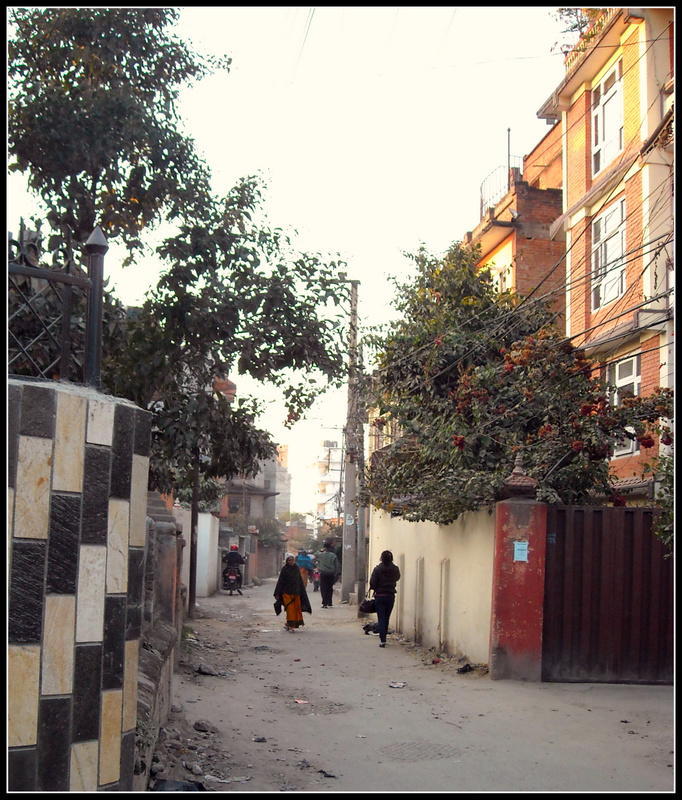
Usually, when I travel for work, I stay in a hotel.  It’s different when I travel to Nepal. Here, I stay with a family at their home in Kathmandu.  I could never give you directions to their house on the unnamed street in the warren of hundreds of small streets and alleys in the Battisputali neighborhood.  But I could show you how to get there.

Morning noises.  I lie in my bed on the third floor and listen as the house wakes up.  Doors of wood and metal creak and slam.  Outside, I hear the sounds of chickens, dogs, some kind of hoarse-cawing bird.  Women speaking in Nepali in the kitchen building below my window at the back of the house.  A man sings off-key at the top of his lungs as water sluices into his bucket from the water tap next door.  Someone is whistling loudly, someone else is hawking and spitting.  No need to modulate your voice – everyone here rises at dawn. All this before the rooster crows.  Tinny Nepali music is playing on a transistor radio. There’s a knock on my door, followed by a cheerful “Namaste!”  The tea tray is set on my bedside table. I have the first of many, many cups of tea in bed.  This is how the day begins in this home in Kathmandu.
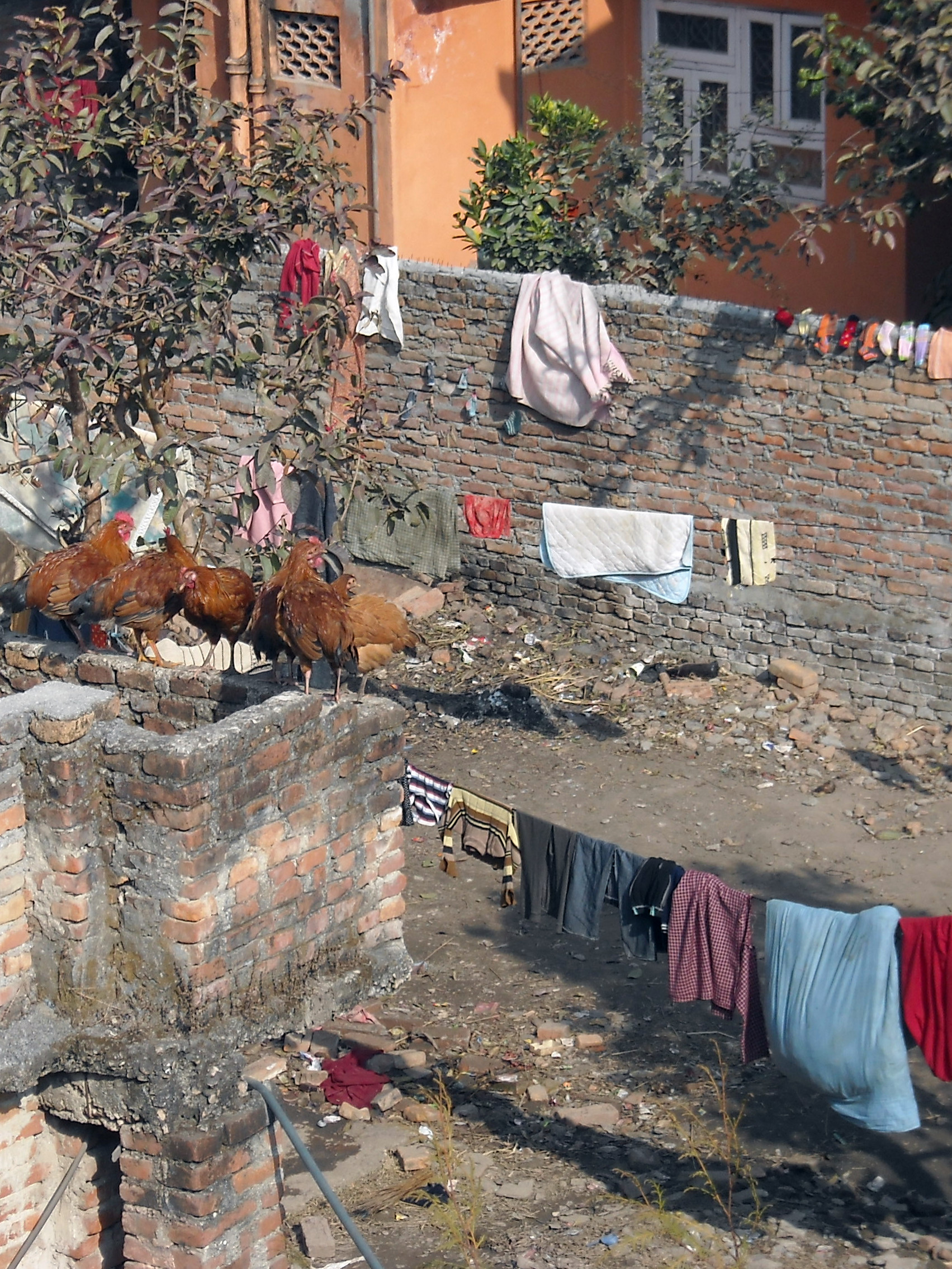
Can you see my alarm clock in this picture?

Some things have changed since I was last here in March. There is a new security gate with a buzzer, as well as a flat screen TV.  Crime is a growing concern in some neighborhoods in Kathmandu.
The biggest news is the daughter has married.  Like most marriages in Nepal (but unlike her parents, who made a love match), this one was arranged. Her new husband is in the Army, so the wedding procession was especially grand with a military band and an antique Nepali horse-drawn carriage.  Someone told me that the only horses in Nepal are in the Army cavalry, so the only people who know how to ride are in the Army.  The polo grounds in the park in central Kathmandu are, therefore, de facto used only by the cavalry.  The daughter is 23 and has just finished university.  Her mother thought maybe she should go to graduate school first, but she was ready to get married.  Her green wedding garland, stitched in red and covered with spangles, is on the wall on the stairway to my room.  It has been framed, with a wedding picture in the middle.  The wedding couple wore their garlands during the three days of ceremonies.  She first met her future husband about two months before the wedding.  They come over for dinner and I meet her new husband.  She seems happy.

The daughter has now gone to live with her husband’s family.  The family I stay with also has two adult sons who are close to my own age.  They live here with their parents and their own families.  The oldest son just finished building a big, new house in front of the family home. The younger son and his family live in the parents’ house, which he will inherit.   Property in Kathmandu is expensive, so it is better to divide what is already in the family.  There is a driveway and small courtyard in the front.  In the back is a kitchen garden, flowers and fruit trees.  It is a small green oasis in a dirty, dusty city.

Niches in the courtyard wall are home to animal sculptures

Three grandchildren live here, too.  In the big new house, there is a grandson who is in 12th grade.  His classes in college (upper secondary school) go from 6:30 to 11 am. The granddaughter, like my middle son, is in fourth grade and “running 9” (when she turns 10, she will be “9 complete”). Unlike my son, though, she spends 2 to 4 hours a night doing homework. The Nepali is very rigorous and the examinations are taken seriously. The secondary schools post billboards with pictures of their students and their scores on the national standardized exams.  Another change since my last visit – the granddaughter is starting to help her mother and grandmother with cooking and serving meals. She shows me some of her sketches – Krishna and Disney Princesses – and gifts me with a sketch of Minnie Mouse.

Her little brother goes to preschool. He speaks Nepali, but understands English and also Hindi from watching Indian cartoons.  Nepalis have an interesting relationship with India.  In addition to enjoying Indian serials and Bollywood movies, they take the short flight to India if they need a vacation or an operation.  Yet they set their clocks 15 minutes off Indian time so they don’t have to be on the same time zone as their much larger neighbor.

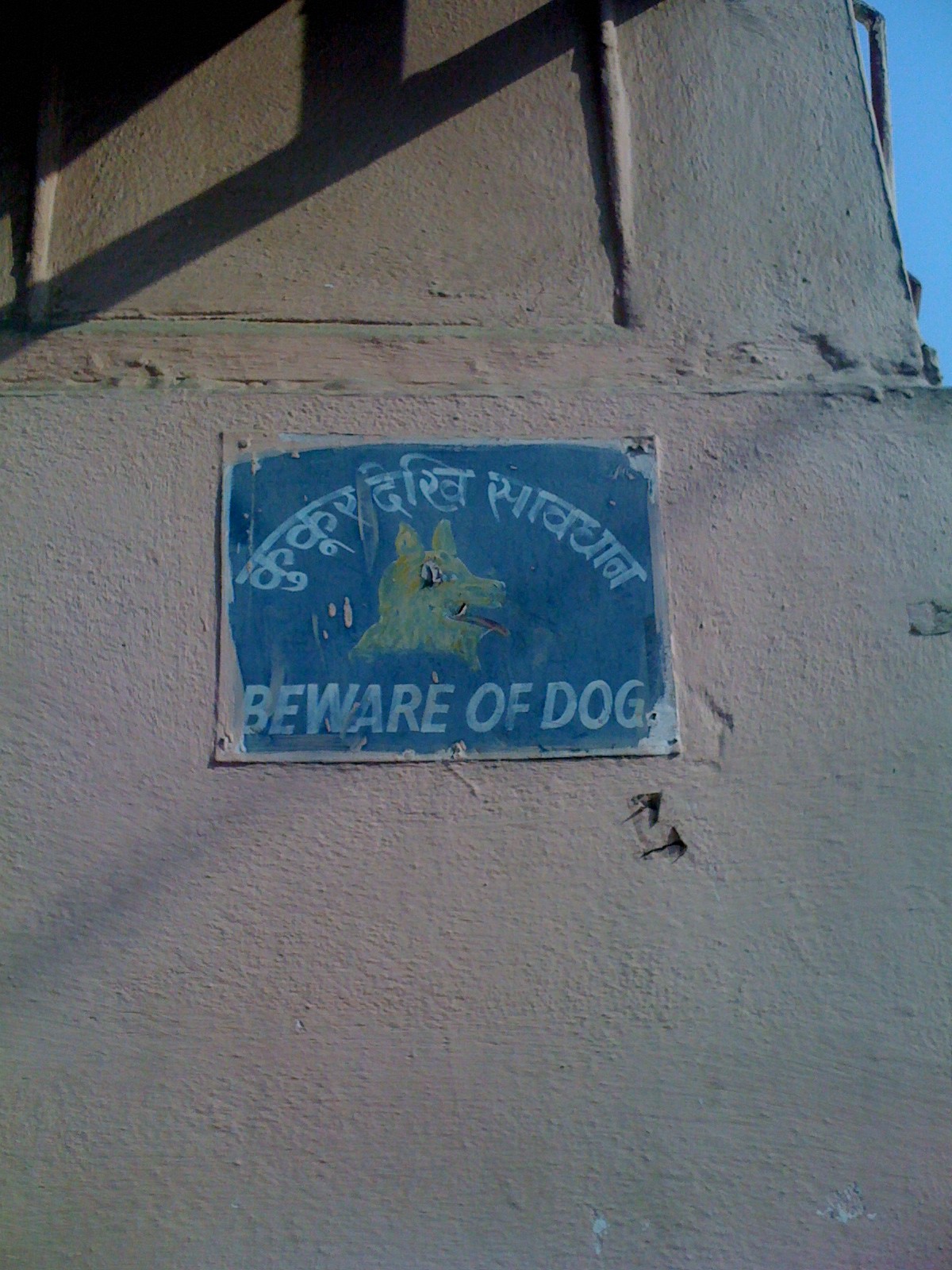
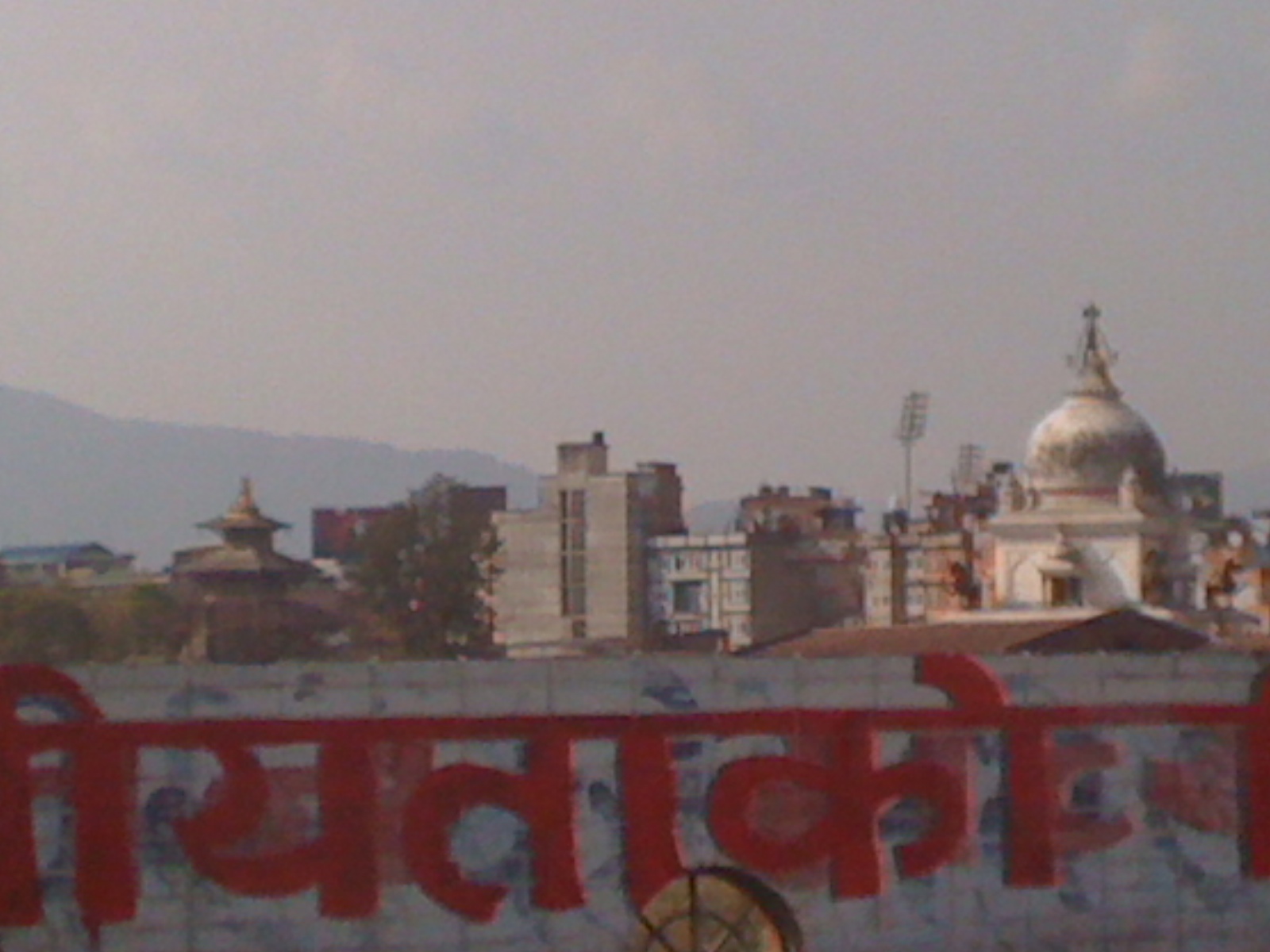
Image from a compound wall in the neighborhood.

There are others who live in this household, helping with the household chores, meal preparation, laundry, washing the cars, minding the kids.  There are eight people employed on this compound by my count, but there could be more or less.  People come and go in a constant swirl of activity.

The water in the house is city water, but the water for drinking and cooking is delivered by tanker truck and pumped into the polytank on top of the kitchen building.  It runs through a filtration system of three plastic basins – one with pebbles, one with sand and one with charcoal.
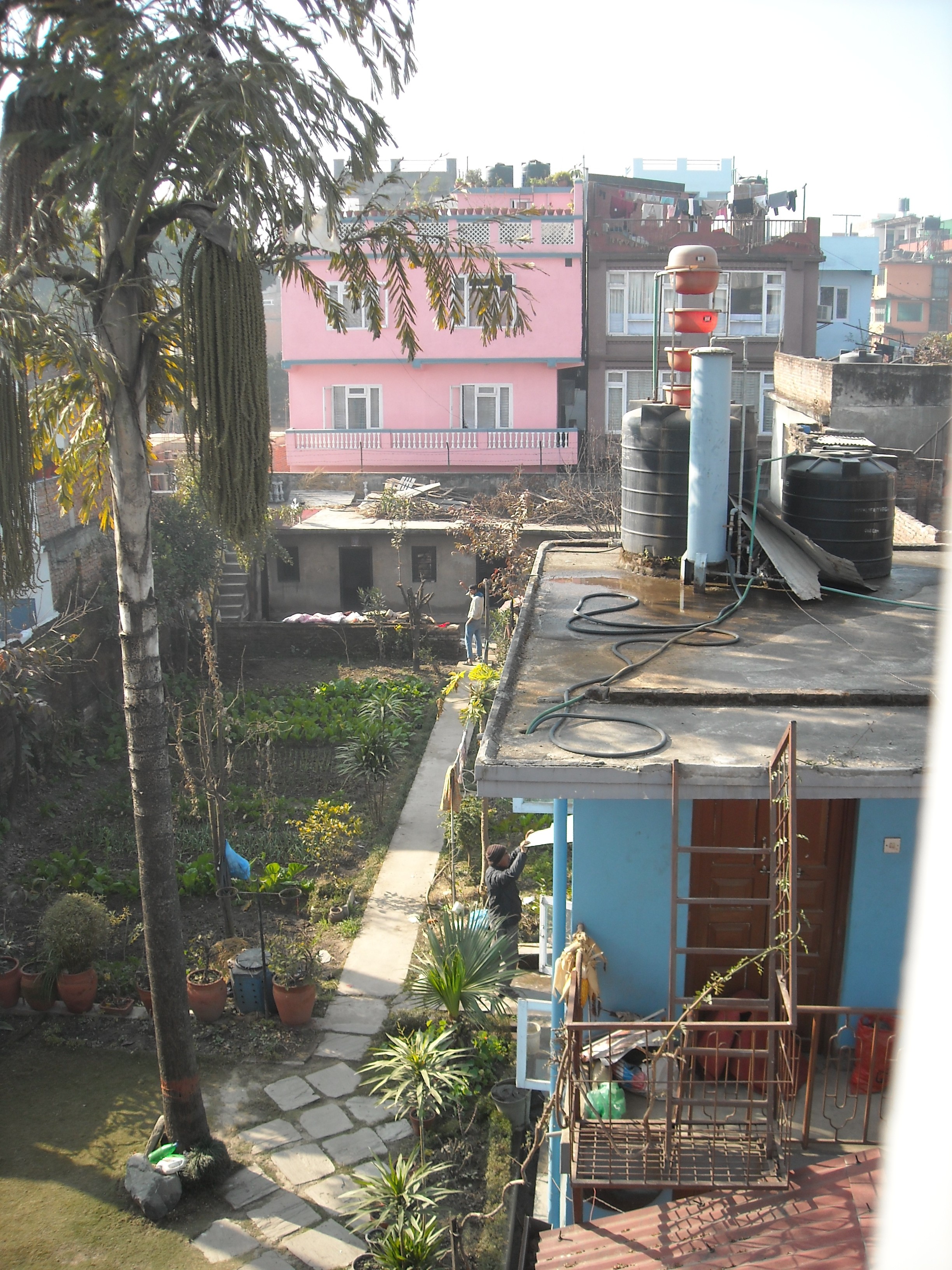
View of the kitchen garden and the water filtration system on the kitchen roof.

After a sunny day, there will be hot water because the water for showers is heated by solar panels.  As your plane makes the approach to land in Kathmandu, you can see the sun winking off the solar panels on every roof. If the day has been overcast, though, you are out of luck and have to ask for someone to bring up a bucket of hot water for bathing.

The shortage of electricity in Nepal has resulted in load sharing in Kathmandu.  Each district has electricity for 4-5 hours at a time, usually twice a day.  The schedule changes every day, so you may have power from 4-8 am and 7-11 pm one day but 10 am- 1 pm and 1 – 4 am the next.  The week’s schedule is on a government website somewhere, but I never know what it is.  Twice already during my stay, a fluorescent light in my room has buzzed to light in the middle of the night.  Our house has a backup battery, but that means that there are only lights in 4 rooms in the house.  Supposedly, there are hydro-electric plants being built with the help of international community.  Once these are completed, Kathmandu will have more regular electricity. Hopefully.

The power situation makes cooking difficult, but the women of the house, who share the cooking duties, somehow manage. For Nepalis, a typical meal involves dal (lentil “soup”), bhat (rice) and tarkari (vegetable curry).  We usually also have at least two kinds of tarkari and sag (greens), as well as aloo (potatoes, usually fried).  Often, there is also chicken but served on the side.  Like my own family, this family has both vegetarians and meat-lovers in residence.  I have never eaten so well.  For dinner, I eat a healthy dal seasoned with turmeric and ginger that is served to women after childbirth. Punctuated by bright green scallions float, it contains fried chickpea lentils that give it a surprising crunch.  At breakfast, I eat papaya from the tree in the backyard. I see grapefruits the size of my head growing there, too.
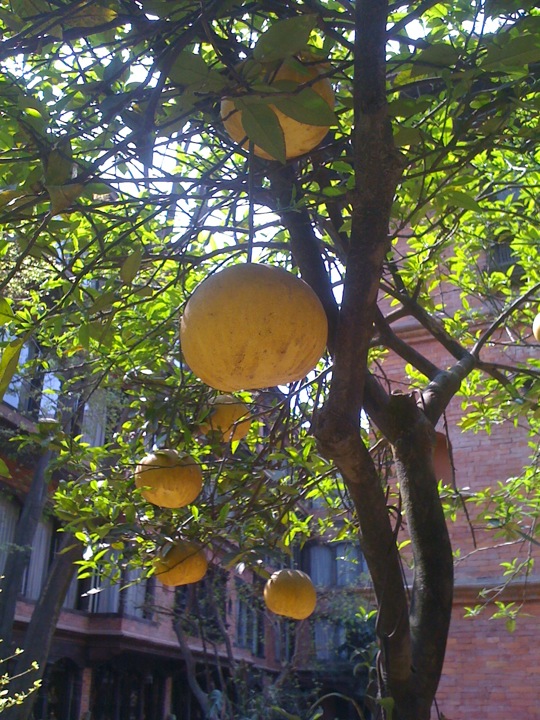
Here in Nepal, people often greet each other by asking, “Bhaat khanu bhayo?”  Literally, this means, “Have you eaten rice?” but in practice it means “Have you had your meal?” Babies eat rice as their first solid food during their first rice feeding ceremony at age 5 months for girls, 6 for boys.  They will eat rice just about every day of their lives.

It is winter, so the days are short in the Kathmandu Valley.   Offices and schools are on winter hours, opening a little later – 10:30 instead of 10 – and closing a little earlier so people can be home by dark.  There is not much nightlife in Kathmandu. During the day, if there is sun, it warms up nicely but at night it is cold.  I sleep under a cotton comforter as thick as a mattress.  Buildings are not insulated and floors are often marble or tile.  I notice that people working in offices and stores are often wearing their coats.

Traffic is a huge problem in Kathmandu. The population grew during the conflict as internally displaced persons fled the Maoists in the countryside.  Now the Maoists are in a power-sharing coalition government.  The violence has ended but the coalition government is gridlocked.  Nepalis have been waiting three years for a new constitution. In the newspaper today, the government promises a completion of the process within the next four months but people are skeptical.  When the committee drafting the constitution gets paid by the month, where is the incentive to finish the job?

The Kathmandu population has continued to grow due to the country’s high unemployment.  People come to the capital looking for work.  There are now 3 million people living in the Kathmandu valley, driving too many cars and motorcycles on streets that were designed for oxcarts.  The air is polluted and many people wear masks over their lower faces.  Many Nepalis have gone abroad to study in India, the UK or the US or work in Malaysia and the Middle East.  Every Nepali I meet has a relative somewhere in the diaspora.
Right now, in January of 2012, there is a scarcity of petrol in Nepal.  I see long queues for gas and hear stories of people waiting 12-14 hours a day and still not getting to the front of the line. The government recently hiked the price of petroleum, resulting in student protests.  The protesters, who are members of different political parties,  called a nationwide bandh for today.   Bandh, the Nepali word for “closed”, is a form of protest requiring the closing of markets and schools. It was a Maoist tactic during the conflict.  Now they are in the government, but the practice continues.  The headline in one newspaper is “Maoists reap the bandhs they sowed.”

No driving is allowed today.  The Nepali Police, as well as the Armed Forces Police, are out in full riot gear today, but the bandh is enforced by the protesters themselves.  It is strange to walk in the middle of the street, with no cars and motorcycles.  There is a holiday mood, more so than yesterday – an actual public holiday.  People mill around, chat, play badminton in the street.  Most people support the protesters and their criticism of the government for the rising prices.

When I get back to the house, my friend waves from the second floor balcony.  When we arrived last week, she was the one who opened the door and said, “Welcome home!”

INTERNATIONAL DAY OF THE GIRL: Kanchi’s Story

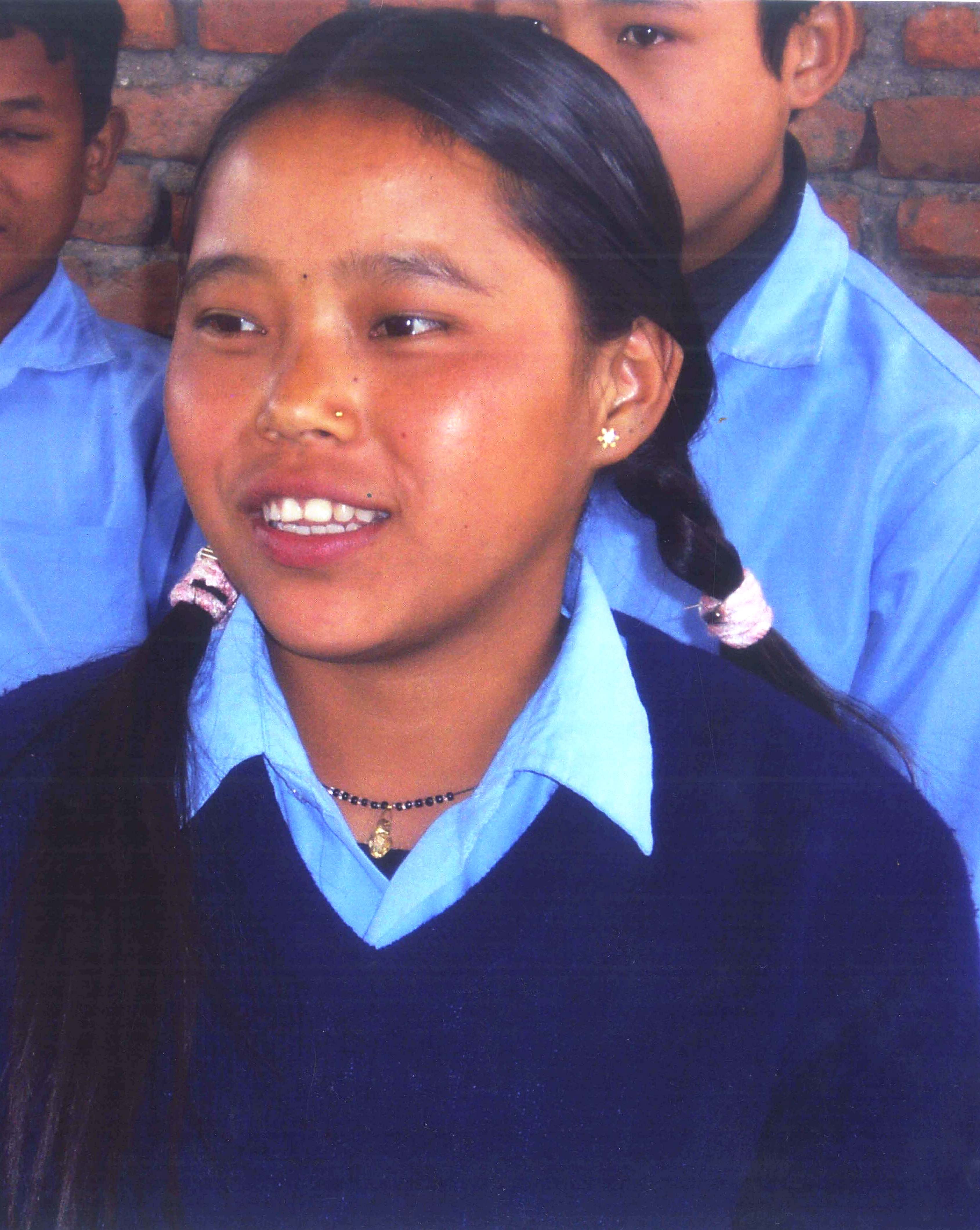
Every morning when I come into work, I am greeted by the smiling face of a young girl. Her hair is pulled neatly back into two braids, glossy black against her pink hairbands.  Her eyes, dark and alert, shine at me – I swear I can see them twinkle.

She wears the blue uniform of her school, the Sankhu-Palubari Community School in rural Nepal.  The Advocates for Human Rights supports the school to provide the right to education to the most disadvantaged kids in the area and to prevent them from becoming involved in child labor.  Photographs from the school hang on the walls of our office, reminders to us of the lives that we impact with our human rights work.

Even though I see her every day, until last month I had never met this cheerful young girl, a girl whose smile – even in a photo – comes from her core, seems to light her entire being. Until last month, I did not know that her name was Kanchi.  And I had never heard her incredible story.

*****

In 1999, Kanchi was six years old.  She lived with her family in a village in the Kathmandu Valley.  Her parents were poor farmers; they had only a little land and some cattle and they struggled to feed their family.  Kanchi was the youngest of six sisters.  She and her sisters (and also her  brother) had to help their parents in the fields and with household chores.  Kanchi’s job was also to take the cattle to the forest to graze.   Kanchi did not go to school.   There were many children in Nepal that did not go to school at that time, but girls, like Kanchi, were more likely than boys to work rather than go to school – particularly in rural areas like the Suntole district where she lived.

Kanchi was a very smart and determined little girl.  She wanted to go to school.   So when she heard that a new school was opening in the Sankhu-Palubari community – a school for kids who were not able to go to school because they couldn’t pay or were discriminated against – she was very excited.  She rushed off to tell her parents.  But her parents, who had never themselves been educated, were not as excited as Kanchi.  Why should they let her go to school?  Who would help feed the family? Why should they send her to school if she was only going to get married in a few years anyway?

Kanchi says that she cried for a month and begged her parents to let her go to school.  One day, teachers from the new school came to visit Kanchi’s parents to talk to them about the school. The teachers explained that it would help THEM if Kanchi could read and write.  They explained why it was important for all children to go to school, even girls.  They told them that all children – even the poorest, the lowest-caste, members of indigenous groups – had a right to education.

Kanchi’s older sisters, who had never had the opportunity to go to school, took her side. Instead getting an education, they had all married young and were working in the fields.  Kanchi’s sisters argued that Kanchi should go to school, take this opportunity for a life that would be different from theirs.  Finally, their parents agreed to let Kanchi go to school.

Kanchi started at the Sankhu-Palubari Community School in 1999, one of 39  students in the first kindergarten class.  To get to school, Kanchi had to walk one and a half hours each way.  There were many other obstacles along the way, too.  At various times, her parents wanted her to stop school and help them with farming.  But she stayed in school and worked hard. She told her parents,  “I want to do something different from the others.”

Kanchi liked her teachers and felt supported by them.  She felt that the best thing about the school was the teaching environment.  She stayed in school and was one of only two girls in the first class to graduate from 8th grade.  She continued on to high school and completed 12th grade at  Siddhartha College of Banepa in 2012.  The first in her family to go to school, Kanchi is also the first girl from the Sankhu-Palubari Community School to graduate from 12th grade.

I met Kanchi for the first time in September.  Almost exactly 13 years after this brave little girl started kindergarten, she is a lovely young woman who is preparing for her university entrance exams.  She plans to study agriculture  starting in January.   Her parents are proud of her and they are happy now – she has chosen the family profession – but Kanchi is interested in learning more about organic farming so she can bring techniques back to her village.  “I want to live a healthy life and give a healthy life to others,” she says.

Sitting in the principal’s office at Sankhu-Palubari Community School, I asked her what the school meant to her.  Kanchi said, “I gained from this school my life.  If I hadn’t learned to read and write, I would be a housewife.”  When asked about her sisters, she told me that they had made sure to send their own children to school.

In her free time, Kanchi likes to sing and dance and make handicrafts to decorate her room.  She likes to play with her sisters’ children.  She has a smile that lights the whole world.  She told me her nickname, Himshila.  She smiled when she told me it means “mountain snow, strong rock”.  Strong rock.  That seems just about right.

*****

October 11, 2012 is the first International Day of the Girl Child.  The United Nations has designated this day to promote the rights of girls, highlight gender inequalities and the challenges girls face, and address discrimination and abuse suffered by girls around the globe.  In many ways, the story of Kanchi and her sisters reflects the experience of girls in many countries throughout the world.  All over the world, girls are denied equal access to education, forced into child labor, married off at a young age, pressured to drop out of school because of their gender.

There are many good reasons to ensure access to education for girls like Kanchi, however. Educating girls is one of the strongest ways to improve gender equality.  It is also one the best ways to reduce poverty and promote economic growth and development.

“Investing in girls is smart,” says World Bank President, Robert Zoellick. “It is central to boosting development, breaking the cycle of intergenerational poverty, and allowing girls, and then women—50 percent of the world’s population—to lead better, fairer and more productive lives.”

The International Day of the Girl is a day to recommit ourselves to ensuring that girls like Kanchi have the chance to live their lives to their fullest possible potential.  To redouble our efforts to promote the rights of girls wherever they live in the world.   This first International Day of the Girl is also a day to honor girls like Kanchi.  A day to take the story of her success in one tiny corner of Nepal and shout it out, an inspiration for girls all around the world.  Girls like Kanchi with the strength, the bravery, the determination to change the world, but who  just need the opportunity.

Originally published on The Advocates Post.

NEPAL: Visiting the Sankhu-Palubari Community School

Some students walk – up to 2 hours each way – to the Sankhu-Palubari Community School to access their right to education.

I’ve been in Nepal for the past ten days with a team of staff and volunteers.  We are here to visit the Sankhu-Palubari Community School (SPCS) in the rural Kathmandu Valley.  The Advocates for Human Rights, the organization I work for, has supported the school since it was founded in 1999 to prevent child labor, encourage gender parity in education, and improve the lives and well-being of the most disadvantaged children in the area.  The school in Palubari village is only about 40 km outside of Kathmandu, but the peaceful, green valley in which it is nestled feels worlds away. The drive out is nerve-wracking (in the terrible Kathmandu traffic), then bone-jarring (on the bumpy, rutted roads). But the sight of these bright, alert children makes it all worthwhile.

In the United States, where education is both compulsory and free, we often forget that the right to education is not meaningfully available in many parts of the world – especially for girls.  The UN estimates that there were more than 67 million primary school-age and 73 million lower secondary school-age children out of school worldwide in 2009.  In addition, an estimated 793 million adults lack basic literacy skills. The majority of them are women.

Most of the students’ families work in agriculture.  They are farmers with little or no money to spare on school fees, uniforms and supplies.   Frequently, the adults in the family are illiterate. Many of them are from marginalized groups such as the Tamang. An indigenous group with their own culture and language, the Tamang students must learn Nepali as well as English when they come to school.  A pre-K program was added in 2011 to provide pre-literacy eduction to better prepare the students for school.

This week, The Advocates’ team has been conducting a site visit which includes interviewing students in grades 5 through 10 about their experiences at the school and their plans for the future.  It has been a treat to interview these kids and learn more about their lives, their hopes, their dreams for the future.

We’ve been inspired to hear from so many of the girls about their commitment to getting a good education. Since the school’s founding in 1999, the teachers have conducted outreach to parents and worked hard to encourage female students to attend and stay in school in spite of societal pressure to get married, work in the fields or enter domestic work.
Their efforts have definitely paid off.  While girls worldwide generally are less likely to access, remain in, or achieve in school, 52% of the students in K-8th grades at the school this year are girls. And a girl is at the top of the class in every single grade at SPCS.
Students had so much to tell us about their hopes and dreams for the future.  Some wanted to be doctors and nurses. Some wanted to be teachers. Some even wanted to be professional football (soccer) players! (Football is very popular here in Nepal, especially among boys. The Nepali national football championship is coincidentally going on right now in Kathmandu.  The national police team has won for the past three years.)  This student demonstrated for me his prowess at left forward.
The Sankhu-Palubari Community School may be a small school in a remote valley, but it is a place where the human right to education is alive and well, providing a better future for these children.  The impact that they have on their community, their country and – hopefully, the world – will be thrilling to watch.
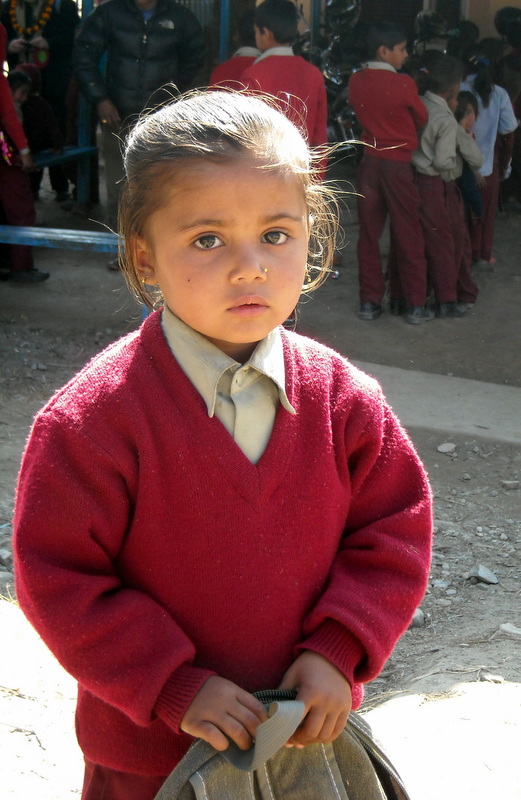
Pre-K students enjoying their noodles at lunch.
7th graders in one of my English conversation practice small groups.
THIS POST WAS ORIGINALLY PUBLISHED IN THEADVOCATESPOST.
PHOTO CREDITS:  Robin Phillips, Jennifer Prestholdt and Laura Sandall
Jennifer Prestholdt is the Deputy Director of The Advocates for Human Rights

The Importance of Educating Girls


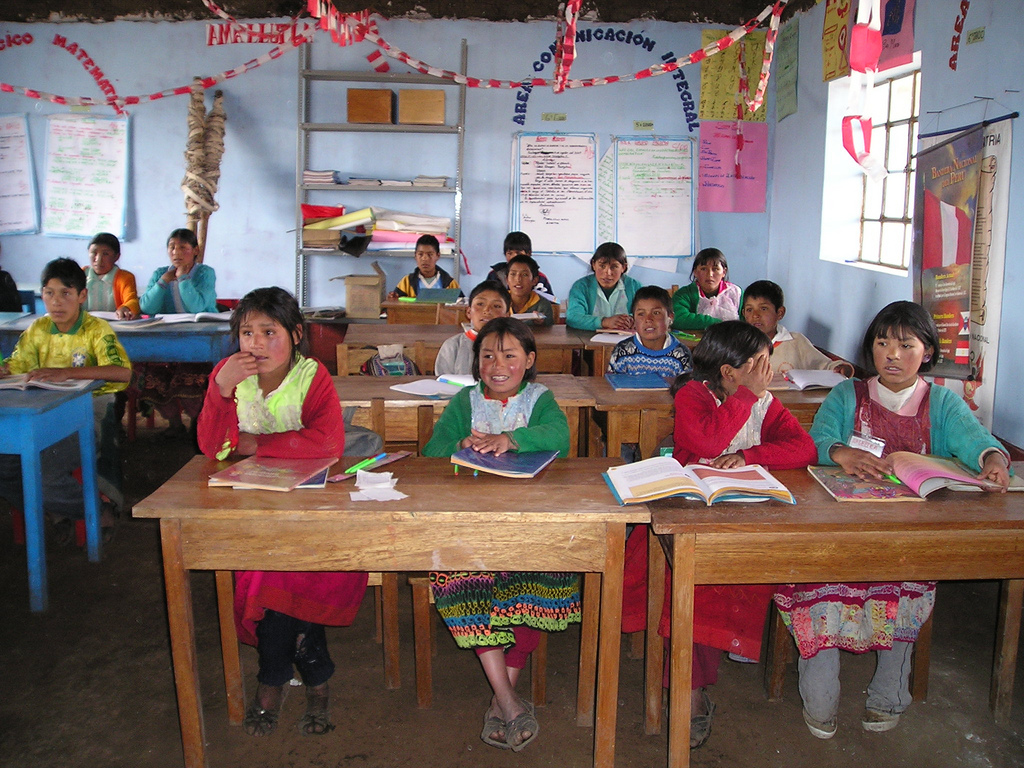
Fifth grade class in Chuchoquesera, Peru

When I visited the classroom pictured above in the Peruvian highlands back in 2004, I noticed that slightly more than half of the students were girls. I remarked on this fact to the human rights activist who was giving us the tour of this Quechua-speaking indigenous community.  He smiled sadly and said,

“Yes, but this is fifth grade.  In sixth grade, children go to a lower secondary school that is farther away.  Most of the girls won’t go.  It takes too long to walk there and they are needed to help at home, so the parents won’t let them go.  Besides, most of them will be married soon.”

Unfortunately, this is a situation of gross inequality for girls that is repeated in communities throughout the world.

In the United States, where education is both compulsory and free, we often forget that the right to education is not meaningfully available in many parts of the world – especially for girls.  The UN estimates that there were more than 67 million primary school-age and 73 million lower secondary school-age children out of school worldwide in 2009.  In addition, an estimated 793 million adults lack basic literacy skills. The majority of them are women.

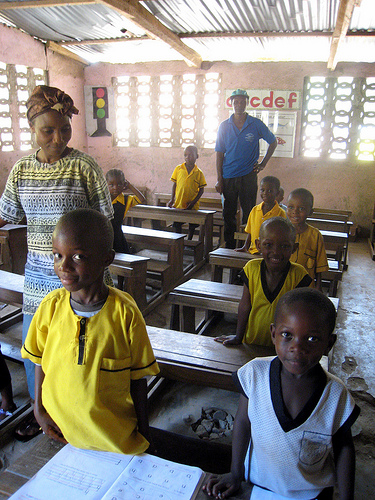
Since then, I have visited classrooms and asked questions about girls’ access to education in countries on several continents.  This is a photo I took at Buduburam Refugee Settlement in Ghana.

Kindergarten class, Buduburam Refugee Settlement, Ghana

Boys far outnumbered girls in this classroom, illustrating another of the problems for girls in accessing education.  When resources are scarce, parents will often choose to spend the money on school fees for their sons rather than their daughters.

There are many good reasons to ensure access to education for girls, however. Educating girls is one of the strongest ways to improve gender equality.  It is also one the best ways to promote economic growth and development.

“Investing in girls is smart,” says World Bank President, Robert Zoellick. “It is central to boosting development, breaking the cycle of intergenerational poverty, and allowing girls, and then women—50 percent of the world’s population—to lead better, fairer and more productive lives.”

Ensuring equal access to education for all girls by 2015 is part of the United Nations’ Millennium Development Goals, making this issue a major focus of work by the United Nations (for more info, check out the UN Girls’ Education Initiative site), the World Bank and many international non-governmental organizations.   October 11  has been designated as the International Day of the Girl Child to draw attention to the topic.
Nepal
On a much smaller scale, the Sankhu-Palubari Community School in Nepal is doing its part to encourage gender parity in education and  increase literacy rates.  The school works in partnership with The Advocates for Human Rights (the non-profit where I work) to prevent child labor and improve the lives and well-being of the neediest children in this community in the Kathmandu Valley. I travel there regularly to monitor progress at the school.
 cropped-spcs-program1.jpg
 For several years, the school has successfully met goals for gender parity among students in both the primary and lower secondary grades. For the 2011-2012 school year, 147 of the 283 students in pre-school through eighth grade are girls. Additionally, and perhaps more significantly, 15 of the 31 students in ninth and tenth grade are young women.
Pre-K student at Sankhu-Palubari Community School, Nepal

Most of the students’ families work in agriculture.  They are farmers with little or no money to spare on school fees, uniforms and supplies.   Many of them are from disadvantaged groups such as the Tamang and Newari.  Indigenous group with their own cultures and languages, the indigenous students must learn Nepali as well as English when they come to school.  Frequently, the adults in the family are illiterate.
 

 9th Grade students at SPCS

How has the teaching staff managed this success at keeping girls in school?  Since the school’s founding in 1999, the teachers have conducted outreach to parents and worked hard to encourage female students to attend and stay in school in spite of societal pressure to get married or enter domestic work. It took more than 10 years, but their efforts have paid off.  While girls worldwide generally are less likely to access, remain in, or achieve in school, 52% of the students in K-8th grades at the Sankhu-Palubari Community School this year are girls. And a girl is at the top of the class in most of the grades at SPCS.

The impact of the school both on the individual students and on the community over the past 12 years has been profound.  When I was there in March of 2011, we interviewed approximately 60% of the parents of SPCS students.  It was clear to me that parents value the education that their children are receiving and, seeing the value, have ensured that the younger siblings are also enrolled in school rather than put to work.  Twelve years ago, there were many students in the area out of school but now most are attending school. I could also see the physical benefits that the students derived from attending school when they stood next to their parents.  Even the 5th grade girls towered over their parents, illustrating the simple cause-and-effect of adequate nutrition, wellness checkups, and not having to work in the fields from a very young age.

The Sankhu-Palubari Community School may be a small school in a remote valley, but it is a place where the human right to education is alive and well, providing a better future for these children.  In particular, the effect that these girls have on their community, their country and – hopefully, the world – will be thrilling to watch.


This post was originally written for World Moms Blog.
Photo credit for photo to Dulce Foster

The Right to Education

Photo by Dulce Foster
As my own daughter headed back to school, I found myself thinking about another group of girls at a school halfway around the world.  Unlike my three kids, who are driven to their well-appointed classrooms on the first day because they have too many school supplies to carry, the kids at the Sankhu-Palubari Community School (SPCS) in Nepal do their work on rickety desks in cramped classrooms.  These kids in pre-K through 10th grade walk to school – some an hour each way – six days a week because this school provides the opportunity to realize their human right to education.
 In the United States, where education is both compulsory and free, we often forget that the right to education is not meaningfully available in many parts of the world – especially for girls.  The UN estimates that there were more than 67 million primary school-age and 73 million lower secondary school-age children out of school worldwide in 2009.  In addition, an estimated 793 million adults lack basic literacy skills. The majority of them are women.
Sankhu-Palubari Community School
Photo by Dulce Foster
     Overwhelming as those numbers are, there are pinpricks of light that give me hope that they will someday change.  I saw one when I visited Nepal for the first time in March 2011.  Opened inSeptember 1999, the Sankhu-Palubari Community School is a partnership between The Advocates for Human Rights, Hoste Hainse (a Nepali NGO), the local School Management Committee, and the dedicated teaching staff.  The school now enrolls more than300 students in grades pre-K-9, and also provides scholarships for graduates who continue on to 10th grade.
The goals of the Sankhu-Palubari Community School Project are to prevent child labor, encourage gender parity in education, increase literacy rates, and improve the lives and well-being of the neediest children in the area.   This year, the school has successfully met goals for gender parity among students in both the primary and lower secondary grades. For the 2011-2012 school year, 147 of the 283 students in pre-school through eighth grade are girls. Additionally, and perhaps more significantly, 15 of the 31 students in ninth and tenth grade are young women.
Since the school’s founding in 1999, the teachers have conducted outreach to parents and worked hard to encourage female students to attend and stay in school in spite of societal pressure to get married or enter domestic work. Their efforts have paid off.  While girls worldwide generally are less likely to access, remain in, or achieve in school, 52% of the students in K-8th grades at the Sankhu-Palubari Community School this year are girls. And a girl is at the top of the class in most of the grades at SPCS.
     Most of the students’ families work in agriculture.  They are farmers with little or no money to spare on school fees, uniforms and supplies.   Many of them are from disadvantaged groups such as the Tamang.  An indigenous group with their own culture and language, the Tamang students must learn Nepali as well as English when they come to school.  Frequently, the adults in the family are illiterate.
8th Grade Class
Photo by Dulce Foster
The impact of the school both on the individual students and on the community over the past 12 years has been profound.  As part of our evaluation and monitoring process, our team interviewed approximately 60% of the parents of students atthe school in March.  It was clear to me that parents value the education that their children are receiving and, seeing the value, have ensured that the younger siblings are also enrolled in school rather than put to work.  Twelve year sago, there were many students in the area out of school but now most are attending school. I could also see the physical benefits that the students derived from attending school when they stood next to their parents.  Even the 5th grade girls towered over their parents, illustrating the simple cause-and-effect of adequate nutrition, wellness checkups, and not having to work in the fields from a very young age.
      Challenges certainly remain, particularly as the cost of operating the school continues to rise. But so far two classes of students who started at the school in kindergarten have graduated from the 10th grade; they all received either high distinction or first division on their School Leaving Certificate examinations.
Morning Assembly
Photo by Dulce Foster
The Sankhu-Palubari Community School may be a small school in a remote valley, but it is a place where the human right to education is alive and well, providing a better future for these children.  In particular, the effect that these girls have on their community, their country and – hopefully, the world – will be thrilling to watch.