PHOTO ESSAY: Cartooning for Peace

Cartoon by Kianoush

In May, I was in Geneva to participate in the United Nations’ Universal Periodic Review of Morocco and India.  I went for a run one day along Quai Wilson on Lake Geneva and discovered an exhibition of political cartoons. The exhibition was sponsored by Cartooning for Peace/Dessins pour la paix, an initiative conceived of by French political cartoonist Plantu and launched at the United Nations in 2006.  The goal of Cartooning for Peace is to promote better understanding and mutual respect between people of different faiths and cultures.  Cartooning for Peace also works to promote freedom of expression and to protect the rights of cartoonists.

Cartooning for Peace and the City of Geneva created the new International Prize for Editorial Cartoons to honor cartoonists for their talent, outstanding contribution and commitment to the values of tolerance, freedom and peace. On May 3, 2012  – the World Day of Press Freedom – the prize was awarded for the first time to four Iranian political cartoonists.

Cartoon by Mana Neyestani

The exhibition Dessins Pour La Paix  2012 displayed the work of the award-winning Iranian artists Mana Neyestani, Kianoush,  Firoozeh Mozaffari and Hassan Karimzade.

In addition, the exhibition included dozens of political cartoons by cartoonists around the world on the themes of freedom of expression, the Arab spring and the rights of women.

The exhibition in Geneva ran from May 3 to June 3, 2012.  The full catalogue of the cartons featured in the exhibit is now available online.

Take a stroll with me along Quai Wilson and witness the power of the cartooning for peace!

ARAB SPRING 

FREEDOM OF EXPRESSION

ET LES FEMMES? (AND THE WOMEN?)

Photo credits to Amy Bergquist

Originally posted on 8/7/12 on

The Advocates for Human Rights’  blog

The Advocates Post.

India’s Politics Without Principles

Raj Ghat,  Mahatma Ghandi Memorial

New Delhi, India

Note:  This essay was originally published on The Advocates Post.

Last year, on my first trip to India, I visited Raj Ghat in New Delhi.   Raj Ghat (or Rajghat) is the Mahatma Gandhi Memorial and, as Gandhi has long been one of my human rights heroes, I was glad to have this opportunity to pay my respects to the man whose lessons of non-violence and human rights have had such an impact on our world.  Gandhi is known of the “Father of the Nation” because of his pivotal role in India’s independence movement.  But how far has Gandhi’s beloved India come in fulfilling his vision for humanity?  From Raj Ghat, I went to directly a meeting with Indian human rights activists. They told us that, while important reforms have been made recently to protect the human rights of its 1.21 billion citizens, India still has a long way to go to adequately protect the rights of its religious minorities.

Gandhi was cremated at Raj Ghat on the Yamuna River on January 31, 1948, the day after he was assassinated. Raj Ghat is  a solemn space, a large, walled enclosure purposefully left open to the air and the white-hot sun of central India. It is set within an even larger park, with flagstone paths and shade trees – grandeur and greenery that surprised me in a city as crowded as Delhi.  Yet Raj Ghat itself is true to the simple life that Gandhi himself chose.  As you walk around the upper level, on a path bordered by flowers and creeping vines, you can see the square platform in the center that marks the site of Gandhi’s cremation. The black marble is so smooth that it reflects and extends the eternal flame that burns at one end of the monument, like a torch lighting the way forward in the dark of night.  The red soil of his dear homeland surrounds the marble samadhi, as in life Gandhi rejected the green lawns of the English colonialists, choosing instead to leave the grounds of his residences in their natural state.

To enter Raj Ghat, you must remove your shoes.  This is a sign of respect, one that I honor, but I admit to never having pictured myself meeting my idol in sock feet.  It was in sock feet, however, that, in the cool shade of the thick stone walls, I walked the perimeter of the memorial.  On the walls of the memorial are quotes from Gandhi, inscribed in the many languages of the Indian people as well as other world languages. Raj Ghat is a contemplative place; in concert with this, visitors are encouraged to circle the memorial three times.  My first time around, near the marble platform,  I stopped short.  Before me, inscribed in black on the red sandstone wall, were words of deep truth.  Gandhi was a prolific writer who first published his “Seven Social Sins” in 1926 in Young India, one of several newspapers he edited.
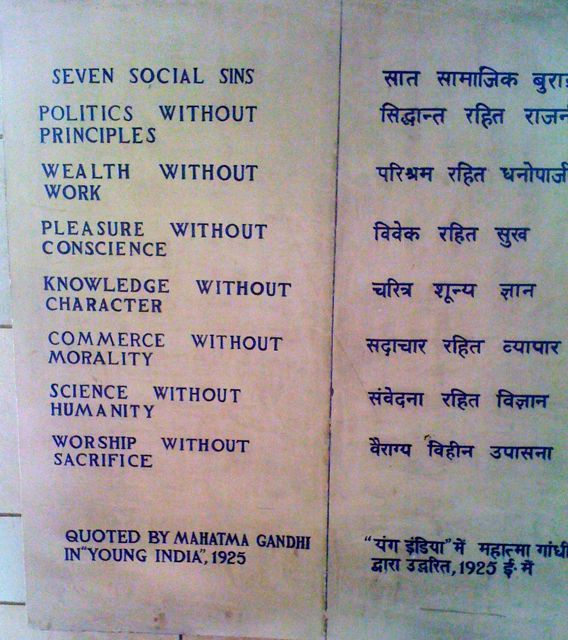
Seven Social Sins

Quoted by Mahatma Gandhi in “Young India”, 1925

Gandhi’s Seven Social Sins – complicated concepts remarkably expressed with a few simple words – remain apt nearly 100 years later.  They are:

POLITICS WITHOUT PRINCIPLES

WEALTH WITHOUT WORK

PLEASURE WITHOUT CONSCIENCE

KNOWLEDGE WITHOUT CHARACTER

COMMERCE WITHOUT MORALITY

SCIENCE WITHOUT HUMANITY

WORSHIP WITHOUT SACRIFICE

Mahatma Gandhi’s words have stayed with me.  Unlike the numerous foreign dignitaries who visit Raj Ghat, I did not receive a khadi scroll imprinted with the Seven Social Sins.  But they are written in my heart as distinctly as they are carved on the sandstone wall of Raj Ghat. Certainly, the words were fresh in my mind later that afternoon at a meeting with Indian human rights activists. Over cups of masala tea, these human rights defenders told us about the alarming rise in discrimination and violence against religious minorities – particularly Muslims and Christians – in various states across India, including Gujarat, Orissa and Karnataka. While discrimination and violence against Muslims has long been a problem in India (including communal attacks targeting Muslims in Gujarat in 2002 that killed nearly 2000 and displaced as many as 140,000), these courageous human rights activists have documented the increasingly systematic discrimination and violence in the name of counter-terrorism since a series of bombings in 2007 and 2008.  One group, Act Now for Harmony and Democracy (ANHAD), published a report in 2011 containing the testimony of scores of Indian Muslims at a People’s Tribunal on the Atrocities Committed Against Muslims in the Name of Fighting Terrorism.  As they described their experiences, as well as the impunity enjoyed by security forces and non-state actors that targeted religious minorities in the name of counter-terrorism, I thought again of Gandhi.   Allowing human rights abuses to be committed against a broad category of in the name of fight against terrorism is indeed practicing “Politics Without Principles”.

Later in 2011, and partly as a result of what we learned at this meeting, The Advocates for Human Rights made a submission to the Human Rights Council for the 2012 Universal Periodic Review (UPR) of India.  Our submission, made jointly with the Indian American Muslim Council in the US and the Jamia Teacher Solidarity Association (along with input from other Indian human rights organizations) in India, addresses India’s failure to comply with its international human rights obligations to protect members of minority groups. Major human rights challenges in India today include extrajudicial executions committed by security personnel as well as non-state actors, arbitrary and unlawful detentions, torture and cruel, inhuman and degrading treatment of terrorism suspects in police custody, and harassment of human rights defenders (including lawyers who defend Muslims accused of terrorist acts), whistleblowers and journalists.

Additionally, our submission highlights the failure of the Indian government to adequately investigate and effectively prosecute perpetrators of these human rights violations against members of minority groups.  The UN Special Rapporteur on freedom of religion or belief reported in 2009 that the Indian government’s failure to adequately investigate and prosecute individuals and government officials involved in human rights violations exacerbates tension between India’s political and religious groups.  Discrimination against religious minorities extends to all facets of life, including access to education, employment and housing.  Religious minorities also face violence and discrimination due to state level “Freedom of Religion Acts”, which fail to clearly define an “improper conversion” – a lack of clarity which gives the authorities the power to accept or reject the legitimacy of a conversion.

Under the UPR, the human rights record of every member of the UN is reviewed once every four and one-half years.  Indiawas one of the first countries to be reviewed in 2008 following the creation of this new human rights mechanism. I was in Geneva on May 24 for the Second Universal Periodic Review of India. The Indian government sent a large, 20 member  delegation, headed by the Attorney General and including representatives from several ministries, and clearly viewed the UPR process as both serious and important.  The Human Rights Council is a human rights mechanisms designed to be an interactive dialogue between governments.  I was gratified to see Human Rights Council delegates from 20 countries address the issues raised in our submission, including the recommendation from the United States to “Ensure that laws are fully and consistently enforced to provide adequate protections for members of religious minorities…”

The Human Rights Council made 169 recommendations toIndia, but the government chose not to adopt them at the June 2012 session. Instead, they government promised to respond “in due time” but no later than September 2012.


India’s large and religiously diverse population makes it one of the most pluralistic societies in the world. The Indian Constitution provides all citizens with the “right to equality before the law,” the right to “the prohibition of discrimination on grounds of religion, race, caste, sex or place of birth”, and the “right to freedom of speech and expression”. Further, it specifies that “no person who is arrested shall be detained in custody without being informed, as soon as may be, of the grounds for such arrest” and that every person arrested be presented to the nearest magistrate within 24 hours of the arrest.

India has made great progress in setting up a domestic legal framework to protect human rights and must be commended for that. India must now end the practice of  “Politics Without Principles” and implement and effectively enforce these laws in a manner that protects the rights of members of its religious minority communities.

Statue of Gandhi at the United Nations

Geneva, Switzerland

Justice delayed may be justice denied for Minnesota Cambodians

Skulls of Khmer Rouge victims.
Skulls of Khmer Rouge victims. (Photo credit: Wikipedia)

Justice delayed may be justice denied for Minnesota Cambodians.

Monoram Hang was just 9 years old in April 1975, when Khmer Rouge soldiers forced his family from their home in Phnom Penh. His mother, weak from giving birth two days earlier, fell to her knees and begged for permission to wait for her husband to return from work so their family could leave together. The soldiers kicked her to the ground and ordered them out at gunpoint, forcing them to join the swollen river of people leaving Cambodia’s capital. As Hang related, “At that time we walk, we don’t know where we are going, we don’t know where we end up. We just walk and walk. …  And Khmer Rouge soldiers behind us and shoot from behind and force us to go.”

Hang was lucky to survive; as many as 2 million Cambodians died in the “killing fields” of the Khmer Rouge regime. He found refuge in the United States, one of nearly 10,000 Cambodians now living in Minnesota — the country’s sixth-largest home to Cambodians. Like Hang, most witnessed genocide and endured forced migration and labor camps under the Khmer Rouge.

1990: Minnesota puts the Khmer Rouge on trial

In 1990, Hang and other survivors testified at a mock trial of the Khmer Rouge leadershipthat was held at the State Capitol in St. Paul. The Advocates for Human Rights organized the mock trial with Minnesota’s Cambodian community to give voice to the victims of Khmer Rouge atrocities. The panel of public officials serving as judges at the mock trialfound the Khmer Rouge leaders guilty of genocide. The entire Minnesota Congressional Delegation issued a statement formally recognizing members of Minnesota’s Cambodian community for their testimony and joined “the appeal to establish an international inquiry into crimes of genocide perpetrated by the Khmer Rouge between 1975-79. Well-established principles of international law require accountability and punishment for those responsible for genocide, the Khmer Rouge being no exception.”


2012: Actual justice remains elusive
The mock trial was such a positive experience for the Cambodian community that The Advocates then created the Khmer Oral History Project, enlisting volunteer attorneys to interview Hang and other members of Minnesota’s Cambodian community about their experiences under the Khmer Rouge, their life in refugee camps, and their immigration to the United States. Transcripts and video recordings of those interviews are available through the Minnesota Historical Society.

Yet more than two decades after The Advocates put the Khmer Rouge on trial in Minnesota and Minnesota lawmakers called for accountability, one — and only one — Khmer Rouge leader has actually been brought to justice. In 2010, a hybrid United Nations-Cambodian tribunal, the Extraordinary Chambers in the Courts of Cambodia (ECCC), found Kaing Guek Eav responsible for the deaths of more than 14,000 people at the notorious S-21 prison and convicted him of crimes against humanity, murder, and torture. An ECCC appeals court last month increased his sentence to life imprisonment.

For survivors like Hang, justice delayed may be justice denied. Thirty-five years after the Khmer Rouge took power, only three additional leaders, all in their 80s, are answering charges in an ECCC “mini-trial.” Additional mini-trials against the same elderly defendants will follow — if their health holds out. Proceedings against a fourth defendant have been stayed as she battles age-related dementia.

Culture of impunity

A recent dispute between U.N. and Cambodian authorities threatens to bring the ECCC’s slow progress to a grinding halt. The Cambodian government, which is bidding for a rotating seat on the U.N. Security Council for 2013–2014, has made plain that it opposesany additional charges against other defendants. International co-investigating judge Siegfried Blunk resigned last October, complaining of government interference. According to the painstakingly negotiated agreement establishing the ECCC, Cambodia’s Supreme Council of the Magistracy was obligated to appoint reserve judge Laurent Kasper-Ansermet to replace Blunk. Kasper-Ansermet took his post in December, paying no heed to government efforts to obstruct justice and launching investigations against new defendants. In January, however,the Supreme Council rejected his appointment and Kasper-Ansermet’s Cambodian co-investigating judge has contested his authority to investigate cases. U.N. Special Expert to the ECCC, David Scheffer has emphasized to Cambodians on the court that Kasper-Ansermet has full authority to serve as the international investigating judge.

On March 19, frustrated with the recalcitrance of his Cambodian colleague and the resulting “dysfunctional situation within the ECCC,” Kasper-Ansermet tendered his resignation. He did so in view of “the victims’ right to have investigations conducted in a proper manner.” The UN has voiced “serious concern” at the developments prompting Kasper-Ansermet’s departure.

Time to get tough

Hang and other victims of the Khmer Rouge have waited too long for justice. For their sake, it is time to ensure that the work of the ECCC goes forward to hold the perpetrators of horrific crimes against humanity accountable. Minnesota’s lawmakers should joinCalifornia Rep. Ed Royce in calling for more trials and an end to the Cambodian government’s culture of impunity. The United States, which has contributed more than $6.7 million to the ECCC, should demand that the Cambodian government cease its interference in the proceedings. Unless the meddling ends, Cambodia has no place at the table on the Security Council.

Jennifer Prestholdt is the deputy director of The Advocates for Human Rights and the director of The Advocates’ International Justice Program. Amy Bergquist is a staff attorney for the International Justice Program.

Amina Filali and Violence Against Women in Morocco

Amina Filali was only 16 years old when she took her own life.  According to reports, Amina was raped last year at the age of 15 by an older man, but that crime alone was not what drove her to swallow rat poison. Instead of seeing her rapist punished for his crime, Amina was forced to marry him. A few months into an unconscionable marriage, her rapist/ husband was beating her, she told her mother. Her mother counseled her to try and bear it, according to the Moroccan daily al-Massa.  Amina must have seen no way out, no future worth living.

Why would a judge order – or even recommend – a young girl to marry her rapist? Under Article 475 of the Morocco Penal Code, a perpetrator of rape on a minor is allowed to escape punishment if he marries the victim.  While it may not be a provision of Moroccan law that is used frequently, it is a violation of human rights that has attracted international scrutiny both before and after Amina’s tragic death.  I saw this myself when I was in Geneva last November with a group of Moroccan human rights activists.  We were there to participate in the review of Morocco’s compliance with the United Nations Convention Against Torture.  Violence against women is considered torture under the Convention and the independent committee of experts charged with monitoring state compliance with the treaty had many pointed questions for the Moroccan delegation about Article 475 and other provisions related to the Moroccan government’s failure to protect women from violence.

There is no text that allows a rapist to escape prosecution or a “kidnapper” to escape punishment if he marries his victim, the Government assured the UN Committee Against Torture.  The penal code has a law on the rape of a minor, but the victim – if she has reached puberty – may CHOOSE to marry.  The marriage, if it takes place, continued the Moroccan Government delegation, would have to be based on the consent of the victim.

As Amina’s case shows, “consent” is neither adequate protection for a minor nor a remedy for the crime of rape.  Victims are not often in a position to offer informed consent as they may be pressured into marriage as an alternative in order to preserve family honor.  But in Amina’s case, Amina’s father has, according to some news reports, denied that the family ever consented to the court ruling ordering marriage to preserve family honor.

Amina’s story may be shocking to some of us, but it is a glimpse at the reality of the violence faced by women in Morocco every day.  While it is difficult to determine the exact prevalence of domestic violence throughout Morocco, statistics that are available demonstrate that domestic violence is a widespread problem. A 2011 national study on the prevalence of violence against women found that 62.8% of women in Morocco of ages 18-64 had been victims of some form of violence during the year preceding the study.

The Moroccan Penal Code provides insufficient protection against rape and sexual assault, which are often unreported and prosecutions not pursued. Spousal (also called marital or conjugal) rape is not specifically considered a crime in the Penal Code nor is it prosecuted in practice. Women are deemed to have consented to all sexual relations with their husband by the fact of marrying them. Women do not seek help when they are raped by their husbands because of the social stigma associated with rape, the difficulty in proving rape, and the futility in reporting an act that the Moroccan Government does not even recognize it as a crime. The issue of marital rape in Morocco is trivialized by the officials and executives, and is considered as being unimportant, and therefore, it is not defined nor is it acknowledged by the Moroccan law.

Rape cases in general are difficult to prove in Morocco, as actual physical injuries are required to prove non-consent. Under the Penal Code, rape is considered a crime against morality and not identified as a crime against persons.Women are deterred from reporting rape cases because of the lack of response from law enforcement and the criminal justice system. Even when a rape case is investigated, the perpetrator is not always punished.

Furthermore, sexual relations outside of marriage are illegal in Morocco, and penalties are increased if one or both people engaged in the affair are already married. Thus, there is a strong disincentive for a woman like Amina to report a rape as she risks being prosecuted for illicit sexual relations if she does not prevail in proving her rape case and she is not married to her rapist. Is it any wonder that Amina apparently kept her rape a secret even from her parents for two months?

Amina’s story is a tragedy.  But the media attention it has drawn is a cause for hope.  Amina’s story has raised awareness both inside and outside of the country about violence against women.  In addition to the media attention, there is a reinvigorated campaign to abolish the law.  There is a Facebook page and an online petition.  There have been demonstrations, with protests planned for this Saturday, March 17.

The silver lining to Amina’s story would be that the internal and external pressure  on the Moroccan government finally results in the passing of a Violence Against Women law in Morocco.  (A draft is currently stalled in InterMinisterial consultations and has not yet been introduced in Parliament.)

As the Moroccan human rights activists recommended to the UN Committee Against Torture last November:

The Moroccan Government should pass a specific violence against women law that contains both criminal and civil provisions.

• Care should be taken that that the new law does not contain provisions that would cause further harm to victims.
• The new law should expand the definition of violence against women and ensure various types of relationships
are covered by the law
• The new law should establish civil remedies, including comprehensive Civil Protection Order provisions for
women who are victims of violence

Morocco’s Penal Code should be amended to:

• explicitly criminalize conjugal rape;
• abolish criminal prosecutions for illicit sexual relations;
• eliminate laws that criminalize those who assist or harbor married women;
• abolish provisions that allow a perpetrator of rape to escape prosecution for marrying his victim; and
• eliminate discriminatory legal provisions that place heavy burdens of proof solely on the victim of violence.

Sources:

Moroccan girl commits suicide after being forced to marry her rapist, Al Arabiya News, March 14, 2012  http://english.alarabiya.net/articles/2012/03/14/200577.html

 Morocco protest after raped Amina Filali kills herself, BBC News, March 15, 2012  http://www.bbc.co.uk/news/world-africa-17379721

Morocco Penal Code, Article 475

U.S. Department of State, Country Reports on Human Rights Practices, “2010 Human Rights Practices: Morocco”, (April 8, 2011), available at http://www.state.gov/g/drl/rls/hrrpt/2010/nea/154468.htm (last visited October 10, 2011).

Moroccan Haut Commissaire au Plan, “Principaux résultats de l’Enquête Nationale sur la Prévalence de la Violence à l’Egard des Femmes (version française)”, (January 2011), available at  http://www.hcp.ma/Conference-debat-consacree-a-l-etude-de-la-violence-a-l-egard-de-femmes-au-Maroc_a66.html (last visited October 6, 2011); see also, UN Women, “Moroccan Government Release Extensive Gender-Based Violence Study”, (10 January 2011), available at  http://www.unwomen.org/2011/01/moroccan-government-releases-extensive-gender-based-violence-study/ (last visited October 6, 2011).

Written Communications to The Advocates for Human Rights from Moroccan NGOs (26 September 2011).

MOROCCO: Challenges with addressing domestic violence in compliance with the  Convention Against Torture 47th  Session of the Committee Against Torture (31 October – 25 November, 2011), Joint Written Statment submitted by The Advocates for Human Rights and Global Rights, in collaboration with an alliance of Moroccan NGOs at http://www.theadvocatesforhumanrights.org/uploads/final_shadow_report_to_cat_re_morocco_response_to_dv_oct_14_2011_sent_to_geneva_2.pdf

The Importance of Educating Girls


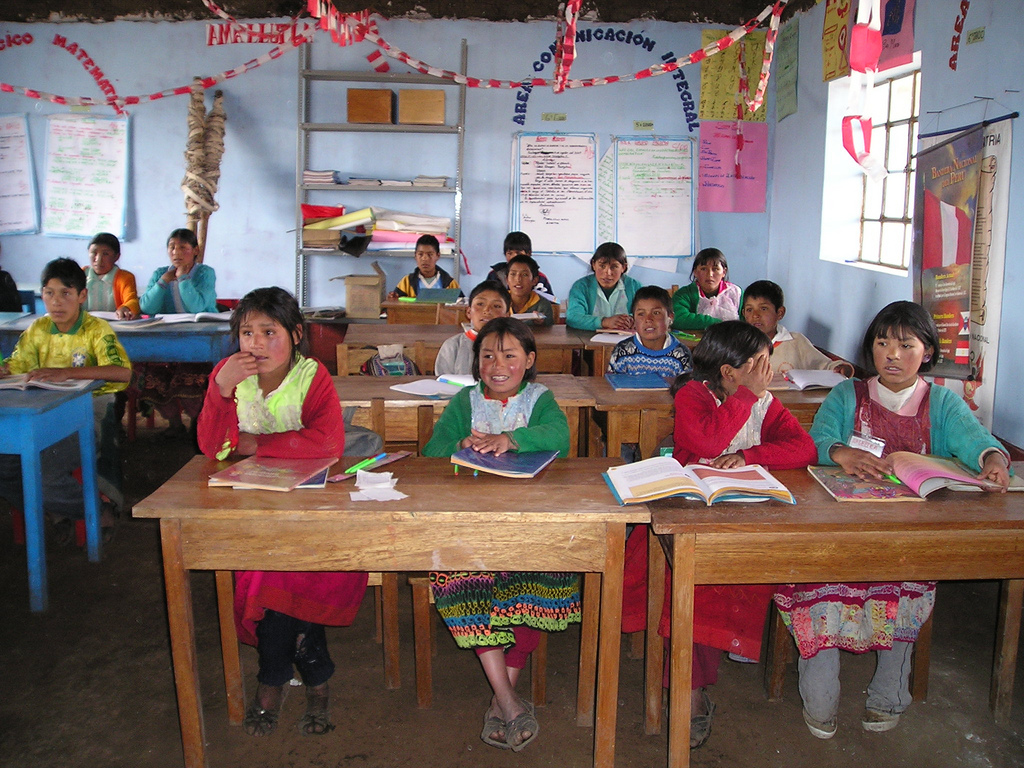
Fifth grade class in Chuchoquesera, Peru

When I visited the classroom pictured above in the Peruvian highlands back in 2004, I noticed that slightly more than half of the students were girls. I remarked on this fact to the human rights activist who was giving us the tour of this Quechua-speaking indigenous community.  He smiled sadly and said,

“Yes, but this is fifth grade.  In sixth grade, children go to a lower secondary school that is farther away.  Most of the girls won’t go.  It takes too long to walk there and they are needed to help at home, so the parents won’t let them go.  Besides, most of them will be married soon.”

Unfortunately, this is a situation of gross inequality for girls that is repeated in communities throughout the world.

In the United States, where education is both compulsory and free, we often forget that the right to education is not meaningfully available in many parts of the world – especially for girls.  The UN estimates that there were more than 67 million primary school-age and 73 million lower secondary school-age children out of school worldwide in 2009.  In addition, an estimated 793 million adults lack basic literacy skills. The majority of them are women.

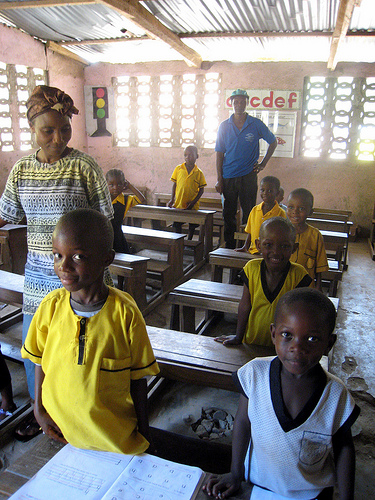
Since then, I have visited classrooms and asked questions about girls’ access to education in countries on several continents.  This is a photo I took at Buduburam Refugee Settlement in Ghana.

Kindergarten class, Buduburam Refugee Settlement, Ghana

Boys far outnumbered girls in this classroom, illustrating another of the problems for girls in accessing education.  When resources are scarce, parents will often choose to spend the money on school fees for their sons rather than their daughters.

There are many good reasons to ensure access to education for girls, however. Educating girls is one of the strongest ways to improve gender equality.  It is also one the best ways to promote economic growth and development.

“Investing in girls is smart,” says World Bank President, Robert Zoellick. “It is central to boosting development, breaking the cycle of intergenerational poverty, and allowing girls, and then women—50 percent of the world’s population—to lead better, fairer and more productive lives.”

Ensuring equal access to education for all girls by 2015 is part of the United Nations’ Millennium Development Goals, making this issue a major focus of work by the United Nations (for more info, check out the UN Girls’ Education Initiative site), the World Bank and many international non-governmental organizations.   October 11  has been designated as the International Day of the Girl Child to draw attention to the topic.
Nepal
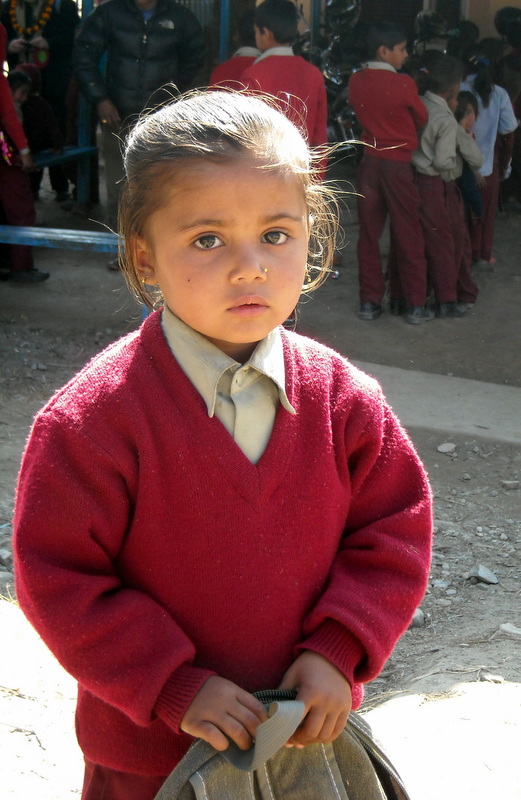
On a much smaller scale, the Sankhu-Palubari Community School in Nepal is doing its part to encourage gender parity in education and  increase literacy rates.  The school works in partnership with The Advocates for Human Rights (the non-profit where I work) to prevent child labor and improve the lives and well-being of the neediest children in this community in the Kathmandu Valley. I travel there regularly to monitor progress at the school.
 cropped-spcs-program1.jpg
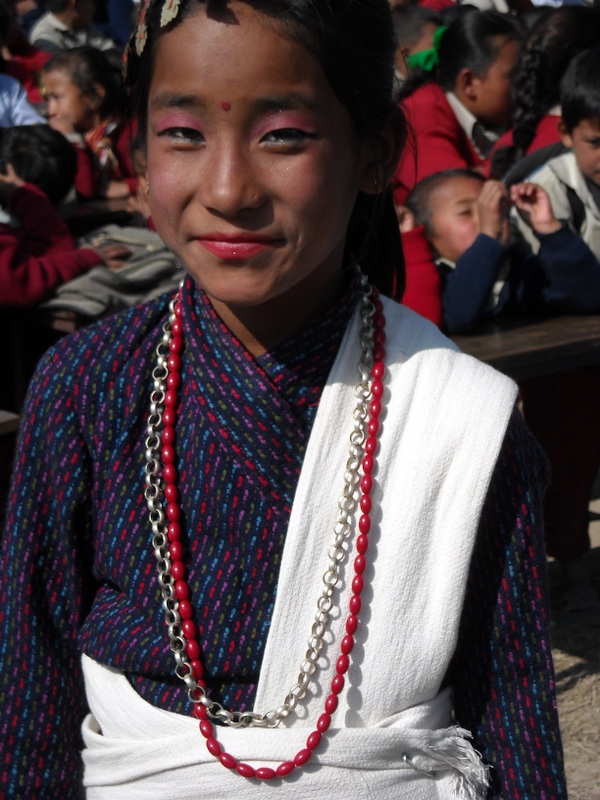
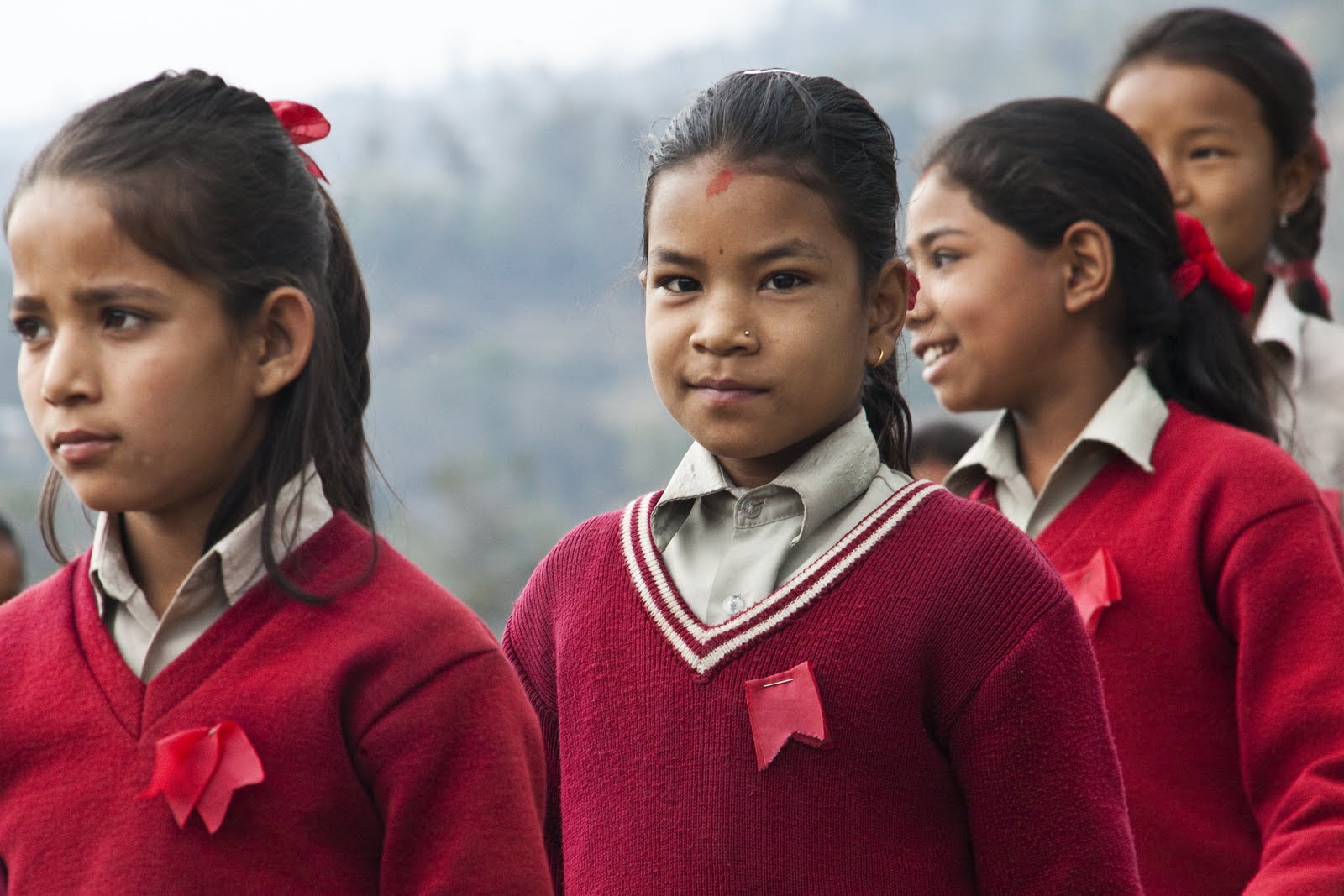
 For several years, the school has successfully met goals for gender parity among students in both the primary and lower secondary grades. For the 2011-2012 school year, 147 of the 283 students in pre-school through eighth grade are girls. Additionally, and perhaps more significantly, 15 of the 31 students in ninth and tenth grade are young women.
Pre-K student at Sankhu-Palubari Community School, Nepal

Most of the students’ families work in agriculture.  They are farmers with little or no money to spare on school fees, uniforms and supplies.   Many of them are from disadvantaged groups such as the Tamang and Newari.  Indigenous group with their own cultures and languages, the indigenous students must learn Nepali as well as English when they come to school.  Frequently, the adults in the family are illiterate.
 

 9th Grade students at SPCS

How has the teaching staff managed this success at keeping girls in school?  Since the school’s founding in 1999, the teachers have conducted outreach to parents and worked hard to encourage female students to attend and stay in school in spite of societal pressure to get married or enter domestic work. It took more than 10 years, but their efforts have paid off.  While girls worldwide generally are less likely to access, remain in, or achieve in school, 52% of the students in K-8th grades at the Sankhu-Palubari Community School this year are girls. And a girl is at the top of the class in most of the grades at SPCS.

The impact of the school both on the individual students and on the community over the past 12 years has been profound.  When I was there in March of 2011, we interviewed approximately 60% of the parents of SPCS students.  It was clear to me that parents value the education that their children are receiving and, seeing the value, have ensured that the younger siblings are also enrolled in school rather than put to work.  Twelve years ago, there were many students in the area out of school but now most are attending school. I could also see the physical benefits that the students derived from attending school when they stood next to their parents.  Even the 5th grade girls towered over their parents, illustrating the simple cause-and-effect of adequate nutrition, wellness checkups, and not having to work in the fields from a very young age.

The Sankhu-Palubari Community School may be a small school in a remote valley, but it is a place where the human right to education is alive and well, providing a better future for these children.  In particular, the effect that these girls have on their community, their country and – hopefully, the world – will be thrilling to watch.


This post was originally written for World Moms Blog.
Photo credit for photo to Dulce Foster

Honoring The Defenders

I wrote this post for Bloggers Unite.

On Human Rights Day 2011, we pay tribute to all human rights defenders.  What is a human rights defender?  The UN Declaration on Human Rights Defenders describes them as people who act to address any human right (or rights) issue, anywhere in the world, on behalf of individuals or groups.  Human rights defenders can be individuals acting in their professional capacity or volunteering their time to work with an association or group.  If you add it all up, there are thousands – maybe millions – of human rights defenders in the world.  Each of us that takes action to promote and protect human rights is a defender.

As a human rights defender working in the United States, I have the freedom to work without fear of reprisal. For many defenders around the world, however, this is not the case.  Because of they act for human rights, human rights defenders are often targeted for human rights violations, including executions, torture, beatings, arbitrary arrest, trial without due process, detention, death threats, harassment and discrimination.  They face restrictions on their freedom of movement, expression, association, and assembly. In addition to targeting human rights defenders themselves and the organizations through which they work, the human rights violations frequently target members of defenders’ families.   Women human rights defenders confront risks that are gender specific.

What happens to human rights defenders when the targeting gets to be too much? For more than seven years, I represented human rights defenders who were fleeing persecution and seeking asylum in the U.S.   Though I may not have seen them for years, I often think about my former clients.  On this Human Rights Day, I am thinking about James and Julia (not their real names). James and Julia were human rights defenders in their native Kenya, speaking out against an oppressive government.  They had a little boy who I’ll call William.  When the police came to their house to arrest Julia, a police dog had bitten William on the head.  You could still see the wound a year later when, having left everything they owned behind to escape Kenya, they were seeking legal assistance with their asylum claim in the U.S.

In police custody, Julia had been brutally and repeatedly raped.  Julia testified about her experiences in a straightforward manner and in excruciating detail, but with such poise and dignity that both the asylum officer and I were in tears.  It is one of the very  few times that have I seen an asylum officer (specially trained federal officials who make decisions about asylum cases based on a written application and an in-person interview) actually cry during an an asylum interview.  I remember well how James sat next to her, utterly still. Anguish is the only word that could possibly describe the look on his face as he listened to her testimony.

Years later, after they got their citizenship, James and Julia had a party to say thank you to all of the people who had helped them.  In addition to their attorneys, there were people from their church and other members of the Kenyan community. They now lived in a big, new house out in the suburbs. Julia was close to graduation from nursing school  William, who I hadn’t seen since he was three, was now in middle school.  He was a straight-A student and talented musician who had just gotten braces.  They had had another child, too – a daughter born here in America.

The ending is not always this happy for all human rights defenders.  That is why, this Human Rights Day, we all need to honor the work of human rights defenders and promote human rights both at home and in other countries.  One way to honor the work of the defenders is to be a defender yourself – take action.  The UN is asking you to Make a wish for human rights today!

To learn more about protecting human rights defenders:

http://www.ohchr.org/EN/Issues/SRHRDefenders/Pages/SRHRDefendersIndex.aspx

http://www.protectionline.org/-Home-.html

http://www.fidh.org/-Human-Rights-Defenders,180-

How To Live To 101

My Grandpa Olaf at 99

When people asked him his secret to living past 100, my Grandpa Olaf  had a standard response:  “Don’t die!”  But truth be told, he had more going for him than just his sense of humor and hardy Norwegian genes.  My grandpa actually DID have a secrets, rules he lived by that help explain his long and good life.

My Grandpa Olaf – who would have turned 104 this week – was born in 1907 and died in his sleep right before Christmas 2008.    My middle son cried even more than I did when we got the news.  I’m so thankful that my children knew him well, the man with the Winnie-the-Pooh voice. The man full of joie de vivre who taught me to ride a bike and twirled me on the dance floor at my wedding.  The loving man who made the doll bed that my daughter’s Americal Girls “sleep” in today.

The amazing thing is that, not only did my Grandpa Olaf live to be 101, but he was still going so strong.  When he was 99, my mom had to ask him to (please!) stop travelling .  He did –  internationally, at least – but he still got a huge kick out of showing people his ID with the 1907 birthdate.  He did not get much of a kick, however, out of the fact that after he turned 100,  the box marked “1907”  disappeared as a birthdate choice on most online forms.  That made him mad.

Some secrets are just not meant to be kept and I’m sure my Grandpa Olaf wouldn’t mind me sharing a few of his.  So here goes:

Two almonds a day keep cancer away.  From the time of my earliest memories, he had a big jar of raw almonds in the kitchen.  When I stayed with my grandparents, he made me eat them, too.  Turns out tat there is ongoing research on the phytochemicals in almonds which may have potential health benefits, including preventing cancer.  In any event, almonds are cholesterol-free, a good source of dietary fiber, and high in monounsaturated fat (which lowers LDL cholesterol).

Show up!!!  This was the guy who never missed a graduation – or any other important event in our lives, for that matter.  He even bore witness to my brief stage career, which ended after a single performance of Alice in Wonderland in 5th grade at Wildwood Elementary School in Baton Rouge, La. (Guess who played Alice? Guess who memorized everyone else’s lines and said them for them – sotto voce –  if they missed their cue? Afterwards, Grandpa Olaf said to me, “Well, Jen, you really gave it your all!”)  As I grow older, I realize more and more how important it is to show up for the important events.  My regrets definitely center more on things that I have not done and weddings I have missed than things that I have done.
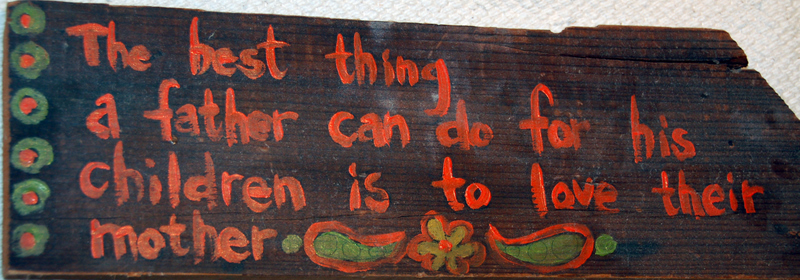
Appreciate your spouse.  Husband, wife, life partner, whatever. “The best thing a father can do for his children is to love their mother.” My grandpa made this sign for my dad, who later gave it to my husband.

Never stop learning.    He had a tough childhood in a poor,  immigrant family.  The kind where your Norwegian mama makes you take castor oil but you have to line your holey shoes with cardboard.  He had to drop out of school to work and never made it past about sixth grade.   But he valued education above all else, and sent his daughters to the best schools he could.  He was so proud of my mother, the first in her family to get a PhD.  As an adult, he chose to learn through experience.  Between the ages of 65 and 99 – and particularly after age 80 – he traveled the world.  (If you have a bucket list – Grandpa Olaf says to prioritize the Galapagos Islands.)

Make the effort to connect with people.  My grandpa was a pretty social guy, one who believed strongly in getting out there and talking with people. He also liked to help and volunteered his skills with a number of nonprofits, fixing things for seniors and building community theater sets.   He lived for the last decade or so of his life at the Holladay Park Plaza in Portland, Oregon; people there called him “The Mayor”.

Fight for what’s right.  A union member for nearly 70 years, my grandpa used to tell me stories about having to wear flannel pjs under his wafer-thin airplane mechanic uniform in the Minnesota sub-zero winter cold.  He was part of the fight for every benefit and workplace protection, from insulated uniforms and hearing protection to paid vacation to safety regulations.  He was really, really proud of that.

My daughter chatting with my Grandpa Olaf

Spend time with children.  I fondly remember my grandfather  reading the Brer Rabbit stories to me and my brother, but he also spun us wild yarns about a character of his own invention –  Redpants Cookie.  From what I remember of this young, maroon-chaps-wearing cowboy, he always returned safely home from his adventures to find a glass of milk and a plate of cookies.  (If I ever write a children’s book, this is it, so don’t go stealing my Redpants Cookie!)  What I didn’t realize until his memorial service was that, in addition to me, my brother, and our cousins, he had been Grandpa to his second wife’s grandchildren as well.

Talk about things, don’t bottle them up inside.  My grandfather was an airplane mechanic in the Pacific during World War II.  He saw a lot of stuff, but what really troubled him was taking the returning POWs  off the planes.  Like most of his generation, he didn’t talk about it for years.  In his 90s, however, he would recount in vivid detail the helpless and  emaciated bodies of these human rights victims. “I should have talked about this years ago,” he told me. ” I shouldn’t have kept it inside for so long.”

Don’t postpone joy.  After my grandmother died, he went on an Elderhostel trip to Russia; my step-grandmother was on the same trip.  When they returned, they decided to get married.  They had only known each other for about a month, but at their age (he was 80, she was 70) – they figured, why wait?  They were married for 21 years.

"Father of Waters" statue, complete with the toe to rub for good luck and the stairs my grandpa used to run up when delivering papers

Seek your luck.   As a boy in the late 1910s, he delivered papers in City Hall in Minneapolis.  His job required that he run, carrying a heavy bag of newspapers, up many flights of stairs to the offices.  There is a large marble sculpture, called “Father of Waters” after the nearby Mississippi River. According to legend, rubbing his big toe brings good luck.  My Grandpa Olaf paused every day on his paper route to rub the big toe of the “Father of Waters”.  Later in life, we visited the statue together.  This week, on the 104th anniversary of his birth, I went by myself to City Hall and I rubbed that marble toe.  I thought of my grandpa and all that he taught and me.  And all he continues to teach me.

Celebrating Grandpa Olaf's 100th birthday!

In Small Places, Close to Home

This is my first original post on World Moms Blog

Eleanor Roosevelt once said,

“Where, after all, do universal human rights begin? In small places, close to home – so close and so small that they cannot be seen on any maps of the world.”

She knew what she was talking about.  Eleanor Roosevelt was the chair of the UN Human Rights Commission and even wrote part of the text of the Universal Declaration of Human Rights (adopted by the UN General Assembly on December 10, 1948).  Eleanor Roosevelt was also the mother of six children.

Mothers have an important role to play in making the world a better place for all children.   This is not to minimize the roles of fathers or grandparents or guardians or anyone charged with the responsibility of raising children. But I do believe wholeheartedly that mothers have a special role.  It is our job to change the world, one kid at a time.

Often mothers are the most vocal advocates for the rights of their children.  This is true whether you are a mom trying to get your special needs child the services she deserves or trying to get your child out of arbitrary detention in Iran (like Shane Bauer’s mom).  There are many examples of mom/human rights advocates-  Mothers of the Disappeared in Argentina, Mothers of Soldiers in Russia .

I personally have had the chance to meet and interview mothers involved with the organization ANFASEP in Ayacucho, Peru.  These are mothers whose sons were disappeared during the long, violent conflict in Peru.   For nearly 30 years, these women have been trying to find out what happened to their family members and where their remains are.  One of the women we talked to had four family members who were disappeared.  She wants to know where they are and who killed them.  “We’re looking for justice,” she said, “and we want to know the truth.”  As Mama Angelica Mendoza, President of ANFASEP, told us, “We’ll never forget about all the killings.  We’ll fight to the end.”

Mothers of the disappeared (ANFASEP) in Peru.As Eleanor Roosevelt implied more than 50 years ago, the most important place for human rights to begin is at home.

Human rights are the standards that allow all people – each and every one of the 7 billion of us on this planet- to live with dignity, freedom, equality, justice and peace.

Aren’t these the principles that govern the way we want our children to be treated?  And, in a nutshell, aren’t these also the core values that every parent wants to instill in their children?

The secret to a better world is not only protecting our children from human rights abuses inflicted on them by others, but also by making them better citizens of the world.  Caring about others, judging right from wrong, standing up against bullying or racist comments or sexist jokes. These are the human rights that are essential to the full development of each child as an individual, as well as to the community in which they live. This is the human rights work that changes the world.

Here are my three reasons to work for human rights.  I’d love to see and hear about yours!

Constabulary Notes From Suburbia

True confession.  Whenever I’m feeling down, I cheer myself up by reading the police reports.  It’s true! They are right there in the newspaper every week, but I suspect most people don’t even notice.  Maybe they even avoid them because they just don’t want to read any more bad news.  That’s a shame, really, because the police blotter can be pretty comforting.   Reading it  just plain reminds you that people are silly, that the police help a lot of people, and that pretty much everything is going to be just fine.

I started reading the police blotter when I was 15 or 16 and growing up in the suburbs, right round the time I became a fan of News of the Weird.  It never even occurred to me that it was weird to turn straight to the police reports.   (I had one friend who read the obituaries and then crossed the names out of the phone book. That DID seem weird. In life, I guess, everything is relative.)  Let me tell you, the newspapers in Louisiana had some great stuff in the police reports.  Women seemed to be giving birth in cars ALL the time! And there was always some kind of dispute about stolen boudin or voodoo.  Sometimes both boudin AND voodoo.

I live up north now and within the city limits.  While I  still read the police reports in my local paper,  they basically just remind me to lock the car door if I park it on the street overnight.  So if I’m feeling down, I turn to the suburban police blotter.  Or blotters, I guess, since this is a metropolitan area on the wide open plains of the Midwest and there is a North, a South, an East and a West Metro.

Here are a few recent items from the Minneapolis Star Tribune:

PRIOR LAKE (OCT. 8) Littering. A Prior Lake police officer observed a refrigerator, old tires and concrete blocks dumped along the road near Howard Lake Rd. NW. and NW. 154th Street. The city maintenance crew was advised of the debris.

CORCORAN (SEPT. 29) Suspicious person. Someone reported that a suspicious man with a clipboard was going door-to-door and walking around the neighborhood on the 8600 block of Trail Haven Road. Officers located the man and found he was a city assessor inspecting properties.

See, now aren’t you starting to feel a little better already?  Sure, there are downers in the police reports – DWIs or sisters throwing peanut butter jars and hurting each other. But mostly it’s like Andy Griffith moved on up to Lake Wobegon.

 COCORAN (OCT. 4) Property damage. Officers responded to a home on the 7800 block of Maple Hill Road regarding property damage. Someone had keyed the residents’ vehicle and had written on it with marker. Officers discovered that two children, ages 2 and 3, had marked up the vehicle.

There you have it – proof of the principle of Occam’s Razor!  Now for more from Midwestern suburbia:

MINNETRISTA (OCT. 1) Suspicious activity. Officers confiscated 30 rolls of toilet paper after encountering suspicious vehicles along Eastview Avenue.

High School TPers Foiled Again!  Football season must be Level Orange Alert.  Let’s forge onward:

HOPKINS (SEPT. 26) Theft. A cat carrier was reported missing from a home on the 9100 block of 7th Street S.

MINNETRISTA (SEPT. 25) Theft. Gargoyles valued at $300 were stolen from the yard of a home on Kennedy Memorial Drive.

COON RAPIDS (SEPT. 16) Theft. A coin purse containing lipstick and a nail clipper were stolen from an unlocked car parked in a lot on the 3100 block of 111th Avenue NW

More than anything, the thefts in the police report remind me that we are fortunate enough to live in a country with a functioning justice system.   No matter how small the theft, people feel that they can and should report it to the police.  Then the police report officially record that the thing (whether it is a cat carrier or a nail clipper or a gargoyle) was stolen.  And then someone at the newspaper writes about it and prints it.  Total transparency, zero corruption.  This is the standard that the police in many countries in the world need to achieve.

Every once in a while, there is even a little something to remind me of my youth:

 FRIDLEY (SEPT. 10)  Assisting the public. A woman from the 6000 block of 2nd Street NE. complained to officers that her neighbors were doing voodoo on her. Police discussed the woman’s options with her.

I’m a human rights lawyer, so I see the worst aspects of humans in my work.  But I also see the best very aspects of humanity and that has taught me to look for the joy in life, no matter how mundane   That’s why I read the police reports these days.

I’ve always imagined that these police blotter descriptions are the work of an intern with a highly developed sense of satire, who is, in her spare time, writing the next Great American Novel.   Sometimes I worry that the decline of print media will mean that this public service will get the ax and deprive me of the solace that I take in these random acts of strangers.   Or, then again, maybe not.  Maybe someone will just develop an app for that. (Please?)

Rise Up Singing!

Pete Seeger died yesterday at the age of 94.  I can’t remember a time before I knew his voice; his songs are part of the soundtrack of my childhood.  I began listening to Pete Seeger’s music again more recently, when my own children were young.  Together, we sang his songs “Goodnight, Irene” and “We Shall Overcome” and  “If I Had a Hammer.  Yet, in spite of the fact that Pete Seeger gave thousands of performances during my lifetime, I only saw him in person once.   He was not on a stage.   Pete Seeger was standing alone in the rain on the side of the highway near his home in New York’s Hudson Valley.  He was holding not a banjo or guitar, but a sign protesting the Iraq War.   As we drove by, I noticed that his mouth was open and moving.  “Hey, I think that’s Pete Seeger!”  I said, turning in my seat to continue watching him.

And I realized that his mouth was moving because – alone in the rain, on the side of a highway- Pete Seeger was singing his heart out for peace.

I’m thankful to Pete Seeger for his music and his activism – and for being someone who who really does make me believe, deep in my heart, that “We Shall Overcome” one day.

Rise Up Singing!

(Originally published on October 14, 2011 and updated on January 28, 2014)

History shows the incredible power of music to inspire and influence, to energize and heal.  The power of song can be seen in its impact on movement-building,  from the anti-slavery and  labor union movements in the 1800s to the civil rights and anti-war movements in the 1960s.  Liberation music has been important throughout the world, including songs of resistance during the anti-Apartheid struggle in South Africa.  Most recently, music has been part of this year’s Arab Spring.  In protests against Hosni Mubarak in Egypt, for example, music was a powerful way to convey the voice of the people.  (NPR story did a great story on The Songs of The Egyptian Protest)

I absolutely love Rise Up Singing, the folk music group singing songbook.  The book contains the chords and lyrics to more than the 1200 songs.  When you flip through it, you get a sense of how many songs there are out there that speak to such a wide variety of social justice issues.  Rise Up Singing grew out of Peoples Songs, Inc., Sing Out! The Folk Song Magazine and the post-World War II American folk song movement led by Pete Seeger and Woody Guthrie, and many others who sought to combine political activism with music.

But music that inspires me to stand up for human rights is not just about protest songs or folk music.  Music speaks to the individual. Inspiration is personal.   In 2006, I was in Geneva with representatives from dozens of U.S. human rights groups to participate in the UN’s review of  US compliance with the International Covenant on Civil and Political Rights.  We were all working on different issues and we came from all over the country, from Florida to Hawaii.

As an icebreaker at our first meeting, we were asked, “What is your favorite human rights song?”  I remember being amazed as we went around the room at the tremendous variety in terms of songs, genres, languages, meanings that had inspired this group of activists.   I told the group that my song was “If I Had a Hammer”.  (My kids were still quite young at the time and we were listening to a lot of Pete Seeger, who is my own personal antidote to Barney.)

Since then, I’ve been making a mental playlist of the songs that have inspired me over the years.   My list of songs is actually long enough for several playlists, but I decided to pull out just a few songs from each of the eras of my life so far.  This was a real challenge and there are a lot of obvious omissions.  Maybe I’ll just have to do another playlist someday.

In the meantime, I’ve got the HUMAN RIGHTS WARRIOR PLAYLIST for you on YouTube.  You can also link to each song individually below.   Enjoy!

From My Childhood

  1. If I Had a HammerPete Seeger      (See above. Pete >Barney.)
  2. Free to Be You and Me   – Marlo Thomas & Friends     In my opinion, one of the best things about being a kid in the 70s.
  3. The PreambleSchoolhouse Rock      Did you know that the U.S. Constitution is one of the first documents to establish universal principles of human rights?
  4. Star Wars Main Title/Rebel Blockade Runner – John Williams   People say Star Wars was a Western set in space, but I saw the Empire for the police state that it was. Extrajudicial execution of Luke’s family,  arbitrary detention of Han Solo et al. Not to mention the genocide on Alderaan.
  5. FreedomRichie Havens         My parents had the Woodstock album.  I think I know this and every other song on it by heart.
From My Youth 
  1.  Sunday Bloody SundayU2       I first heard this on my high school radio station WBRH. I went right to the library and looked up the 1972 Bloody Sunday Massacre in Northern Ireland. (Yes, I’m a nerd. I know.)
  2. Holiday in CambodiaDead Kennedys      I went through a big DK phase in high school.  Also, I knew a family that had fled the Pol Pot regime.  I still think of them when I hear this song.
  3. Talkin’ Bout a Revolution Tracy Chapman    Growing up in Louisiana, I had seen poverty.   But it didn’t prepare me for the mid-80s urban poverty I saw when I went to college in New Haven.  This song still rings true 25 years later.
  4. Tell Me Why  – Bronski Beat      I remember this as the first song I heard that directly addressed prejudice against LGBT persons. Rock on!
  5. Waiting for the Great Leap ForwardBilly Bragg     The lyrics have changed since I first bought Worker’s Playtime (on cassette!) in college, but I think it is possible that I have listened it to 1,000,000 times.
From My Adulthood
  1. All You Facists (Are Going to Lose) – Lyrics by Woody Guthrie, Music by Billy Bragg & Wilco     From the Mermaid Avenue album.  Yes, the Facists are bound to lose some day.
  2. HurricaneBob Dylan       Rubin “Hurricane” Carter did an event for us to help raise money for our Death Penalty project.   If anyone ever wants to make a movie about your life, he highly recommends that you ask that they get Denzel Washington to play you.
  3. Living Like a Refugee –  Sierra Leone’s Refugee All Star Band                     I spent the first 5 years of my career working with asylum seekers.   This song captures many of the things I heard about their experiences.
  4. Face Down  – Red Jumpsuit Apparatus     Violence against women is the most common human rights violation in the world – 1 in 3 women will experience abuse in her lifetime.   In the US, a woman is beaten or assaulted every 9 seconds.  Kudos to these guys for singing about it.
  5. MinorityGreen Day      Sometimes I have to remind myself that not everyone thinks the way I do about human rights – yet.
  6. Sons & DaughtersThe Decemberists        This is kind of where I am right now.  With sons and daughter.  Hoping to “Hear all the bombs fade away.”