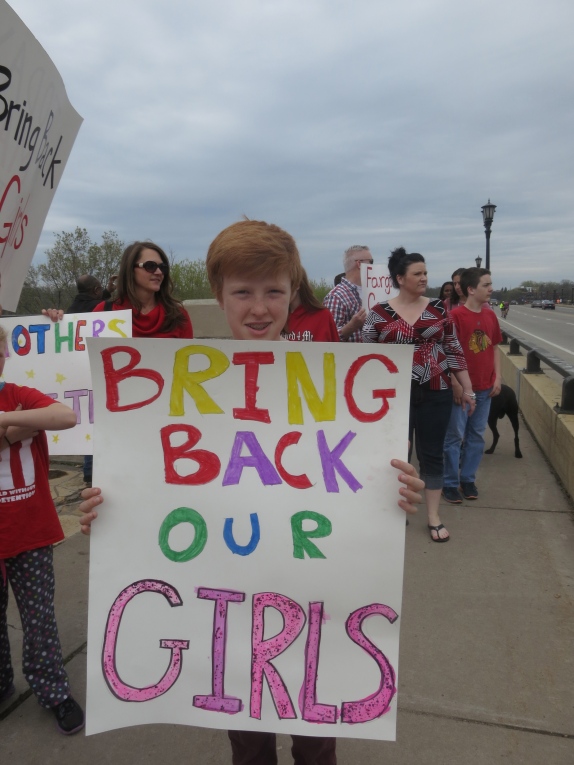
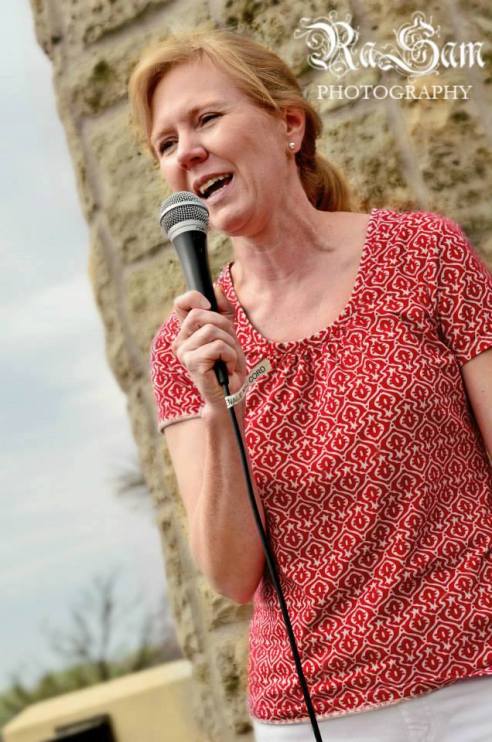
On Mother’s Day, I spoke at a local march and rally to show support for the nearly 300 school girls abducted a month ago in Nigeria.
Here’s what I said:
Bring Back Our Girls Twin Cities March
May 11, 2014
Thanks to organizers and to all of you for being here.
I’m here as a lawyer and Deputy Director of The Advocates for Human Rights, a non-profit based in Minneapolis that works on human rights issues around the world.
But I’m also here as a mother. My kids Simon and Eliza are here today as well to stand in honor of the nearly 300 girls abducted simply because they were pursuing their human right to education. I think that’s pretty much the best Mother’s Day gift they could give me.
There are a lot of things that we don’t know about the situation in Nigeria. We don’t know where the girls are or what is happening to them. We don’t even know the exact number abducted and we only know a few of their names. We can only imagine the agony their families are going through.
But the tragedy of the nearly 300 girls in Chibok shines a spotlight on the systemic human rights abuses against faced by women and girls worldwide.
And there are many things we do know about violations of the rights of girls and women:
We know that girls around the world lack equal access to basic education (in the NE region of Nigeria where these girls lived, girl enrollment is the lowest in the country – only 22%. In part, they were targeted because they were seeking an education that would change their lives.
We know that girls and women are not valued equally as boys and men in many parts of the world. The Nigerian government’s lack of action both before and after certainly makes it seem that these girls were not deemed worthy of protection.
We know that when these girls are found and hopefully rescued, they will need support in the form of psychosocial and health care. Women’s access to health care is woefully limited.
We know that 1 in 3 girls under age 18 are still being forced into marriage too early. By some estimates, that’s about 14 million girls a year. Too many girls still endure harmful traditional cultural practices such as FGM.
We know that girls and women suffer the most in times of conflict. What these girls have experienced is likely a war crime. Trafficking remains a huge problem around the world and in our own community.
We know that 1 in 3 of the world’s women experience violence, including domestic violence (The Advocates for Human Rights works on domestic violence legal reform around the world);
And we know that these are all things that have to change.
We need to do more to push our governments to make this change a priority. We can’t stop with just these 276 girls.
Now these are human rights abuses that may seem intractable. It may seem like you are powerless to make a difference. But you can:
Support the NGOs that work on issues you care about. No amount is too small – a little money really does go a long way in this area.
Write to our members of Congress and the President to encourage support for women’s rights as a critical part of our US foreign policy.
For those of you with young people in your lives, teach them about the world around them so that they will grow up to continue the fight to ensure that every child, wherever he or she lives in the world, has the chance to live in safety and dignity and to achieve their greatest human potential.
For those of you doubting whether sharing this story on social media really makes a difference, I’d like to share a message I got on my blog from a woman named Winnie in Nigeria:
we here in nigeria are so angry and feel very helpless, the government and opposition leaders have politicized this, while our daughters are still in captivity. the government officials do not want to listen to ‘ordinary’ people. and word has it that the Nigerian press have been ordered to kill the story (as the have killed other stories in the past). pls this is a passionate plea to the international community to keep this story alive until our girls are returned home safely.
Here in the Twin Cities and all around the world, we are working to keep this story alive until our girls are returned home safely.
And after our girls come home, I hope we can keep working together for a future where all girls around the world can go to school in safety and grow up to reach their full human potential.
Image used with permission of RaSam Photography. Thank you!
While unconfirmed, these reports are a chilling reminder of the threat of sexual violence faced by women and girls in conflict zones.
The girls who were abducted were targeted simply because they were exercising their right to go to school, out of the ordinary for a girl in Nigeria. Access to basic education for girls has remained low, particularly in the northern region which has the lowest girl child enrollment in Nigeria —in 2008 the net enrollment rate for girls into secondary school was only 22 percent. The girls (who were both Christian and Muslim) at the Government Girls Secondary School in Chibok must each have been determined to get an education in spite of tremendous odds. The fact that these girls were also risking violence to be in school illustrates how important the right to education was to each of them.
Boko Haram also has a history of taking hostages as “slaves.” In May 2013, Boko Haram leader Abubakar Sheku released a video saying that Boko Haram had taken women and children, including teenage girls, as hostages as part of its latest campaign. These hostages would be treated as “slaves,” he said. This has raised concern among the family members of those abducted that “Boko Haram is adhering to the ancient Islamic belief that women captured during war are slaves with whom their ‘masters’ can have sex. Regardless of alleged rationale, enslavement, imprisonment, forced labor, rape and sexual slavery are all serious violations of international law. They are defined by the Rome Statute of the International Criminal Court as crimes against humanity.
The mass kidnapping in April was unprecedented and shocking. Even more shocking – after more than two weeks, the Nigerian government has done very little to find and rescue the girls.
The lack of government response has provoked outrage in Nigeria. On Wednesday, several hundred participated in a “million-woman protest march” in Abuja, Nigeria’s capital to demand that more resources be put toward finding and securing the kidnapped girls. The protesters in Nigeria are joined on Twitter with a growing movement under the hashtags #BringBackOurGirls, #BringBackOurDaughters and #234Girls. There is also a Change.org petition to Nigeria’s President Goodluck Jonathan asking him to do more to save the abducted girls and ensure that schools in Nigeria are safe.
One man, whose daughter was abducted along with his two nieces, said his wife has hardly slept since the attack. She lies awake at night “thinking about our daughter”. As the mother of a young school girl myself, I feel deeply for her. The continuing tragedy of these young Nigerian school girls is every parent’s worst nightmare.
It’s time for world to wake up to the escalating violence in Nigeria, as well as the Nigerian government’s lack of response.
Liberian brothers at the Buduburam Refugee Settlement in Ghana.
A Few Reflections On How We Define “Family”
We had just dropped off my old friend Erik and his unwieldy crew at the airport, when my daughter Eliza let out a dramatic sigh from the back of the minivan.
“It’s pretty much BORING without our cousins!”
Curious, I launched into a lengthy cross-examination to determine why she thought they were our blood relations. She went along with the questioning for a while, mumbling one syllable responses out of the corner of her mouth as she gazed morosely out the window at a long, undulating line of sunflowers. Some kind person, in the interest of beauty, had planted them along the highway. Now they were more than six feet tall, so large that you could almost see the Fibonacci sequences in their bright spirals. Even from a minivan with a six-year-old pouting in her booster seat in the back.
After several miles of this, Eliza suddenly sucked in air until her cheeks were full. She then blew it all out, frustration personified. I watched her in the rearview mirror as she put everything in her small, defiant being into these words:
“Because! I just FEEL like they are.”
How do you define family? Is it common ancestry? Shared experiences? Mutual commitment? Living in the same household? Common values? The people you know you can count on for support? The people you know you can get into a knock-down-drag-out fight with but they’ll still love you? People who you feel deeply connected to even though you rarely see them? All of the above? Or none of them at all?
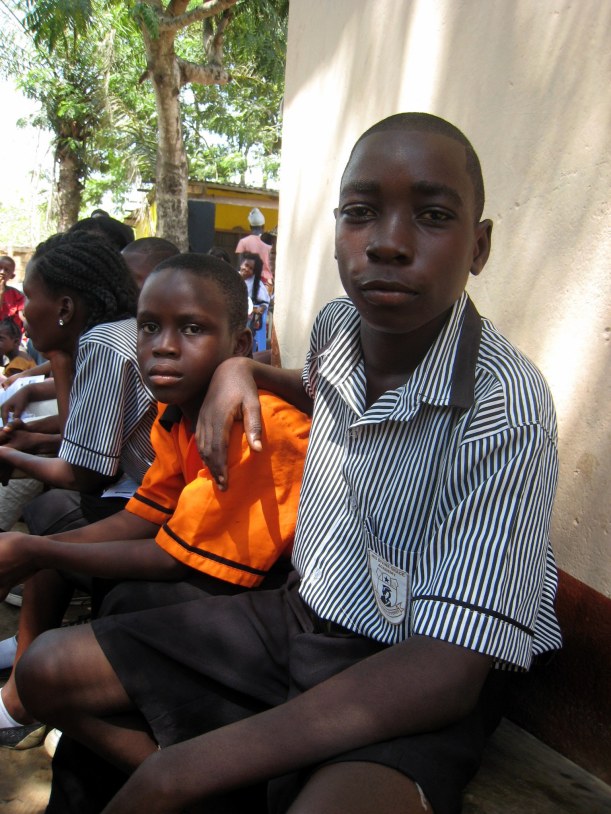
The boys in the photo above are brothers I met at the Buduburam Refugee Settlement in Ghana. Their mother Kebbeh considers them her sons, although only the oldest is her biological son. The younger boy and his little brother (not pictured) are her neighbor’s sons. The neighbor had gone back to Liberia with the first wave of resettled refugees, with the promise to send for the boys after she got settled. They never heard from her again. Post-conflict Liberia was dangerous, so they fear the worst. But they really don’t know what happened to her. So Kebbeh is raising the boys as her own, feeding and caring for them, sending them to school. They are family.
When I was in Buduburam, I met a woman called Ma Fatu who ran a cook shop on the main thoroughfare of the camp where many of the refugee-owned businesses were. The street had no name, of course, but the Liberian refugees called it “Wall Street” because so many financial transactions were made there. Ma Fatu has a feisty personality. I think she would have been equally at home as the proprietor of a saloon in the Wild West or a grogshop in Regency England. She took a lot of pride in her cooking and in knowing her customers. She’d eye me critically as I tucked into my jollof rice and say, “I know what you white people like to eat.” Then, the next day, she would dish me up a heaping serving of jollof vermicelli.
I had noticed that there were several young people helping in the cook shop, washing dishes, waiting tables, whatever needed to be done. It was only on my second trip to Buduburam that someone told me that they were not actually her children. During the war in Liberia, her husband and her biological children – her entire family – had been killed. Over the years at Budububuram, she had taken in several young people who had also lost everyone. In the face of all this loss, Ma Fatu had created a new family. In a refugee camp – miles from home and without even the possibility of legal recognition – she had forged familial bonds of love and support.
Like every parent, I’ve got a stockpile of my kids’ drawings of our family – stick figures showing Mom and Dad, Brother and Sister. Sometimes Grandma and Grandpa and/or Cat and Hamster.
When you are young, the definition of family is very narrow and also very immediate. But as you get older, you develop deeper relationships with people who are not related by blood. In many ways, you create your own family of the people who give you what you need to flourish. Like the heliotropic sunflowers, you turn to the light, needing full sun to thrive. If you don’t, you wither away.
I’ve had this discussion about the definition of family with a number of my former asylum clients. Under U.S. immigration law, your family is defined as your spouse (only one – your first spouse), your children by birth or legal adoption, and your parents. Of course, many people in the world use a broader definition, with half-siblings, cousins, and children adopted without legal recognition counting as immediate family members.
One of my asylum clients once said to me,
“I feel so sorry for you Americans. Your families are so very small!”
I had never really thought about it that way before. But I could see her point.
Article 16(3) of the Universal Declaration of Human Rights states that,
“The family is the natural and fundamental unit of society and is entitled to protection by society and the State.”
Back when the UDHR was adopted in 1948, it is doubtful that the drafters envisioned even biracial marriage, much less same-sex marriage and the multiple forms of family that exist today.
But the bigger point, I think, is that no matter how you define “marriage”, the push for the changes in the legal definition has happened because of thousands – maybe millions – of personal decisions by individuals to define their closest relationships as “family”. The reality is that there is a very human need to live in a family social structure – the natural and fundamental group unit of society. The law can better accommodate that reality but regardless of what the law says, people – like Kebbeh and Ma Fatu – will create their own families.
Maybe my young daughter is right. The true definition of family is a very personal one, self-defined by each of us. The definition of family maybe really IS the people who you feel like are your family.
So I think the real questions for each of us then become:
How do you define your family?
What does your family mean to you? and
Wouldn’t we all be better off if society and the State protected and supported all of our families?
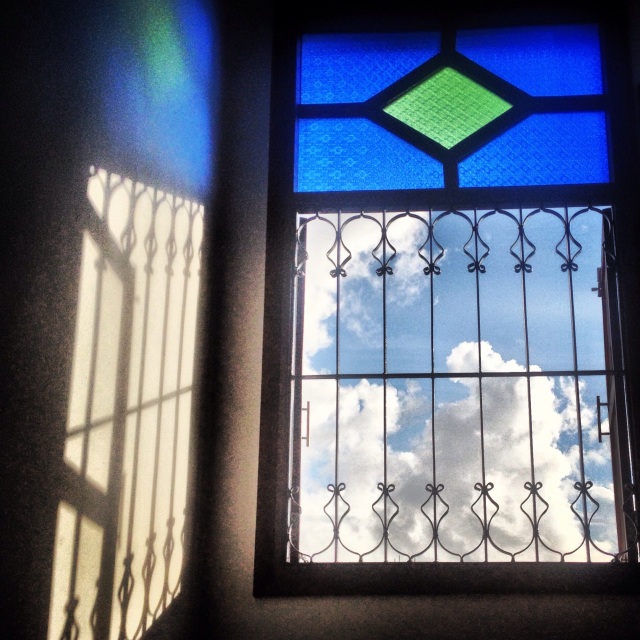
The last in my Window on the World response to the Weekly Photo Challenge. The bright morning sun through this window caught my eye when I was in Stone Town last March.
As part of their Community Health initiative, a Cameroonian non-governmental organization developed this map of the city of Douala. Douala, a major Central African port and the commercial capital of Cameroon, is in the departement of Wouri.
The map shows the locations of potential transmission sites for HIV/AIDS, STDs and TB.
It was created based on information gathered through field work in the community. Staff members use it to target their outreach and community health intervention strategies to effectively reach the most at-risk populations.
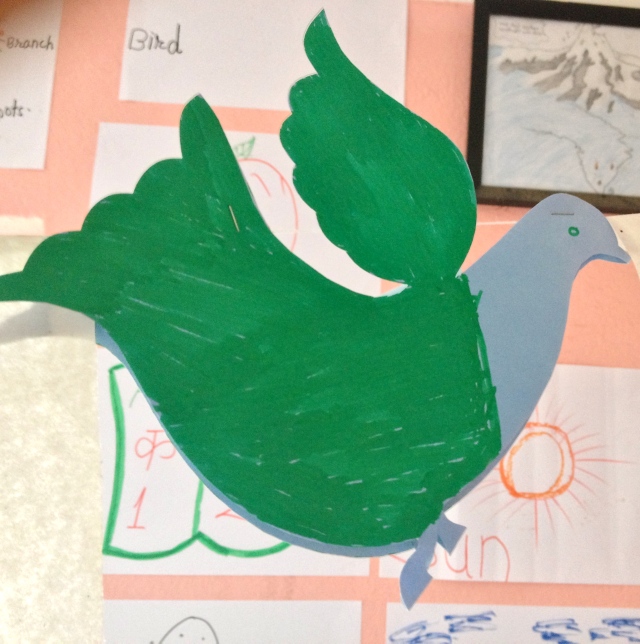
1. Make a World Wishes Dove with your family. Cut feathers from white paper or colored construction paper. Have everyone in the family decorate and write their wish for the world on a feather. Cut out the body of a dove or other bird and glue all the feathers on it. Once decorated, your bird will be a beautiful and hopeful expression of your family’s hopes for our world.
2. Play a game that helps kids understand human rights. Blind Trust (from ABC – Teaching Human Rights): In pairs, have one child blindfold the other and have the sighted member of the pair lead the “blind” one about for a few minutes. Make sure the leading child is not abusing the power to lead, since the idea is to nurture trust, not to destroy it. The “leader” of the pair should try to provide as wide a variety of experiences as possible, such as hav- ing the “blind” partner feel things with his or her feet or fingers, leading with vocal directions or even playing a game. After a few minutes have the children reverse the roles and repeat the process so that the “leader” is now the led, and the “blind” partner is now the sighted one.
Once the activity is over, allow the children to talk about what happened. Discuss how they felt – not just as “blind” partners but their feelings of responsibility as “leaders” too. This can lead not only to a greater awareness of what life is like for people with sight (or hearing) disabilities, but to a discussion of the importance of trust in the whole community. This can lead in turn to a discussion of world society, how it works and how it can fail to work too. (teaches about Universal Declaration of Human Rights article 28; Convention on the Rights of the Child articles 3, 23)
3. Learn about how children live in other countries. For example, you can learn what kinds of food children in East Africa grow and eat from the Lessons from Africa resource created by the British non-governmental organization Send A Cow (also check out their website http://www.cowforce.com). You can download the powerpoint about typical East African food. You can also print out some of the recipes for things like chapatis and pepper soup to make and try for yourself.
5. Play Human Rights Twister to teach about cooperation, respect and inclusion. Make a “Twister” game in which kids spell out key human rights words using their feet and hands. Draw a grid with 6 columns and 5 rows with marker on a large piece of cloth (like an old sheet) or plastic (like a plastic tablecloth). You can also use chalk to draw it on the ground. Write the following letters in the grid:
(blank) W X Y Z(blank)
Q R S T U V
K L M N O P
E F G H I J
(blank space)A B C D(blank)
Ask the children to name some rights and list them on a large piece of paper or whiteboard. Underline a key word in each right from this list of rights in one word:
Dignity Education Equality Food Freedom Home Love (from parents) Name
Nationality Opinion Participation (in decisions that affect us) Play Protection Religion
When you have listed at least 3 or 4 rights, have the children spell out the key word in the human right from the list by placing their hands and feet on the appropriate letters of the “Twister” game. When 1 child’s hands and feet are in place and the word is not yet completed, ask another child to join in to complete the word. If the hand or foot of another child already covers a letter, the player just has to touch the child that is on that letter. When a letter is too far to reach, invite another child to join in. (This activity and dozens of others to teach about human rights values and peaceful conflict resolution are available for free download in the Canadian organization Equitas‘ Play It Fair Toolkit. )
You can also make and play the Sudanese game “Dala” (the Cow Herder Game). In many parts of the world, games mimic everyday life; this game mimics the Sudanese practice of bull herding. Sudanese people play it on the ground, using sticks to make the lines and pebbles or seeds as “bulls”.
7. Ask the question “What Does a Child Need?”Have your child lie down on a large piece of paper and trace their outline on the paper.Ask your child(ren) to name this paper child. Discuss and decide on the mental, physical, spiritual and character qualities they want this ideal child to have as an adult (e.g. good health, sense of humour, kindness) and write these qualities inside the outline. They might also make symbols on or around the child to represent these ideal qualities (e.g. books to represent education). Talk about what human and material resources the child will need to achieve these qualities (e.g. if the child is to be healthy, it will need food and health care); write them down on the paper outside of the outline. You can also read a simplified version of the Convention on the Rights of the Child (available in English, French, Spanish, Russian, German, etc.) When children hear an article that guarantees a child each of the needs they have listed, they can write the number of the articles next to that item. Circle any needs identified but not covered by the Convention.
9. Get creative and enter your work in a contest with a human rights theme. Local, regional or international contests are powerful activities for getting youth involved and learning about human rights. Take action by entering some of the contests listed here on the Youth For Human Rights website. (You can also learn more on the website about their educational programs, projects, awareness campaigns and human rights outreach campaigns.)
10. Make a Human Rights Day card. You can give the card to a friend or member of your family. Or you can make multiple cards to decorate your house. My eight year old daughter (that’s her self-portrait in the background) made this card for all the children of the world.
ADDITIONAL RESOURCES: You’re on your way to a great Human Rights Day! If you are a classroom teacher or homeschooling your kids (or if you just want to dig deeper), you can find tons more ideas through the following resources:
ABC – Teaching Human Rights – practical activities in English, French, Russian, Arabic, Chinese, and Spanish from the UN Office of the High Commissioner for Human Rights







 The Human Rights Warrior
You must be logged in to post a comment.