In Small Places, Close to Home

This is my first original post on World Moms Blog

Eleanor Roosevelt once said,

“Where, after all, do universal human rights begin? In small places, close to home – so close and so small that they cannot be seen on any maps of the world.”

She knew what she was talking about.  Eleanor Roosevelt was the chair of the UN Human Rights Commission and even wrote part of the text of the Universal Declaration of Human Rights (adopted by the UN General Assembly on December 10, 1948).  Eleanor Roosevelt was also the mother of six children.

Mothers have an important role to play in making the world a better place for all children.   This is not to minimize the roles of fathers or grandparents or guardians or anyone charged with the responsibility of raising children. But I do believe wholeheartedly that mothers have a special role.  It is our job to change the world, one kid at a time.

Often mothers are the most vocal advocates for the rights of their children.  This is true whether you are a mom trying to get your special needs child the services she deserves or trying to get your child out of arbitrary detention in Iran (like Shane Bauer’s mom).  There are many examples of mom/human rights advocates-  Mothers of the Disappeared in Argentina, Mothers of Soldiers in Russia .

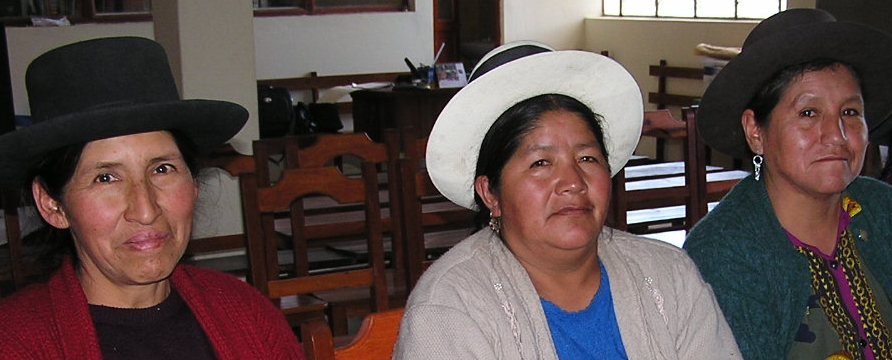
I personally have had the chance to meet and interview mothers involved with the organization ANFASEP in Ayacucho, Peru.  These are mothers whose sons were disappeared during the long, violent conflict in Peru.   For nearly 30 years, these women have been trying to find out what happened to their family members and where their remains are.  One of the women we talked to had four family members who were disappeared.  She wants to know where they are and who killed them.  “We’re looking for justice,” she said, “and we want to know the truth.”  As Mama Angelica Mendoza, President of ANFASEP, told us, “We’ll never forget about all the killings.  We’ll fight to the end.”

Mothers of the disappeared (ANFASEP) in Peru.As Eleanor Roosevelt implied more than 50 years ago, the most important place for human rights to begin is at home.

Human rights are the standards that allow all people – each and every one of the 7 billion of us on this planet- to live with dignity, freedom, equality, justice and peace.

Aren’t these the principles that govern the way we want our children to be treated?  And, in a nutshell, aren’t these also the core values that every parent wants to instill in their children?

The secret to a better world is not only protecting our children from human rights abuses inflicted on them by others, but also by making them better citizens of the world.  Caring about others, judging right from wrong, standing up against bullying or racist comments or sexist jokes. These are the human rights that are essential to the full development of each child as an individual, as well as to the community in which they live. This is the human rights work that changes the world.

Here are my three reasons to work for human rights.  I’d love to see and hear about yours!

Constabulary Notes From Suburbia

True confession.  Whenever I’m feeling down, I cheer myself up by reading the police reports.  It’s true! They are right there in the newspaper every week, but I suspect most people don’t even notice.  Maybe they even avoid them because they just don’t want to read any more bad news.  That’s a shame, really, because the police blotter can be pretty comforting.   Reading it  just plain reminds you that people are silly, that the police help a lot of people, and that pretty much everything is going to be just fine.

I started reading the police blotter when I was 15 or 16 and growing up in the suburbs, right round the time I became a fan of News of the Weird.  It never even occurred to me that it was weird to turn straight to the police reports.   (I had one friend who read the obituaries and then crossed the names out of the phone book. That DID seem weird. In life, I guess, everything is relative.)  Let me tell you, the newspapers in Louisiana had some great stuff in the police reports.  Women seemed to be giving birth in cars ALL the time! And there was always some kind of dispute about stolen boudin or voodoo.  Sometimes both boudin AND voodoo.

I live up north now and within the city limits.  While I  still read the police reports in my local paper,  they basically just remind me to lock the car door if I park it on the street overnight.  So if I’m feeling down, I turn to the suburban police blotter.  Or blotters, I guess, since this is a metropolitan area on the wide open plains of the Midwest and there is a North, a South, an East and a West Metro.

Here are a few recent items from the Minneapolis Star Tribune:

PRIOR LAKE (OCT. 8) Littering. A Prior Lake police officer observed a refrigerator, old tires and concrete blocks dumped along the road near Howard Lake Rd. NW. and NW. 154th Street. The city maintenance crew was advised of the debris.

CORCORAN (SEPT. 29) Suspicious person. Someone reported that a suspicious man with a clipboard was going door-to-door and walking around the neighborhood on the 8600 block of Trail Haven Road. Officers located the man and found he was a city assessor inspecting properties.

See, now aren’t you starting to feel a little better already?  Sure, there are downers in the police reports – DWIs or sisters throwing peanut butter jars and hurting each other. But mostly it’s like Andy Griffith moved on up to Lake Wobegon.

 COCORAN (OCT. 4) Property damage. Officers responded to a home on the 7800 block of Maple Hill Road regarding property damage. Someone had keyed the residents’ vehicle and had written on it with marker. Officers discovered that two children, ages 2 and 3, had marked up the vehicle.

There you have it – proof of the principle of Occam’s Razor!  Now for more from Midwestern suburbia:

MINNETRISTA (OCT. 1) Suspicious activity. Officers confiscated 30 rolls of toilet paper after encountering suspicious vehicles along Eastview Avenue.

High School TPers Foiled Again!  Football season must be Level Orange Alert.  Let’s forge onward:

HOPKINS (SEPT. 26) Theft. A cat carrier was reported missing from a home on the 9100 block of 7th Street S.

MINNETRISTA (SEPT. 25) Theft. Gargoyles valued at $300 were stolen from the yard of a home on Kennedy Memorial Drive.

COON RAPIDS (SEPT. 16) Theft. A coin purse containing lipstick and a nail clipper were stolen from an unlocked car parked in a lot on the 3100 block of 111th Avenue NW

More than anything, the thefts in the police report remind me that we are fortunate enough to live in a country with a functioning justice system.   No matter how small the theft, people feel that they can and should report it to the police.  Then the police report officially record that the thing (whether it is a cat carrier or a nail clipper or a gargoyle) was stolen.  And then someone at the newspaper writes about it and prints it.  Total transparency, zero corruption.  This is the standard that the police in many countries in the world need to achieve.

Every once in a while, there is even a little something to remind me of my youth:

 FRIDLEY (SEPT. 10)  Assisting the public. A woman from the 6000 block of 2nd Street NE. complained to officers that her neighbors were doing voodoo on her. Police discussed the woman’s options with her.

I’m a human rights lawyer, so I see the worst aspects of humans in my work.  But I also see the best very aspects of humanity and that has taught me to look for the joy in life, no matter how mundane   That’s why I read the police reports these days.

I’ve always imagined that these police blotter descriptions are the work of an intern with a highly developed sense of satire, who is, in her spare time, writing the next Great American Novel.   Sometimes I worry that the decline of print media will mean that this public service will get the ax and deprive me of the solace that I take in these random acts of strangers.   Or, then again, maybe not.  Maybe someone will just develop an app for that. (Please?)

Raising Boys Not To Be Total Jerks

At some level, I’ve known since before my oldest son was born that this moment would come.  But when it did, it took me utterly and completely off guard.  I was driving a car full of boys home from a soccer tournament last week when my 9-year-old son piped up from the back,

“Hey mom! I’ve got a funny joke.  I’ll ask you a question and you say, ‘Ketchup and rubber buns'”.  “I’ve heard this one,” chuckled my 12-year-old son.  Snickers all around from the soccer players.  

Apparently, I was the only one who didn’t know what was coming next.

“What did you have for breakfast?”  “Oatmeal and ketchup and rubber buns.”

“No! Mom!  Just say ketchup and rubber buns.”

“What did  you have for breakfast?” “Ketchup and rubber buns.”

“What did you have for lunch?”  “What did you have for dinner?”  Etc. etc.  And then we get to the punchline:

“What do you do when you see a hot chick? You catch up and rub her buns!”     Peals of laughter from the boys.

To my very great credit, I did not run the station wagon off the road and into the ditch.  I kept driving – silent, hands gripping the wheel, looking straight ahead.  It was a perfect autumn day.  The sky was brilliant blue and the afternoon sun was catching the full color of the orange and yellow leaves on the trees along the highway.   It was a beautiful, perfect day but inside I was angry. I was mortified. I was disappointed.  I was desperately struggling to think of what I should say.

Every once in a while, though, it is helpful to have gone to law school.  “I don’t think that joke is funny.  You know, if you actually ran after a woman and touched her in an offensive way like that, it would be called “assault and battery”. It is a crime.  You could be arrested.”

“You could be arrested for THAT?”  “Yes.  Plus, the woman could also sue you.”

Silence descends.

“Also, I’ve actually had that happen to me. How do you think it feels to have a stranger grab your butt?”

“WHAT? That actually happened to YOU?”

“Sure. More than once. Usually at parties.”

“That’s kind of  making me feel sick,” said the 12-year-old.

More silence.

From the 9-year-old:  “I remember you saying that you didn’t like running past construction sites because the construction workers whistled and yelled things at you.”

I didn’t remember telling them that, but it’s true.  When I was a teenager, I used to go way off my normal running routes just to avoid running past a construction site.  Good, they were listening.

“So what are you going to say the next time you hear someone tell a joke like that?”        “Stop, Mom! We get it, ok?”

Teachable moment: ended.  I decided just to leave it there  – for now.  These are intelligent boys, good kids who love and respect their mom and their sister, their grandmothers, their female friends and teachers.   But they, like other young Americans, are deeply impacted by the culture that they live in. Children are exposed to an estimated 16,000 images every day.  They are powerfully influenced by their peers (I know they didn’t hear THAT joke at home).   How can that not impact the way that they view girls and women?  And isn’t it only going to get worse as they move through middle and high school?

The Ketchup Joke was a call to action for me.  I need to do more to raise these boys to recognize the problem and, hopefully one day, to speak up when they hear someone tell a sexist joke.    Thankfully, there are a lot of resources out there – research, organizations, websites.   The Advocates for Human Rights has developed a Challenge the Media workshop and resource list.   And I know that other parents have successfully managed to raise their sons not to be total jerks, but to be men who respect and treat women as equals.

I’ll report back periodically on what I have found.  In the meantime, I would welcome hearing about what others have learned.    But first, I’ve got a date with my sons.  We are going to see Miss Representation.

We've still got a long way to go, but we've taken the first step.

Rise Up Singing!

Pete Seeger died yesterday at the age of 94.  I can’t remember a time before I knew his voice; his songs are part of the soundtrack of my childhood.  I began listening to Pete Seeger’s music again more recently, when my own children were young.  Together, we sang his songs “Goodnight, Irene” and “We Shall Overcome” and  “If I Had a Hammer.  Yet, in spite of the fact that Pete Seeger gave thousands of performances during my lifetime, I only saw him in person once.   He was not on a stage.   Pete Seeger was standing alone in the rain on the side of the highway near his home in New York’s Hudson Valley.  He was holding not a banjo or guitar, but a sign protesting the Iraq War.   As we drove by, I noticed that his mouth was open and moving.  “Hey, I think that’s Pete Seeger!”  I said, turning in my seat to continue watching him.

And I realized that his mouth was moving because – alone in the rain, on the side of a highway- Pete Seeger was singing his heart out for peace.

I’m thankful to Pete Seeger for his music and his activism – and for being someone who who really does make me believe, deep in my heart, that “We Shall Overcome” one day.

Rise Up Singing!

(Originally published on October 14, 2011 and updated on January 28, 2014)

History shows the incredible power of music to inspire and influence, to energize and heal.  The power of song can be seen in its impact on movement-building,  from the anti-slavery and  labor union movements in the 1800s to the civil rights and anti-war movements in the 1960s.  Liberation music has been important throughout the world, including songs of resistance during the anti-Apartheid struggle in South Africa.  Most recently, music has been part of this year’s Arab Spring.  In protests against Hosni Mubarak in Egypt, for example, music was a powerful way to convey the voice of the people.  (NPR story did a great story on The Songs of The Egyptian Protest)

I absolutely love Rise Up Singing, the folk music group singing songbook.  The book contains the chords and lyrics to more than the 1200 songs.  When you flip through it, you get a sense of how many songs there are out there that speak to such a wide variety of social justice issues.  Rise Up Singing grew out of Peoples Songs, Inc., Sing Out! The Folk Song Magazine and the post-World War II American folk song movement led by Pete Seeger and Woody Guthrie, and many others who sought to combine political activism with music.

But music that inspires me to stand up for human rights is not just about protest songs or folk music.  Music speaks to the individual. Inspiration is personal.   In 2006, I was in Geneva with representatives from dozens of U.S. human rights groups to participate in the UN’s review of  US compliance with the International Covenant on Civil and Political Rights.  We were all working on different issues and we came from all over the country, from Florida to Hawaii.

As an icebreaker at our first meeting, we were asked, “What is your favorite human rights song?”  I remember being amazed as we went around the room at the tremendous variety in terms of songs, genres, languages, meanings that had inspired this group of activists.   I told the group that my song was “If I Had a Hammer”.  (My kids were still quite young at the time and we were listening to a lot of Pete Seeger, who is my own personal antidote to Barney.)

Since then, I’ve been making a mental playlist of the songs that have inspired me over the years.   My list of songs is actually long enough for several playlists, but I decided to pull out just a few songs from each of the eras of my life so far.  This was a real challenge and there are a lot of obvious omissions.  Maybe I’ll just have to do another playlist someday.

In the meantime, I’ve got the HUMAN RIGHTS WARRIOR PLAYLIST for you on YouTube.  You can also link to each song individually below.   Enjoy!

From My Childhood

  1. If I Had a HammerPete Seeger      (See above. Pete >Barney.)
  2. Free to Be You and Me   – Marlo Thomas & Friends     In my opinion, one of the best things about being a kid in the 70s.
  3. The PreambleSchoolhouse Rock      Did you know that the U.S. Constitution is one of the first documents to establish universal principles of human rights?
  4. Star Wars Main Title/Rebel Blockade Runner – John Williams   People say Star Wars was a Western set in space, but I saw the Empire for the police state that it was. Extrajudicial execution of Luke’s family,  arbitrary detention of Han Solo et al. Not to mention the genocide on Alderaan.
  5. FreedomRichie Havens         My parents had the Woodstock album.  I think I know this and every other song on it by heart.
From My Youth 
  1.  Sunday Bloody SundayU2       I first heard this on my high school radio station WBRH. I went right to the library and looked up the 1972 Bloody Sunday Massacre in Northern Ireland. (Yes, I’m a nerd. I know.)
  2. Holiday in CambodiaDead Kennedys      I went through a big DK phase in high school.  Also, I knew a family that had fled the Pol Pot regime.  I still think of them when I hear this song.
  3. Talkin’ Bout a Revolution Tracy Chapman    Growing up in Louisiana, I had seen poverty.   But it didn’t prepare me for the mid-80s urban poverty I saw when I went to college in New Haven.  This song still rings true 25 years later.
  4. Tell Me Why  – Bronski Beat      I remember this as the first song I heard that directly addressed prejudice against LGBT persons. Rock on!
  5. Waiting for the Great Leap ForwardBilly Bragg     The lyrics have changed since I first bought Worker’s Playtime (on cassette!) in college, but I think it is possible that I have listened it to 1,000,000 times.
From My Adulthood
  1. All You Facists (Are Going to Lose) – Lyrics by Woody Guthrie, Music by Billy Bragg & Wilco     From the Mermaid Avenue album.  Yes, the Facists are bound to lose some day.
  2. HurricaneBob Dylan       Rubin “Hurricane” Carter did an event for us to help raise money for our Death Penalty project.   If anyone ever wants to make a movie about your life, he highly recommends that you ask that they get Denzel Washington to play you.
  3. Living Like a Refugee –  Sierra Leone’s Refugee All Star Band                     I spent the first 5 years of my career working with asylum seekers.   This song captures many of the things I heard about their experiences.
  4. Face Down  – Red Jumpsuit Apparatus     Violence against women is the most common human rights violation in the world – 1 in 3 women will experience abuse in her lifetime.   In the US, a woman is beaten or assaulted every 9 seconds.  Kudos to these guys for singing about it.
  5. MinorityGreen Day      Sometimes I have to remind myself that not everyone thinks the way I do about human rights – yet.
  6. Sons & DaughtersThe Decemberists        This is kind of where I am right now.  With sons and daughter.  Hoping to “Hear all the bombs fade away.”

My Suffragist Grandmother

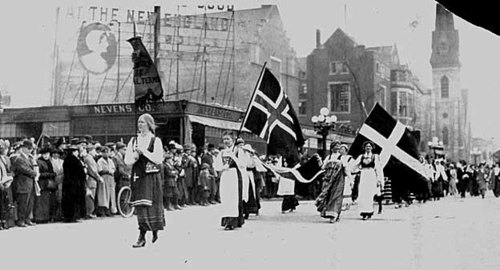
Suffrage procession in Minneapolis on May 2, 1914
From the collections of the Minnesota Historical Society
Source: thomaslowrysghost.tumblr.com


Election Day is coming up Tuesday and you can be damn sure that I am going to cast my vote.  

I’m doing it for my Grandma Lillian and all the inspirational people that I’ve met over the years who have risked everything to secure their right to participate in government.

My Grandma Lillian was raised by her grandmother, Thorina Melquist.  Thorina was an immigrant from Norway whose oldest daughter (my great-grandmother) died of typhoid fever just weeks after she gave birth to my grandmother. Thorina’s youngest child was only nine months older than my grandmother.  She weaned him in order to nurse my newborn grandmother, who had also contracted typhoid but somehow – miraculously – survived. (And, yes, “Thorina” is the female version of the name of the Norse god of thunder.)

In addition to farmwork and child-rearing, Thorina was a dedicated suffragist.  She believed strongly in equal voting rights for women and she often participated in demonstrations advocating for the right to vote for women. Women received full suffrage rights in Norway in 1913, so Norwegian immigrant women (along with their Finnish, Swedish and Danish counterparts) played a notable role in the suffrage movement at the local level in Minnesota and other states with large Scandinavian immigrant populations.  The photo at left shows women from several Scandinavian countries in traditional dress marching against inequality and for universal women’s suffrage on Hennepin Avenue in downtown Minneapolis.
My Grandma Lillian grew up as a suffragist.  She was still pretty young in 1919 when the Nineteenth Amendment was passed by Congress and ratified by Minnesota.  Women’s suffrage became national law on August 18, 1920 when Tennessee became the 36th state to ratify the Constitutional amendment.In some ways, it is surprising to think that less than 100 years ago, women in America could not vote.  I was a toddler in Louisiana when that state ratified the 19th Amendment in 1970 – 50 years after initially rejecting it.   And Mississippi didn’t ratify the 19th Amendment until 1984!

Now the right to participate in government is one that we Americans take for granted – so much so that less than half of the population votes unless it is a Presidential election year.  In 2008, the voter turnout was 63%, a high water mark that is low in comparison with most countries.  In U.S. local elections, the voter turnout is even lower.  Many of the mayors of major U.S. cities are elected with single-digit turnout. That’s just shameful.

I love to vote.  In fact, I vote every chance that I can – legally at least. I always try to bring my kids with me when I vote, so they can see that having a voice in the democratic process is something both important and valuable.

But when I’m standing in the voting booth, I feel like there are others there in the voting booth with me.  They are some of the inspirational people that I’ve met over the years who have risked everything to secure their right to participate in government.

Standing with me is the young Haitian asylum seeker who was beaten by police at a polling place in order to discourage him from voting for Jean-Bertrand Aristide in 1990.  He held his own, though, and stood there bleeding and bandaged for several hours before he finally had the opportunity to put his check next to Aristide’s rooster symbol on the ballot.  It was the first time he had ever voted – and it was a remarkable act of courage and endurance.  In telling me about it, he summed it up by saying,

“I voted!  It was a very good day.”

In the voting booth with me are also many of the amputees in Sierra Leone in 2004.  It was common practice during the conflict there for members of the Revolutionary United Front (RUF) to hack off the hands or arms of people with machetes.  Some of them had been targeted during elections so that they couldn’t vote by leaving their fingerprint mark on the paper ballot.  I also heard that the RUF brutally amputated hands during one election because the government’s slogan was that,”The power is in the hands of the people.”

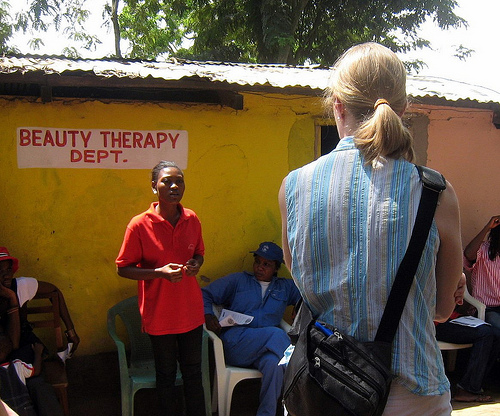
I visited Sierra Leone in 2004, after the conflict had ended and just prior to the first post-conflict elections.  As I traveled through the countryside, I saw people coming together for meetings to discuss the upcoming elections.  In spite of the horrors that they had endured, they were coming together in villages big and small, to exercise their right to participate in their government.  Here is a photo I took of a gathering in a village far out in the bush in the Kono district, an area that endured particularly brutal human rights abuses.  Yet now, as the country was slowly emerging from the conflict, the villagers were coming together to discuss the upcoming local election process.

My Suffragette Grandmother

Although my grandmother gained the right to vote, she was never able to go to college.   She was certainly smart enough, but her family couldn’t see the point in wasting good money on educating a girl.  Grandma Lillian never expressed bitterness about this to me. But one afternoon when I was in high school, I stopped by to say hello and to get her thoughts on my top college picks.  I remember sitting in my grandparents’ darkened living room.  A mantel clock ticked and the air conditioner hummed.  It now seems impossibly calm and quiet, so different from my current raucous and messy living room. My Grandma Lillian told me that the most important thing was to follow my dreams.

 “You can do whatever you want to with your life. Be what you want to be.  
But never forget those of us who weren’t able to follow our dreams.                
Follow your dreams for us.”


Upcountry girls in Sierra Leone.  Photo by my colleague Rosalyn Park.
Upcountry girls in Sierra Leone. Photo by my colleague Rosalyn Park.

So that’s why I never miss the chance to vote.  I’m doing it for my Grandma Lillian.  And for everyone else who can’t follow their dreams.

Every election day is an opportunity.  An opportunity to have a say in the decisions, big and small, that impact the lives of you and everyone around you.  Don’t make excuses, don’t be discouraged.  This is a right that is too valuable to waste.  On Tuesday, please get out there and VOTE!  If you need help finding your polling place, go here:


The photo at the top is of the Scandinavian Women’s Suffrage Association marching in a parade in Minneapolis in 1914.

I keep it in my office in honor of my Grandma Lillian.

The Right to Education

Photo by Dulce Foster
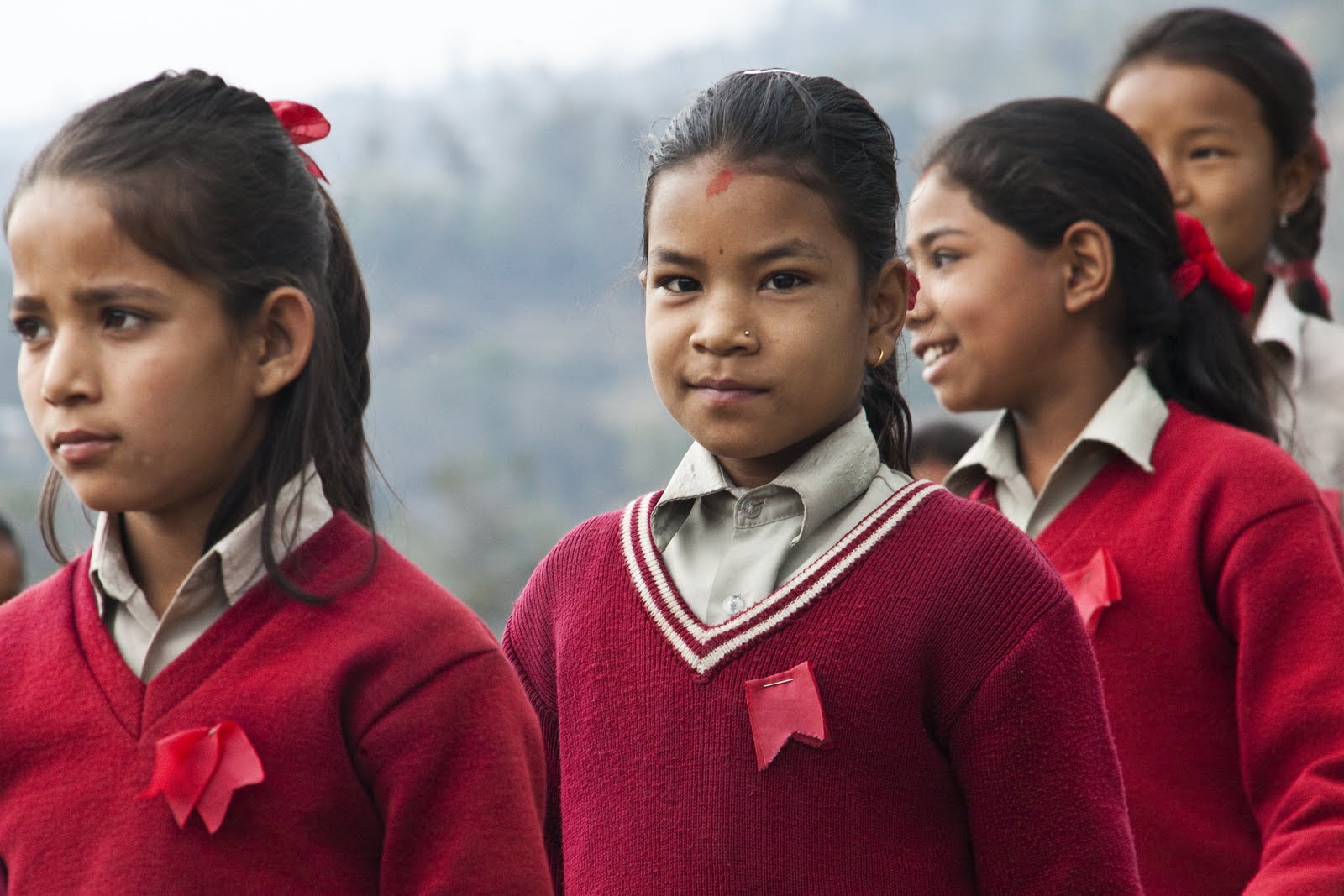
As my own daughter headed back to school, I found myself thinking about another group of girls at a school halfway around the world.  Unlike my three kids, who are driven to their well-appointed classrooms on the first day because they have too many school supplies to carry, the kids at the Sankhu-Palubari Community School (SPCS) in Nepal do their work on rickety desks in cramped classrooms.  These kids in pre-K through 10th grade walk to school – some an hour each way – six days a week because this school provides the opportunity to realize their human right to education.
 In the United States, where education is both compulsory and free, we often forget that the right to education is not meaningfully available in many parts of the world – especially for girls.  The UN estimates that there were more than 67 million primary school-age and 73 million lower secondary school-age children out of school worldwide in 2009.  In addition, an estimated 793 million adults lack basic literacy skills. The majority of them are women.
Sankhu-Palubari Community School
Photo by Dulce Foster
     Overwhelming as those numbers are, there are pinpricks of light that give me hope that they will someday change.  I saw one when I visited Nepal for the first time in March 2011.  Opened inSeptember 1999, the Sankhu-Palubari Community School is a partnership between The Advocates for Human Rights, Hoste Hainse (a Nepali NGO), the local School Management Committee, and the dedicated teaching staff.  The school now enrolls more than300 students in grades pre-K-9, and also provides scholarships for graduates who continue on to 10th grade.
The goals of the Sankhu-Palubari Community School Project are to prevent child labor, encourage gender parity in education, increase literacy rates, and improve the lives and well-being of the neediest children in the area.   This year, the school has successfully met goals for gender parity among students in both the primary and lower secondary grades. For the 2011-2012 school year, 147 of the 283 students in pre-school through eighth grade are girls. Additionally, and perhaps more significantly, 15 of the 31 students in ninth and tenth grade are young women.
Since the school’s founding in 1999, the teachers have conducted outreach to parents and worked hard to encourage female students to attend and stay in school in spite of societal pressure to get married or enter domestic work. Their efforts have paid off.  While girls worldwide generally are less likely to access, remain in, or achieve in school, 52% of the students in K-8th grades at the Sankhu-Palubari Community School this year are girls. And a girl is at the top of the class in most of the grades at SPCS.
     Most of the students’ families work in agriculture.  They are farmers with little or no money to spare on school fees, uniforms and supplies.   Many of them are from disadvantaged groups such as the Tamang.  An indigenous group with their own culture and language, the Tamang students must learn Nepali as well as English when they come to school.  Frequently, the adults in the family are illiterate.
8th Grade Class
Photo by Dulce Foster
The impact of the school both on the individual students and on the community over the past 12 years has been profound.  As part of our evaluation and monitoring process, our team interviewed approximately 60% of the parents of students atthe school in March.  It was clear to me that parents value the education that their children are receiving and, seeing the value, have ensured that the younger siblings are also enrolled in school rather than put to work.  Twelve year sago, there were many students in the area out of school but now most are attending school. I could also see the physical benefits that the students derived from attending school when they stood next to their parents.  Even the 5th grade girls towered over their parents, illustrating the simple cause-and-effect of adequate nutrition, wellness checkups, and not having to work in the fields from a very young age.
      Challenges certainly remain, particularly as the cost of operating the school continues to rise. But so far two classes of students who started at the school in kindergarten have graduated from the 10th grade; they all received either high distinction or first division on their School Leaving Certificate examinations.
Morning Assembly
Photo by Dulce Foster
The Sankhu-Palubari Community School may be a small school in a remote valley, but it is a place where the human right to education is alive and well, providing a better future for these children.  In particular, the effect that these girls have on their community, their country and – hopefully, the world – will be thrilling to watch.

The Definition of Family

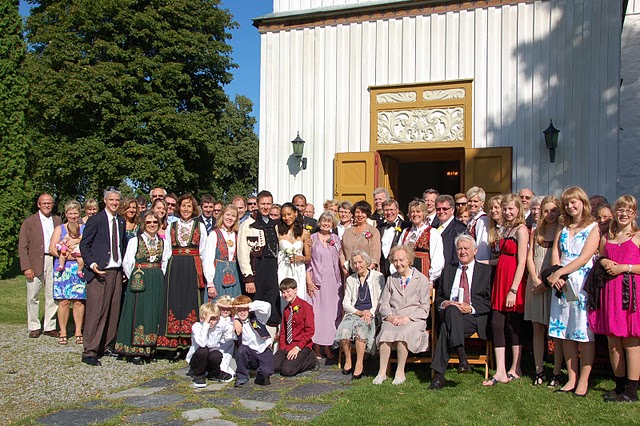
Extended family from 3 continents at my brother’s wedding
(Nes kirke, Norway, August 2010)

I’ve been thinking a lot about family recently.  We had just dropped off my old friend Erik and his “unwieldy crew” at the airport, when my daughter Eliza sighed, “It’s pretty much BORING without our cousins.”  Knowing there was no actual blood relation, I cross-examined her on why she thought they were our cousins.  (It must sometimes stink to have a lawyer for a mom.) Finally she said in frustration, “Because, I just FEEL like they are.”

How do you define family?  Is it common ancestry? Shared experiences?  Mutual commitment? Living in the same household? Common values?  The people you know you can count on for support?  The people you know you can get into a knock-down-drag-out fight with but they’ll still love you?  People who you feel deeply connected to even though you rarely see them?  All of the above?  Or none of them at all?

When I was at the Buduburam Refugee Settlement in Ghana, I met a woman who runs a cook shop there.  Called Ma Fatu, her feisty personality would have been equally at home as the proprietor of a saloon in the Wild West or of an inn in medieval England.  She took a lot of pride in her cooking and in knowing her customers.  She’d eye me critically as I tucked into my jollof rice and say, “I know what you white people like to eat.” Then, the next day, she would serve me up a heaping serving of jollof vermicelli.  

I had noticed that there were several young people helping in the cook shop, washing dishes, waiting tables, whatever needed to be done.  It was only on my second trip to Buduburam that someone told me that they were not actually her children.  During the war in Liberia, her husband and children – her entire family – had been killed.  Over the years at Budububuram, she had taken in several young people who had also lost everyone.   In the face of all this loss, Ma Fatu had created a new family.  In a refugee camp – miles from home and without even the  possibility of legal recognition – she had forged familial bonds of love and support.

Like every parent, I’ve got a stockpile of my kids’ drawings of our family – stick figures showing Mom and Dad, Brother and Sister.  Sometimes Grandma and Grandpa and/or Cat and Hamster.   When you are young, the definition of family is very narrow and also very immediate.  But as you get older, you develop deeper relationships with people who are not related by blood.  In many ways, you create your own family of the people who give you what you need to flourish.

I’ve had this discussion about the definition of family with a number of asylum clients.  Under U.S. immigration law, your family is defined as your spouse (only one – your first spouse), your children by birth or legal adoption, and your parents.  Of course, many people in the world use a broader definition, with half-siblings, cousins, and children adopted without legal recognition counting as immediate family members.  I once had a client say to me, “I feel so sorry for you Americans.  Your families are so very small!” 

Article 16(3) of the Universal Declaration of Human Rights states that, “The family is the natural and fundamental unit of society and is entitled to protection by society and the State.” Back when the UDHR was written in 1948, it is doubtful that the drafters envisioned even biracial marriage, much less the multiple forms of family that exist today.

Now, I am a strong supporter of same-sex marriage.  I also believe that the equal rights of LGBT persons to marry, file joint taxes, visit partners in hospital, raise children, etc.  will be guaranteed by law sooner rather than later.  But the bigger point I’d like to make is that, no matter how you define “marriage”, the push for the change in law happened because of thousands – maybe millions – of personal decisions by individuals to define themselves as “family”.  The reality is that there is a very human need to live in a family social structure – the natural and fundamental group unit of society.  The law can better accommodate that reality but regardless of what the law says, people –like Ma Fatu – will create their own families. 

Maybe my six-year-old Eliza is right – the true definition of family is a very personal one, self-defined by each of us.  The definition of family maybe IS really the people who you feel like are your family.  And if that is so, wouldn’t we all be better off if society and the State protected our families? 

So I think the real questions are: How do you define your family?  What does your family mean to you?  And what could our society and State do better to support YOUR family?

Forgiveness

I am just about the last person who should be lecturing on the subject of forgiveness.  I’ve always tended to savor the little niggling injustices in my life, holding onto them and working them over the way you worry a sore spot in your mouth with your tongue.

I’ve noticed that my children are constantly denying responsibility for wrongdoings.  Or, to state it more accurately, they are always claiming innocence and then laying the blame on someone else.  All three of them will pipe up with “I didn’t do it! It was (fill in the blank)!” in response to questions about who left the door open, who spilled the milk, who left gum on the floor, who threw that bread at me (just to give some examples from the last 20 minutes).

That says something to me about human nature. Our first instinct is to shift the blame, deny responsibility.  Admitting you are wrong is one of the most difficult things you can do.  It’s so much easier to deny or make excuses or pretend like you didn’t know what was going on.  And while it takes a lot to acknowledge blame, it takes even more to ask for forgiveness.

What does it take to really, truly grant forgiveness to someone who did something that hurt you?  My son came home from Sunday School with one of those sheets where you have to decode the hidden message, which turned out to be Colossians 3:13  “If someone does wrong to you, then forgive him.  Forgive each other because the Lord forgave you.”  “So you should forgive your brother for eating your candy, right?” I said.  “It’s not that easy,”  he replied.


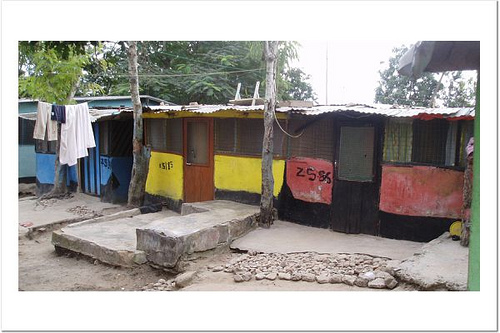
Houses at the Buduburam Refugee Settlement

No, forgiveness is NOT that easy.  But when we were working with the Truth and Reconciliation Commission of Liberia back in 2007 and 2008, I interviewed a surprising number of people who said that they had forgiven the people who had hurt them and killed their loved ones.   We made two trips to Buduburam Refugee Settlement in Ghana to take statements.  At the time, there 38,000 refugees living there, some of whom had been there for almost twenty years.  The conditions on the camp were very difficult. It was hot and crowded, with inadequate sanitation and electricity.  All the water for drinking and washing had to be purchased; most people didn’t have enough money to do both and a lot of people only ate one meal a day.  There weren’t a lot of job opportunities in Ghana, so most of the refugees relied on remittances from relatives in the U.S. or Europe.  Educational opportunities were also limited.

Also, as in many refugee situations, there were ex-combatants and perpetrators living there along with the victims of human rights abuses.  Many of the people we talked to had encountered the perpetrator their on the camp.  One woman I interviewed told me that she saw the men who had raped her every single day.  In spite of the harsh conditions of daily life at Buduburam, however, I saw firsthand not only the possibility of forgiveness, but the necessity of forgiveness.

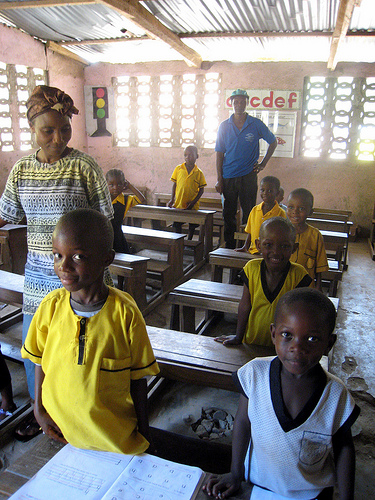
A kindergarten class at Buduburam

The TRC asked us to gather information about how statement givers felt about reconciliation so, unlike most of my work in documenting human rights abuses, I was asking questions about forgiveness in addition to questions about what happened.  Not everyone was ready to forgive and only a handful were willing to meet with the perpetrators, but many said that they had in their hearts already forgiven the perpetrators.  As one woman told me, “I had to forgive him, once I realized that if I didn’t, I would never move on with my life.”

Forgiveness does not in any way minimize the gravity of the wrong that was done.  It does not mean forgetting what happened or ignoring the need for justice.  Archbishop Desmond Tutu said, “Forgiving means abandoning your right to pay back the perpetrator in his own coin, but it is a loss that liberates the victim.”  Forgiveness, at its core, is a choice to take action.  It is something that you do for yourself, because you cannot be happy and healthy if you hold on to the anger and bitterness.  It’s kind of like eating your vegetables – sometimes you have to force yourself to do it, but you know that you are better off in the long run if you do.  Forgiveness doesn’t happen overnight. It is a process, but it is a process of change that takes you out of the role of victim and puts you in control.

Listening to refugees tell their stories at
a skills training school at Buduburam

Recently, a woman told me this story about forgiveness.  During the war in Liberia, she witnessed the killing of her – by a neighbor who they had known for many years. She had so much anger for him for long, long time. Years later, after much praying, she decided that she needed to try to forgive him.  Eventually, again with much praying, she began to feel as if she really had truly forgiven him.

Last year she returned to Liberia for the first time.  She wasn’t sure how she would feel if she actually saw the man, but when she did, she went right up to him.  This is how I recall her describing what happened next:

“I gave him a big smile and I said, ‘Mr. ___, do you remember me?’  I want you to know that I saw what you did to my father.  But I forgive you for it. I forgive you and I’m praying for you.’  He didn’t know what to do, he couldn’t look me in the eye!  After that, if he saw me coming, he would avoid me.  Imagine that! An old man running away from me.  But now I’m out of it.  It is between him and God now.”

Three Minute Fiction

Are you familiar with MPR’s Three Minute Fiction? I was not until January 8, when I heard the announcement on Weekend All Things Considered of Round Six: Laughing and Crying.  The premise is simple:  a fictional story of 600 words, which, it turns out, actually takes closer to four minutes to read the story out loud.  Each round has a different theme and this time the celebrity author/judge mandated that one character tell a joke and that another cry.

I heard the MPR piece and the following story “Why?” sprang fully-formed into my head. It did’t win (the winning story will be broadcast this weekend); it didn’t even get selected as one of the weekly “Favorites”, of which there were 22.   That wasn’t really much of a surprise since a) I haven’t written fiction since the 6th grade, b) my juvenilia is Crap! with a capital C;  c) there were 4000 entries; and d) there were apparently a disproportionate number of stories about chickens.   If I had won, though, I would have told Guy Raz all about how I wrote it (only during the minutes that my son Simon was not playing) at a hockey rink in a suburb called New Hope and how, on the way to the rink,  I had to drive in the middle of the snowy road to avoid the African refugees walking, not on the sidewalks, but in the road just like I have seen so many people do on roads in West Africa.

Why?
“Here’s a classic: Why did the chicken cross the road? Ever heard that one before?”  He was a good man, a volunteer with the resettlement agency.  He drove her to doctor appointments and to the Asian grocery store that sold palm butter.  They sat across from each other at her kitchen table, drinking tea.  He had helped her find this table at a secondhand store.  He had brought her this blood-red teapot, had showed her how to use the gas stove.  He was doing his best to help her understand America.   Today he was teaching her American jokes.
But those words…chicken ….road…brought her back to her village, back to that day.  She looked down at her hands, folded politely in front of her.  It was as if the months, the miles had evaporated. She saw it so clearly. Her little son and the chicken, in the road.  Blessing loved that chicken – a small white hen, feisty and independent.  Little Blessing loved that chicken and he worried about her, following her around much of the day as she scrabbled in the dirt.  People in the village thought it was odd, laughed at the thought of treating an animal like it was more than something to eat.  That was one of the things she had noticed that was different in America.
That day, when they heard the trucks, they had all run inside to hide.  The rebels had passed on the road many times before without stopping, but it was best to hide, to do nothing to draw their attention. That day in her village, she was on her knees on the dirt floor.  It was the rainy season and there was water on the road.  She heard the squeal of the brakes, the flat splash of water when the truck stopped.  She squeezed her eyes shut and prayed harder.  But Blessing, her little Blessing, saw his chicken crossing the road. He watched the truck stop. When one of the rebels grabbed his chicken, Blessing ran out of the house.
It was a boy who did it.  He was carrying a gun almost as big as himself.  He could not have been more than a few years older than Blessing.  In different times, he may have kicked a ball to him and laughed when Blessing ran after it on his chubby little legs.   But this was a bad time. Everything had changed when the fighting began.  The rebels took what they wanted, hurt who they wanted. That boy was carrying a gun almost as big as himself.  And it was the young ones who were the most dangerous because they were unpredictable.
She remembered everything else that had happened that day.  The bullets that blazed her temple, her leg, her arm as she ran to Blessing.  She remembered the women from her village who were raped, the men who were killed, the children who were taken to be porters and fighters.  The rebels took all their animals, all their food; they burned all their buildings.  She remembered her months in the refugee camp, her long journey to this strange, cold country.  But she had built a wall inside around that part of herself since the moment when her little Blessing had crumpled to the ground.  Until this moment, this unexpected American joke about the chicken and the road.
She saw that her hands, balled into fists now, were glistening with wet.  Another teardrop fell, rolling over her her knuckle, pulled inexorably down.  She looked up and saw that he, too, had tears in his eyes.
“I’m sorry,” she said quietly.  “Please tell me.  Why did the chicken cross the road?”

(597 words)

When I wrote this, I remember thinking that this story would also be an appropriate blog entry.   I hoped to show with this story the connection between two people who outwardly don’t have much in common.  He doesn’t know why she is crying, but still feels and bears witness to her pain.

I also hoped to show that plenty of normal-seeming people are walking around with hidden scars, pain that is kept at bay, but only just and that might be suddenly triggered and result in a full-blown flashback. This story is fiction, but I have been in situations where something I said sent a human rights victim back into a bad time and place.  Here is an example, if I gave you Coca Cola in a glass bottle, what would you think of?   I think of the Coke machine in the basement of Audubon Hall on the LSU campus.  When I visited my dad at his office, I was allowed to go down to the basement and put a quarter in the old-fashioned machine, open the door and retrieve an ice cold bottle.  So for me, a bottle of Coca Cola has entirely positive connotations.  But I had a client once who was tortured with an empty glass Coke bottle.  For her, the thought or sight of a glass bottle could cause her to panic.

It’s scary when someone suddenly begins to disassociate.  And like the guy in this story, you feel guilty when something you do triggers it.    Ideas for stories (some realistic fiction like this and some not) spring into my head all the time, but I the reason that I took the time to write this one down – in that ice arena in New Hope, MN – was because I think more people need to be aware that many of us (not just refugees) are carrying a heavy burden of memories from a painful time.  More of us should be on the lookout for how we can make that human connection.  It won’t change the world, but it might just help make it a little bit better.

Same and Different

Each February, my kids’ schools have special programming for National African American Parent Involvement Day.  The activities are different every year, but in 2008 there was a parent-led component that involved reading the class a book and facilitating a classroom discussion about diversity.  I signed up to be the parent volunteer in Simon’s kindergarten and Sevrin’s second grade class.  I had a great picture book (by no less than Kermit the Frog!) about children’s rights that I had picked up at the UN bookstore years before; my kids liked it, so their classmates probably would.  Easy peasy, right?  But that’s where, brakes squealing, I slammed head-on into a solid brick wall. 


I just had no idea how to facilitate the discussion or talk about human rights in a way that was simple enough for them to understand.  Fortunately, I got some help from people who are smarter than me about things like this – teachers.  You could never in a million years get a lawyer to summarize an argument in just three words, but teachers can and do.  Thanks to my sons’ classroom teachers and Kathy Seipp from our Education Program, the theme for my parent-led discussion was “Same and Different”.  


In February 2008, I had just returned from Liberia, a West African country emerging from more than a decade of violent conflict. I picked a few photos of people and scenes from Liberia and had them blown up and mounted on foam core.  The plan was that I would hold up a photo and have the kids point out what they saw in the picture that was the same in their lives and what was different.   


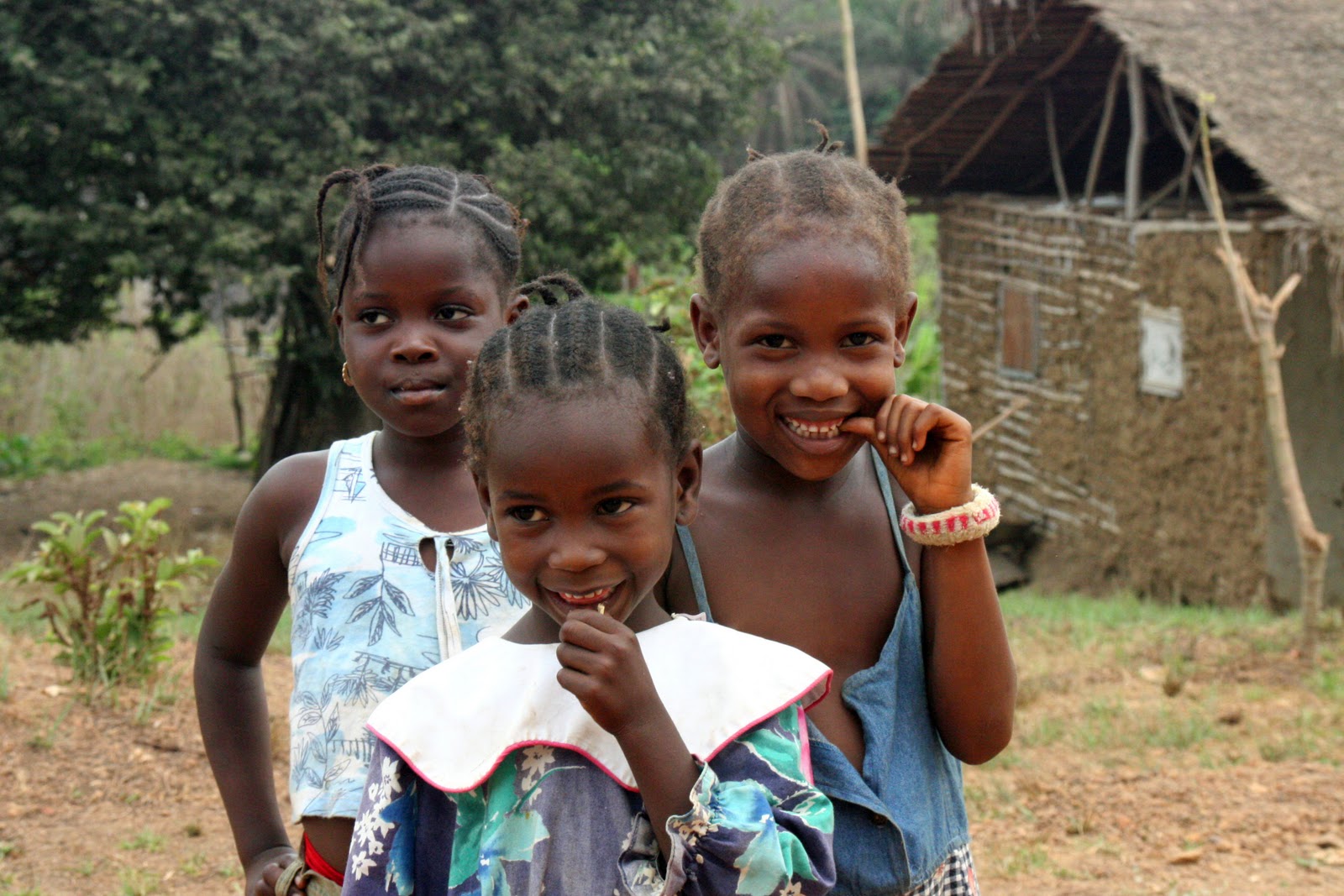
It was really and truly amazing to hear what the kids had to say.  But before I tell you, take a look at the picture and think about what you see that is the same and different from your own life: 

photo by Dulce Foster

Here are some of the things the kids said:  “I like that bracelet.”  “I sometimes wear my hair in braids, too.” “They have dark skin and I have white skin.”  “We have different trees here, like conifers.”  “We have snow here right now.”  “Is that corn growing behind them?  Because I LOVE to eat corn, too.”  “Is that a house? It’s not like my house.”  “You couldn’t live in that house in Minnesota.  You would get too cold.”


Here is another one:  

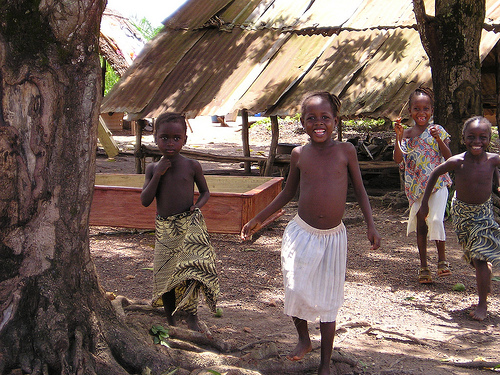
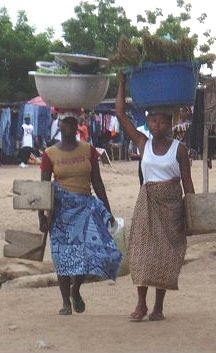
photo by Dulce Foster

“I think they are brothers and sisters who love each other.”  “I think they are cousins.  I love my cousins, too.”  “It must be very hot there. We can only wear clothes like that in summer.”  “Do they have seasons?” “Hey! I have flip flops just like that!”


One more time:

street scene in Monrovia, 2008

“How do they carry those big things on their heads?  We can’t do that!”  “There is a lot of trash on the street.”  “We have that same blue cooler.  We take it with us when we go camping.” “We have windows, too, but there is no glass in their windows.”  “They have electric wires like we do.”  “That’s so funny that they are using the wheelbarrows to carry things.  We only use our wheelbarrow in the garden.”


Each picture offered many more opportunities to talk about “same and different” than I had imagined.  For example, “I have flip flops just like that” (same) but those may be the only pair of shoes the kid owns (different).  The “no glass in the windows” comment led to a discussion of mosquitos (same) and malaria (different).  They do have power lines like us, but there is no electricity running through them.  At the time, only a  tiny area of Monrovia had electric power; the rest of the country relied on generator power – at best.  I told them about seeing the the dozens of kids huddled around the bases of the 5 or 6 working streetlights in Monrovia, doing their homework.  “Just like Abraham Lincoln,” breathed one particularly precocious second grader. 

The book I read is called For Every Child, A Better World.  It’s a UN Publication/Muppet Press collaboration which is now out of print but you can still find used copies online. If you follow the link  For Every Child, A Better World, you’ll see the format:  “Every child needs food to eat, but sometimes there isn’t enough to go around.”  I’ve done this “Same and Different” presentation several times now in kindergarten, 1st and 2nd grade classrooms. Every time, I walk away surprised by how these very young kids are able to understand and express the concept of basic human rights.  If they get it so completely, what is wrong with us adults?


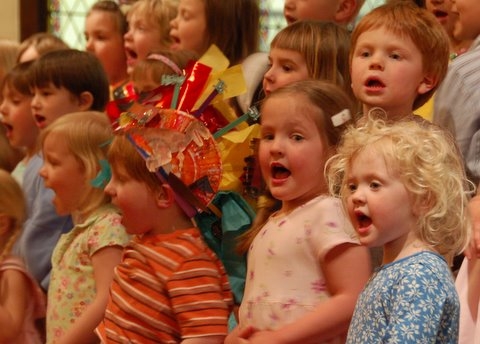
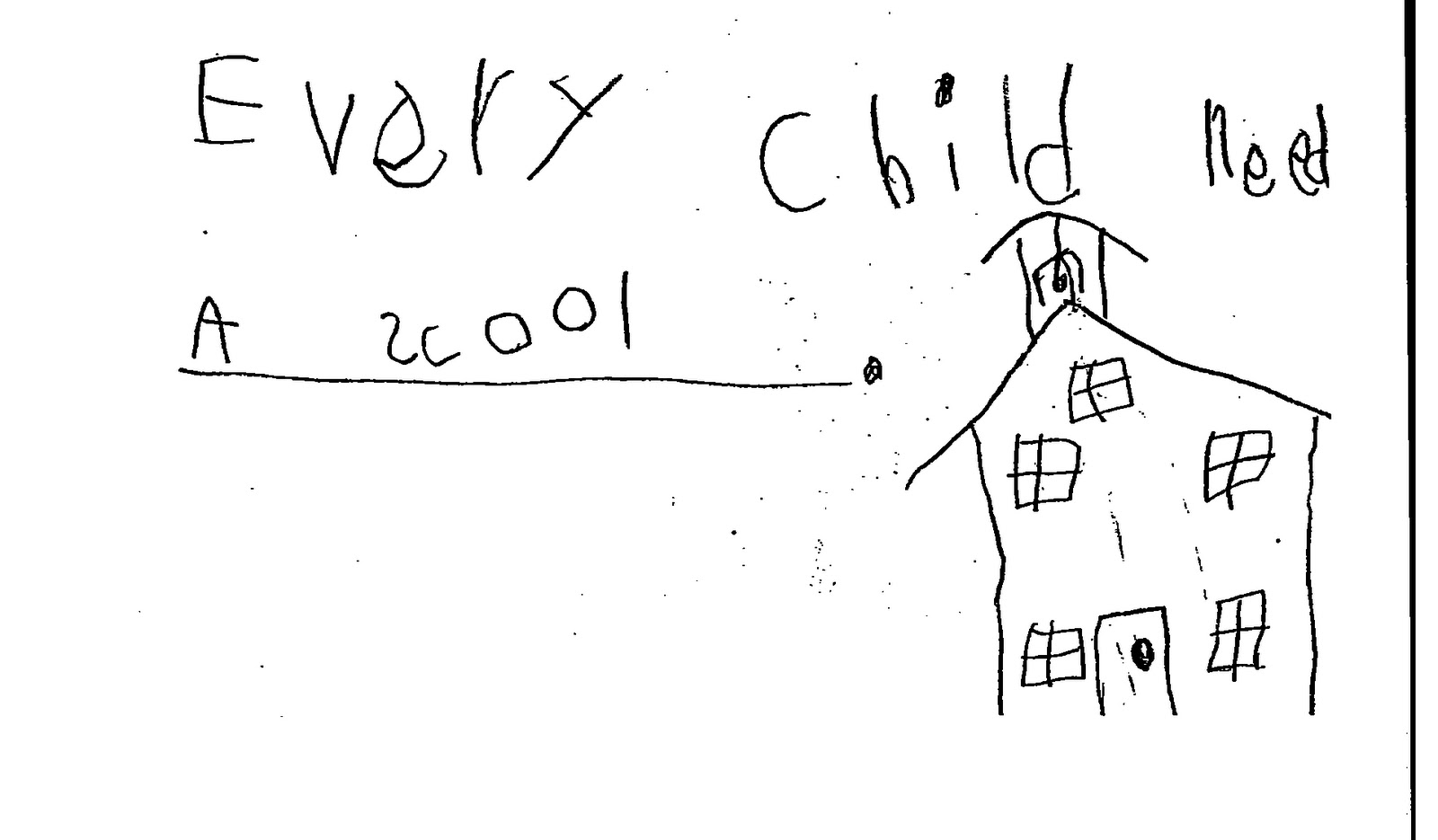
Simon’s kindergarten teacher, however, really took the “Same and Different” theme to the next level.  For several weeks, she incorporated “Same and Different” into various classroom activities, including one assignment to draw and write about something that they thought that every child needs.  She sent me copies of all of the drawings so I’ll end with a few.  Of course, my favorite is the one I posted at the top of this blog entry: “Every child needs peace.”