Wishes for Peace, Love and Joy

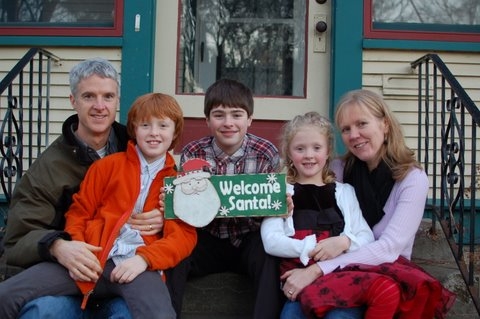
From my family to yours!

Why American Moms are Cheering for Licia Ronzulli

Photos of European Parliament Member Licia Ronzulli with her daughter keep popping up on my Facebook news feed and Pintrest.  My friends are mostly moms, so I speculate that they had an emotional reaction when they first saw the photo of MEP Ronszulli with her baby.  I know that I did.  I cheered and teared up a little, almost simultaneously.   Then I stopped and asked myself, “Why?”

The photo of Ms. Ronzulli at work with her baby is not a new – it was taken in September 2010.   While this photo caused a splash in Europe in 2010, it took  a while for it to catch on here.  That’s about right – as a country, the US is generally well behind Europe in terms of policies that support mothers.

Although she doesn’t bring her daughter to the European Parliament regularly, there are other photos of Ms. Ronzulli and the  now-toddler  Vittoria.  During a vote on the Eurozone debt crisis on February 15, 2012, reporters snapped several photos of Vittoria with her mom at the European Parliament.

The media coverage I have seen has focused on the cutesy (“awwwwwww”) or “hilarious” aspects of the photos.  That’s too bad. I think the media missed the opportunity to talk about WHY American moms like me are cheering for Ms. Ronzulli.

Here are a few reasons:

1)  Ms. Ronzulli’s employer, the European Parliament, has rules that allow women to take their baby with them to work.  Most American women do not have that option.
2)  The photos perfectly symbolize the work-family balance that all of us working moms struggle with every day.   The fact that, according to media reports, the photo of Ms. Ronzulli with her infant was taken during a vote on proposals to improve women’s employment rights makes it all the more poignant.
3)  Ms. Ronzulli is showing the world that childbirth does not automatically flip the offswitch on our female brains.  Women continue to be productive  employees even after they become mothers.  The Daily Mail, which ran the February 2012 photo in an article titled “Does my vote count, mummy?”,  describes the 36-year old Ronzulli as seeming “in complete control in spite of having her baby on her lap throughout.”  Why is this such a surprise?  I know that I, for one, have become better at multitasking and more efficient at doing my work since I had my first child.
4) In the 2010 photo, it appears that Ms. Ronzulli is choosing to keep her 7 week old infant with her as much as possible.  In my experience, that’s important for babies who are still so little.  Yet 6 weeks is the typical maternity leave in the U.S.  That doesn’t mean that it is paid leave, however. The U.S. is also one of only a handful of countries with no national law mandating paid time off for new parents.
5) Ms. Ronzulli was entitled to a parenting leave, but chose to take only 1 month of it.  She makes the point that it is about personal choice.  In 2010, she told The Guardian “It’s a very personal choice. A woman should be free to choose to come back after 48 hours. But if she wants to stay at home for six months, or a year, we should create the conditions to make that possible,” she said.   Amen, sister!
6) She looks GOOD!  I know I never looked that good 7 weeks after labor and delivery, but many of my friends very quickly looked like their pre-baby selves again.   I certainly didn’t look my best when I was the sleep-deprived parent of a toddler, but the world didn’t end.  Moms like a little reminder now and then that a having a baby doesn’t slam the door on our ability to look and feel good.  Sometimes it sure feels like that, but really it’s just a temporary setback.
7) Ms. Ronzulli probably didn’t have to nurse baby Vittoria sitting on a toilet in the ladies room.  That’s something I had to do at some point or other with all three of my babies here in America.

So thank you, Licia Ronzulli, for giving us American moms something to cheer for today and a reminder of what we need to continue to work towards tomorrow!

Memories Captured

This is why I work for human rights – I want to make the world a better place for my children and children everywhere. Sometimes, though, I just need to stop and be thankful that my children are happy and healthy. Galit Breen and Alison Lee are doing a cool blog link up called Memories Captured. Here are some of my favorite photos of my children from the past year or so:

She cracks me up!  Her is my daughter with My Little Pony giving Mary, Joseph and Jesus in Santa’s sleigh.  (Thankfully, Jesus is in a carseat!)


10 Things To Do With Your Kids on Human Rights Day!

This is a post that I wrote for World Moms Blog.  Originally published here.

Make your own human rights tapestry!

Human Rights Day is December 10! The date was chosen to honor the United Nations General Assembly‘s adoption on 10 December 1948 of the Universal Declaration of Human Rights (UDHR), the first global statement of international human rights principles.  Here are some ideas for simple yet meaningful ways for your family to celebrate the rights and responsibilities that we all share as human beings.

1.  Learn about the Universal Declaration of Human Rights. Check out the UDHR plain language version  or the Amnesty International UK book We Are All Born Free (15 of the illustrated pages of the book can be found on The Guardian’s website if you want to look at them online or print them out). You can also watch  a short video together and talk about it with your kids. My kids loved this animated video version of the UDHR even back when they couldn’t understand what the words meant. For a more historical view, check out The Story of Human Rights.

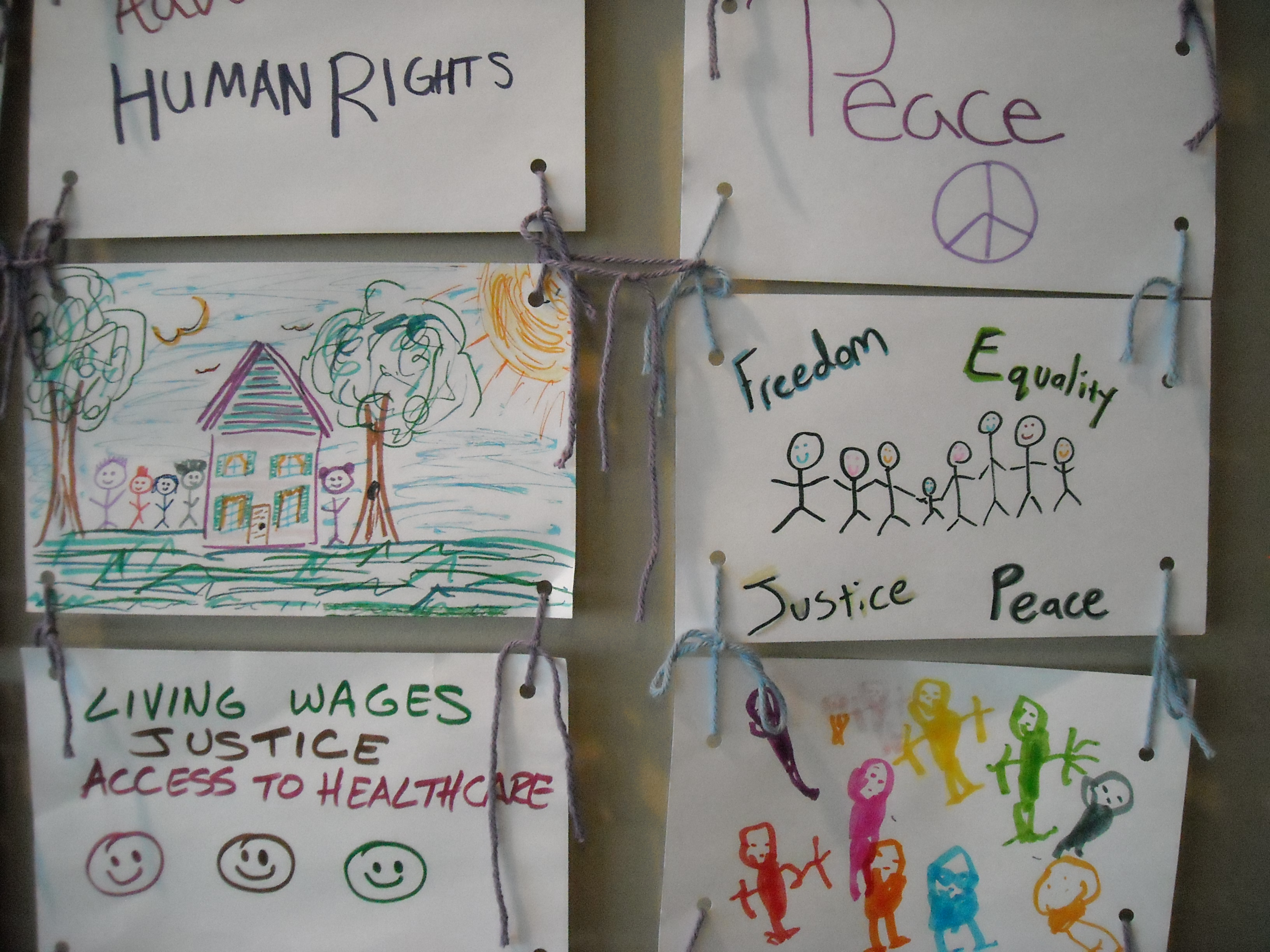
2.  Exercise your right to freedom of expression! Draw pictures together of the rights and freedoms that are important to you. You can make your own family “Human Rights Tapestry” by drawing on index cards and using a hole punch to make holes in each corner.  Use yarn to tie together the cards to make a tapestry. (See the picture above of the Human Rights Tapestry conceived of by Chanida Phaengdara Potter and created by visitors to The Advocates for Human Rights‘ booth at the Minnesota State Fair.) You can alsomake posters or collages together.  Help your kids write a poem or story about human rights.  Older kids can even make a video!

3.  Listen to some human rights music with your kids. Here are a few suggestions, but you might also want to check out the folk music songbook Rise Up Singing.  The book contains the chords and lyrics for more than the 1200 songs on a wide variety of social justice issues.

  • The Rainbow Connection – Kermit the Frog  Someday we’ll find it!
  • If I Had a Hammer – Pete Seeger   Really, anything by Pete Seeger.  Pete is my own personal antidote to Barney.
  • Free to Be You and Me   – Marlo Thomas & Friends     In my opinion, one of the best things about being a kid in the 70s.
  • The Preamble – Schoolhouse Rock      Did you know that the U.S. Constitution is one of the first documents to establish universal principles of human rights?
  • Star Wars Main Title/Rebel Blockade Runner – John Williams   People say Star Wars was a Western set in space, but I see it as a movie about the fight for human rights against the Empire.

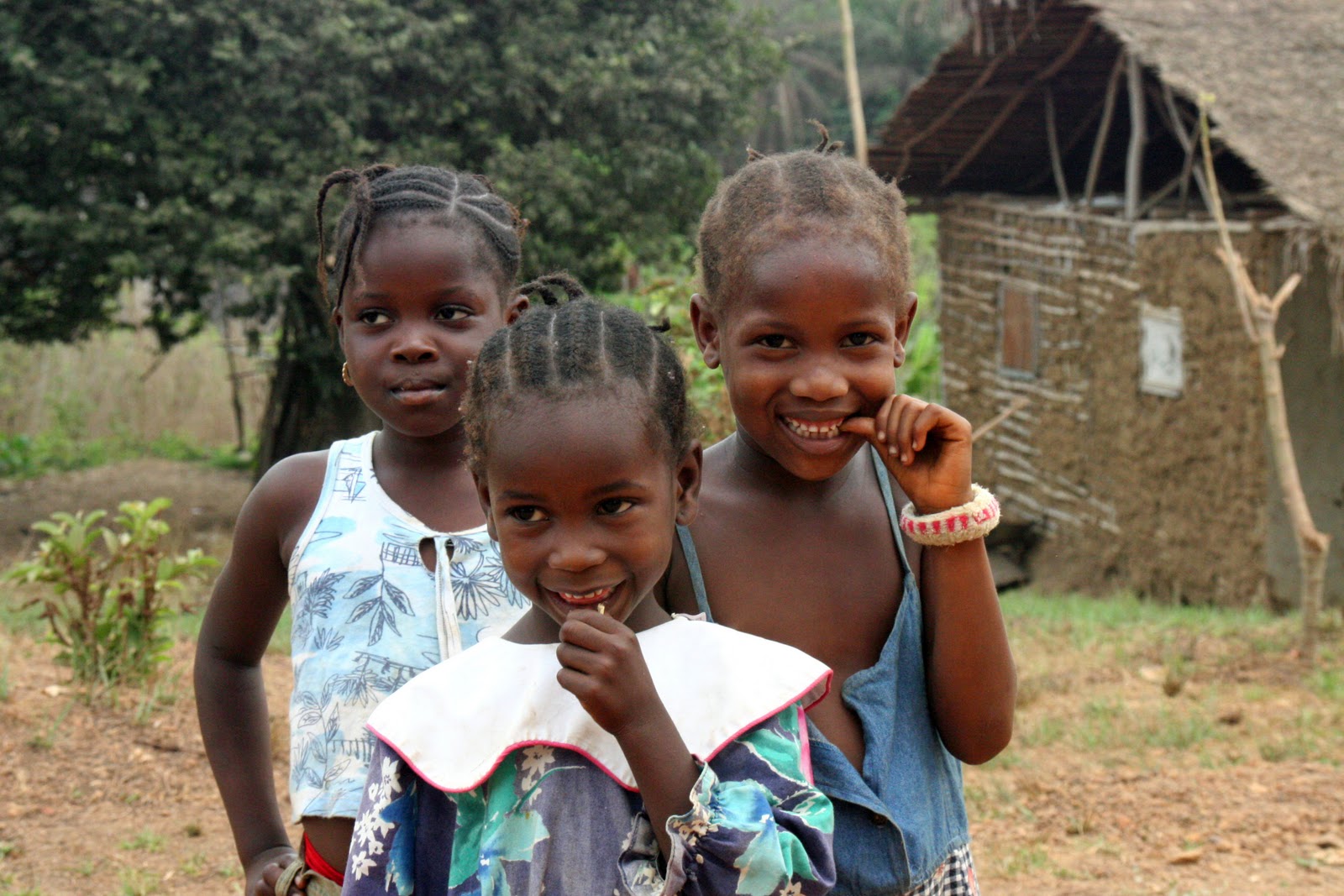
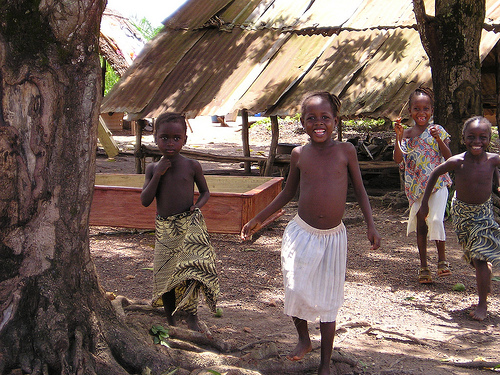
4.  Same and Different.  I started doing this activity in my childrens’ classrooms and really learned a lot from the kids about tolerance and respect.  Show your kids a photo and have them point out what they see in the picture that is the same in their lives and what is different.  Here’s an example but more can be found on my blog post Same and Different:

photo by Dulce Foster

The kids’ responses:  ”I like that bracelet.”  ”I sometimes wear my hair in braids, too.” “They have dark skin and I have white skin.”  ”We have different trees here, like conifers.”  ”We have snow here right now.”  ”Is that corn growing behind them?  Because I LOVE to eat corn, too.”  ”Is that a house? It’s not like my house.”  ”You couldn’t live in that house in Minnesota.  You would get too cold.”

5.  Let your kids use their screen time to learn about human rights!  Play games and quizzes on the UN cyberschoolbus.  Check out these free, downloadable video games:

  • Against All Odds  Experience life as a refugee, for ages 7+.
  • Stop Disasters!  Learn how to respond to different humanitarian disasters.
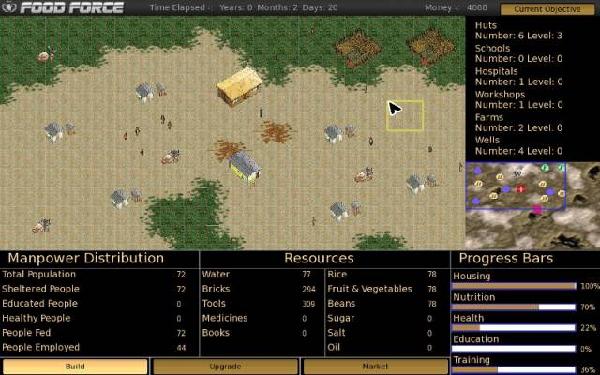
  • Food Force   Gamers ages 8-16 undertake 6 virtual missions to stop world hunger. Download the game in English, French, Norwegian, Portuguese, Korean, etc. (I’ll be testing newly launched Food Force 2  with my 12 year old gamer son. Something tells me he’s going to kick my butt at saving the world!)

Photo from Food Force 2

6.  Talk to someone you know who is from another country.  Where are they from?  What was their life like there?  What language did they speak?  Did they go to school? What do they miss?  What do they like about their new country?

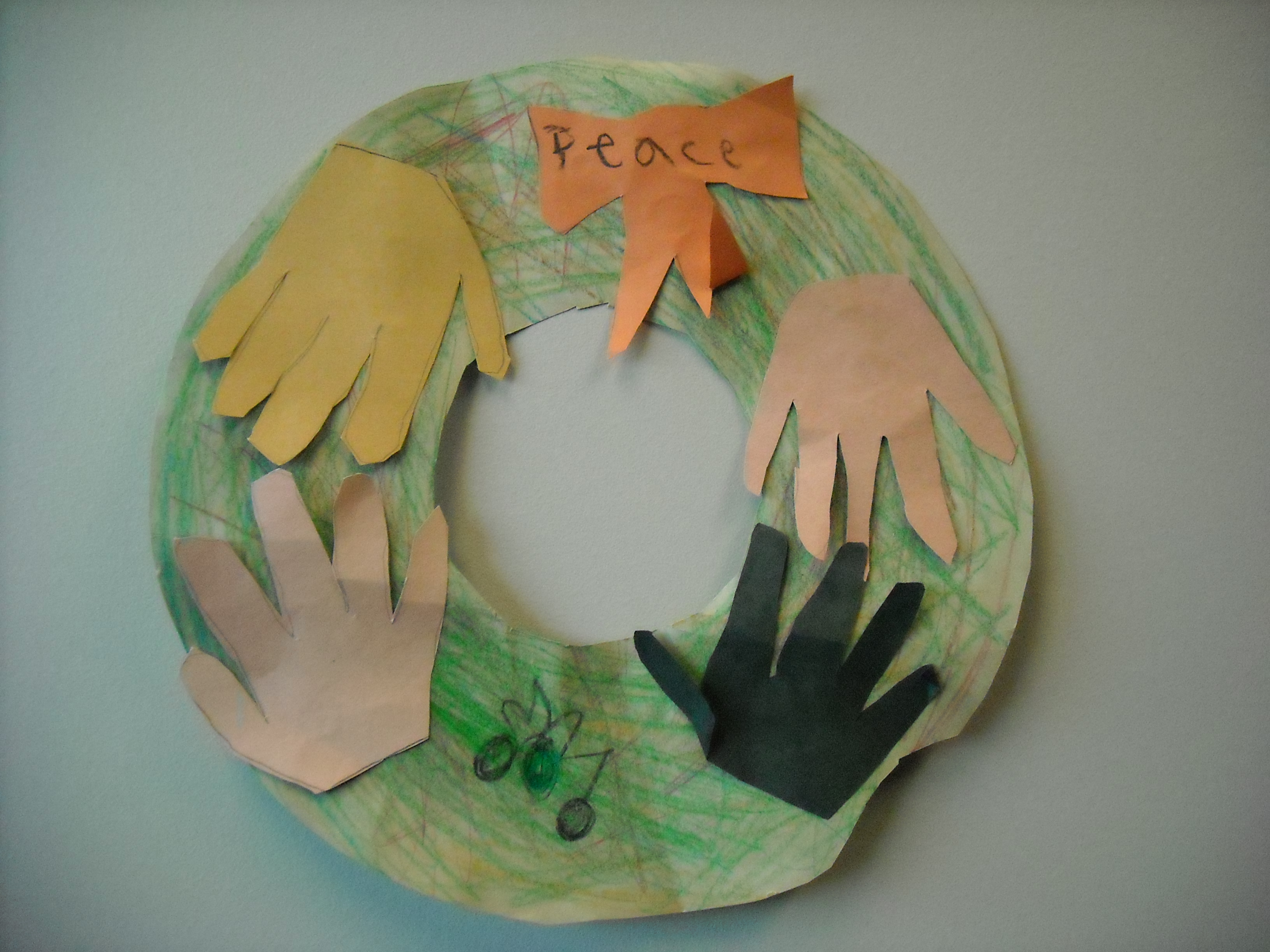
7.  Make a Helping Hands Wreath to symbolize the responsibility we all have to help each other.  Trace your hands on different color construction paper.  Cut out the hand shapes and glue or staple them on a paper plate to make a wreath.

8.  Act out a skit with puppets.  You can use any puppets or even make your own paper bag or sock puppets.  This skit is from RAISING CHILDREN WITH ROOTS, RIGHTS, & RESPONSIBILITIES , but you can also write your own skit, using a problem that your children have had to deal with themselves.

  • Example skit: Puppet 1: Hi everybody, my name is Jan.Puppet 2: Hi, everybody! I’m Sam, and I’m building a bridge. (Puppet is working with blocks.) Jan: Hey, Sam, I need those blocks for the airport I’m building. (Jan takes some blocks.) Sam: Hey! Don’t do that! You’re taking away my right to play!  (Puppets tussle over a block.)
  • Discussion:  What do you think Jan could have done differently? Has anyone ever interfered with your play?  How did that make you feel?
  • “Can you do a different ending to the story?” Choose children to act out the play again with the puppets, but coach them in some respectful ways to play together to share, take turns, or use other solutions they think of themselves.
  • “I know you can act very respectfully and responsibly toward each other. In fact, I’ve seen ________________________ (give examples of a time when acted responsibly).

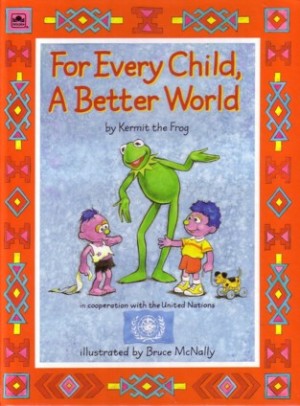
9.  Read a book about human rights.   There are so many, but for young children, I like  Horton Hears a Who by Dr. Seuss, The Giving Tree by Shel Silverstein,  Giving Hand, For Every Child, A Better World by Kermit the Frog. (Yes, I have a thing for Kermit.)

Photo from Wiki Muppets

Older kids may enjoy books more like The Hunger Games and Diary of Anne Frank.  For more ideas for books for teens and tweens, see the Discover Human Rights Institute resources, especially the Peace and Justice booklist and the  Equality and Tolerance booklist.

10.  Take action!  Teach your kids that they really can make a difference in the world.  Collect food and bring it to a local foodshelf.  Write a letter or sign a petition on behalf of a prisoner of conscience. Volunteer to help serve a meal at a homeless shelter.  Raise money from friends or neighbors for UNICEF or another organization working on human rights. (Remember to Trick-or-Treat for UNICEF next Halloween.)  Check out additional service learning ideas for kids in grades K-12 at 160 Ways To Help The World

ADDITIONAL RESOURCES:  You’re on your way to a great Human Rights Day!  If you are a classroom teacher or homeschooling your kids (or if you just want to dig deeper), you can find tons more ideas through the following resources:

 MY 2012 HUMAN RIGHTS DAY POST 10 MORE THINGS TO DO WITH YOUR KIDS ON HUMAN RIGHTS DAY!

MY 2013 HUMAN RIGHTS DAY POST HUMAN RIGHTS DAY ACTIVITIES TO DO WITH YOUR KIDS

MY 2014 HUMAN RIGHTS DAY POST HUMAN RIGHTS DAY ACTIVITIES FOR YOU & YOUR KIDS

ABC – Teaching Human Rights – practical activities in English, French, Russian, Arabic, Chinese, and Spanish

The Advocates for Human Rights’ Discover Human Rights Institute – human rights education lesson plans and curriculum

Human Rights Here and Now  – human rights lesson plans and resources

Raising Children With Roots, Rights and Responsibilities – activities for preschool and young elementary children

The Sharing Table

I first heard about “The Sharing Table” when my son came home from kindergarten and exclaimed, “No snack for me today!  I had three hot dogs – plus my home lunch.” I pictured the Oscar Wienermobile pulling up at his school, tossing hot dogs like Mardi Gras beads.  “Where did you get three hot dogs?” “The Sharing Table, of course.”

The concept is simple.  If there is something in your school lunch that you don’t like, you leave it on the table.  If there is something in the school lunch that you want more of, or – if you are like my children –  you would like to supplement to your home lunch, well, you can just help yourself.  I couldn’t find any official Minneapolis Public Schools food policy, so I quizzed the kids.

Me:  “So, how did you find out about The Sharing Table?”
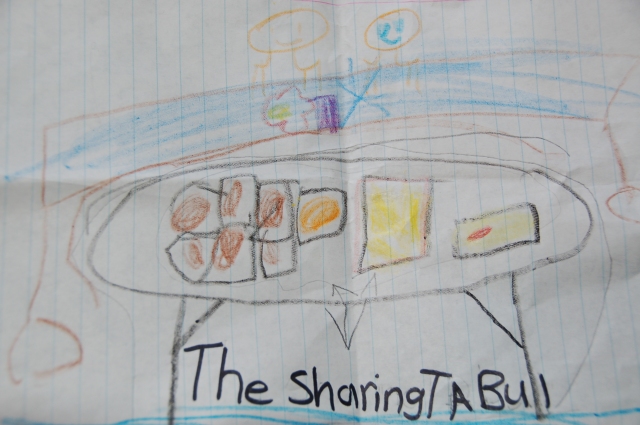
  • Oldest son (age 12):  “Duh!  It is right next to the Allergy Aware Table. You can’t miss it.” (This one has a peanut allergy.)
  • Youngest son (age 9):  “I didn’t really know about it, but then I think the Lunchroom Teacher told us at some point. The Lunchroom Teacher is kind of mean. If you forget your lunch, you go to The Sharing Table.”
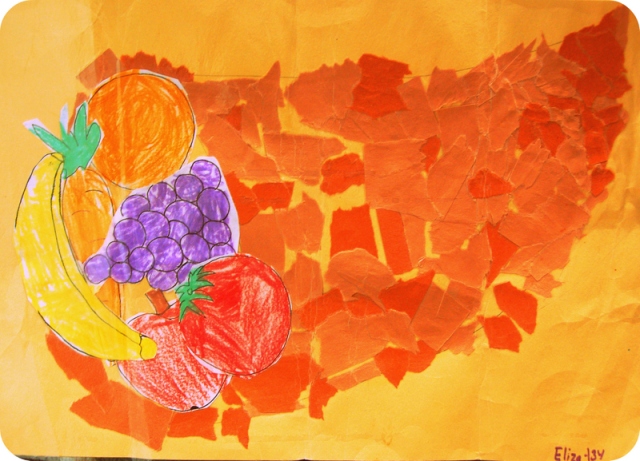
  • Daughter (age 6 1/2):  “It’s right there! Kids put their grapes there.  I like it when I can get the ‘mandrigan’ oranges.  Sometimes I take something and put it in my lunchbox for a snack later.”
All three agreed that the only real rules were that the items on the Sharing Table had to be from the school lunch, i.e. pre-packaged. Sometimes the pre-packaged school lunches bum me out.  When I was growing up in Louisiana, the lunches were not pre-packaged.  They were made in the cafeteria kitchen by large African-American women who always seemed to be stirring giant stainless steel pots and having a grand old time.  The East Baton Rouge Parish schools offered up jambalaya, shrimp creole, crawfish etouffee, cornbread, buttery rolls, yams, succotash, John Marzetti casserole, iced spice cake – for only 90 cents a lunch. My high school cafeteria had both a “hot lunch” side and a gumbo/salad bar/milkshake side.

Those East Baton Rouge Parish school lunches were some of the best in the world.  The melamine compartment lunch trays (which I recall as being pastel green, orange, yellow, and blue) came back to the kitchen clean as a whistle – except when greens were served.  Nobody  EVER touched the greens.  The greens remained on the trays in the perfect ice cream scooper-formed mounds in which they were served.   The rumor was that the greens were actually grass and, in fact, there was some circumstantial evidence to support the hypothesis.   Not only did they look exactly like grass, but I myself observed over years – at Magnolia Woods Elementary, at Wildwood Elementary, at Glasgow Middle Magnet – that greens were always on the menu THE DAY AFTER the janitors mowed.  At Baton Rouge Magnet High, where students came from all over the parish, we did an informal survey and discovered that this was happening in all the school cafeterias.  Harbinger of the locovore movement? Or just coincidence?  You be the judge.  All I know is that nobody EVER touched the greens.

One greens day when I was a sophomore in high school, I brought my lunch tray back to the kitchen.  My tray was clean, except for the greens.  On the conveyor belt, there was a long line of trays with ice cream scoop mounds of greens waiting to be dumped.  The cafeteria lady who was spraying down the trays looked me in the eye and said,

“Y’all is wasting perfectly good greens. Y’all must not know what it’s like not having enough to eat.”

Y’all, in case you don’t know, can be used both in the singular as well as the plural.  I understood exactly what she was saying that day – she meant both.  The only possible response to this was, “Yes, ma’am.”

By which I meant, “I’m sorry.”

Last year 65% of kids in grades K-8 qualified for free and reduced lunch.  I think The Sharing Table is a fine way to make sure that all of these kids get enough to eat.  At my kids’ schools they also have R.O.T., where the kids have to sort the remains of their lunches into recycling, organics, and trash.  I think that’s a good idea, too.

This Thanksgiving I am thankful for the many blessings in my life: for my family, my health, the opportunity to do good work.  I rediscovered my love of writing this year and I’m grateful for that, too.  I’m thankful to that long-ago Baton Rouge High School lunchlady.  And I’m also thankful for The Sharing Table.  My children are learning lessons at school that are not in any curriculum.  They are learning a lifestyle of avoiding waste and paying attention to what happens to their garbage.  They are learning, by giving and taking equally, that if you have more than you need, you should share it.  If you need more than you have, you can take it without questions or shame.  It’s not political, it’s just about being together in a community.  Today I am thankful that I am not alone in raising these children to be good citizens of their community.

Throwdown* Crawfish Etouffe

1 lb. crawfish tail meat (can also use shrimp or catfish)

2-3 teaspoons Tony Cacherie’s Creole seasoning (if you don’t have that, use 2 tsp. salt, 2 tsp. garlic powder and 1/2 tsp. cayenne)

1/2 stick of butter

1 medium yellow onion, chopped

2 bunches scallions (green onions), chopped

2 stalks celery, chopped

2 cloves garlic, minced

1 can Rotel Tomatoes (diced tomatoes with green chiles)

1 can Campell’s Cream of Mushroom soup (the TRUE secret of Cajun cooking!)

Mix seasoning with crawfish and put in refrigerator for 30 minutes.

Over medium-high heat, melt the butter in a heavy pot.  Add the chopped onions, celery and garlic and saute until the yellow onion is translucent.  Add the seasoned crawfish and mix real good.  After about a minue, add the can of soup (no water) and stir.  Then add the Rotel tomatoes and mix.  Lower the heat, cover the pot, and cook the rice.  Stir the etoufee often and simmer over low heat for 20 minutes.  Season to taste with more Tony’s.

*The lazy version

JOHN MARZETTI CASSEROLE

Not my recipe, but I ate a whole lot of it and make it for my family now.  I do wonder how a dish from Ohio became such a mainstay on the EBRP public school lunch menu. Here is the source for this version of the recipe.

3 tbsp. olive oil

1 large onion, chopped

¾ lb. mushrooms, cleaned and sliced

2 lbs. lean ground beef

3 ½ cups tomato sauce

1 ½ lbs. cheddar cheese, shredded

1 lb. elbow macaroni, cooked and drained

In skillet, saute onion in oil until limp, about 3 minutes. Add mushrooms and fry until juices are released, about 5 minutes. Add beef and cook, stirring, breaking up clumps, until no longer red. Remove from heat and mix in tomato sauce and all but 1 cup of cheese. Transfer to greased 9- by 13-inch baking dish and add macaroni. Toss gently to mix. Scatter remaining cheese on top. Bake, uncovered, in 350-degree oven until browned and bubbling (35 to 40 minutes). Serves 10 to 12.

In Small Places, Close to Home

This is my first original post on World Moms Blog

Eleanor Roosevelt once said,

“Where, after all, do universal human rights begin? In small places, close to home – so close and so small that they cannot be seen on any maps of the world.”

She knew what she was talking about.  Eleanor Roosevelt was the chair of the UN Human Rights Commission and even wrote part of the text of the Universal Declaration of Human Rights (adopted by the UN General Assembly on December 10, 1948).  Eleanor Roosevelt was also the mother of six children.

Mothers have an important role to play in making the world a better place for all children.   This is not to minimize the roles of fathers or grandparents or guardians or anyone charged with the responsibility of raising children. But I do believe wholeheartedly that mothers have a special role.  It is our job to change the world, one kid at a time.

Often mothers are the most vocal advocates for the rights of their children.  This is true whether you are a mom trying to get your special needs child the services she deserves or trying to get your child out of arbitrary detention in Iran (like Shane Bauer’s mom).  There are many examples of mom/human rights advocates-  Mothers of the Disappeared in Argentina, Mothers of Soldiers in Russia .

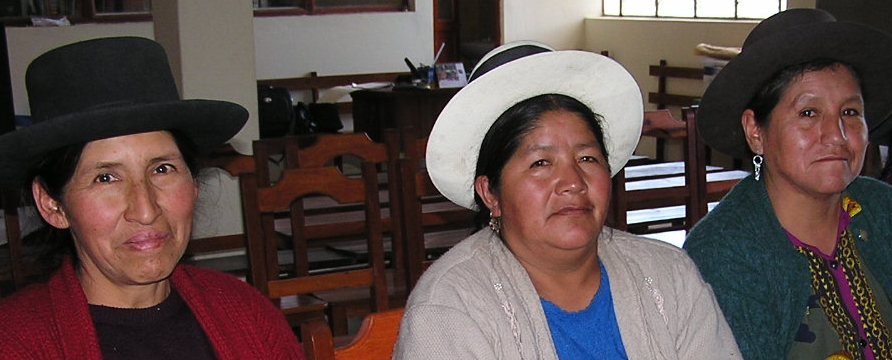
I personally have had the chance to meet and interview mothers involved with the organization ANFASEP in Ayacucho, Peru.  These are mothers whose sons were disappeared during the long, violent conflict in Peru.   For nearly 30 years, these women have been trying to find out what happened to their family members and where their remains are.  One of the women we talked to had four family members who were disappeared.  She wants to know where they are and who killed them.  “We’re looking for justice,” she said, “and we want to know the truth.”  As Mama Angelica Mendoza, President of ANFASEP, told us, “We’ll never forget about all the killings.  We’ll fight to the end.”

Mothers of the disappeared (ANFASEP) in Peru.As Eleanor Roosevelt implied more than 50 years ago, the most important place for human rights to begin is at home.

Human rights are the standards that allow all people – each and every one of the 7 billion of us on this planet- to live with dignity, freedom, equality, justice and peace.

Aren’t these the principles that govern the way we want our children to be treated?  And, in a nutshell, aren’t these also the core values that every parent wants to instill in their children?

The secret to a better world is not only protecting our children from human rights abuses inflicted on them by others, but also by making them better citizens of the world.  Caring about others, judging right from wrong, standing up against bullying or racist comments or sexist jokes. These are the human rights that are essential to the full development of each child as an individual, as well as to the community in which they live. This is the human rights work that changes the world.

Here are my three reasons to work for human rights.  I’d love to see and hear about yours!

Raising Boys Not To Be Total Jerks

At some level, I’ve known since before my oldest son was born that this moment would come.  But when it did, it took me utterly and completely off guard.  I was driving a car full of boys home from a soccer tournament last week when my 9-year-old son piped up from the back,

“Hey mom! I’ve got a funny joke.  I’ll ask you a question and you say, ‘Ketchup and rubber buns'”.  “I’ve heard this one,” chuckled my 12-year-old son.  Snickers all around from the soccer players.  

Apparently, I was the only one who didn’t know what was coming next.

“What did you have for breakfast?”  “Oatmeal and ketchup and rubber buns.”

“No! Mom!  Just say ketchup and rubber buns.”

“What did  you have for breakfast?” “Ketchup and rubber buns.”

“What did you have for lunch?”  “What did you have for dinner?”  Etc. etc.  And then we get to the punchline:

“What do you do when you see a hot chick? You catch up and rub her buns!”     Peals of laughter from the boys.

To my very great credit, I did not run the station wagon off the road and into the ditch.  I kept driving – silent, hands gripping the wheel, looking straight ahead.  It was a perfect autumn day.  The sky was brilliant blue and the afternoon sun was catching the full color of the orange and yellow leaves on the trees along the highway.   It was a beautiful, perfect day but inside I was angry. I was mortified. I was disappointed.  I was desperately struggling to think of what I should say.

Every once in a while, though, it is helpful to have gone to law school.  “I don’t think that joke is funny.  You know, if you actually ran after a woman and touched her in an offensive way like that, it would be called “assault and battery”. It is a crime.  You could be arrested.”

“You could be arrested for THAT?”  “Yes.  Plus, the woman could also sue you.”

Silence descends.

“Also, I’ve actually had that happen to me. How do you think it feels to have a stranger grab your butt?”

“WHAT? That actually happened to YOU?”

“Sure. More than once. Usually at parties.”

“That’s kind of  making me feel sick,” said the 12-year-old.

More silence.

From the 9-year-old:  “I remember you saying that you didn’t like running past construction sites because the construction workers whistled and yelled things at you.”

I didn’t remember telling them that, but it’s true.  When I was a teenager, I used to go way off my normal running routes just to avoid running past a construction site.  Good, they were listening.

“So what are you going to say the next time you hear someone tell a joke like that?”        “Stop, Mom! We get it, ok?”

Teachable moment: ended.  I decided just to leave it there  – for now.  These are intelligent boys, good kids who love and respect their mom and their sister, their grandmothers, their female friends and teachers.   But they, like other young Americans, are deeply impacted by the culture that they live in. Children are exposed to an estimated 16,000 images every day.  They are powerfully influenced by their peers (I know they didn’t hear THAT joke at home).   How can that not impact the way that they view girls and women?  And isn’t it only going to get worse as they move through middle and high school?

The Ketchup Joke was a call to action for me.  I need to do more to raise these boys to recognize the problem and, hopefully one day, to speak up when they hear someone tell a sexist joke.    Thankfully, there are a lot of resources out there – research, organizations, websites.   The Advocates for Human Rights has developed a Challenge the Media workshop and resource list.   And I know that other parents have successfully managed to raise their sons not to be total jerks, but to be men who respect and treat women as equals.

I’ll report back periodically on what I have found.  In the meantime, I would welcome hearing about what others have learned.    But first, I’ve got a date with my sons.  We are going to see Miss Representation.

We've still got a long way to go, but we've taken the first step.

My Suffragist Grandmother

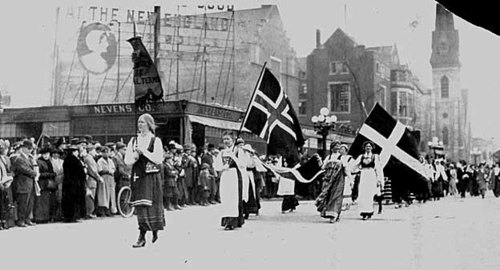
Suffrage procession in Minneapolis on May 2, 1914
From the collections of the Minnesota Historical Society
Source: thomaslowrysghost.tumblr.com


Election Day is coming up Tuesday and you can be damn sure that I am going to cast my vote.  

I’m doing it for my Grandma Lillian and all the inspirational people that I’ve met over the years who have risked everything to secure their right to participate in government.

My Grandma Lillian was raised by her grandmother, Thorina Melquist.  Thorina was an immigrant from Norway whose oldest daughter (my great-grandmother) died of typhoid fever just weeks after she gave birth to my grandmother. Thorina’s youngest child was only nine months older than my grandmother.  She weaned him in order to nurse my newborn grandmother, who had also contracted typhoid but somehow – miraculously – survived. (And, yes, “Thorina” is the female version of the name of the Norse god of thunder.)

In addition to farmwork and child-rearing, Thorina was a dedicated suffragist.  She believed strongly in equal voting rights for women and she often participated in demonstrations advocating for the right to vote for women. Women received full suffrage rights in Norway in 1913, so Norwegian immigrant women (along with their Finnish, Swedish and Danish counterparts) played a notable role in the suffrage movement at the local level in Minnesota and other states with large Scandinavian immigrant populations.  The photo at left shows women from several Scandinavian countries in traditional dress marching against inequality and for universal women’s suffrage on Hennepin Avenue in downtown Minneapolis.
My Grandma Lillian grew up as a suffragist.  She was still pretty young in 1919 when the Nineteenth Amendment was passed by Congress and ratified by Minnesota.  Women’s suffrage became national law on August 18, 1920 when Tennessee became the 36th state to ratify the Constitutional amendment.In some ways, it is surprising to think that less than 100 years ago, women in America could not vote.  I was a toddler in Louisiana when that state ratified the 19th Amendment in 1970 – 50 years after initially rejecting it.   And Mississippi didn’t ratify the 19th Amendment until 1984!

Now the right to participate in government is one that we Americans take for granted – so much so that less than half of the population votes unless it is a Presidential election year.  In 2008, the voter turnout was 63%, a high water mark that is low in comparison with most countries.  In U.S. local elections, the voter turnout is even lower.  Many of the mayors of major U.S. cities are elected with single-digit turnout. That’s just shameful.

I love to vote.  In fact, I vote every chance that I can – legally at least. I always try to bring my kids with me when I vote, so they can see that having a voice in the democratic process is something both important and valuable.

But when I’m standing in the voting booth, I feel like there are others there in the voting booth with me.  They are some of the inspirational people that I’ve met over the years who have risked everything to secure their right to participate in government.

Standing with me is the young Haitian asylum seeker who was beaten by police at a polling place in order to discourage him from voting for Jean-Bertrand Aristide in 1990.  He held his own, though, and stood there bleeding and bandaged for several hours before he finally had the opportunity to put his check next to Aristide’s rooster symbol on the ballot.  It was the first time he had ever voted – and it was a remarkable act of courage and endurance.  In telling me about it, he summed it up by saying,

“I voted!  It was a very good day.”

In the voting booth with me are also many of the amputees in Sierra Leone in 2004.  It was common practice during the conflict there for members of the Revolutionary United Front (RUF) to hack off the hands or arms of people with machetes.  Some of them had been targeted during elections so that they couldn’t vote by leaving their fingerprint mark on the paper ballot.  I also heard that the RUF brutally amputated hands during one election because the government’s slogan was that,”The power is in the hands of the people.”

I visited Sierra Leone in 2004, after the conflict had ended and just prior to the first post-conflict elections.  As I traveled through the countryside, I saw people coming together for meetings to discuss the upcoming elections.  In spite of the horrors that they had endured, they were coming together in villages big and small, to exercise their right to participate in their government.  Here is a photo I took of a gathering in a village far out in the bush in the Kono district, an area that endured particularly brutal human rights abuses.  Yet now, as the country was slowly emerging from the conflict, the villagers were coming together to discuss the upcoming local election process.

My Suffragette Grandmother

Although my grandmother gained the right to vote, she was never able to go to college.   She was certainly smart enough, but her family couldn’t see the point in wasting good money on educating a girl.  Grandma Lillian never expressed bitterness about this to me. But one afternoon when I was in high school, I stopped by to say hello and to get her thoughts on my top college picks.  I remember sitting in my grandparents’ darkened living room.  A mantel clock ticked and the air conditioner hummed.  It now seems impossibly calm and quiet, so different from my current raucous and messy living room. My Grandma Lillian told me that the most important thing was to follow my dreams.

 “You can do whatever you want to with your life. Be what you want to be.  
But never forget those of us who weren’t able to follow our dreams.                
Follow your dreams for us.”


Upcountry girls in Sierra Leone.  Photo by my colleague Rosalyn Park.
Upcountry girls in Sierra Leone. Photo by my colleague Rosalyn Park.

So that’s why I never miss the chance to vote.  I’m doing it for my Grandma Lillian.  And for everyone else who can’t follow their dreams.

Every election day is an opportunity.  An opportunity to have a say in the decisions, big and small, that impact the lives of you and everyone around you.  Don’t make excuses, don’t be discouraged.  This is a right that is too valuable to waste.  On Tuesday, please get out there and VOTE!  If you need help finding your polling place, go here:


The photo at the top is of the Scandinavian Women’s Suffrage Association marching in a parade in Minneapolis in 1914.

I keep it in my office in honor of my Grandma Lillian.

The Definition of Family

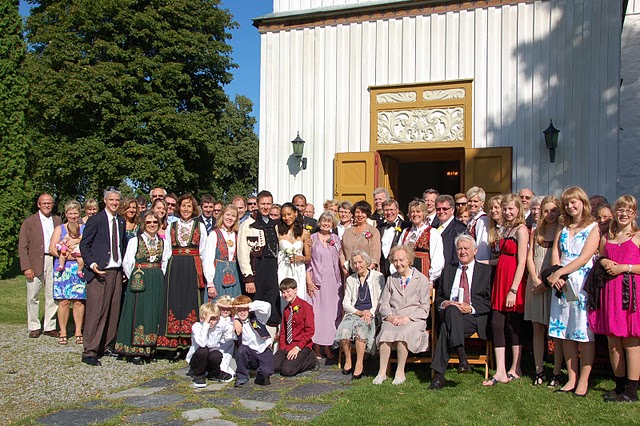
Extended family from 3 continents at my brother’s wedding
(Nes kirke, Norway, August 2010)

I’ve been thinking a lot about family recently.  We had just dropped off my old friend Erik and his “unwieldy crew” at the airport, when my daughter Eliza sighed, “It’s pretty much BORING without our cousins.”  Knowing there was no actual blood relation, I cross-examined her on why she thought they were our cousins.  (It must sometimes stink to have a lawyer for a mom.) Finally she said in frustration, “Because, I just FEEL like they are.”

How do you define family?  Is it common ancestry? Shared experiences?  Mutual commitment? Living in the same household? Common values?  The people you know you can count on for support?  The people you know you can get into a knock-down-drag-out fight with but they’ll still love you?  People who you feel deeply connected to even though you rarely see them?  All of the above?  Or none of them at all?

When I was at the Buduburam Refugee Settlement in Ghana, I met a woman who runs a cook shop there.  Called Ma Fatu, her feisty personality would have been equally at home as the proprietor of a saloon in the Wild West or of an inn in medieval England.  She took a lot of pride in her cooking and in knowing her customers.  She’d eye me critically as I tucked into my jollof rice and say, “I know what you white people like to eat.” Then, the next day, she would serve me up a heaping serving of jollof vermicelli.  

I had noticed that there were several young people helping in the cook shop, washing dishes, waiting tables, whatever needed to be done.  It was only on my second trip to Buduburam that someone told me that they were not actually her children.  During the war in Liberia, her husband and children – her entire family – had been killed.  Over the years at Budububuram, she had taken in several young people who had also lost everyone.   In the face of all this loss, Ma Fatu had created a new family.  In a refugee camp – miles from home and without even the  possibility of legal recognition – she had forged familial bonds of love and support.

Like every parent, I’ve got a stockpile of my kids’ drawings of our family – stick figures showing Mom and Dad, Brother and Sister.  Sometimes Grandma and Grandpa and/or Cat and Hamster.   When you are young, the definition of family is very narrow and also very immediate.  But as you get older, you develop deeper relationships with people who are not related by blood.  In many ways, you create your own family of the people who give you what you need to flourish.

I’ve had this discussion about the definition of family with a number of asylum clients.  Under U.S. immigration law, your family is defined as your spouse (only one – your first spouse), your children by birth or legal adoption, and your parents.  Of course, many people in the world use a broader definition, with half-siblings, cousins, and children adopted without legal recognition counting as immediate family members.  I once had a client say to me, “I feel so sorry for you Americans.  Your families are so very small!” 

Article 16(3) of the Universal Declaration of Human Rights states that, “The family is the natural and fundamental unit of society and is entitled to protection by society and the State.” Back when the UDHR was written in 1948, it is doubtful that the drafters envisioned even biracial marriage, much less the multiple forms of family that exist today.

Now, I am a strong supporter of same-sex marriage.  I also believe that the equal rights of LGBT persons to marry, file joint taxes, visit partners in hospital, raise children, etc.  will be guaranteed by law sooner rather than later.  But the bigger point I’d like to make is that, no matter how you define “marriage”, the push for the change in law happened because of thousands – maybe millions – of personal decisions by individuals to define themselves as “family”.  The reality is that there is a very human need to live in a family social structure – the natural and fundamental group unit of society.  The law can better accommodate that reality but regardless of what the law says, people –like Ma Fatu – will create their own families. 

Maybe my six-year-old Eliza is right – the true definition of family is a very personal one, self-defined by each of us.  The definition of family maybe IS really the people who you feel like are your family.  And if that is so, wouldn’t we all be better off if society and the State protected our families? 

So I think the real questions are: How do you define your family?  What does your family mean to you?  And what could our society and State do better to support YOUR family?

Så Heldig Jeg Er (How Lucky I Am)

Simon and me in our bunads
I’ve often been asked how I ended up as a human rights lawyer. It would be inaccurate to say that any one event made me decide to go into the human rights field.  Many little, meandering creeks had to come together to make this river flow.  Without a doubt, though, one reason for my career choice was my longstanding interest in all things international. That interest was nurtured during my childhood summers in northern Minnesota at Skogfjorden, the Concordia Language Villages’ Norwegian language camp. It would be hard to deny that the Concordia Language Villages, the mission of which “is to prepare young people for responsible citizenship in our global community,” had a big impact on my life.  (For more on the Concordia Language Villages, check out www.concordialanguagevillages.org)

Here is something that I wrote last year when I went back on staff after 22 years of life in the “real world”. I’m reposting on this blog as Sevrin, Simon and I are leaving shortly for two weeks at the Skog, but also because one of the things that I have learned from doing human rights work is that I am so incredibly lucky.  I am lucky to have my health, my family, my home.  I have plenty of food to eat and good healthcare.  I am lucky to be able to say whatever I want and associate with whomever I want without fear of arrest and imprisonment.  Even though I am a woman, I had the opportunity to get a good education and to make my own decisions about my career.  Nothing reminds you of how lucky you are like spending time with people who don’t have these rights and opportunities.  And I feel so privileged and lucky to be able to do the work that I do.

Så Heldig Jeg Er 

When I hung up my stabsjakke (staff jacket) for the last time in 1988, I fully expected to someday drive up Thorsenveien with a minivan full of kids bound for Skofjorden.  I never imagined that I would park that minivan and spend two weeks here WITH my kids.  But here I am, wearing a navnskilt (nametag), living with the girls in Tromsø, and sharing the Skogfjorden experience with my 10 and 8 year old sons.   

There have been some changes in the 22 years since I was last on staff.  The first thing I noticed was how much taller the trees are in front of Utgard.  The circular staircases are gone, as are the woodburning, metal mid-century modern fireplaces in the hytter (cabins).  There are new places – Fagertun, Låven, Mine’s Brønn – as well as some new names for old places.  There are new hand movements for songs I once knew and a whole lot of new songs.  The schedule has changed a bit, so sometimes I feel like a villager myself, “What happens next?  Where am I supposed to be now?”

Sev playing kubb (that’s a navnskilt/nametag)
As a parent, I can say that I feel that Skogfjorden is even better than when I was a villager or on staff.  It’s a safer place, both in terms of physical plant and safety policies, and staff members receive better and more comprehensive training. I see every day how hard the lederer (counselors) here work, with patience and good humor, to give our kids the best possible experience.  More than ever, this is a place that supports and encourages all levels of learning and abilities. Staff are as creative and energetic as they were in my day, but they do a better job of making this a total Norwegian immersion experience.

One thing that has not changed is that Skogfjorden is a place where kids learn and grow and have fun.  LOTS of fun.  It’s a joy to watch my kids singing their hearts out at allsang (singing) and to eat middag (lunch) with them and hear about what they did during kretser (an activity that was new for me, too).

One of the new songs that I learned this week captures my feelings about this session exactly.  The refrain of the song is, “Å så heldig jeg er, som kan være her med deg.”  “Oh, so lucky I am to be here with you.”  Å så heldig we parents are to be able to give our children the Skogfjorden experience.

Beste hilsen,

Jenni