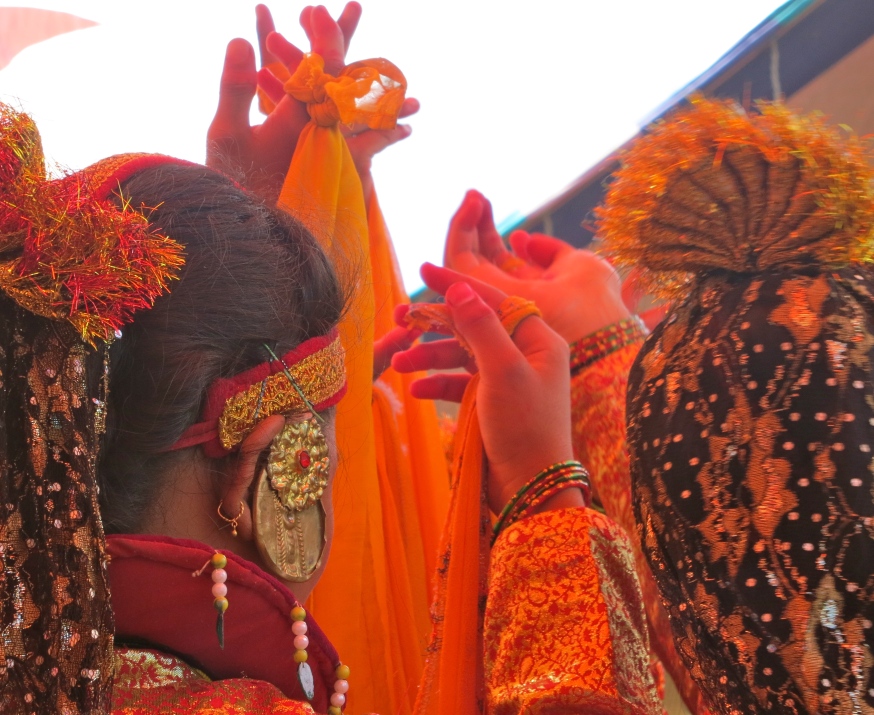
When the Weekly Photo Challenge theme Layers was announced today, I immediately thought of a series of photos I recently took in Nepal of dancers performing a traditional dance. It was mesmerizing to watch them, their colorful costumes so rich in detail and contrast, their bodies flowing gracefully through the complicated dance steps. These young Nepali dancers produced gorgeous layers of color and movement that these photographs cannot truly capture.
I couldn’t decide which photo to use for the Challenge, but I did succeed in narrowing it down to two.
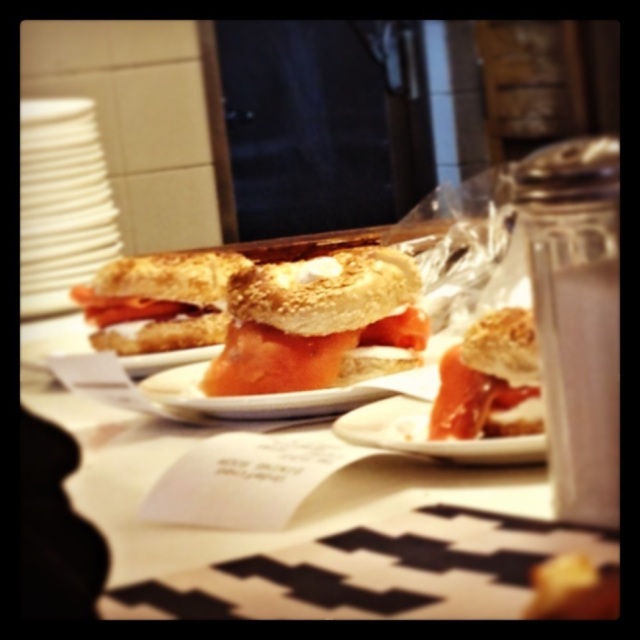
Order up! Beauty’s Specials at Beauty’s Luncheonette in Montreal
“I’ve been coming here since the beginning,” he said conspiratorially, leaning towards me from the stool next to mine.
I had noticed the white haired gentleman earlier, as he was shouldering his way through the Sunday brunch crowd at Beauty’s Luncheonette. He took a seat on the chrome-and-blue pleather stool next to me. As he carefully placed his folded Montreal Gazette on the formica countertop, he caught the server’s eye. “Hi hon!” she sang out as she filled his coffee cup.
He didn’t even have to place his order. In a matter of minutes, “the usual” was set in front of him. Side of home fries, black coffee, and a Beauty’s Russian Black Special. Most people who come to Beauty’s get the Beauty’s Special – smoked salmon, cream cheese, tomato, and onion on the infamous Montreal sesame bagel. But The Regular clearly prefers the Special on on a Russian rye bread so black that it looks like it is made of dark chocolate.
“You’ve been coming here since 1942?” I asked.
“Sure, I went to high school just down the street. I used to buy my school supplies here back when it was a stationary shop. There was always a poker game going on back in the back room.”
He pointed towards an open door behind the kitchen to a small room where they now store the mops and brooms and cleaning supplies. (You can see it in the background of the photo above.)
“They won’t tell you THAT in the history.”
He gestured vaguely towards the blue and white menu, which contains a detailed history of Beauty’s. How newlyweds Hymie and Freda Sckolnick bought the shop on the corner of Mont Royal and St. Urbain and started serving lunch to the garment workers from the factories in the neighborhood. The name “Beauty” came from Hymie’s bowling nickname. It grew so popular that the workers started bringing their families on the weekend. “And the Montreal brunch was born,” to quote the menu. Indeed, there was no mention of the poker game in the back room.
“I’m in my 80s,” he confided, “so Hymie must be into his 90s. You met him when you came in, right?”
I had indeed met Hymie. He was guarding the door when we arrived – literally standing in the inner doorway and quizzing the groups of Montreal hipsters queued up outside. Since we only had two in our party, we scored an immediate seating at the lunch counter. “I like American money,” Hymie told me as he resettled, ever vigilant, on his perch by the door.
“Hymie opened up this morning,” The Regular told me. “That’s the son, Larry.” He waved dismissively at a white-haired man with black frame glasses who was dashing about with a pot of coffee. “He just showed up now.”
We talked for a few minutes. He told me how he grew up to be a lawyer and a politician. He represented the neighborhood for a number of years before returning to private practice. He lives downtown now, but he made it very clear that he is not retired.
“What’s your practice area?” I asked. Corporate, I thought.
“Immigration,” he said. “There’s always work and it’s interesting.”
“I know,” I said. “I’m a human rights lawyer at a non-profit, but I started out practicing asylum law. We always look to Canada as the better asylum system. Even now in the debate about immigration reform, we are using Canada as the example of why we should provide counsel for indigent asylum seekers.”
“Well,” he replied, “It was a hell of a lot better before the Conservatives took over. Now I’m not sure we’re a model for anyone anymore.”
As he paid his bill and gathered up his car keys and his black leather gloves, he asked, “What are you going to do today?”
“We’re thinking of going up to the top of Mont-Royal.”
“Mount Royal? How are you going to get there? Do you have a car?”
“No, we’re planning to bike,” I said.
He looked at me for a few seconds, as if assessing whether I was truly insane. Then he moved on.
“Well, you’re going to want to go to Schwartz’s Deli, so here’s a tip. Don’t bother with the line. Go across the street to Main Deli. It’s just as good, but without the wait. We call it “smoked meat” here. There’s no such thing as “pastrami” here in Canada,” he said emphatically.
“Thanks for the tip,” I said. As a vegetarian, my interest in cured meat – whatever you call it – is minimal.
It struck me later that, based on the facts that he dropped, I could easily pin a name and full bio on this guy. It would just take a couple of quick internet searches. But I have not chosen to do that.
As he said good-bye, I felt I had been privileged with a small glimpse into not just a life, but also into a unique time and place and people in this city’s history. I saw in a flash the habits of a lifetime, traces of a distinctive community. The institution of Beauty’s Luncheonette will certainly continue, but someday in the relatively near future it will be without Hymie and the others who were there from the beginning. On this, my first visit to Montreal, The Regular had given me a rare, small gift.
He put on his long, black wool coat and headed for the door, threading his way through throngs of young people – young people of all races and backgrounds, chatting energetically and switching effortlessly between French and English. In the midst of this microcosm of contemporary Montreal, The Regular turned back, eyes twinkling, and winked at me.
“My wife is in Florida. Don’t tell her I was here.”
Recently, our family took a daytrip down to visit some friends who live near the town of Nerstrand, MN about an hour outside of the Twin Cities. When I first moved to Minnesota, I was struck by the fact that people here always give you directions in north, south, east or west – as in “Go two blocks north and then turn west”. I had never before used the cardinal directions as a point of reference, so this was confusing to me at first. But I soon discovered that it makes sense in a Plains state where you can actually see the horizon. It becomes only natural to use the horizon and the sun’s relation to it as a frame of reference, a way of understanding the natural order of the world. When I took this picture, for example, I knew that I was facing north because it was afternoon and the sun was clearly in the west.
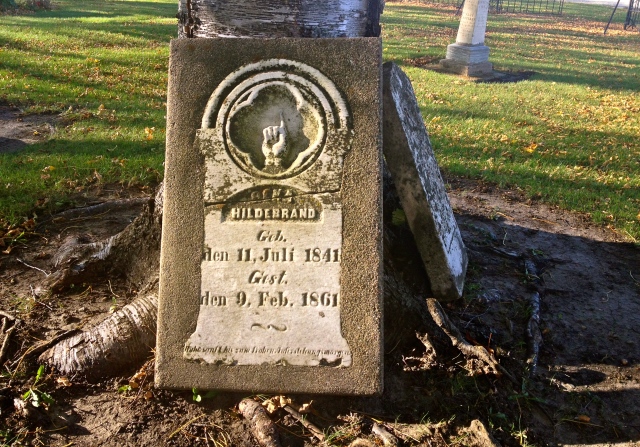
We happened to visit the country on a glorious fall day. The kids rode the horses (and pony) through the fields and down the road to an old graveyard that is populated by German and Norwegian immigrants to the area who settled here beginning in the 1850s. Some of the gravestones were so old that the carved names and dates had been all but erased by the elements. Others were propped against a birch tree. Having lost all connection to the graves that they once marked, they now appeared to gaze out beyond trees and fields and farms to whatever lies beyond the horizon.
Gravestones in Wheeling (German) Evangelical Cemetary Nerstrand, MN
It reminded me of the melancholy, nostalgic-sounding song Beyond The Horizon by Minnesota’s own Bob Dylan.
Beyond the horizon, behind the sun
At the end of the rainbow life has only begun
In the long hours of twilight ‘neath the stardust above
Beyond the horizon it is easy to love
My wretched heart’s pounding
I felt an angel’s kiss
My memories are drowning
In mortal bliss
Beyond the horizon, in the Springtime or Fall
Love waits forever for one and for all
Beyond the horizon across the divide
‘Round about midnight, we’ll be on the same side
Down in the valley the water runs cold
Beyond the horizon someone prayed for your soul
I’m touched with desire
What don’t I do?
I’ll throw the logs on the fire
I’ll build my world around you
Beyond the horizon, at the end of the game
Every step that you take, I’m walking the same
Beyond the horizon the night winds blow
The theme of a melody from many moons ago
The bells of St. Mary, how sweetly they chime
Beyond the horizon I found you just in time
It’s dark and it’s dreary
I ponder in vain
I’m weakened, I’m weary
My repentance is plain
Beyond the horizon o’er the treacherous sea
I still can’t believe that you’ve set aside your love for me
Beyond the horizon, ‘neath crimson skies
In the soft light of morning I’ll follow you with my eyes
Through countries and kingdoms and temples of stone
Beyond the horizon right down to the bone
It’s late in the season
Never knew, never cared
Whatever the reason
Someone’s life has been spared
Beyond the horizon the sky is so blue
I’ve got more than a lifetime to live lovin’ you
Bare ruined choirs, where late the sweet birds sang.
In me thou seest the twilight of such day
As after sunset fadeth in the west,
Which by and by black night doth take away,
Death’s second self, that seals up all in rest.
In me thou seest the glowing of such fire
That on the ashes of his youth doth lie,
As the deathbed whereon it must expire
Consumed with that which it was nourished by.
This thou perceiv’st, which makes thy love more strong,
To love that well which thou must leave ere long.
“Sonnet 73: That Time of Year Thou Mayst In Me Behold” by William Shakespeare. (Public domain.)
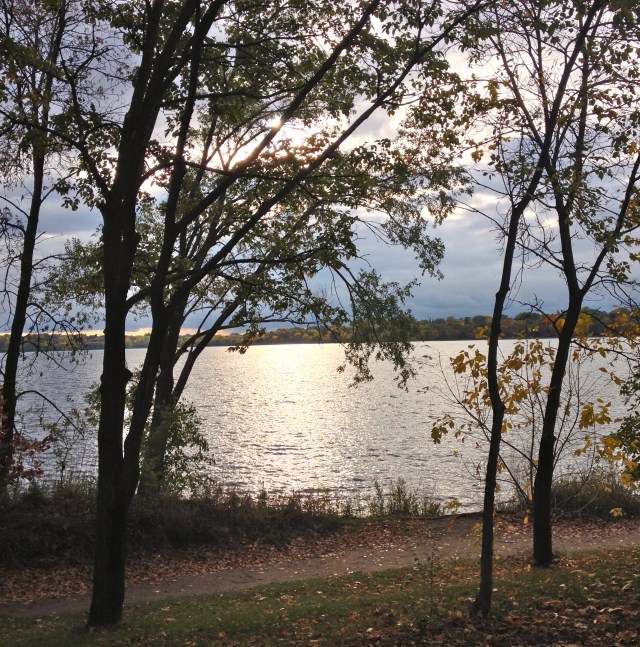
Sonnet 73, one of Shakespeare’s most metaphoric works, has long symbolized the season of autumn for me. With thanks to The Writer’s Almanac, William Shakespeare, Mr. Burns (my high school freshman English teacher) and Lake Harriet – and everything else in this world which never ceases to inspire and interest.
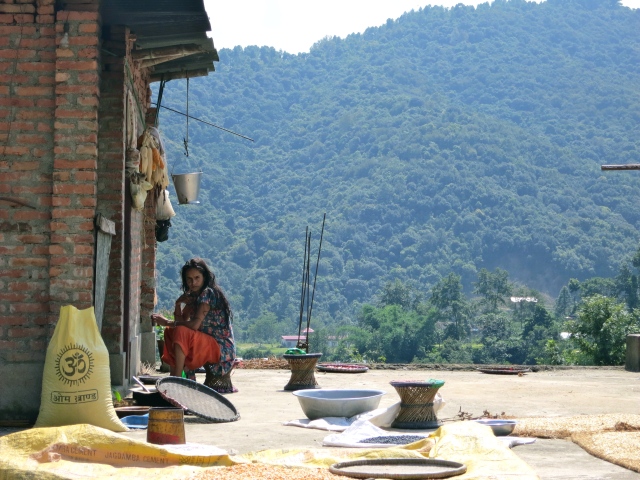
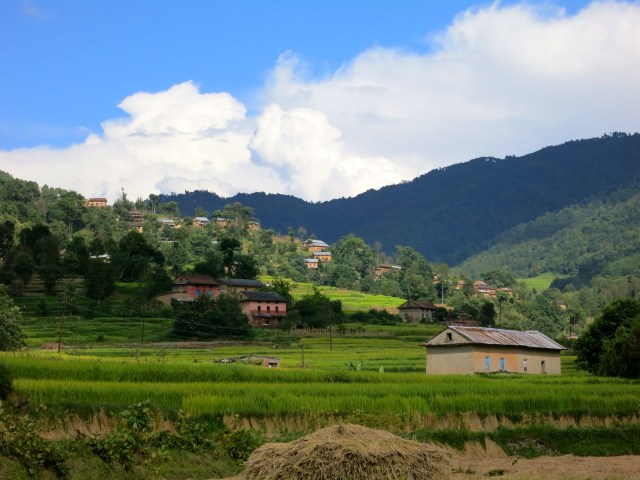
I took this photo last week in the Kathmandu Valley, near the village of Palubari, in Nepal. The monsoon season has just ended in Nepal, so the colors of the vegetation are especially vibrant right now. And the people of Nepal are always vibrant, both in their personalities and their dress.
Palubari took its name for the ginger that was once grown here, but this area in the eastern end of the Kathmandu Valley is fertile enough to grow rice, maize (corn), wheat, potatoes and many other vegetable crops.
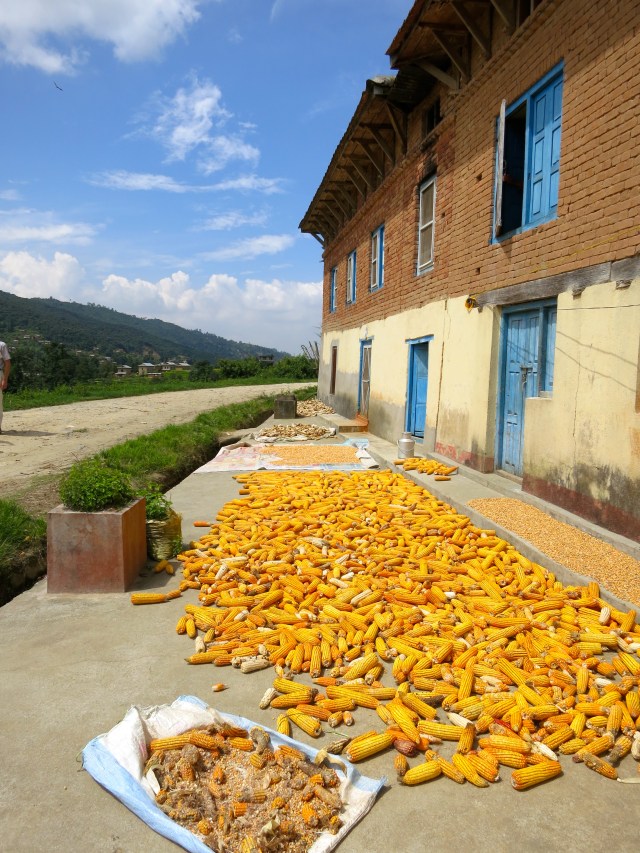
The corn crops have been harvested already, the cobs and kernels drying in the sun along the roads that run through the valley.
Corn drying in the sun.
Now the rice crop must be brought in. All the harvesting is done by hand (you can see the scythe in the hand of the woman in the first picture). It is hard, labor intensive work and it must all be done before the major festivals next month of Dashain and Tihar.
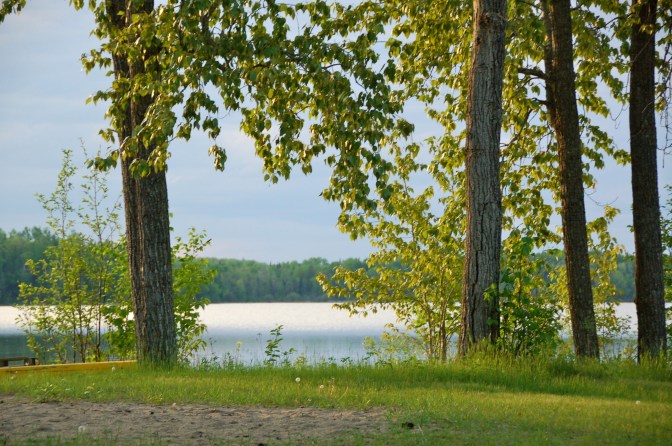
The Golden Hour on Turtle River Lake Bemidji, Minnesota USA
E.B. White once said:
“I arise in the morning torn between a desire to improve the world and a desire to enjoy the world. This makes it hard to plan the day.”
Note that he didn’t say that it was impossible to balance these seemingly competing impulses, but rather that it creates some planning challenges. As a human rights lawyer, I believe that is is crucial to find that balance on a daily basis. I try to show my kids that every day you can find a way to improve the world, in big ways and small. It may not seem like much, but when you say something nice instead of something mean or share your lunch with a friend who forgot his, you really are making an affirmative choice to improve the world around you.
At the same time, it is important to look for beauty in the world around you. It’s there, we just sometimes forget to look. Or listen. I pulled up short during my run the other day to listen to a robin. The robins have been back for months, so I usually don’t even hear their songs, but this particular robin was balanced on a telephone wire over an alley, stretching her (or his – I guess I can’t tell) body high to belt out a string of clear whistles. “Cheer up! Cheer up! Cheer up!” sang this avian Aretha Franklin. Beautiful!
When I was 11 or 12, one of my favorite books was Never Miss A Sunset by Jeannette Gilge. Told from the perspective of a 13-year-old girl, it is part of a series about a large family struggling to survive on a homestead in the early 1900s. It has been decades since I read it, but I still follow the advice of the father. No matter how hard the day’s work has been, you should take a moment every day to enjoy the sunset. For me, it is not so much the sunset that I try to take time to enjoy, but The Golden Hour before the sun sets.
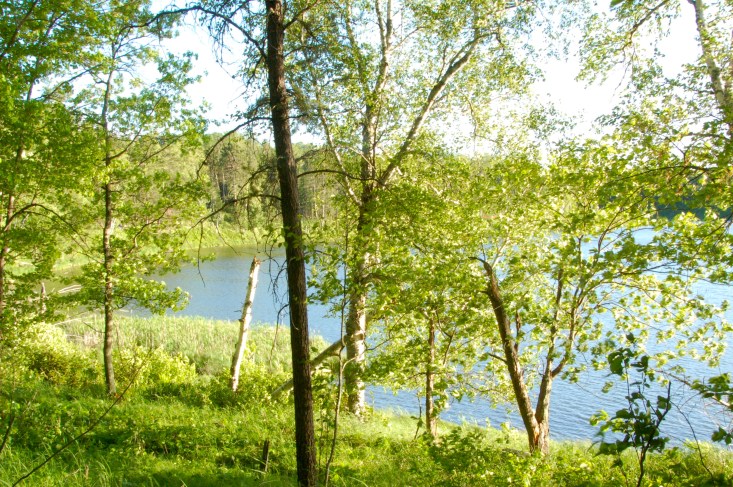
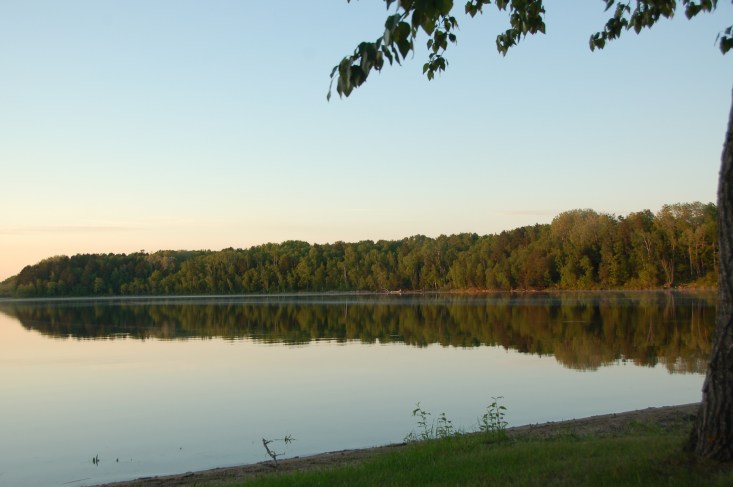
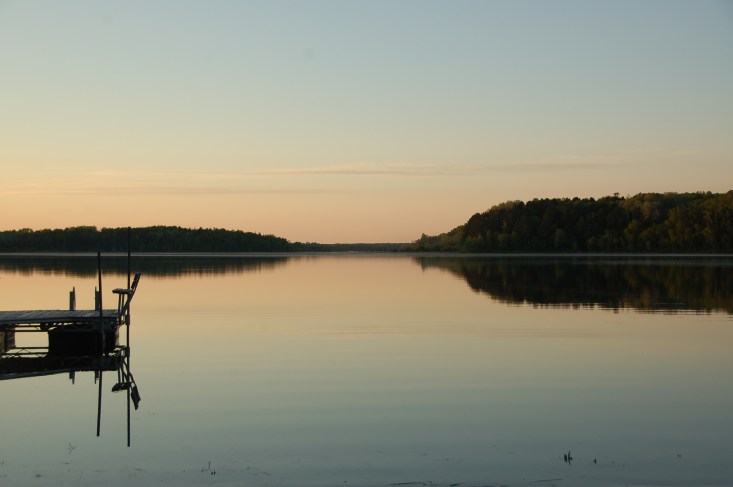
Maybe E.B. White had trouble planning his day, but there is a fixed moment on my daily schedule to enjoy the world. For the Weekly Photo Challenge this week, I am sharing some photos of The Golden Hour that I took in northern Minnesota recently.
Sunset at Bukkesjøen near Bemidji, Minnesota USAThe path to BukkesjøenThe Golden Hour at BukkesjøenMy daughter dances with friends from her cabin. Skogfjorden Norwegian Language Village, Bemidji Minnesota USASunset on Turtle River Lake Bemidji, Minnesota USATurtle River Lake Bemidji, Minnesota
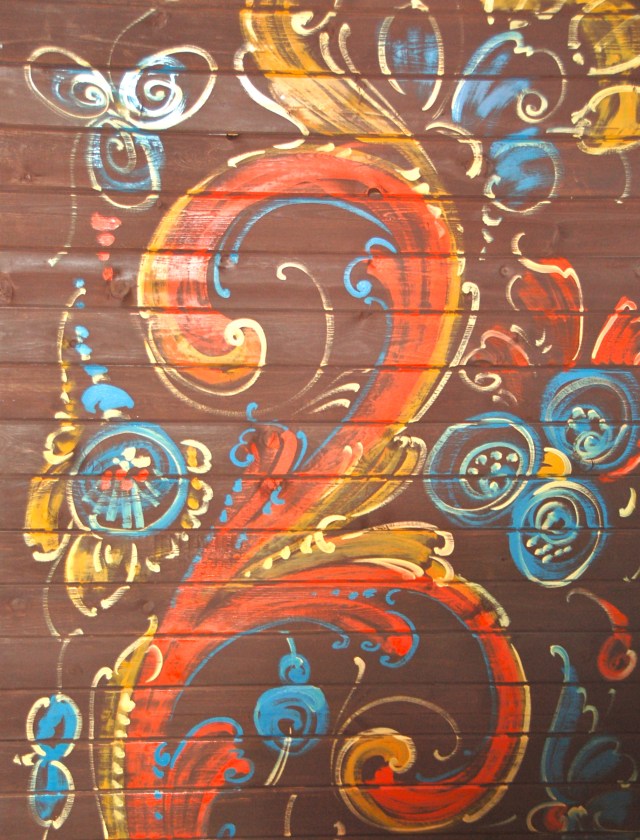
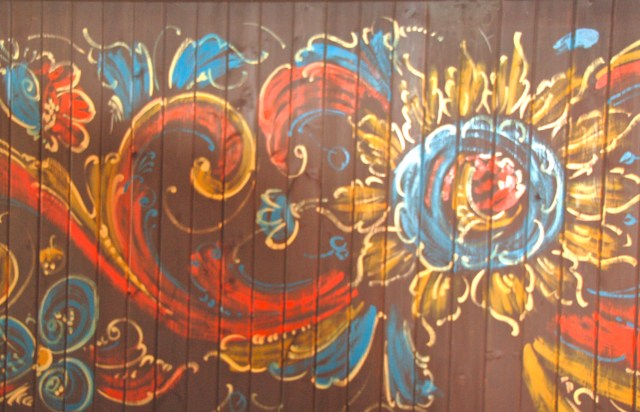
Rosemaling, the decorative folk painting of Norway, began in the low-land areas of eastern Norway about 1750. Persons who rosemaled for their livelihood would not have been land owners but poor, city dwellers. After being trained within a “guild” they would travel from county to county painting churches and/or the homes of the wealthy for a commission of either money or merely room and board. Thus rosemaling was carried over the mountains and toward Norway’s western coast. Once farther away from the influence of the guilds, these artists tried new ideas and motifs.
Soon strong regional styles developed. The Telemark and Hallingdal valleys became especially known for their fine rosemaling.Upon their exposure to rosemaling, rural folk would often imitate this folk art. Not having been taught in an urban guild, the amateur became spontaneous and expressive in his work on smaller objects such as drinking vessels and boxes.
Rosemaling went out of style in about 1860-1870. Rosemaling experienced it’s revival in America in the 20th century when Norwegian-Americans gave attention to the painted trunks and other objects brought to America by their ancestors.
The rosemaling pictured above were painted by Sigmund Aarseth.
They decorate the walls and ceiling of Gimle (the dining hall) at Skogfjorden,Concordia College’s Norwegian Language Village in Minnesota.
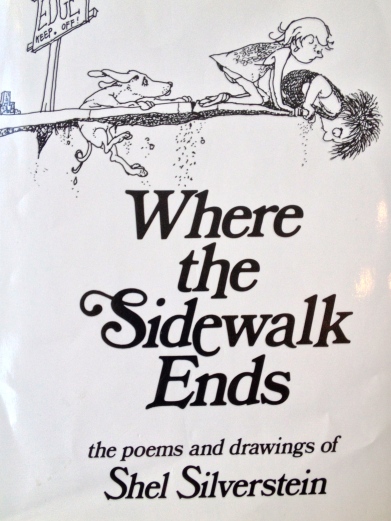
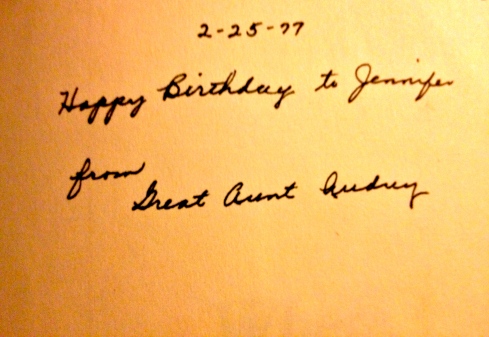
April is National Poetry Month and one of the “30 Ways to Celebrate” is to revisit a poem that you loved when you were young. So tonight I pulled out the Shel Silverstein‘s classic Where The Sidewalk Ends. We have all of Shel Silverstein’s books, even the posthumous Everything On It. I actually have two copies of Where The Sidewalk Ends. My first copy was a gift I received for my birthday from my great-aunt Audrey.
There is so much humor and sense and joy in these poems! If I read the opening line, I can close my eyes and recite many of the shorter ones. Flipping through the pages and familiar illustrations, one of my favorite poems jumped out at me. Perhaps it influenced me more as a child than I realized.
LISTEN TO THE MUSTN’TS
Listen to the MUSTN’TS, child,
Listen to the DON’TS
Listen to the SHOULDN’TS
The IMPOSSIBLES, the WON’TS
Listen to the NEVER HAVES
Then listen close to me–
Anything can happen, child,
ANYTHING can be.
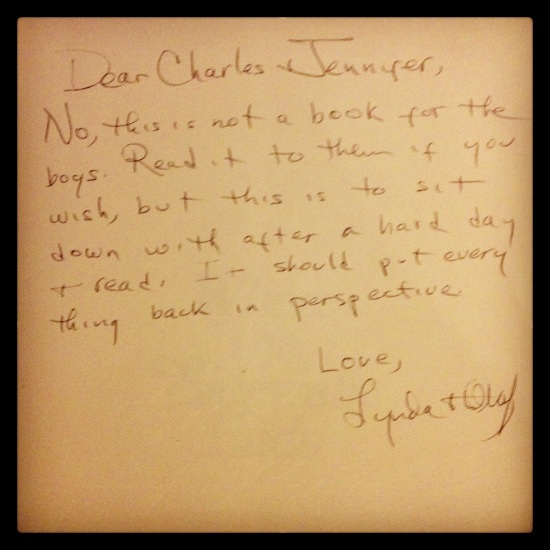
In the second of my two copies of Where The Sidewalk Ends, I re-discovered this dedication from my Grandpa Olaf (I have written about his secrets to a long and happy life before) and my step-grandmother Lynda:
My grandpa signed it, but this dedication was clearly written by Lynda. Both have been gone for a couple of years now. The book was given to us perhaps 10 years ago; I am certain that I have read the dedication before. But reading it again was a like a familiar touch on the shoulder. An unexpected blessing.
So I, for one, will be embracing the expected – and unexpected – richness of the National Month of Poetry.
***
Two more poems from Where The Sidewalk Ends and one bit of trivia:
HUG O’ WAR
I will not play at tug o’ war.
I’d rather play at hug o’ war,
Where everyone hugs
Instead of tugs,
Where everyone giggles
And rolls on the rug,
Where everyone kisses,
And everyone grins,
And everyone cuddles,
And everyone wins.
On the way to school in Minneapolis, USA
NO DIFFERENCE
Small as a peanut,
Big as a giant,
We’re all the same size
When we turn off the light.
Rich as a sultan,
Poor as a mite,
We’re all worth the same
When we turn out the light.
Red, black or orange,
Yellow or white,
We all look the same
When we turn out the light.
So maybe the way to make
Everything right
Is for God to just reach out
And turn out the light!
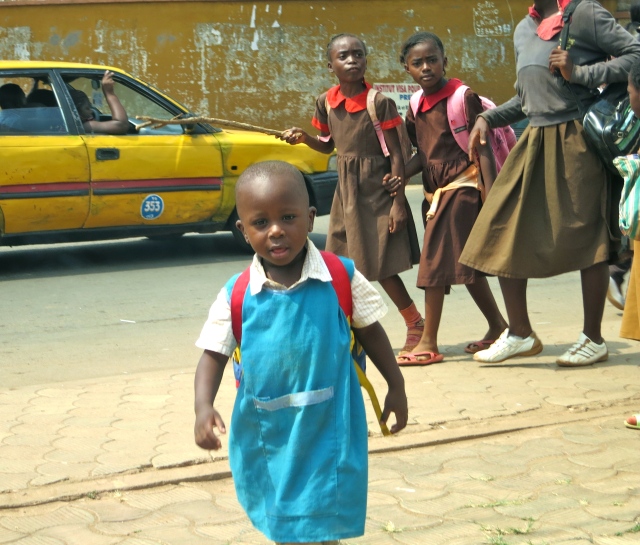
On the way home from school in Yaounde, Cameroon
Here is the Trivia bit: Shel Silverstein also wrote the lyrics to the Johnny Cash song “A Boy Named Sue”. (It’s true!)
More about Shel Silverstein’s poetry and illustrations – and activities, too – can be found on www.shelsilverstein.com.
***
For National Poetry Month, here are more of my posts with poems:












 The Human Rights Warrior
You must be logged in to post a comment.