Regrets

A couple of days ago, my  daughter asked me, “Do you ever have regrets?”

She asked me this in the bathroom, as I was drying my hair.  No matter what I am doing, my two youngest kids seem to hover around me, fluttering like moths to a flame.  The lack of privacy – not to mention personal space – doesn’t really bother me anymore.  And often, as on this particular morning, it provides the opportunity to talk about whatever is bubbling to the surface of  their young minds.

I weighed my possible responses. My daughter just turned eight. What could a second-grader possibly know about regret?  In the end, I answered that, in general, my regrets were not about things that I had done but rather about things that I had NOT done.

“Do YOU have any regrets?” I asked.

After a pause, she admitted, “Sometimes I’m not so nice to some kids at school.”

“But recognizing that you aren’t always nice means that you can do something about it,” I pointed out.  “Right?”

She shrugged and wandered off with her American Girl doll.  Maybe the message would sink in.

But for me,  a question remained, left hanging in the humid, post-shower bathroom air.

What do you do when you have regrets but you know that there is not a thing in the world that you can do about them?

The truth is that my daughter’s question brought me back to a conversation that I had in a very different context.  Several years ago, I spent some time in the Buduburam Refugee Settlement in Ghana. I was with a team taking statements from Liberian refugees for the Truth and Reconciliation Commission of Liberia.  It was almost exactly six years ago – May 2007 – and it was grueling, emotional work.  I interviewed more than 40 people that week and every single one of them  had suffered multiple layers of trauma and unimaginably tragic loss.  One after another, in family groups and as individuals, they sat before me in a small, cramped office.  Sometimes there was power for the ceiling  fan to move the hot, heavy air; sometimes there was not.  Each one of them was a survivor of horror, a testifier to the nightmare of war.  (I’ve written about some of them before in Talking To My Kids About Death.)

Even though they had left their homeland of Liberia, what they had experienced was still very much with them.  Even if they could push it down deep during the day, the terrors they witnessed would return to haunt their dreams.   Many people I interviewed told me of how the nightmares startled them awake at night, sweating and crying.  Many more told me of hearing others screaming in the night, neighbors who were trapped in their own PTSD- induced nightmares. There is no privacy in a refugee camp.

There was one woman who has always stayed with me.  She was middle-aged, calm and collected.  She told me her story in detail, almost scientifically exact.  Clearly, she had relived the events many times over.  She told me of her life before the war, the fighting and chaos that separated her from her husband and some of her children, the desperate weeks when she, her youngest children, and their neighbors hid in the bush, the treacherous journey to the border. The years – more than a decade- of limbo in this refugee camp.

At the end of any interview, I always ask, “Is there anything else you would like to tell me?”

This woman told me of that the only true regret that she had, the only regret of her life, was about something that she had not been able to do. What she told me went something like this:

We were hiding in the bush and the rebels passed close by.  They attacked a village there.  They didn’t see us, but we saw them.   They killed a lot of people.  We were too afraid to move, so afraid they would hear us.  There was a baby crying; they must have killed the mother.  The baby kept crying and crying and crying.  I wanted to go get that baby, but what could I do?  I knew the baby’s crying would give us all away to the rebels. The baby kept crying and crying and crying, all night long.  And then it stopped.  I knew that the baby had died.  In the morning, we saw that the rebels had moved on and we left our hiding place.  Now I hear that poor baby crying every night in my dreams.

Most people will never be put in a position like this, this untenable Hobson’s Choice.  Most of us will never be faced with having to make the choice between our own life -and that of our children and neighbors – and that of an innocent baby.  Many of us would like to assume that we would find a way to not make the choice; that we would find a way to save that baby.

I knew I could not save that baby.  I wanted to, so much, but I knew I could not.  Even so, I have always felt bad about it. I have never told anyone – not one single person – about this before. Just telling you now – it makes me feel better.

I don’t have any answers here, just as I had nothing to say to this woman other than “I am so sorry.”  I can’t change the world.   I can’t promise my daughter that she won’t experience pain or sorrow or guilt or regret.  I don’t even have an image to go along with this post.

But if there is one thing that I took away from that hot, cramped interview room in that refugee camp in Ghana, it is that there is a value in bearing witness.  I had worked with refugees and torture survivors for years, but it took this one woman to bring that point home to me.  There is a value in simply listening,  and in confirming for someone who suffered injustice that, “It is not right and I’m sorry that this happened to you.”

It may seem insignificant, but it is not.  And it is a reminder that when you come in contact with someone who is suffering, in either a big or a small way, there is always something that you can do. You can listen.

So do it.
Ode to Shel Silverstein

IMG_1348

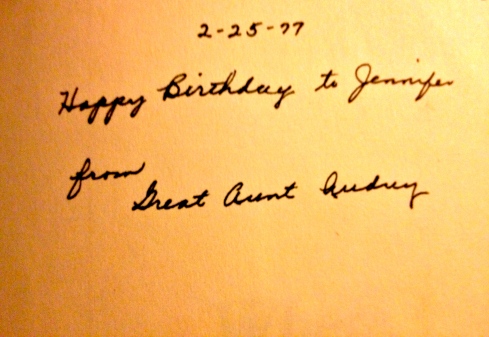
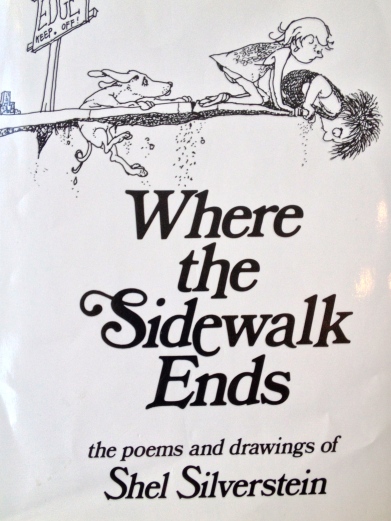
April is National Poetry Month and one of the “30 Ways to Celebrate”  is to revisit a poem that you loved when you were young.  So tonight I pulled out the Shel Silverstein‘s classic Where The Sidewalk Ends.  We have all of Shel Silverstein’s books, even the posthumous Everything On It. I actually have two copies of Where The Sidewalk Ends. My first copy was a gift I received for my birthday from my great-aunt Audrey.

IMG_1346

There is so much humor and sense and joy in these poems! If I read the opening line, I can close my eyes and recite many of the shorter ones. Flipping through the pages and familiar illustrations, one of my favorite poems jumped out at me.  Perhaps it influenced me more as a child than I realized.

LISTEN TO THE MUSTN’TS

Listen to the MUSTN’TS, child,

Listen to the DON’TS

Listen to the SHOULDN’TS

The IMPOSSIBLES, the WON’TS

Listen to the NEVER HAVES

Then listen close to me–

Anything can happen, child,

ANYTHING can be.

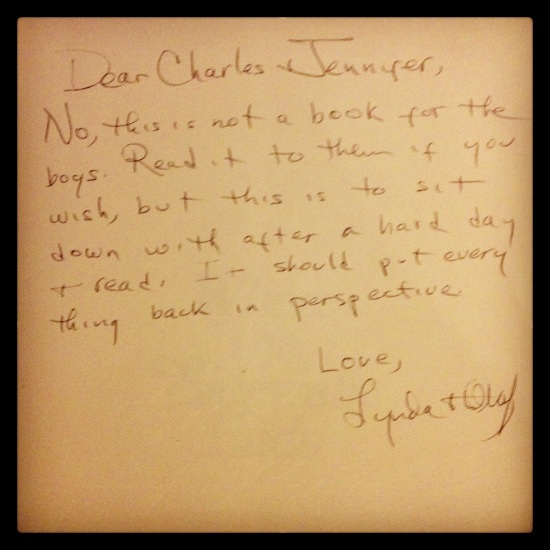
In the second of my two copies of Where The Sidewalk Ends, I re-discovered this dedication from my Grandpa Olaf (I have written about his secrets to a long and happy life before) and my step-grandmother Lynda:

Dedication

My grandpa signed it, but this dedication was clearly written by Lynda.  Both have been gone for a couple of years now.   The book was given to us perhaps 10 years ago; I am certain that I have read the dedication before.  But reading it again was a like a familiar touch on the shoulder.  An unexpected blessing.

So I, for one, will be embracing the expected – and unexpected – richness of the National Month of Poetry.

***

Two more poems from Where The Sidewalk Ends and one bit of trivia:

HUG O’ WAR

I will not play at tug o’ war.

I’d rather play at hug o’ war,

Where everyone hugs

Instead of tugs,

Where everyone giggles

And rolls on the rug,

Where everyone kisses,

And everyone grins,

And everyone cuddles,

And everyone wins.

Hug o' War
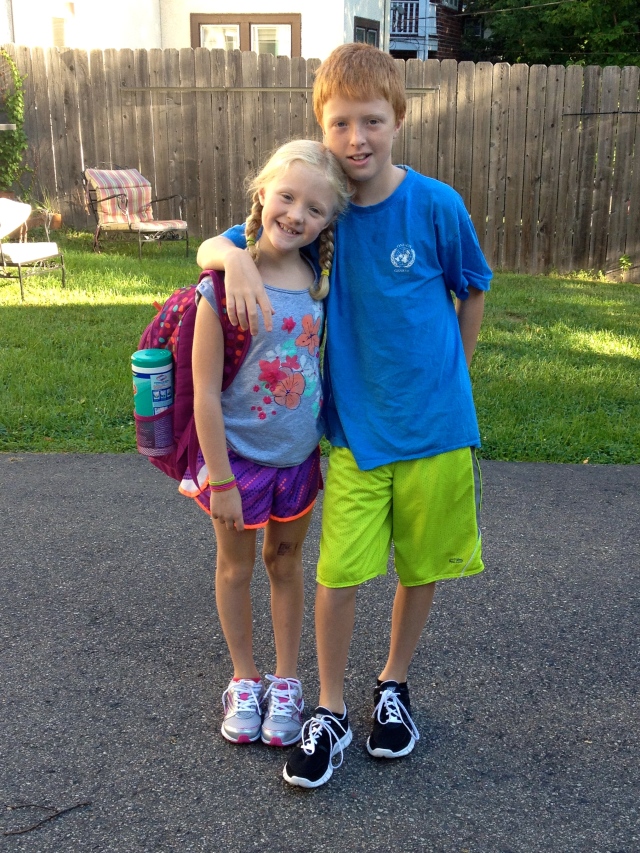
On the way to school in Minneapolis, USA

NO DIFFERENCE

Small as a peanut,

Big as a giant,

We’re all the same size

When we turn off the light.

Rich as a sultan,

Poor as a mite,

We’re all worth the same

When we turn out the light.

Red, black or orange,

Yellow or white,

We all look the same

When we turn out the light.

So maybe the way to make

Everything right

Is for God to just reach out

And turn out the light!

IMG_0202
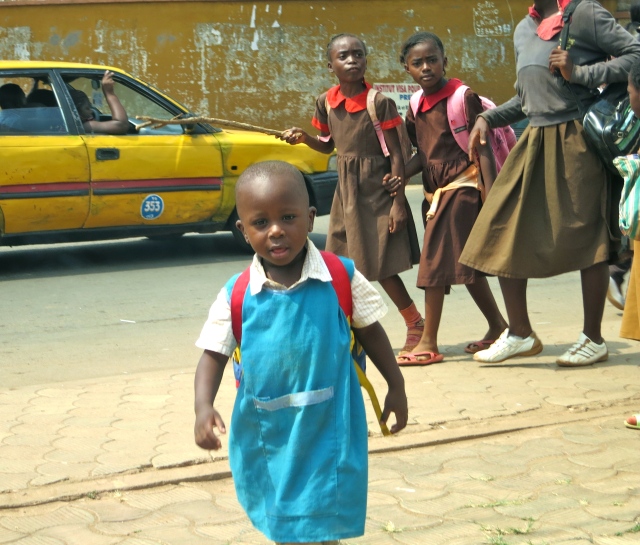
On the way home from school in Yaounde, Cameroon

Here is the Trivia bit:  Shel Silverstein also wrote the lyrics to the Johnny Cash song “A Boy Named Sue”. (It’s true!)

More about  Shel Silverstein’s poetry and illustrations – and activities, too – can be found on www.shelsilverstein.com.

***

For National Poetry Month, here are more of my posts with poems:

A Mother In A Refugee Camp by Chinua Achebe

April Rain Song by Langston Hughes

Dust of Snow by Robert Frost

Marriage Equality, Through the Eyes of a 10-Year-Old

20130328-160336.jpg

With the Supreme Court hearing arguments in two cases related to same-sex marriage, much has been written – and said and thought – this week about marriage equality in the United States. No matter how these particular nine justices rule (and there is speculation that, unlike the Warren Court which in 1967 issued a sweeping ruling on the unconstitutionality of state bans on interracial marriage, this court might actually punt), I am convinced that it is only a matter of time before same-sex marriage is a recognized as a right in this country.

This week, I re-read Hockey Moms, a post I wrote last summer about my 10-year-old son and his discussions with his hockey team about marriage equality. It was a lesson to me at the time about the importance of engaging people in the conversation about same-sex marriage. In re-reading it, however, I am struck by how much forward movement there has been in just the past six months. Not only was the proposed amendment (which would have defined marriage as between one man and one woman in the Minnesota state constitution) that Simon was lobbying against defeated last November, but it was defeated handily. In fact, it went down in flames. Even my 98 year-old grandmother voted NO! In a huge reversal, this year there is a real chance that our Minnesota state legislature will pass legislation legalizing same-sex marriage. The number of states with same-sex marriage jumped on election day in November when three states – Maryland, Maine and Washington – legalized same-sex marriage through popular vote. Recently, it seems like politicians have been “coming out” in favor of marriage equality on a daily basis.

The momentum in favor of same-sex marriage appears to be increasingly rapidly and there are signs that the trend will not be reversed. I asked my 13-year-old what he thought about the recent ABC/Washington Post poll that found that 81% of Americans aged 18-29 supported legal same-sex marriage, he said, “Well ,that makes sense. Although I am disappointed in the 20%. At my school, there are only two kids who oppose same-sex marriage.” They didn’t poll Americans under the age of 18, but anecdotally at least, support for marriage equality may be even higher among his peer group.

My kids are part of a generation which, although it doesn’t have an official name yet, is already saying, “Of course same-sex marriage should be legal. Why was this even an issue?” They have grown up with favorite teachers, beloved camp counselors, trusted neighbors, friends and classmates who are openly LGBT. They go to school and church with kids from families with parents who are in same-sex relationships, some but not all legally sanctioned by state law. Men kissing men, men kissing women, women kissing women – my kids don’t care. Frankly, it is disgusting to them when ANY adults kiss!

I’m sharing an excerpt from Hockey Moms to illustrate my kids’ perspective on marriage equality, a peek into the future.

***

My 10-year-old son comes out of the ice arena, swaggering despite the heavy hockey bag that he carries like a giant backpack. His hockey stick and water bottle he wields before him like a rod and staff. I’m sitting on a picnic table in the sun and, yes, I am facebooking on my iPhone. His cheeks are flushed, his bright ginger hair is damp-dark with sweat. He has an announcement to make.

“I’ve got everyone but one kid on my team to be in favor of same-sex marriage.

AND two of the coaches.”

He beams at me. I can feel my jaw as it drops.

I’ll be the first to admit that I’m a terrible hockey mom. I hate almost everything about the sport. I’ve got two sons who play, so I did put a decent amount of effort into learning the basic rules and terminology. My biggest problem is that I grew up in the Deep South, so my natural impulse when winter strikes is to hibernate. The whole concept of driving (in the cold) to sit (in the cold) to watch a sport played (on ice, in the cold) boggles my mind.

Going inside to watch hockey on a cold winter day is one thing. Going inside to watch hockey on a beautiful summer day is completely inconceivable to me. But here in Minnesota, hockey is a year round sport. Serious players play AAA from March to September and, unlike the regular season, players are not required to play where they live. There are kids on my 10-year-old’s team from throughout the Twin Cities Metro and even some kids who travel here for the weekend practices and tournaments from as far away as Florida and Texas.

But my two sons are way, way into hockey. They LOVE this sport! I respect that, so I suck it up and wash their stinky gear and drive them to the rink.

Until last winter, I went into the locker room when I took my boys to hockey – even though I have been banned from years from tying their skates because I (quote, unquote) “don’t do it right.” When my oldest son moved up to PeeWees, however, there was an unfortunate incident. I burst into the locker room, my 6-year-old daughter (wearing a pink jacket and sparkle ballet flats) in tow, only to find a gaggle of 12 year-olds in their underwear listening to loud music and talking trash. “Mom!” my son hissed. “I’m good.”

Given my locker room banishment, I was completely floored to hear that the hockey team was having a discussion about same-sex marriage while putting on their pads and breezers. Here is the story, from the perspective of my 10 year old: “One kid brought it up. He said it was gross, a man with a man or a woman with a woman.” So I said,

“ARE YOU CRAZY? That’s their choice who they love. It doesn’t affect you. Why does it matter to you? No one can tell you who to love.”

That launched the discussion which later led to the purported locker room conversions. It is a timely discussion in Minnesota, where there is a proposed constitutional amendment on the November ballot: “Shall the Minnesota Constitution be amended to provide that only a union of one man and one woman shall be valid or recognized as marriage in Minnesota?” VOTE NO signs have sprouted throughout our neighborhood; they line the roads on the way to the hockey rink.

Simon had been late getting to practice (my fault – more evidence for the Worst Hockey Mom title). A coach came in to hurry along the stragglers and Simon asked, “You’re voting NO on the marriage amendment, right?” “I don’t know yet,” he admitted. Simon laid out his arguments again, to which the coach responded, “You make a good point. I think I probably will vote No. Now get out on the ice.”

My son can be like a dog with a bone, so he brought it up again at the next practice. This time he was on time, so when he brought it up in the locker room, everyone on the team was there. One kid, a player who Simon describes as a “tough guy” got really upset when the other kid described same-sex marriage as “gross”. He stood up, half his gear on, and said,

“That’s my family you are talking about! I have two moms and they are married. It hurts my feelings when you say that my family is gross!”

Well, that sure got the team’s attention. According to Simon, he was too emotional to say much more but Simon was able to pick up where he left off.

See? He’s got two moms. So what? Why should his family be treated any differently than yours?

***

The US Supreme Court justices, who appear to be gnashing their teeth about the appropriate timing of a ruling on marriage equality, could benefit from the point of view of my 10 year-old.

People are just people; we are all equal. People love each other and benefit from loving, committed relationships.

We should all be able to marry who we love. Families should all be treated the same.

Marriage equality, through the eyes of a 10-year-old, is just not complicated.

Love

As the United States Supreme Court considers cases related marriage equality, you can read more – including the Top 100 Marriage Equality Blogs – here.

CALL OF (Parental) DUTY: Part II “Freedom To Game Is Important”

This is the second in my series of CALL OF (Parental) DUTY posts about the discussion we are having in our house about violent video games. Today is my 13 year-old son Sevrin’s chance to share his point of view.  Below is a letter that he wrote to us (his parents) about his frustrations with not be able to get Call of Duty: Black Ops II.

I’m proud of you, Sev, for expressing your feelings so eloquently and – especially – for putting the time and effort into writing them down for us. When I read this, I remember precisely how frustrating it is to feel that you are no longer a child but yet are not allowed to make many choices for yourself. Thank you for writing this and allowing me to share it with others. 

Freedom To Game Is Important

I want you to imagine, for a minute, that you are in a library. Or maybe a book store. There are rows and rows of books. Each book holds a story, unique and special in its own way. In this library filled with books you have the Fantasy row, the Action row, the Poetry row and then you come across the Childrens section. The library lady (or man) says that you are only allowed  to check out books from the Childrens row because she (or he) doesn’t think that you are “ready” for the big boy books. Now I ask you, how would you feel? You have rows and rows of books and yet you are restricted to the small corner and you’ve just been told to deal with it. If you were me, you’d probably feel sad, maybe a little frustrated, and a little bit confused on why you have to read Elmo and Barbie when you could be reading Shakespeare and anything you could possibly dream of. Alas, this brings me to my point. Of course I am exaggerating when I say all I can do is read Elmo but I’m trying to make my point clear. Why is gaming any different from reading in terms of age restrictions?

If it’s because M games are too gorey then I wonder why I’m allowed to read A Long Way Gone: Memoirs of a Boy Soldier. The true horrors of war seep from that book. Kids get kidnapped, hopped up on drugs, and told to kill anybody who opposes their “Dad” (The General of the RUF). In the book, the character sees people get stabbed and shot all the time. He sees people with their fingers chopped off and the letters RUF scorched into their backs. He’s seen women running from the fight with babies on their backs, not knowing that their kin had just taken a bullet and saved their parent’s life. So now I’ve seen it too. And I know what war is like in real life. I know what war does to people and I understand how terrible it is. But I don’t see a problem with shooting a blob in the form of a human that is really just something on the screen. I’m not hurting anybody by playing an M game. That’s like saying that I can’t shoot a target at a shooting range because I might hurt the wooden carving of a person. Besides, do you really think that I’ll become some sort of stone cold killer if a kill something in a digital world?!

If you are concerned about exposing me to bad language then you’re going to have to do a lot more than not allowing me to play M games. Say we are to watch a movie like umm… let’s just go with Band of Brothers. Swearing in that series is important in the plot. It gives the viewer a really good sense of WWII and war in general. But it’s not just from movies and books, it’s also from people around me. Take you/Dad for example. If you/Dad get angry, really angry, you tend to have a fairly large potty mouth. But sometimes swearing is required to get it into my head that “Yeah, I do need to stop complaining about bedtime.”  Plus, there is no doubt that there is swearing in T games, too. On top of all of that, I don’t think that just because I hear people swearing in a video game means I’m going to repeat the words I hear to other people say or mouth off at you/Dad. Like I said, I hear swearing all around me.Now, if the problem is that I’m just not old enough to be able to have the freedom to choose any game I want well, I disagree. I’m turning 13. That means I’m a teenager. I am both physically mature and mentally mature.  I am shaving and my voice is dropping, no, plummeting like a giant rock. I am also taller than Mom (Mocky!) and catching you, Dad. As for mentally, I’ve been trying to keep all A’s in part because of this. I am smart and know I can handle M games but have not been given a chance for three years. I made the mistake of asking for Deus Ex. But once again, I was ten and had a squeaky voice. I need freedom and choice instead of getting advice (although, sometimes the advice is helpful). I’m asking for a chance to try it again.

The bottom line is, I think that I can take it. If I don’t get to play M games now, I will probably have to wait two or three more years! We have no solid date or age in which I can play M games and I think that 13 is the perfect time to start. I want the ability to choose what games I should and shouldn’t play. And believe me, I know what games I want to get and don’t want. I sit here and search and search and search. I research games all the time and the reason I chose Black Ops II is because I honestly think that it would be fun. I didn’t choose this game just to be with the Kewl Kids. I’m not, as you may well know, a “hop on the bandwagon” kind of guy. Maybe one of the reasons the Call of Duty franchise got so big is because people had a really good time playing them. One other thing about Call of Duty is that Treyarch is the company making BLOPS II and they are known for making a much better story than Infinity Ward and with the futuristic setting, they have opened the floodgates to creative ideas and lots of options. I hope you at least consider what I’m asking for and thank you for reading.

Read the introduction to the CALL OF (Parental) DUTY series here.
For more of the Weekly Writing Challenge: Just Do It!, click here.

CALL OF (Parental) DUTY: Part I

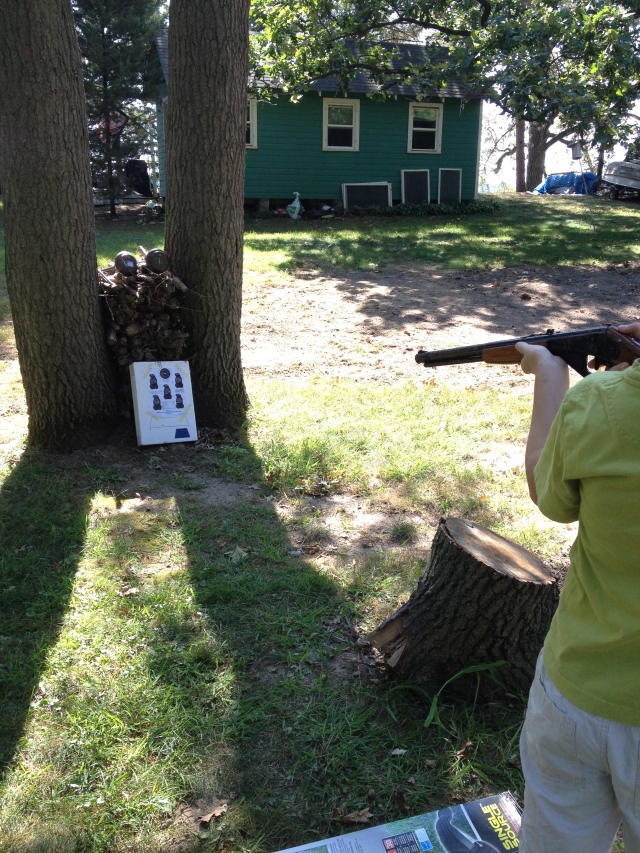
Target PracticeIt’s pretty rare that a national debate mirrors so exactly one that is raging within my own family circle.  But in the wake of the recent tragedy at Sandy Hook Elementary – and subsequent comments by National Rifle Association CEO Wayne LaPierre blaming gun violence on video game makers – a public discussion has been reopened  about violent video games and their impact on society.  It is the same discussion that has been going on, on a micro level, all fall in our household.  Although, frankly,  “discussion” is too mild a verb to capture the emotions surrounding the debate between the parents and the teenager about whether he can have CALL OF DUTY: Black Ops II.

My oldest son turned 13 years old in October.  He is a great kid, the kind of kid that other parents want their own kids to hang out with.  He’s smart and self-confident, has good friends and does well at school.  He is, I think, exceptionally mature for his age.  And he likes to play video games.  He has always liked to play video games, going way back to when he would choose to play Freddi Fish rather than watch a movie for his screentime.

His father and I don’t enjoy playing video games, so we start from a position of divergence.

Allowing for a difference in entertainment preferences (which I do), there is a second preliminary point that we don’t see eye to eye on: I don’t understand why it is fun to shoot at things.  We’ve got a couple of BB guns at the cabin, and the kids are allowed to shoot them at targets.  I’ve tried target practice and found it completely boring.

When my son was born, I was very clear that we would never have toy guns in the house.  Then one day, when he was about 20 months, he saw a kid at the coffee shop make a gun with his thumb and index finger.  The kid pointed his finger at Sevrin and said,”Pew! Pew!”  And that was all it took.  Fingers, sticks, Duplo legos – it seemed like everything was turned into a “shooter”.  Before long, I had caved in to the reality of nature over nurture.  Over the years, I not only allowed, but I myself purchased, a vast assortment of Nerf gun products for birthday and Christmas gifts.  I didn’t understand it, but I saw no harm in it.  So again, I have to acknowledge that others, including my son, might find it entertaining to shoot at things.

But all of this seemed was a long way off from first person shooter video games like CALL OF DUTY: Black Ops II.   So when he asked for it for his birthday, we immediately said, “NO!”

Then I realized that, my general prejudice against video games and shooting things aside, I didn’t know anything about video games.  I didn’t know what standards were used for rating them or whether there were parental controls.  I realized that my son is a reasonable, intelligent person, even if he is still only 13 years old.  I thought that he did have a point – it wasn’t fair that we were banning the games without knowing anything about them.

So in November, I began to dig deeper.  My son and I both did research on violent video games and the impact on the brain.  We shared our findings with each other, emailing back and forth.  I spent hours not only doing research, but also reading comments by both parents and teenagers on the pros and cons of letting your kids play violent video games.

In the end, I came to the conclusion that CALL OF DUTY: Black Ops II is not appropriate for my 13 year old.  My son was bitterly disappointed, and I am truly sorry for that.  Sometimes a parent has to play the ultimate trump card, but I think it is important that we went through this process together.

This week, I will be writing about our experience in a series of posts I am titling CALL OF (Parental) DUTY.  I think my son deserves the opportunity to voice his opinions to a wider audience, so he will contribute his writing to the series as well.  Stay tuned!

Here are the links to other posts in this series:

CALL OF (Parental) DUTY: Part II “Freedom to Game is Important” (in which my 13 year old son expresses his point of view).

(I’ve been thinking about doing this series for some time, but it took a Weekly Writing Challenge: Just Do It – and a weeklong holiday – to get me motivated to actually do it.  That, and a promise to my son that I would try to be fair and accurate.)

Assault In The Second Degree Grade

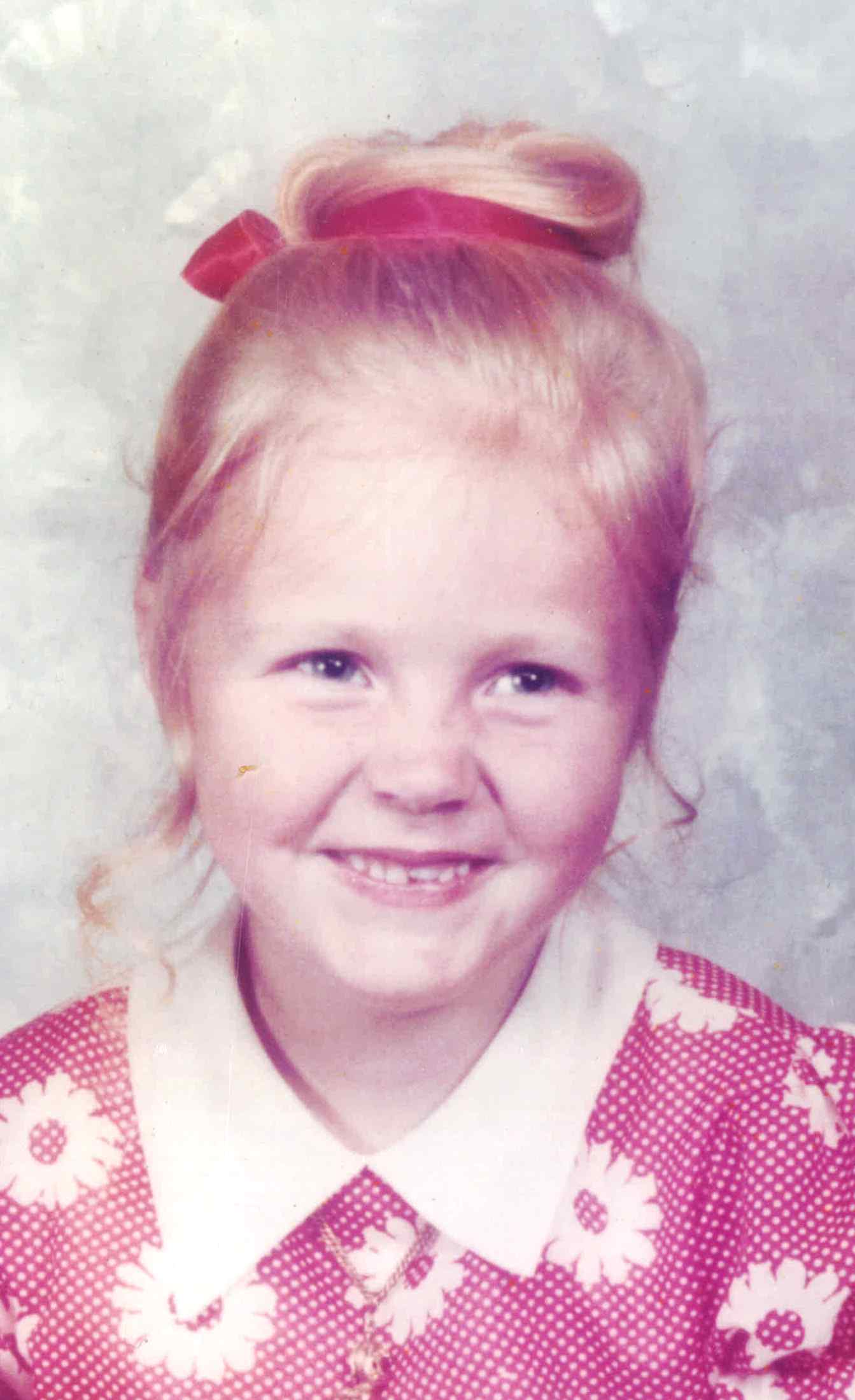
Me at age 7

I picked up my seven-year old daughter early from school one day not too long ago.  “How was your day?” I asked, as she buckled herself securely into her booster seat.  The key was in the ignition, and my brain had already sent the signal to my hand to turn it, when she replied,

“OK. Except that X touched me inappropriately this morning.”

We were running late for the appointment, but I did not start the car.  Instead, I turned around and looked at her.  She sat placidly in the backseat, the afternoon sun backlighting her golden curls like an angel’s aura. She gazed at me innocently with her big blue eyes. She didn’t look at all upset.

“Tell me what happened,” I said.

My voice sounded much calmer than I expected.  It certainly didn’t convey what I was feeling. When you are a parent,  and your most important job in life is to protect your kid, it is terribly disconcerting – not to mention heartrending – to hear her say something like this. I wanted to scream, “Who in the world would have the audacity to touch MY CHILD inappropriately?!?!”

Somehow, I stayed calm and delved for facts.  She answered each question fully and calmly. Here is a summary of what she told me and what I wrote in an email to her teacher later that night:

My daughter told me that X has been touching her a lot and making her feel uncomfortable.  She said on Friday that he was rubbing her upper thighs and touched her briefly in the bathing suit area.  She said that it is usually during circle time that this happens, so she tries not to sit near him.  I told her to tell you immediately the next time it happened, but I would appreciate it if you could keep an eye out for this behavior and help her avoid it.

I did not include this in the email, but she also told me that she always asked her friends to sit around her at circle time, a perimeter of girlfriend protection.

Up until last year, I think my reaction might have been different – more anger than the deep sadness that I was feeling. But after I wrote (and Time published) the How to Raise Boys Not To Be Total Jerks piece about my reaction when my son told a sexist joke, I heard from dozens of women about their experiences with inappropriate touching, sexual harassment, and sexual abuse.  Women of all ages, ethnicities and occupations, shared their experiences from all over the world.  A couple of medical professionals even told me about patients who had touched them inappropriately during medical examinations.  The sad truth is that these are experiences that are all too common for girls and women throughout the world.  I realized, sitting there in the car with my key in the ignition, that this was only the beginning for my second grade daughter.

In those few seconds before normality returned and we drove on to the orthodontist, I saw an image of myself in the second grade.  An image, like I was watching from above, of myself at the age of 7, pinned down in the dust on the playground at Magnolia Woods Elementary School by a boy who easily weighed twice as much as me.  I had not thought of it in more than 30 years, but now I had a sudden, strong remembrance of the feeling of being panicked and trapped, as he sat heavily on my chest and held my wrists down on either side of my head.

I had thought that we were playing chase at recess; HE told me that we were playing kissing chase.  He demanded that I hold still so he could kiss me – he caught me, so it was his right.  A kiss was the price of my freedom.  I remember thrashing, kicking, rolling my head and arching my back, all to no avail.  A crowd of first and second graders gathered to watch. I think they were  cheering him on.

The school may have taken its name from magnolia trees, but I frankly don’t remember any.  There were crepe myrtle trees all along the walkway where we second graders lined up to enter our classrooms.  Small tree frogs congregated there; they seemed to have no purpose in life other than to sing happily and spit down on us.  A certain times in the year, the crepe myrtles’ strange, pink blossoms – which looked like something right out of Dr Seuss – covered the trees.  Pink petals blanketed the sidewalk where we second graders lined up.

As I struggled to break free from this boy, oh how I longed for the crepe myrtle trees and the safety of my classroom door!  I pictured myself running, as fast as I could, to that safe spot. Instead, I lay on my back, trapped, in the dust on the playground, trying not to see the boy’s face hovering inches above me. Looking instead for the freedom above me, in the bright blue of a Louisiana winter sky and a canopy of towering swamp oaks.

I have no complaints about the way my daughter’s school responded.  The teacher replied within a few hours and forwarded the information on to the school principal and social worker.  First thing on Monday morning, the social worker interviewed both students.  By Monday afternoon, they had put place a six point plan of strategies to ensure the safety of all of the second graders.  The school social worker laid it out for me:

1)      I will  speak to all of the 2nd grade classrooms about appropriate interactions.

2)      All students will be reminded to tell an adult as soon as something happens so we will be able to address it.

3)      Teachers will be vigilant and observant in the classrooms for appropriate student interactions.

4)      The playground staff will closely monitor for concerning behavior.

5)      Seating assignments will be made based on student needs.

6)      Students who cannot follow the rules will be seated next to the teacher.

The school social worker also said, “Please acknowledge your daughter for telling you, so you could inform us.”

When my daughter got home from school the next day, she reported that all six points of this plan had already been implemented.

“I’m proud of you for telling me. It was the right thing to do,” I said.

“I know,” she sighed.  “Everyone keeps telling me that! I’m getting kind of tired of hearing about it.”

But here’s the thing.  Statistics on sexual abuse in children are hard to come by because the majority of cases are never reported to authorities (estimates on reporting range from between only 12% (see Hanson, 1999) and 30% of cases (Finkelhor, 2008)). Based on reporting percentages, the real number of cases of sexual abuse could be anywhere from 260,000-650,000 kids a year.  To put it another way, as many as one in three girls and one in seven boys in the United States will be sexually abused at some point in their childhood.

I’m not suggesting that what my daughter (or I) experienced was sexual abuse.  But it was an assault – and definitely a wake up call to my daughter’s vulnerability to the potential of something much worse. I don’t know the little boy who I call X here. I’ve also been around kids enough to know that second graders get squirrelly.  Sometimes, especially in close quarters, they have trouble keeping their hands to themselves.  I’m not willing to make any assumptions about this kid or speculate that his behavior is a sign that he will grow up to be a sexual predator.  But research shows that 40 percent of child sex abuse is committed by other children or adolescents. In fact, as many as 50 percent of those who sexually abuse other children are under the age of 18. These are facts that I did not know before.

When the recess bell rang and that boy got off of me, I sprinted for my second grade classroom door.  I got there before any of the other kids and put my face against the glass window to cool my cheeks, which were burning with shame and embarrassment.  For the next week or so, I spent recess in different part of the playground, doing penny flips on the monkey bars.  When I finally went back to playing chase, I made sure that I ran as fast as I could so I would never get caught.  For the rest of my time at Magnolia Woods, I was careful to keep away from that boy.  But I never told a single person – not my friends, not my teacher, not my parents – about him holding me down and trying to kiss me.  Not even when I saw him do the same thing to other girls.

So I’m thankful that my daughter told me about what happened to her.  And I’m thankful that the school took quick and decisive action, reinforcing the message for all of the kids and staff that school is a place where everyone has a right to feel safe. I’m especially thankful that something worse did not happen to my daughter, but also that this experience has left her better prepared for the future.

Child sexual abuse happens in all racial, religious, ethnic and age groups, and at all socio-economic levels.   Talk to your daughters and your sons about appropriate v. inappropriate touching, as well as what to do if it happens to them – or if they see it happening to someone else.  If you’ve talked to them about it once, then do it again.  Kids need to hear it again as they move through their various developmental stages. If you feel uncomfortable, just remember that what you are doing is preparing your kids to protect themselves, something they will have to do for the rest of their lives.

Resources about identifying signs of and avoiding child sexual abuse can be found at Stop It Now.  If you know of other good resources, please feel free to add them in the comments. 


The Thankful Turkey

It is Thanksgiving Day here in the United States.  This uniquely American holiday is supposed to remind us of all that we have to be thankful for, both as individuals and as a nation, but I fear that this sometimes gets lost in our collective national appetite for overindulgence (we don’t stop eating until we feel remorse) and entertainment (Macy’s Parade, football, holiday TV specials).  That we carry out these traditions in the company of our closest friends and family members is important and perhaps even the saving grace of the day, but have we lost the true spirit of Thanksgiving?

I was at my daughter’s school last week for Turkey Bingo. At this event, 25 lucky families won a turkey.  We did not, although we came within a B11 of winning.   As we were leaving, she grabbed my hand and said, “I want to show you something.” She led me out into the hall to a giant, colorful turkey on the wall.  She explained that each of the students had written what they were thankful for on a feather.

The thoughts expressed on the feathers give a picture of the typical things for which the average American kid is thankful.  I saw feathers that said things like:

“I am thankful for friends and family.”  “I am thankful for my mom.” “I am thankful for my sisters.”

“I am thankful for my grandma and grandpa.” “I’m thankful for my daddy.”

Other feathers said things like:

“I’m thankful for my cat” and “I am thankful for my xBox.”

I noticed a couple of feathers, though, that said things like:

“I’m thankful to be here”  and “I am thankful for America.”

“I am thankful to live in a place with no war.”

My daughter goes to a school that has a large number of English Language Learner students.  Many came to this country as refugees from Somalia or other countries in East Africa, but she also has friends who came to this country as refugees from Tibet or were adopted from orphanages in China.  There are also kids at her school from Central and South America.

Sometimes we forget that the Pilgrims were refugees.  In England, they were persecuted on account of their religious beliefs.  They took the tremendous risk of coming to this new land in order to be free to practice their own religion.  And giving thanks for their freedom was a big part of the first Thanksgiving.

As I looked at that turkey on the wall of my daughter’s school, I had a moment of inspiration. When all of those individual feathers, childishly and colorfully decorated, are put together, you get a lovely image.  But you also get much more.  When all of those truthful and thankful thoughts are put together, you feel the true spirit of Thanksgiving.

And that is the inspiration and the spirit in which I hope to celebrate this holiday.

Happy Thanksgiving to you and yours, from me and (one of) mine!

INTERNATIONAL DAY OF THE GIRL: Kanchi’s Story

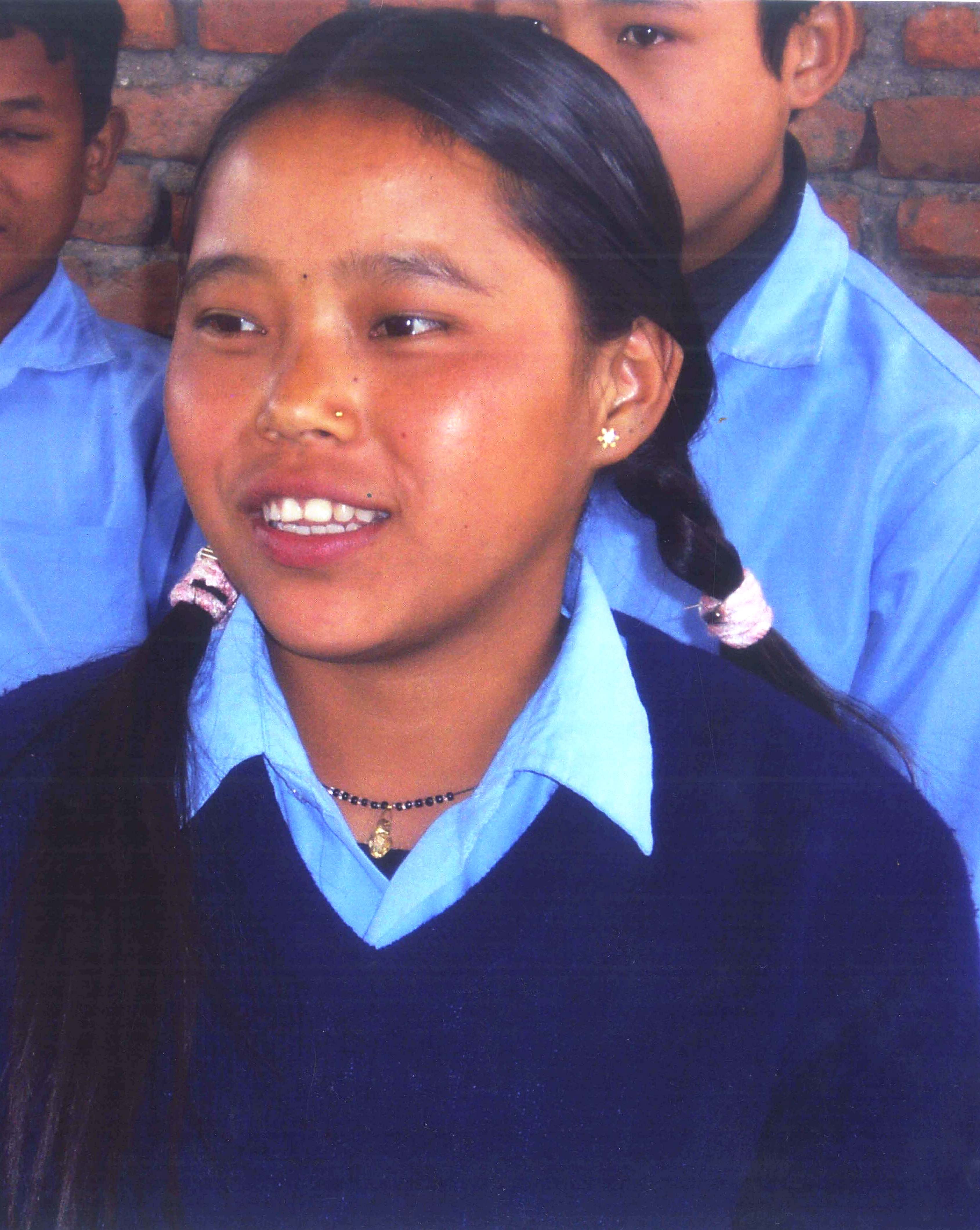
Every morning when I come into work, I am greeted by the smiling face of a young girl. Her hair is pulled neatly back into two braids, glossy black against her pink hairbands.  Her eyes, dark and alert, shine at me – I swear I can see them twinkle.

She wears the blue uniform of her school, the Sankhu-Palubari Community School in rural Nepal.  The Advocates for Human Rights supports the school to provide the right to education to the most disadvantaged kids in the area and to prevent them from becoming involved in child labor.  Photographs from the school hang on the walls of our office, reminders to us of the lives that we impact with our human rights work.

Even though I see her every day, until last month I had never met this cheerful young girl, a girl whose smile – even in a photo – comes from her core, seems to light her entire being. Until last month, I did not know that her name was Kanchi.  And I had never heard her incredible story.

*****

In 1999, Kanchi was six years old.  She lived with her family in a village in the Kathmandu Valley.  Her parents were poor farmers; they had only a little land and some cattle and they struggled to feed their family.  Kanchi was the youngest of six sisters.  She and her sisters (and also her  brother) had to help their parents in the fields and with household chores.  Kanchi’s job was also to take the cattle to the forest to graze.   Kanchi did not go to school.   There were many children in Nepal that did not go to school at that time, but girls, like Kanchi, were more likely than boys to work rather than go to school – particularly in rural areas like the Suntole district where she lived.

Kanchi was a very smart and determined little girl.  She wanted to go to school.   So when she heard that a new school was opening in the Sankhu-Palubari community – a school for kids who were not able to go to school because they couldn’t pay or were discriminated against – she was very excited.  She rushed off to tell her parents.  But her parents, who had never themselves been educated, were not as excited as Kanchi.  Why should they let her go to school?  Who would help feed the family? Why should they send her to school if she was only going to get married in a few years anyway?

Kanchi says that she cried for a month and begged her parents to let her go to school.  One day, teachers from the new school came to visit Kanchi’s parents to talk to them about the school. The teachers explained that it would help THEM if Kanchi could read and write.  They explained why it was important for all children to go to school, even girls.  They told them that all children – even the poorest, the lowest-caste, members of indigenous groups – had a right to education.

Kanchi’s older sisters, who had never had the opportunity to go to school, took her side. Instead getting an education, they had all married young and were working in the fields.  Kanchi’s sisters argued that Kanchi should go to school, take this opportunity for a life that would be different from theirs.  Finally, their parents agreed to let Kanchi go to school.

Kanchi started at the Sankhu-Palubari Community School in 1999, one of 39  students in the first kindergarten class.  To get to school, Kanchi had to walk one and a half hours each way.  There were many other obstacles along the way, too.  At various times, her parents wanted her to stop school and help them with farming.  But she stayed in school and worked hard. She told her parents,  “I want to do something different from the others.”

Kanchi liked her teachers and felt supported by them.  She felt that the best thing about the school was the teaching environment.  She stayed in school and was one of only two girls in the first class to graduate from 8th grade.  She continued on to high school and completed 12th grade at  Siddhartha College of Banepa in 2012.  The first in her family to go to school, Kanchi is also the first girl from the Sankhu-Palubari Community School to graduate from 12th grade.

I met Kanchi for the first time in September.  Almost exactly 13 years after this brave little girl started kindergarten, she is a lovely young woman who is preparing for her university entrance exams.  She plans to study agriculture  starting in January.   Her parents are proud of her and they are happy now – she has chosen the family profession – but Kanchi is interested in learning more about organic farming so she can bring techniques back to her village.  “I want to live a healthy life and give a healthy life to others,” she says.

Sitting in the principal’s office at Sankhu-Palubari Community School, I asked her what the school meant to her.  Kanchi said, “I gained from this school my life.  If I hadn’t learned to read and write, I would be a housewife.”  When asked about her sisters, she told me that they had made sure to send their own children to school.

In her free time, Kanchi likes to sing and dance and make handicrafts to decorate her room.  She likes to play with her sisters’ children.  She has a smile that lights the whole world.  She told me her nickname, Himshila.  She smiled when she told me it means “mountain snow, strong rock”.  Strong rock.  That seems just about right.

*****

October 11, 2012 is the first International Day of the Girl Child.  The United Nations has designated this day to promote the rights of girls, highlight gender inequalities and the challenges girls face, and address discrimination and abuse suffered by girls around the globe.  In many ways, the story of Kanchi and her sisters reflects the experience of girls in many countries throughout the world.  All over the world, girls are denied equal access to education, forced into child labor, married off at a young age, pressured to drop out of school because of their gender.

There are many good reasons to ensure access to education for girls like Kanchi, however. Educating girls is one of the strongest ways to improve gender equality.  It is also one the best ways to reduce poverty and promote economic growth and development.

“Investing in girls is smart,” says World Bank President, Robert Zoellick. “It is central to boosting development, breaking the cycle of intergenerational poverty, and allowing girls, and then women—50 percent of the world’s population—to lead better, fairer and more productive lives.”

The International Day of the Girl is a day to recommit ourselves to ensuring that girls like Kanchi have the chance to live their lives to their fullest possible potential.  To redouble our efforts to promote the rights of girls wherever they live in the world.   This first International Day of the Girl is also a day to honor girls like Kanchi.  A day to take the story of her success in one tiny corner of Nepal and shout it out, an inspiration for girls all around the world.  Girls like Kanchi with the strength, the bravery, the determination to change the world, but who  just need the opportunity.

Originally published on The Advocates Post.

The Other Greek Crisis: Xenophobia and Mass Detention

Landing at Elefthérios Venizélos in Athens, you can’t miss the sprawling blue and gold IKEA near the airport.  While tourists arriving  in Greece may recognize the siren call of cheap and trendy furniture, they are not likely to notice that there are also detention centers in Athens.  The brand-new Amygdaleza migrant detention center was opened in April in western Athens, shortly before the election. There are plans to build many more detention camps – and quickly.  Greek police reported this week that they have arrested thousands and temporarily detained more than 17,000 migrants, mostly from Asia and Africa, since August 4, 2012.

I traveled to Greece for the first time in May.  I was there briefly and only as a tourist. I stayed in tourist areas, encountering very few Greeks who didn’t work in the tourism industry. Perhaps this is an occupational hazard, but I can’t help but look for human rights violations – even when I’m on vacation.   So I listened carefully when my brother, who had been living in Greece for some months, mentioned that recently the government had started arresting, detaining and deporting migrants.  In fact, the first 56 migrants arrived at the new Amygdaleza migrant detention center on April 29 – only a week before the national election. Undocumented migration had become a major issue in the May 6 election, with several parties pledging to crack down on migrants. Based largely on this issue, the far-right Golden Dawn party gained seats in Parliament for the first time.

While Greece may be idyllic for the foreigners who are tourists, many migrants and asylum seekers have a very different experience.

Since the early 2000s, Greece has been a major entry point to the west and Europe for migrants and asylum seekers from Asia and Africa.  Many of them cross the border with Turkey, which up until August was fairly porous.  By some estimates, a million immigrants live in Greece, which has a population of barely 11 million.  Add to this demographic change the deepening economic crisis and rising social tension and you get a volatile situation in which undocumented migrants and asylum seekers have become the targets of xenophobia.  According to a July 2012 report from Human Rights Watch, “Xenophobic violence has reached alarming proportions in Greece, particularly in the capital city of Athens.”

None of this was apparent to me when I was a tourist in Athens in May.  Even the economic crisis in Greece was surprisingly – shockingly, in fact – invisible.  I tried asking a couple of people about it.  People seemed annoyed with the politicians, but unconcerned that Greece would leave the Euro zone.   The waitress at the take-out place where I got my Greek salad just rolled her eyes when I asked about it.  “Try a FIX Hellas,” she said, proffering a pale Greek beer in a clear plastic cup.  “You can walk around with it.”  So I walked around Plaka like I was on Bourbon Street, thinking about the ironic name of my beverage. Lots of people were shopping.  The Barbie store was doing a particularly brisk business.

Later, I walked over to the Parliament.  Even though it was the middle of a workday, it was as still as a tomb.  I started to understand the Greek frustration with politicians.

I followed the news on the “other Greek crisis” after my return.  In early August, there was a mass crackdown on “irregular migrants”.  Greek authorities deployed 4,500 police around Athens to arrest and detain more than 7,000 migrants in less than 72 hours.    In another example of ironic naming, the Greek authorities called the operation Zeus Xenios after the Greek god of  hospitality and guests.  The Greek office of the United Nations High Commissioner for Human Rights expressed concern that legitimate refugees and genuine asylum seekers could be among those who are summarily deported, but the round-ups have continued.  On September 5, Greek police reported that 17,000 migrants have been temporarily detained in these round-ups, with 2,144 of them arrested. One of the concerns is that the ongoing sweeps target suspected migrants based on little more than their physical appearance; the proportion of temporarily detained to arrest numbers seem to bear that out.  In addition to the problem of arbitrarily detaining migrants, visits to some of the migrant detention centers have documented inhuman and degrading conditions. 

Of course Greece has the right to control migration, to set and enforce their country’s immigration laws.  But Greek authorities must comply with their international and European human rights obligations.  Above all, they should not arrest, detain, and deport foreigners based on appearance or ethnicity – in contrast to the the welcome received by an American tourist like me.  The left-wing main opposition Syriza party has been critical of the crackdown and claims that the migration issue is being used to divert attention from the more difficult and unpopular issues of the economic crisis and the spending cuts that the EU and IMF require in exchange for assistance out of the economic quagmire.  From my limited observation of the situation in Greece, I have to agree.