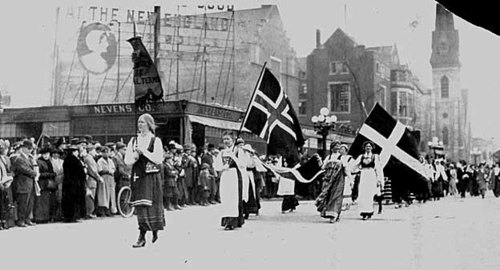
Suffrage procession in Minneapolis on May 2, 1914
From the collections of the Minnesota Historical Society
Source: thomaslowrysghost.tumblr.com
Election Day is coming up Tuesday and you can be damn sure that I am going to cast my vote.
I’m doing it for my Grandma Lillian and all the inspirational people that I’ve met over the years who have risked everything to secure their right to participate in government.
My Grandma Lillian was raised by her grandmother, Thorina Melquist. Thorina was an immigrant from Norway whose oldest daughter (my great-grandmother) died of typhoid fever just weeks after she gave birth to my grandmother. Thorina’s youngest child was only nine months older than my grandmother. She weaned him in order to nurse my newborn grandmother, who had also contracted typhoid but somehow – miraculously – survived. (And, yes, “Thorina” is the female version of the name of the Norse god of thunder.)
In addition to farmwork and child-rearing, Thorina was a dedicated suffragist. She believed strongly in equal voting rights for women and she often participated in demonstrations advocating for the right to vote for women. Women received full suffrage rights in Norway in 1913, so Norwegian immigrant women (along with their Finnish, Swedish and Danish counterparts) played a notable role in the suffrage movement at the local level in Minnesota and other states with large Scandinavian immigrant populations. The photo at left shows women from several Scandinavian countries in traditional dress marching against inequality and for universal women’s suffrage on Hennepin Avenue in downtown Minneapolis.
My Grandma Lillian grew up as a suffragist. She was still pretty young in 1919 when the Nineteenth Amendment was passed by Congress and ratified by Minnesota. Women’s suffrage became national law on August 18, 1920 when Tennessee became the 36th state to ratify the Constitutional amendment.In some ways, it is surprising to think that less than 100 years ago, women in America could not vote. I was a toddler in Louisiana when that state ratified the 19th Amendment in 1970 – 50 years after initially rejecting it. And Mississippi didn’t ratify the 19th Amendment until 1984!
Now the right to participate in government is one that we Americans take for granted – so much so that less than half of the population votes unless it is a Presidential election year. In 2008, the voter turnout was 63%, a high water mark that is low in comparison with most countries. In U.S. local elections, the voter turnout is even lower. Many of the mayors of major U.S. cities are elected with single-digit turnout. That’s just shameful.
I love to vote. In fact, I vote every chance that I can – legally at least. I always try to bring my kids with me when I vote, so they can see that having a voice in the democratic process is something both important and valuable.
But when I’m standing in the voting booth, I feel like there are others there in the voting booth with me. They are some of the inspirational people that I’ve met over the years who have risked everything to secure their right to participate in government.
Standing with me is the young Haitian asylum seeker who was beaten by police at a polling place in order to discourage him from voting for Jean-Bertrand Aristide in 1990. He held his own, though, and stood there bleeding and bandaged for several hours before he finally had the opportunity to put his check next to Aristide’s rooster symbol on the ballot. It was the first time he had ever voted – and it was a remarkable act of courage and endurance. In telling me about it, he summed it up by saying,
“I voted! It was a very good day.”
In the voting booth with me are also many of the amputees in Sierra Leone in 2004. It was common practice during the conflict there for members of the Revolutionary United Front (RUF) to hack off the hands or arms of people with machetes. Some of them had been targeted during elections so that they couldn’t vote by leaving their fingerprint mark on the paper ballot. I also heard that the RUF brutally amputated hands during one election because the government’s slogan was that,”The power is in the hands of the people.”
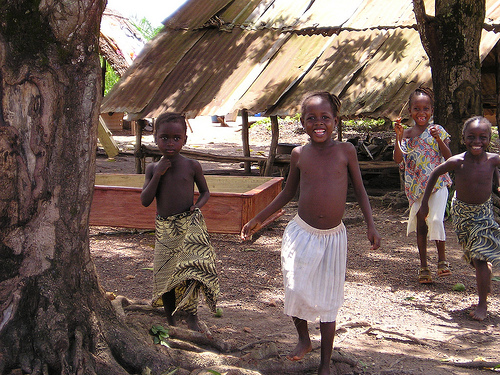
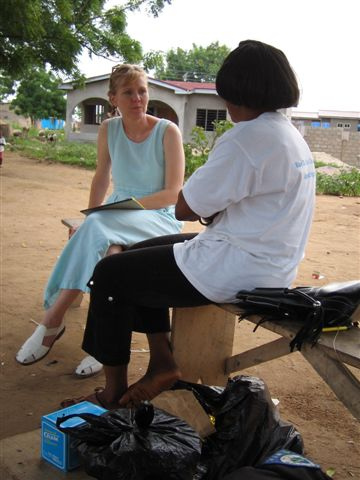
I visited Sierra Leone in 2004, after the conflict had ended and just prior to the first post-conflict elections. As I traveled through the countryside, I saw people coming together for meetings to discuss the upcoming elections. In spite of the horrors that they had endured, they were coming together in villages big and small, to exercise their right to participate in their government. Here is a photo I took of a gathering in a village far out in the bush in the Kono district, an area that endured particularly brutal human rights abuses. Yet now, as the country was slowly emerging from the conflict, the villagers were coming together to discuss the upcoming local election process.
Although my grandmother gained the right to vote, she was never able to go to college. She was certainly smart enough, but her family couldn’t see the point in wasting good money on educating a girl. Grandma Lillian never expressed bitterness about this to me. But one afternoon when I was in high school, I stopped by to say hello and to get her thoughts on my top college picks. I remember sitting in my grandparents’ darkened living room. A mantel clock ticked and the air conditioner hummed. It now seems impossibly calm and quiet, so different from my current raucous and messy living room. My Grandma Lillian told me that the most important thing was to follow my dreams.
“You can do whatever you want to with your life. Be what you want to be.
But never forget those of us who weren’t able to follow our dreams.
Follow your dreams for us.”
Upcountry girls in Sierra Leone. Photo by my colleague Rosalyn Park.
So that’s why I never miss the chance to vote. I’m doing it for my Grandma Lillian. And for everyone else who can’t follow their dreams.
Every election day is an opportunity. An opportunity to have a say in the decisions, big and small, that impact the lives of you and everyone around you. Don’t make excuses, don’t be discouraged. This is a right that is too valuable to waste. On Tuesday, please get out there and VOTE! If you need help finding your polling place, go here:
The photo at the top is of the Scandinavian Women’s Suffrage Association marching in a parade in Minneapolis in 1914.
I keep it in my office in honor of my Grandma Lillian.
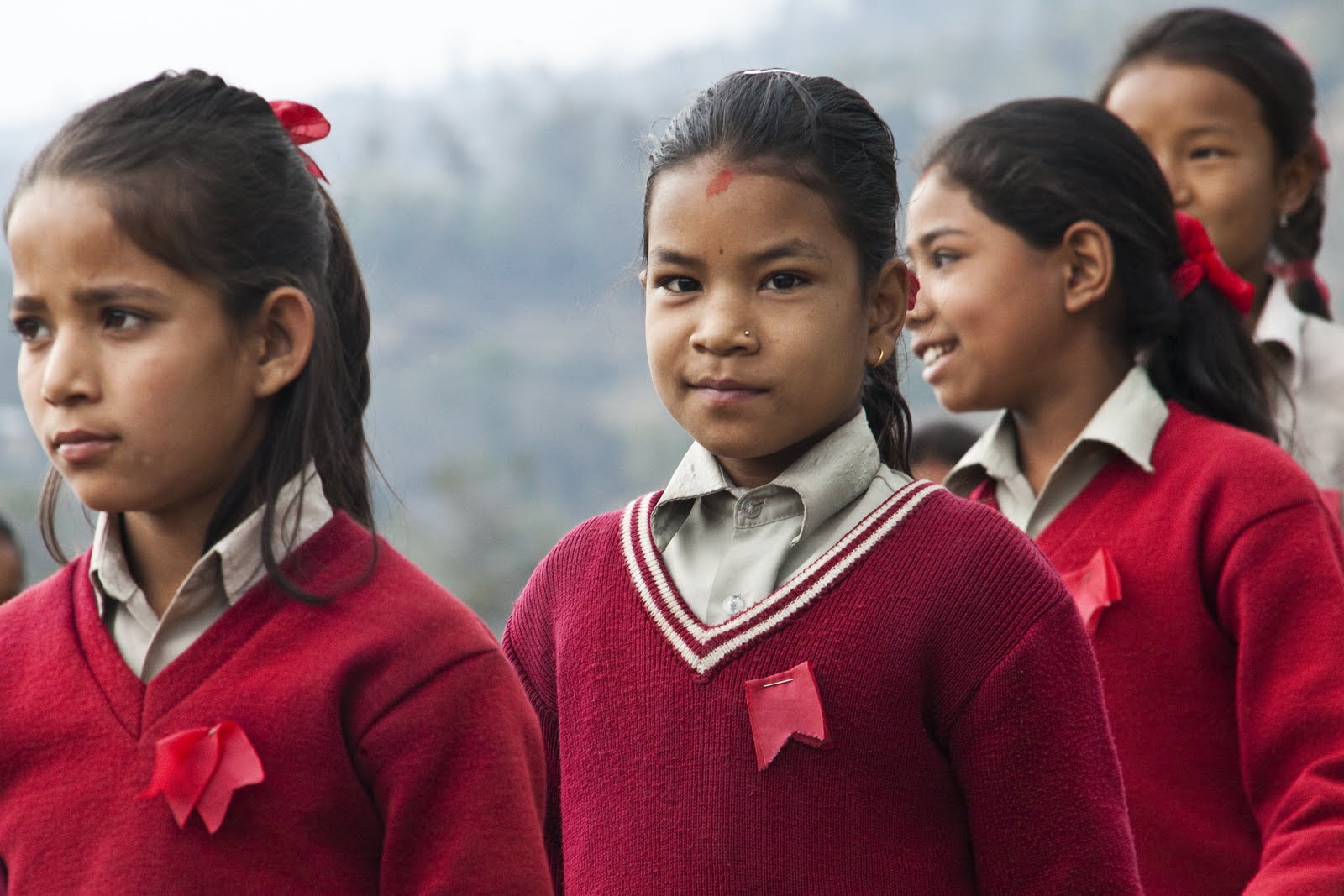
As my own daughter headed back to school, I found myself thinking about another group of girls at a school halfway around the world. Unlike my three kids, who are driven to their well-appointed classrooms on the first day because they have too many school supplies to carry, the kids at the Sankhu-Palubari Community School (SPCS) in Nepal do their work on rickety desks in cramped classrooms. These kids in pre-K through 10th grade walk to school – some an hour each way – six days a week because this school provides the opportunity to realize their human right to education.
In the United States, where education is both compulsory and free, we often forget that the right to education is not meaningfully available in many parts of the world – especially for girls. The UN estimates that there were more than 67 million primary school-age and 73 million lower secondary school-age children out of school worldwide in 2009. In addition, an estimated 793 million adults lack basic literacy skills. The majority of them are women.
Sankhu-Palubari Community School
Photo by Dulce Foster
Overwhelming as those numbers are, there are pinpricks of light that give me hope that they will someday change. I saw one when I visited Nepal for the first time in March 2011. Opened inSeptember 1999, the Sankhu-Palubari Community School is a partnership between The Advocates for Human Rights, Hoste Hainse (a Nepali NGO), the local School Management Committee, and the dedicated teaching staff. The school now enrolls more than300 students in grades pre-K-9, and also provides scholarships for graduates who continue on to 10th grade.
The goals of the Sankhu-Palubari Community School Project are to prevent child labor, encourage gender parity in education, increase literacy rates, and improve the lives and well-being of the neediest children in the area. This year, the school has successfully met goals for gender parity among students in both the primary and lower secondary grades. For the 2011-2012 school year, 147 of the 283 students in pre-school through eighth grade are girls. Additionally, and perhaps more significantly, 15 of the 31 students in ninth and tenth grade are young women.
Since the school’s founding in 1999, the teachers have conducted outreach to parents and worked hard to encourage female students to attend and stay in school in spite of societal pressure to get married or enter domestic work. Their efforts have paid off. While girls worldwide generally are less likely to access, remain in, or achieve in school, 52% of the students in K-8th grades at the Sankhu-Palubari Community School this year are girls. And a girl is at the top of the class in most of the grades at SPCS.
Most of the students’ families work in agriculture. They are farmers with little or no money to spare on school fees, uniforms and supplies. Many of them are from disadvantaged groups such as the Tamang. An indigenous group with their own culture and language, the Tamang students must learn Nepali as well as English when they come to school. Frequently, the adults in the family are illiterate.
8th Grade Class
Photo by Dulce Foster
The impact of the school both on the individual students and on the community over the past 12 years has been profound. As part of our evaluation and monitoring process, our team interviewed approximately 60% of the parents of students atthe school in March. It was clear to me that parents value the education that their children are receiving and, seeing the value, have ensured that the younger siblings are also enrolled in school rather than put to work. Twelve year sago, there were many students in the area out of school but now most are attending school. I could also see the physical benefits that the students derived from attending school when they stood next to their parents. Even the 5th grade girls towered over their parents, illustrating the simple cause-and-effect of adequate nutrition, wellness checkups, and not having to work in the fields from a very young age.
Challenges certainly remain, particularly as the cost of operating the school continues to rise. But so far two classes of students who started at the school in kindergarten have graduated from the 10th grade; they all received either high distinction or first division on their School Leaving Certificate examinations.
Morning Assembly
Photo by Dulce Foster
The Sankhu-Palubari Community School may be a small school in a remote valley, but it is a place where the human right to education is alive and well, providing a better future for these children. In particular, the effect that these girls have on their community, their country and – hopefully, the world – will be thrilling to watch.
In our office, we have a mantra: “You have to laugh or else you would cry.” Maybe working in the field of human rights exposes us to more situations where crazy and ridiculous things happen, but my hunch is – probably not. All you have to do is read the newspaper (how about that woman who tried to mail a puppy?) or watch an episode of “The Office” to come to a different conclusion. The common element here is that we are all humans. We can all be petty and mean and make a big deal about things that seem to be critically important to us at the time, but which, in the grand scheme of things, don’t really matter. We don’t always think through the consequences of our actions and we’re usually not very self-aware. That means that we cause crazy and ridiculous things to happen in our interactions with each other. What I’ve learned – and what I’m trying to teach my kids – is that you can’t control what other people do. But you can control how you handle your reaction to the crazy and ridiculous things that happen to you.
Let me tell you a story about one of my asylum clients who had to deal with something crazy and ridiculous and totally out of her control. Asylum seekers are fingerprinted as part of the asylum application process so that the fingerprint can be checked against the millions of fingerprints in the government’s electronic database. After her asylum interview, my client was instructed to put her index finger on small pad to take an electronic fingerprint.The asylum officer, looking at the computer monitor, got a strange look on her face.“Try it again,” she instructed.My client did so.“You have to look at this,” she said to me.
I could see that my client was getting more and more nervous by the second. She was an older woman from a country in West Africa. She had a valid asylum claim, but it wasn’t the strongest case in the world. To be granted asylum in the U.S., you have to show that you have suffered past persecution or have a well-founded fear of persecution on the basis of race, religion, nationality, political opinion, or social group. That definition comes from the 1950 Refugee Convention, and it reflects the experience of World War II rather than the modern experience of conflict. The biggest problem I saw when I was doing asylum work was not that people were coming to the U.S. and fraudulently applying for asylum. The biggest problem was that there were a lot of people who had experienced persecution but couldn’t show why there was a connection to one of the five grounds. In other words, if you were a victim of random violence in a war in your home country, that isn’t enough to get you asylum in the U.S. We had worked hard to put together a case for my client that showed that the killing of her family and the burning of her home was connected to her tribe (social group) being targeted by one of the fighting factions. She had testified honestly and well. And now, from her perspective, she was going to be denied the safety of staying in the U.S. because of something completely out of her control. Something was wrong with her fingerprint.
My client and I went around to the other side of the desk and looked at the computer screen. There was the digital image of a fingerprint. Right next to it was a photograph of a young, surly-looking man. Under the photo was a caption that said, “Guatemalan Recidivist”. The asylum officer and I looked at each other, paused, and then just burst out laughing. My client didn’t laugh, though. “But that’s not me!” she insisted. “No, of course not,” said the asylum officer. “But that’s not me!” my client said again. “It’s picking up only part of your fingerprint and matching you with the Guatemalan guy,” said the asylum officer. “Sometimes that happens, especially if you’ve got dry skin. I’ll get you some lotion and we’ll try again.” My client looked relieved. “OK, because if there is one thing I know, it is that I am NOT from Guatemala.” As I was driving her back to her house, I told my client, “Sometimes you have to laugh about these things or else you would cry.” Maybe I said it before that day, but that is the first time I remember saying it.
As a coping strategy, humor has come in handy for me when dealing with the absurdities of parenthood. It’s probably safe to say that having a sense of humor about the crazy and ridiculous things my children have done has saved my sanity. I’ll close with a few examples of situations where I had to laugh or else I would cry.
This photo of my ruined front lawn was selected for the “Sh*t My Kids Ruined” book. I couldn’t find a photo that was high enough resolution for the publishers, so I’m not sure that it will be included.
I posted this photo on Facebook a couple weeks ago with the caption “Sometimes I’m not sure how I’m gonna make it through the next 9 winters.”
Finally, here is a video of my family in Olso, shortly after we had to leave the Nobel Peace Prize Center because my children were fighting too much. It’s going to come in handy if one of them ever wins the Nobel Peace Prize.
Ever notice that human rights lawyers are almost never characters in romantic comedies?If there does happen to be a human rights lawyer character, he is portrayed as a stuffy old stick-in-the-mud like Mark Darcy in Bridget Jones’ Diary.(There’s also the guy that Ricky Gervais is supposed to get Tea Leoni to break up with in Ghost Town, which probably also proves that you really only even have a human rights lawyer as a character because there was a Brit involved.) But the reality is that I would never be able to do this work if I didn’t have a sense of humor. The subject matter may be serious, but the fact is that bizarre and funny things happen all the time to us human rights lawyers. Here are just a couple of examples: 1. The “Did I Accidentally Stumble Into a Comedy Sketch?” Moment. During an interview on Sierra Leonean television, the chair I was sitting in started to fall apart. It didn’t crash to the ground or anything, but all the parts (legs, arms, seat) just started to shift slowly towards the left. I had to increasingly lean the other way to keep from sliding to the ground. You try answering questions about women’s rights when you’re sitting on Fun House furniture. 2. The “Did I Just Hear That?” Moment, a.k.a. the “What Is this, Monty Python?” Moment. Last year, during an interview with a government official about conditions on a refugee camp, the guy suddenly stops the discussion and just randomly throws out, “So … does anyone here speak … NORWEGIAN?” After the interview, I also learned that this guy was “the number 3 film idol in Ghana.” Apparently, being #3 on the Ghanaian film scene doesn’t make you a big enough star to quit your day job.
I’ve learned to look for and relish the humor in every situation. My penchant for absurdity has brought me a lot of joy. Here are a few photos from various countries in West Africa.
Caution: Grown Ups!
El Sabor del Perú
3. The “I Can’t Believe I Brought My Breast Pump to a Prison” Moment. I was once visiting a prison in Peru to observe the conditions of detention. During the first part of the visit, we had been given refreshment in the form of very, VERY large glasses of Inca Kola. We’re talking Big Gulp, Trenta sized beverages.
Never had Inca Kola before? It is a shocking electric yellow color. Supposedly, it is flavored with lemon verbena but to me it tastes like super-syrupy, bubblegum flavored cream soda. The Inca Kola in my very large glass on this late spring day was also very warm. But Inka Kola is a national icon and, since it would have been rude and ungracious not to accept it, I managed to do the right thing and drink it all. Which meant, of course, that I soon had to go to the bathroom. Since this was a men’s prison, this created a pretty big problem. Luckily, there was a private bathroom that I could use at the checkpoint to the high-security part of the prison. When I came out of the bathroom, the guard was going through my briefcase. Now, I spent a cumulative total of about 40 months of my life breastfeeding my 3 kids and I had this small, battery-operated breast pump for when I traveled. When I came out of the bathroom, I discovered that the guard had taken the breast pump apart. He had all the pieces laid out and, one by one, was carefully holding them up to the light to examine them. He was obviously trying to figure out exactly what kind of weapon this strange object was. Could it be a bomb? Let’s just say he had never even heard of breast pump and it took some time to explain. Once he understood, the guard dropped the piece he was holding like it was a hot potato. He even started blowing on his fingers. The security check came to a speedy conclusion and we went on with our visit. By the time we came back out, though, the guard was laughing about it. Perhaps, like me, he is still telling that story and laughing about it to this very day.
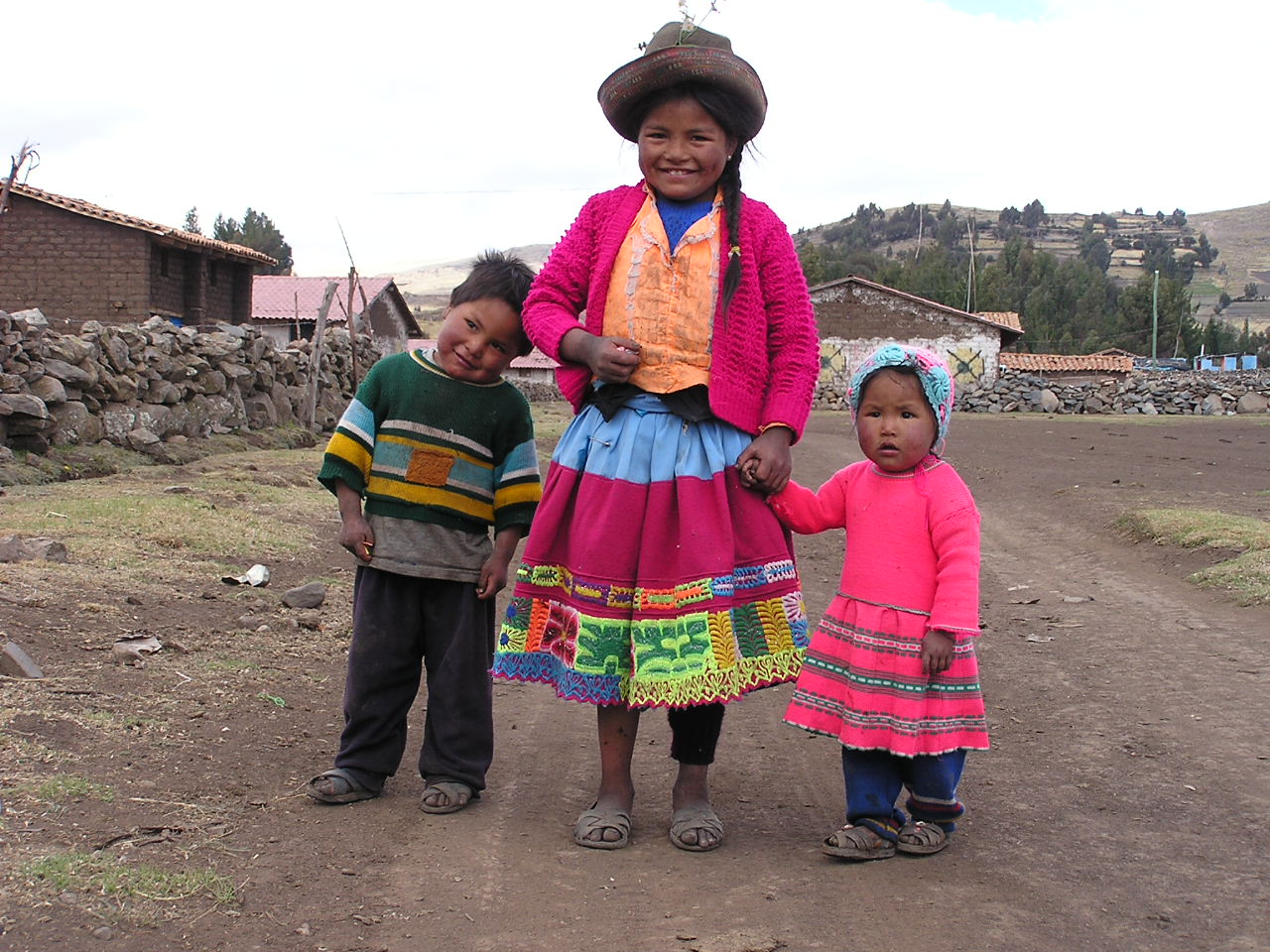
Kids in Pampamarca, Peru. The majority
of those killed during the conflict were
from indigenous communities like this in the highlands
It was November 2002 and I was sitting in a small conference room in Lima, taking notes as a woman tearfully relayed the story of her 9 years in detention. As she spoke, low and soft, the woman (who I’ll call Lourdes) cradled a newborn baby bundled in a pink blanket.
I had left my own 9 month old baby at home to lead a volunteer team on a one week trip to Peru to monitor the work of that country’s Truth and Reconciliation Commission (Comisión de la Verdad y Reconciliación or CVR). I had just recently returned to work after an extended maternity leave and, I have to say, I count those months of being at home with a potty-training toddler and a nocturnal infant as some of the toughest of my life.
Our team was interviewing Lourdes and several other inocentes or “innocents”. Between 1980 and 2000, the conflict between the Peruvian government and the Sendero Luminoso (Shining Path) and Tupac Amaru Revolutionary Movement (MRTA) rebel groups resulted in approximately 69,000 people killed and disappeared. As many as 600,000 were internally displaced; I remember seeing the tent cities on the outskirts of Lima where thousands of people who had fled the political violence in the highlands had lived for twenty years.
Lourdes was one of more than 14,000 Peruvians who were detained, tortured, and denied a fair trial under 1992 anti-terrorism decrees. She told us about the day she was arrested in early 1993. She and her husband were students. They had a three-and-a-half year old son who had health problems, so she had left the house before daybreak to get medicine for him. As she was returning to her house, she was stopped and arrested by the National Directorate Against Terrorism. It turns out that the Shining Path had bombed a nearby part of Lima. Lourdes and four other women who also happened to be out early that morning were arrested, blindfolded and interrogated. “One police officer told us that all of us would die,” she said quietly. Two hours after they were arrested, they were exhibited to the media at a press conference. The arrest was presented as a triumph over terrorism.
For the first several months, Lourdes was detained on a military base. The conditions were very bad and she was tortured. She didn’t go into the details and we didn’t ask her to tell us more. I remember her saying that she was allowed to use the bathroom only once a day – with 3-4 soldiers pointing their rifles at her. She was only allowed to bathe once a week. Lourdes was later moved to a prison, which she described as looking “like a paradise” compared to the military base.
Lourdes’ husband, who we also interviewed that day, had been arrested a month later. His father had to go to the police station to recover their little son, who was cared for by relatives for the next 9 years. Six months later, one of Peru’s “faceless” courts (called that because a one-way mirror concealed the identity of the prosecutors and judges) found Lourdes and her husband guilty of treason and sentenced them to life in prison.
Lourdes and her husband were not allowed to see each other during their detention and their letters to each other were read. For one whole year during her detention, after her sentence was reduced to 30 years, she was not allowed to have visits from anyone. Eventually, Lourdes and her husband were able to submit their cases to a Presidential pardons panel. She was pardoned in 2001, just a few weeks before the ninth anniversary of her arrest.
The interviews went on for more than six hours, but either Lourdes or her husband held that baby for the entire time. They didn’t put her in her carrier or pass her to the others who offered to hold her. They just took turns holding her close. I remember Lourdes saying to me afterwards, “We lost so much time with our son. Now he is a teenager and we’re strangers to him.”
Lourdes’ story highlights some of the problems of a government response to terrorism that doesn’t provide adequate protections for due process and other rights in the administration of justice. The Peruvian experience with terrorism seemed strikingly relevant back in 2002, when the US human rights community was very concerned about just how far the War on Terror might go. But I also learned an important personal lesson that day.
My friend Jim once had to share an office with an extremely annoying coworker. My friend kept a yellow post-it note stuck under his desk that said, “IGNORE ANTHONY”. Whenever the guy was bugging him, he would stick his head under the desk and read that post-it note. I don’t have a post-it note, but I do have a strong visual image of interviewing Lourdes that day in Lima. Whenever I feel that parenthood is more than I bargained for (which, frankly, was twice yesterday), I pluck that image from my garden of memories and think to myself: “REMEMBER LOURDES”.
If you’d like to learn more:
To see photos of life in Peru, go to the photo gallery on The Advocates for Human Rights website (click here.)
Some background on the anti-terrorism laws and why the system produced so many inocentes (click here.)
There is a 9-minute video summary of the Peruvian CVR’s findings related to the inocentes and human rights abuses in the 1990s: CVR Final Report: Fujimori and the Destruction of Democracy It provides a good overview, but be advised that it does contain some graphic images.
It all began, as so many things do, with a misunderstanding. I was putting my son Simon to bed one night when he said, “Mommy … What’s it like to be a human rights warrior?” “But I’m not a human rights warrior. I’m a human rights lawyer.” He waited a couple of seconds – this kid has an uncanny sense of comedic timing – before wrinkling up his little nose and saying skeptically, “What’s a LAWYER?”
I may never know what kind of weapons he thought I was secretly carrying in my briefcase because my description of my actual job put him right to sleep. But this bedtime exchange got me thinking. For 15 years – more if you count my student experiences – I’ve worked with survivors of human rights abuses, documenting stories of unbearable loss from every corner of the world. I have observed the absolute worst aspects of human nature, the dark side in each of us that we would rather not acknowledge.
You might think that this would make me pessimistic about the world in general and Homo sapiens in particular, but the impact has been quite the opposite. It has been my privilege to bear witness to the very best characteristics of humanity – our capacity to overcome adversity, to hope, to forgive. I’ve heard inspiring acts of courage; seen the precious gift of faith.
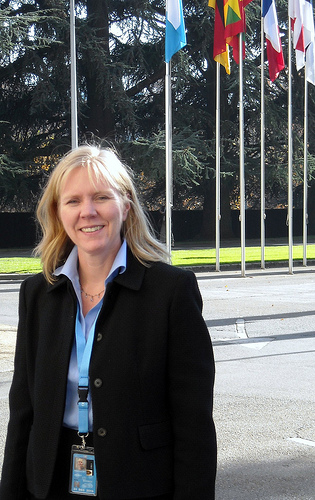
At the UN in Geneva
While I have many stories from my experiences in human rights work, I realize as I write this that most of them have never been shared with anybody. Stories of human rights abuses don’t exactly lend themselves to cocktail party conversation. How do you convey the complex political and social conditions that lead to human rights abuses, honor the victims, and avoid grossing people out with the horrible details – all in a two-minute elevator speech? And how do you even stop talking about injustice once you start?
As a parent, however, I am challenged to distill these experiences into something that Simon – along with his brother Sevrin and his sister Eliza – can understand and profit from. My goal in writing this is to think more intentionally about what I’ve learned from my work in human rights so that I may one day pass these lessons along to my kids. Perhaps these reflections will be interesting or inspiring to others as well.
While I am proud to be the Deputy Director of The Advocates for Human Rights, this blog reflects my personal views rather than those of the organization.








 The Human Rights Warrior
You must be logged in to post a comment.