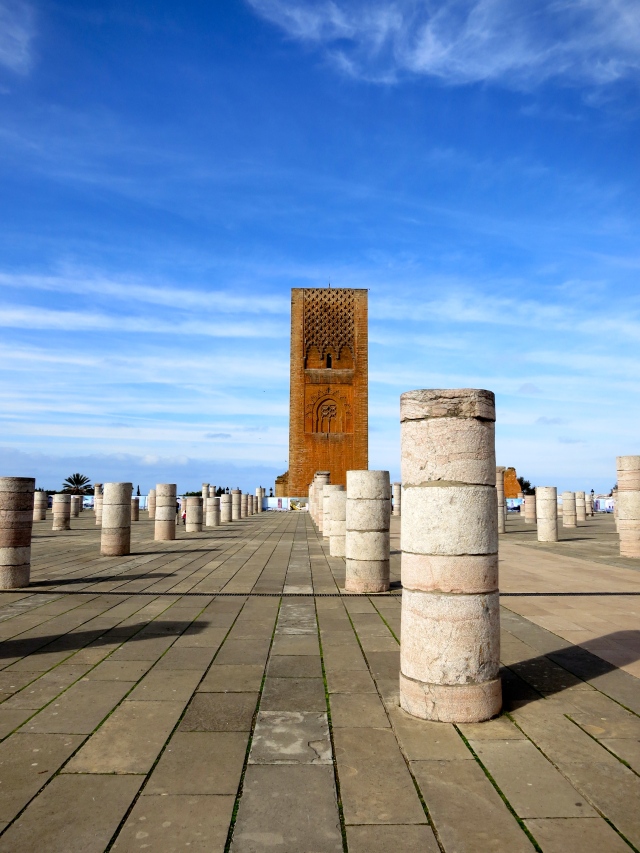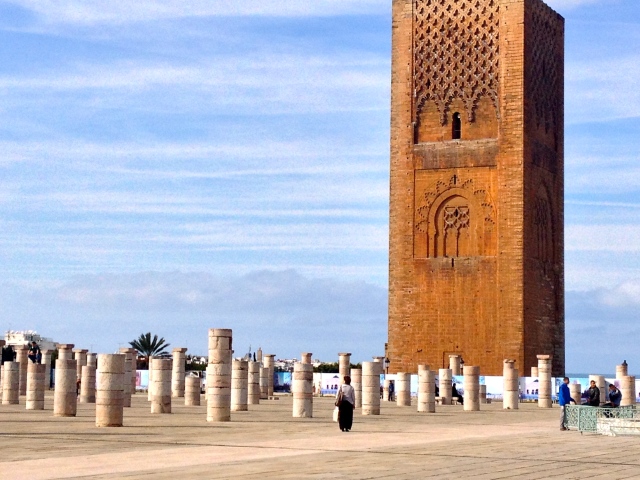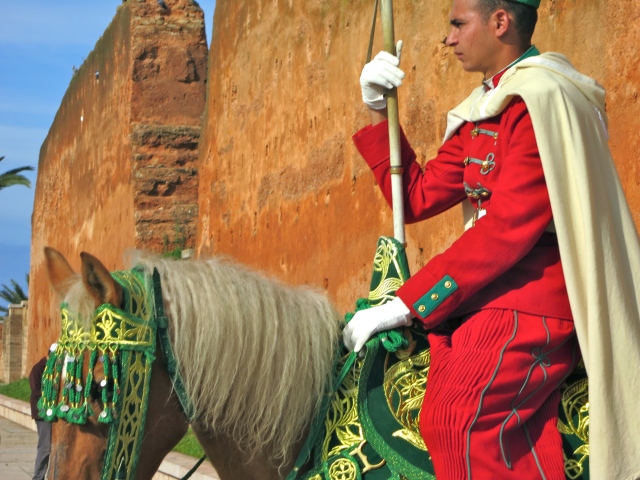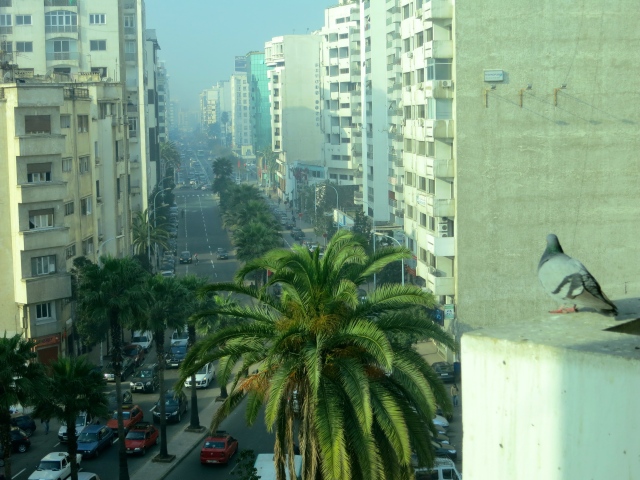
One Day in Zanzibar

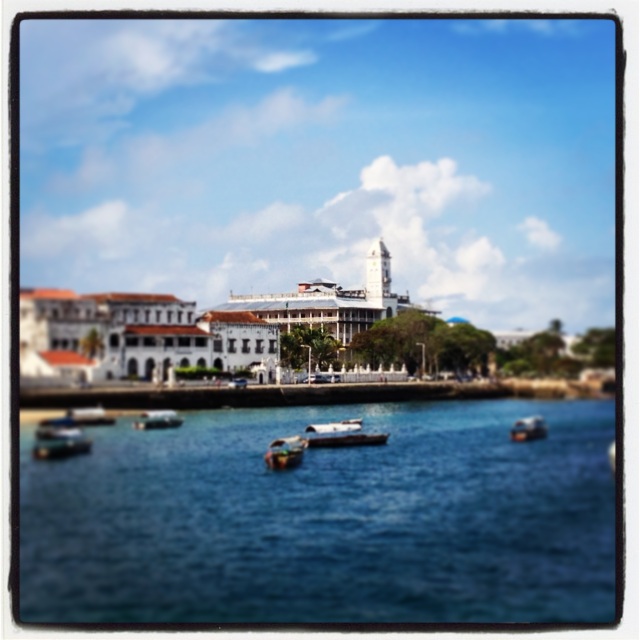
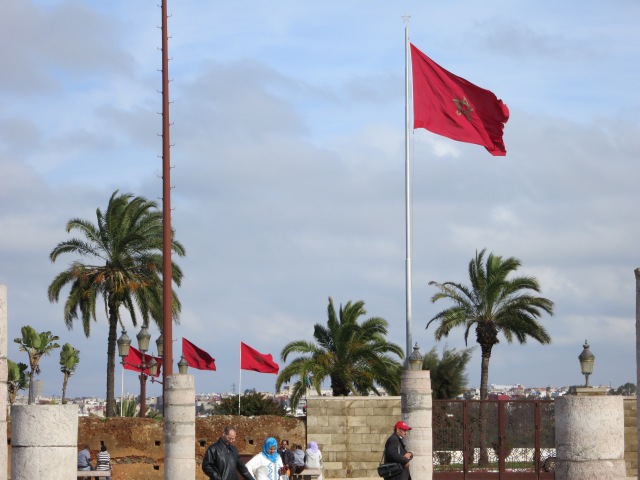
House of Wonders and Stone Town waterfront, Zanzibar

A little more than 10 years ago, I had a rare moment of clarity.  I was sitting with my second child, who was 9 months old, on my lap while my 2-year-old danced and swayed around me.  Everyone else in the Mommy and Me class was singing – with gusto – the Barney song “I Love You”.  Glancing at the clock, I realized that the week before – at exactly this time – I was being interviewed live on national TV in Peru about that country’s truth and reconciliation commission.

The stark contrast made me realize that I had chosen a life in which there might never really be a “typical” day.   Setting aside the insipidity of Barney, I realized that these small moments with my young sons were as important and valuable as the other, more high-profile moments of my career, which often takes me to exotic locales.  I learned not to compare my days.  Not to sift through the experiences of each day and measure the worth of one against another, but to see them all as a whole.  To acknowledge that each endeavor for work and for family gives me strength for the other. To realize that I am fortunate to have these varied experiences, which, woven together form the rich tapestry of my life.

So for the Weekly Photo Challenge: A Day in the Life, I am choosing to share one day that I recently spent in Zanzibar for work.  As I write this, my daughter is sitting beside me, looking at the photos and talking about them with me.  One day in Zanzibar, one day of spring break at home. Days and experiences, knitted together – so many days to be thankful for!


(See more Weekly Photo Challenge entries here.)

In Morocco

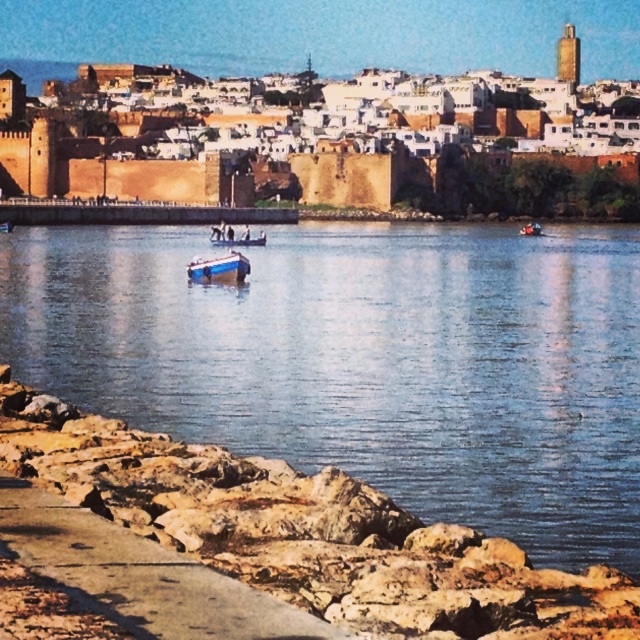
View of the Kasbah in Rabat
January 2013

There is no guidebook to Morocco, and no way of knowing, once one has left Tangier behind, where the long trail over the Rif is going to land one, in the sense understood by any one accustomed to European certainties.  The air of the unforeseen blows on one from the roadless passes of the Atlas.

I recently visited the Kingdom of Morocco for the first time.  Looking for reading material before my trip, I discovered a book about Morocco by Edith Wharton.  This came as a deep surprise to me, a longtime Wharton fan.  I thought that I had read every Edith Wharton publication in print, from her ghost stories right down to her interior design book (I wrote a paper on that one in college).  I knew, of course, that she had written some travel books; I had even read some of them.  But until I saw it listed as a free title on Kindle, I had never heard of In Morocco.  

Published in 1920 (the same year as Age of Innocence), In Morocco is widely considered the first travel guide to Morocco.  (Wharton certainly thought so, as she states, “Having begun my book with the statement that Morocco still lacks a guide-book, I should have wished to take a first step toward remedying that deficiency.”)

I’ve always admired Wharton’s  highly descriptive style, which lends itself exceptionally well to travel writing.  In Morocco is the account of Wharton’s motor trip across Morocco in the fall of 1917, at the tail end of the First World War.  Much of Morocco had become a French protectorate in 1912, so she made the trip at the invitation of the French Resident-General Hubert Lyautey.  It is no secret that Wharton was a committed supporter of French imperialism (she described herself as a “rabid imperialist”) and this comes across strongly in In Morocco.  (Unless you want read a love letter to colonialism, skip the chapter on Gen. Lyautey’s Work In Morocco.)  Equally hard to take is her paternalistic attitude towards and use of  racist terminology to describe Moroccans and their culture.

In spite of this, I enjoyed the historical perspective provided by In Morocco. More than anything,  In Morocco is a series of sketches of a place where past and present are intermingled, at a moment when the country was on the verge of change.  Wharton was very cognisant of the fact that post-war tourism would alter Morocco forever.

IMG_0111

Morocco is too curious, too beautiful, too rich in landscape and architecture, and above all too much of a novelty, not to attract one of the main streams of spring travel as soon as Mediterranean passenger traffic is resumed.

Visiting Morocco nearly 100 years after Wharton, I found it interesting to read her admiring documentation of this specific moment in time, which she has preserved in prose as solidly as if in amber.

To see Morocco during the war was therefore to see it in the last phase of its curiously abrupt transition from remoteness and danger to security and accessibility …

IMG_0112

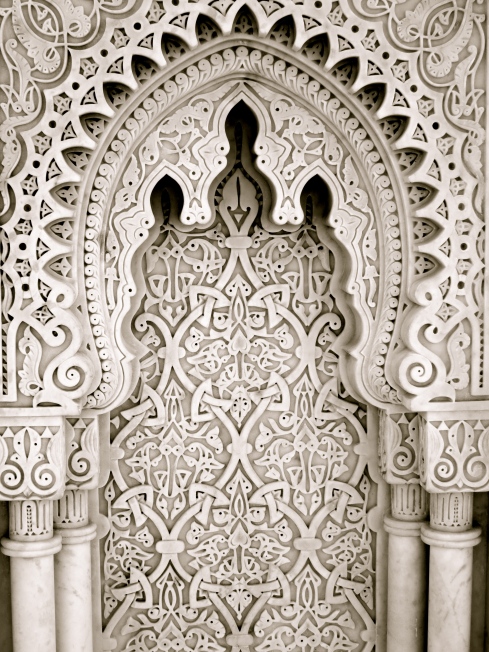
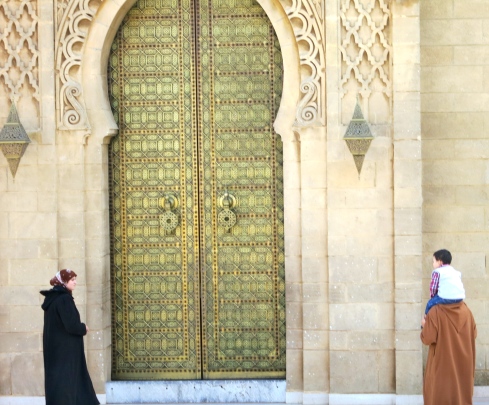
Yet I also found the Morocco of 2013 to be a place where the boundaries between past and present are still slightly blurred.  Visiting many of the same places that Wharton had visited nearly a century before, I discovered that her descriptions were, in many cases, still brilliantly apt. The following photographs were taken by me but the words were written by Edith Wharton.

Tangier

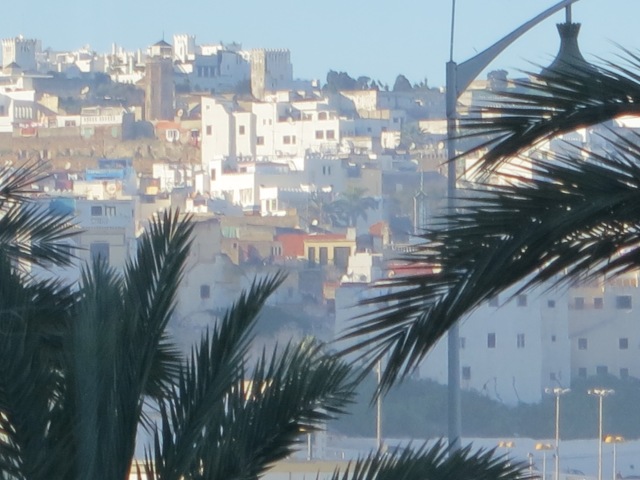
View of the Medina in Tangier

This feeling of adventure is heightened by the contrast between Tangier – cosmopolitan, frowsy, familiar Tangier, that every tourist has visited for the last forty years – and the vast unknown just beyond.

 Rabat

IMG_0099

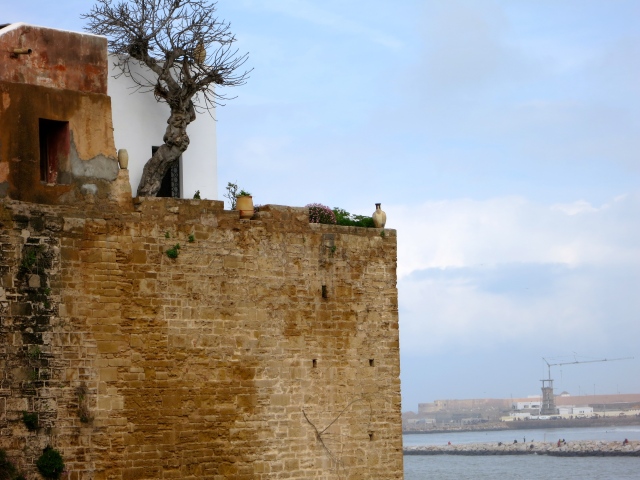
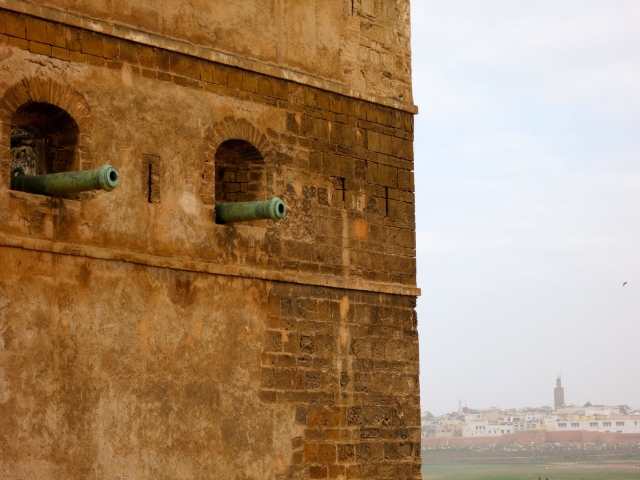
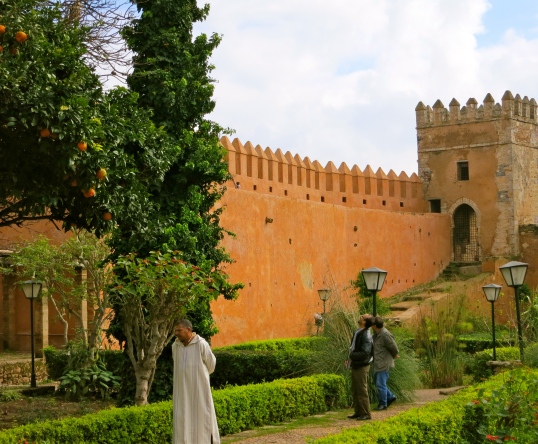
The European town of Rabat, a rapidly developing community, lies almost wholly outside of the walls of the old Arab city.  The latter, founded in the twelfth century by the great Almohad conqueror of Spain, Yacoub-el-Mansour, stretches its mighty walls to the river’s mouth.  Thence they climb the cliff to enclose the Kasbah of the Oudayas…. Great crenallated ramparts, cyclopean, superb, follow the curve of the cliff.

Kasbah of Rabat
Kasbah of Rabat

Salé the white and Rabat the red frown at each other over the foaming bar of the Bou-Regreg, each walled, terraced, minareted, and presenting a singularly complete picture of the two types of Moroccan town, the snowy and the tawny.  To the gates of both, the Atlantic breakers roll in with the boom of northern seas, and under a misty northern sky.

Kasbah in Rabat
View of Salé from the Kasbah in Rabat

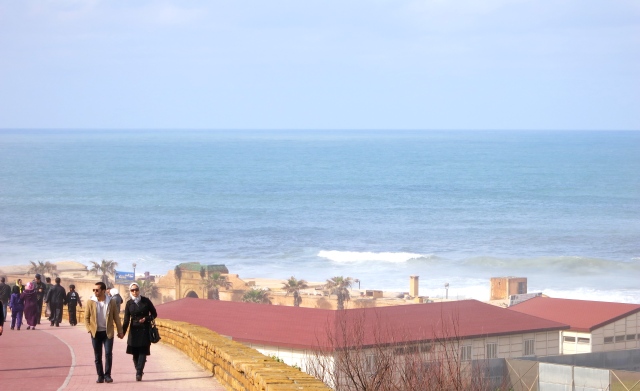
It is one of the surprises of Morocco to find the familiar African pictures bathed in this unfamiliar haze. Even the fierce midday sun does not wholly dispel it – the air remains thick, opalescent, like water slightly clouded by milk.

Seawalk in Rabat
Seawalk in Rabat

Kasbah of the Oudayas

Garden of the Oudayas

Inside the gate of the Kasbah one comes on more waste land and on other walls – for all Moroccan towns are enclosed in circuit within circuit of battlemented masonry.  Then, unexpectedly, a gate in one of the inner walls lets one into a tiled court enclosed in a traciered clositer and overlooking an orange-grove that rises out of a carpet of roses.  This peaceful and well-ordered place is the interior of the Medersa (the college) of the Oudayas.

IMG_0098

IMG_0094

The Tower of Hassan

Tower of Hassan, Rabat

The “Tower of Hassan,” as the Sultan’s tower is called, rised from the plateau above old Rabat, overlooking the steep cliff that drops down to the last winding of the Bou-Regreg. Truncated at half its height, it stand on the edge of a cliff, a far-off beacon to travellers by land and sea.  It is one of the world’s great monuments, so sufficient in strength and majesty that until one its fellow, the Koutoubya of Marrakech, one wonders if the genius of the builder could have carried such perfect balance of massive wall-spaces and traceried openings to a triumphant conclusion.

IMG_1158

Near the tower, the red-brown walls and huge piers of the mosque built at the same time stretch their roofless alignment beneath the sky. This mosque, before it was destroyed, must have been one of the finest monuments of Almohad architecture in Morocco: now, with its tumbled red masses of masonry and vast cisterns overhung by clumps of blue aloes, it still forms a ruin of Roman grandeur.

IMG_0115

The founder of Rabat, the great Yacoub-el-Mansour, called it, in memory of the battle of Alarcos, “The Camp of Victory” (Ribat-el-Path), and the monuments he bestowed on it justified the name in another sense, by giving it the beauty that lives when battles are forgotten.

Casablanca

On the west coast, especially, where the Mediterranean peoples, from the Phenicians to the Portuguese, have had trading-ports for over two thousand years, the harm done to such seaboard towns as Tangier, Rabat and Casablanca is hard to estimate.  The modern European colonist apparently imagined that to plant his warehouses, cafes, and cinema-palaces within the walls which for so long had fiercely excluded him was the most impressive way of proclaiming his domination.

Casablanca
Casablanca

These are just a few of the words and images I found on my recent trip to Morocco.  I was in Morocco for work, however, so my own version of In Morocco will not be a guidebook or travelogue. My version of In Morocco will be a series of sketches, too, but it will the stories of people who are working to improve human rights in their country.  I am not a writer with Edith Wharton’s powers of description, but these are stories that can and should be told.

IMG_0108

Forward Movement: LGBT Rights in Cameroon

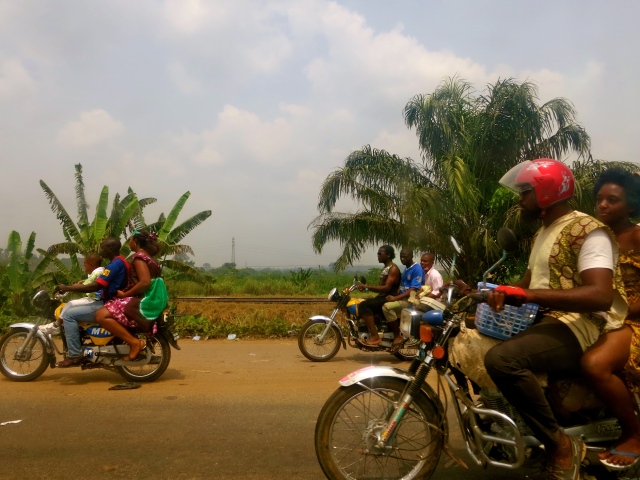
Motorcycle taxis speed toward Douala, Cameroon's major port and commercial center
Motorcycle taxis speed toward Douala, Cameroon’s major port and commercial center

In response to this week’s Photo Challenge: Forward, I thought I would simply post this photo, taken two weeks ago today, of motorcycle taxis speeding towards Douala, Cameroon.  But there is another kind of movement going on right now in Douala, one that is attempting to move the country forward towards acceptance of the rights of LGBT persons.  These courageous activists, who are risking their lives to end discrimination and persecution based on sexual orientation or gender identity in Cameroon, deserve more than a photo.  They deserve to have their stories told.

In Cameroon, people who are LGBT face pervasive societal stigma, discrimination,and  harassment.  They also face the possibility of imprisonment – Article 347 of the Cameroonian penal code criminalizes “sexual relations with a person of the same sex”.  At least 28 people have been prosecuted under the law since 2010. One of them is Roger Jean-Claude Mbede, who was arrested and convicted of homosexuality in March 2011 after sending another man a text message reading, “I’ve fallen in love with you.”  In December 2012, the Cameroonian court of appeals upheld the conviction and sentenced him to three years in prison.

Gay, lesbian, bisexual, and transgender people have a high risk of HIV/AIDS infection.  They are often rejected by their families, who force them out of the home.  When targeted by law enforcement, they have more difficulty in obtaining legal protection.Due to the social stigma and intense climate of fear, most LGBT people are forced to live out their lives in secrecy.  Yet there are several impressive non-governmental organizations  – Alternatives-Cameroun, the Association for the Defense of Gay and Lesbian Rights (ADEFHO), Cameroonian Foundation for AIDS (CAMFAIDS), and Evolve, to name a fewwhich are working hard to raise awareness about and provide services to the LGBT community.

When I was in Douala, I was able to visit Alternatives-Cameroun.  Security is, understandably, a big concern.  There is no sign that marks their center on boulevard de la Liberté, and when you arrive, you have to sign in and show your ID.  Alternatives-Cameroun has one doctor at the center who provides HIV/AIDS treatment and medical services to approximately 75 patients.  In addition, Alternatives-Cameroun provides a small community pharmacy, as well as safe, confidential and free HIV testing.  In 2012, they provided 720 HIV tests.

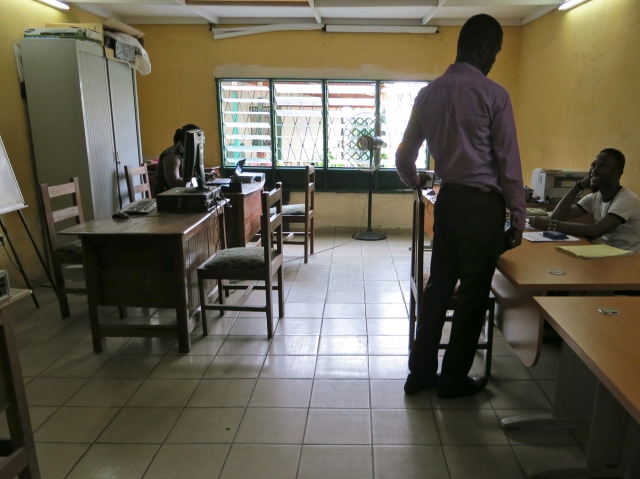
Staff at Alternatives-Cameroun centre in Douala

Equally important are the services provided by a psychologist and two social workers.  Alternatives-Cameroun also provides public education and outreach, both at the center and through peer educators.  On the day I visited, all of the peer educators were at work out “in the field” in Douala.

What touched me most, though, was the real sense of community that is provided by Alternatives-Cameroun.  I saw a small group of young people sitting on plastic chairs around a table in “William’s Hall” (named after one of the organization’s founders, who died in the Kenya Air plane crash).  I could feel that they were providing each other with comfort and support, a feeling so strong that I could see the connection between them almost as clearly as I could see the young man holding the hand of the woman beside him.

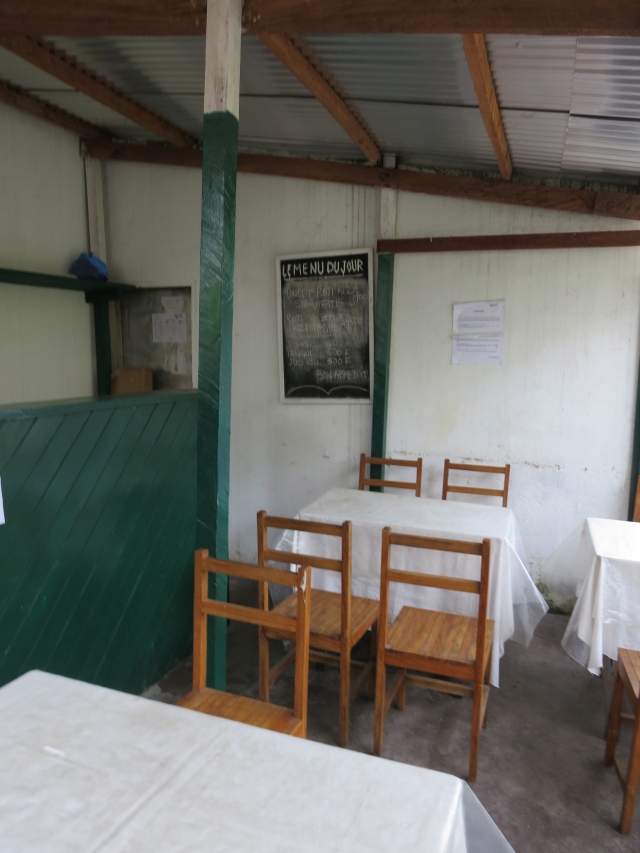
As a way to join the community and to connect with the neighbors around them, Alternatives-Cameroun started a small restaurant that serves a very inexpensive daily lunch. This anti-discriminatory gambit has paid off; the neighbors now come to the restaurant to eat and talk together with the staff and patients.  Often the patients are very poor, so the restaurant means they can offer them a meal or two a day.  The restaurant also provides meals for LGBT detainees in prison.  Prison conditions in Cameroon are notoriously bad, with severe overcrowding and inadequate food.  Most detainees rely on family members to bring them meals.  As LGBT detainees have often been rejected by their families, they have no other access to food.

Restaurant

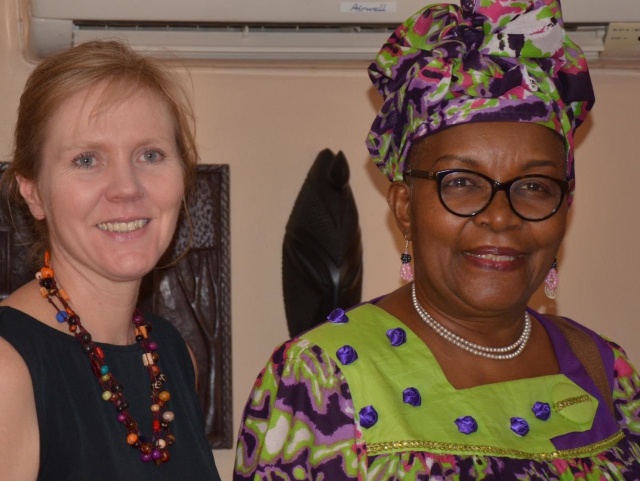
Activists working on LGBT issues in Cameroon told me that one of their main needs is for more lawyers. One of the very few Cameroonian lawyers who is willing to take on these “homosexuality” cases is Alice Nkom.  The first black woman admitted to the Cameroonian bar, Alice has been courageously fighting for the rights of LGBT Cameroonians for many years.  In spite of serious death threats, Alice Nkom continues her work.  “Threats like these show us that the fight must continue,” said Nkom.

with alice in douala

Cameroon has been receiving a lot of criticism recently from the international community, particularly the European Union. The issues of LGBT rights will certainly come up again at the Human Rights Council’s Universal Periodic Review of Cameroon this spring.  On January 31, Cameroonian President Paul Biya told reporters that attitudes are changing in his country about the criminalisation of homosexuality.  “Now I can say that discussions are under way. People are talking, minds can change one way or another but currently it’s a crime.”  

The government of Cameroon must do more than discuss.  The government must protect the rights of all Cameroonians, regardless of sexual orientation or identity. And when things do change, as they will one day, the credit will go to the brave men and women who have put their heart and souls – not to mention their lives – into moving their country forward on LGBT rights.

To read more about LGBT rights in Cameroon:

Human Rights Watch, Criminalizing Identities (2010)

Joint Stakeholder Submission on LGBT Rights for the Universal Periodic Review of Cameroon (2012)

International Gay & Lesbian Human Rights Commission, Cameroon

10 More Things to Do With Your Kids on Human Rights Day!

Last year for Human Rights Day, I wrote a post for World Moms Blog on 10 Things To Do With Your Kids on Human Rights Day.  The date of December 10 was chosen to honor the United Nations General Assembly‘s adoption on 10 December 1948 of the Universal Declaration of Human Rights (UDHR), the first global statement of international human rights principles.  But ten things are not enough, so here are a few more ideas for simple and meaningful activities to do with your kids on Human Rights Day (December 10) 2012.

Screen shot 2012-12-07 at 1.31.52 PM

1.  Make a one minute video showing what “It’s About Ability!” means to you, whether in the world at large or to you personally. The deadline for the It’s About Ability youth video contest on children with disabilities is December 15, 2012.  But even if you don’t enter the contest or make a video, you and your kids can learn about and discuss the rights of children with disabilities by reading the “Thoughts for inspiration” in the contest guidelines and this simple explanation of the Convention on the Rights of Persons with Disabilities (which also includes more ideas for things you can do to change attitudes and rules so that children who have disabilities can go to school, play and take part in activities that every child wants to do.)  The Learning Guide to the Convention of the Rights of Persons with Disabilities, designed to empower kids ages 12-18 to advocate for the rights of persons with disabilities, can be found here.

2.  Make a World Wishes Dove with your family.  Cut feathers from white paper or colored construction paper.  Have everyone in the family decorate and write their wish for the world on a feather.    Cut out the body of a dove or other bird and glue all the feathers on it.  Once decorated, your bird will be a beautiful and hopeful expression of your family’s hopes for our world.

Template for a doveImage Source
Template for a dove
Image Source

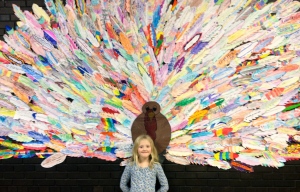
Thankful turkey

(Note: this project was inspired by the Thankful Turkey at my daughter’s school.  You can read more about that here.)

3.  Learn about the challenges that children living in poverty face have overcome to succeed in school.  Play the United Way‘s PASS THE GRADE  game.  In honor of the first  Giving Tuesday on November 27th, The Greater Twin Cities United Way launched a fun, educational online game called PASS THE GRADE.  (My friend ThirdEyeMom wrote about PASS THE GRADE; read her post here.)

4.  Watch some UNICEF Cartoons for Child’s Rights together.  Cartoons for Children’s Rights is a UNICEF broadcast initiative that aims to inform people around the world about children’s rights. The effort has forged partnerships with many well-known animation studios that have developed more than 80 half-minute public service announcements based on the articles of the Convention on the Rights of the Child. Each PSA illustrates a right described in the global rights treaty, such as ‘Freedom from Child Labour’ or ‘Protection from Neglect’. All the spots are non-verbal, in order to get the rights message across to everyone, regardless of language. The spots have aired on more than 2,000 television stations globally.  Links to the top 10 can be found here.

5.  Do an anti-bullying activity together like Sticks and Stones from Teach Peace Now.   Ask your child what think about the saying  “Sticks and stones can break my bones, but names can really hurt me.” Have they heard another version of this saying? Which is truer?  Have they ever had someone say something to them that hurt their feelings. Has someone ever hurt them physically or tried to scare them or one of their friends? Have they ever hurt someone by something they said or did? You can give a personal example of a time you were a victim or a witness to bullying or hurt someone’s feelings. You can also read a book about bullying like This is Our HouseHey, Little Ant, Mr. Lincoln’s WaySay Something, or Simon’s Hook.

Give each child some light gray paper “stones.” Have your kids write a behavior that could hurt someone or make them feel bad such as calling someone a name, or tripping someone. Younger children can draw a picture.  Have them wrinkle up the “stone” and then try to smooth it out. Explain that once someone has been hurt, it is never forgotten. You cannot remove the hurt. The wrinkles will always be there.

Hang stones on wall to create a wall of intolerance or sit in a circle and pile the rocks up in the middle. Ask the kids to think about ways to prevent these bad things from happening. You can make a list together of ideas.

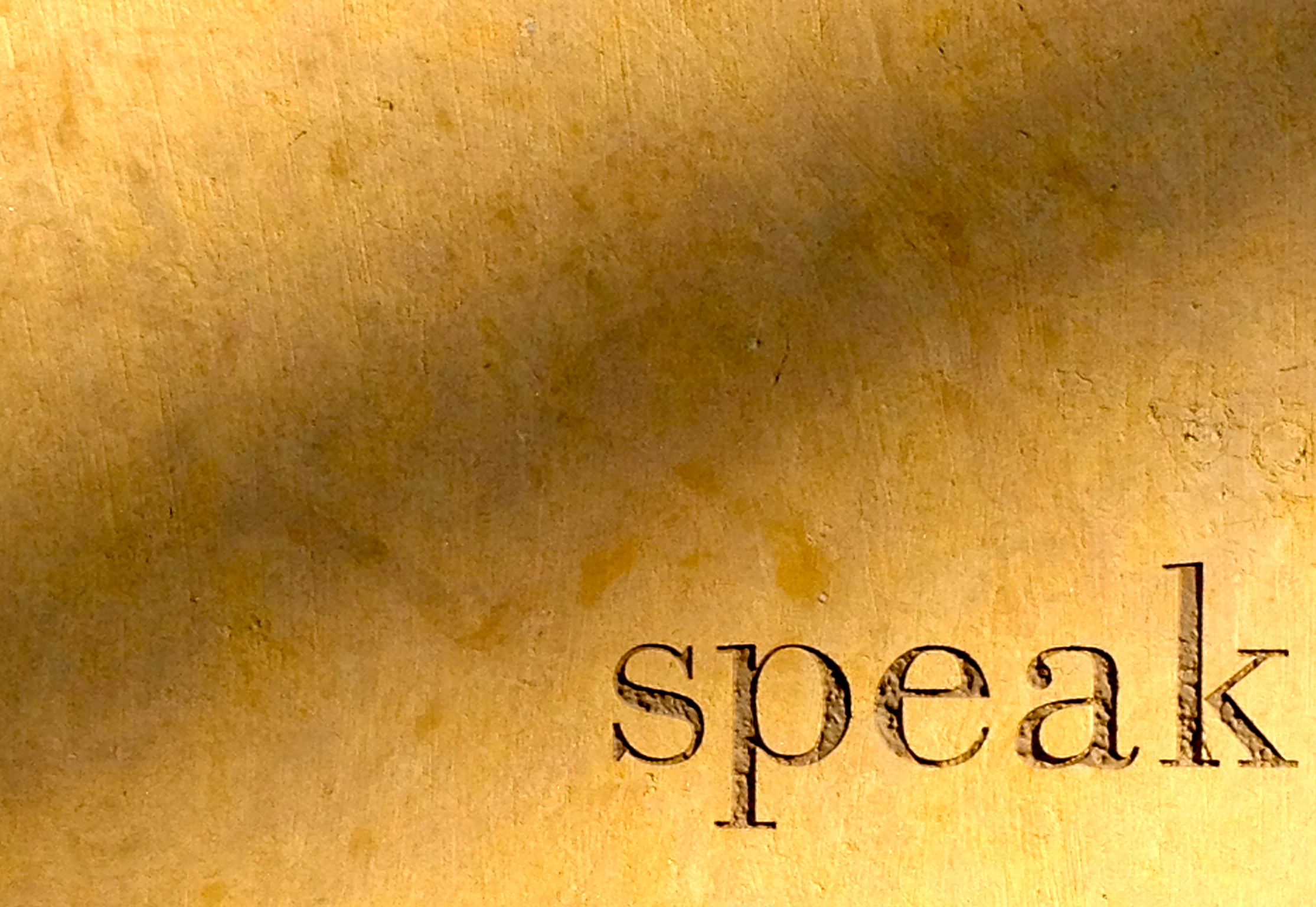
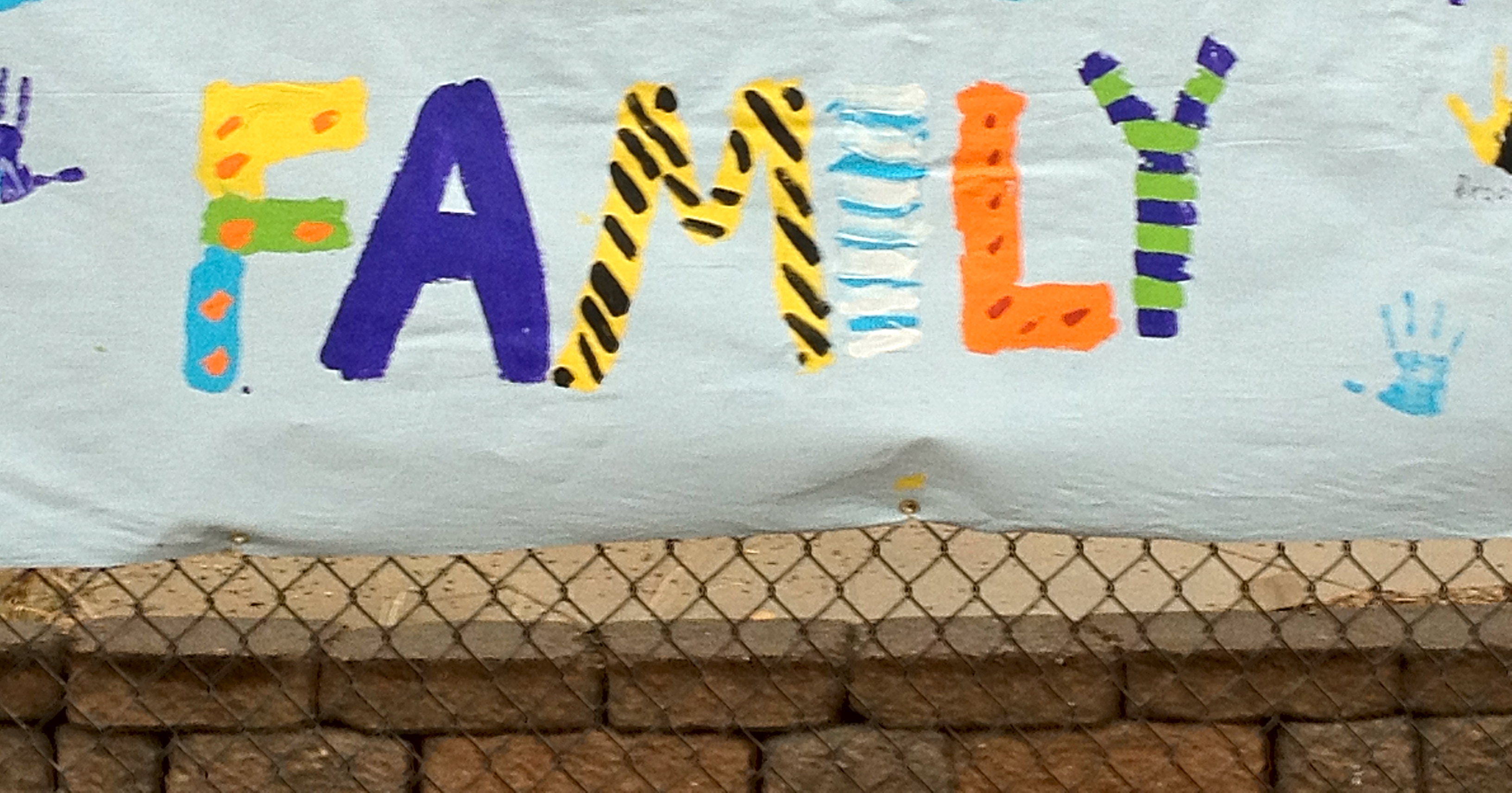
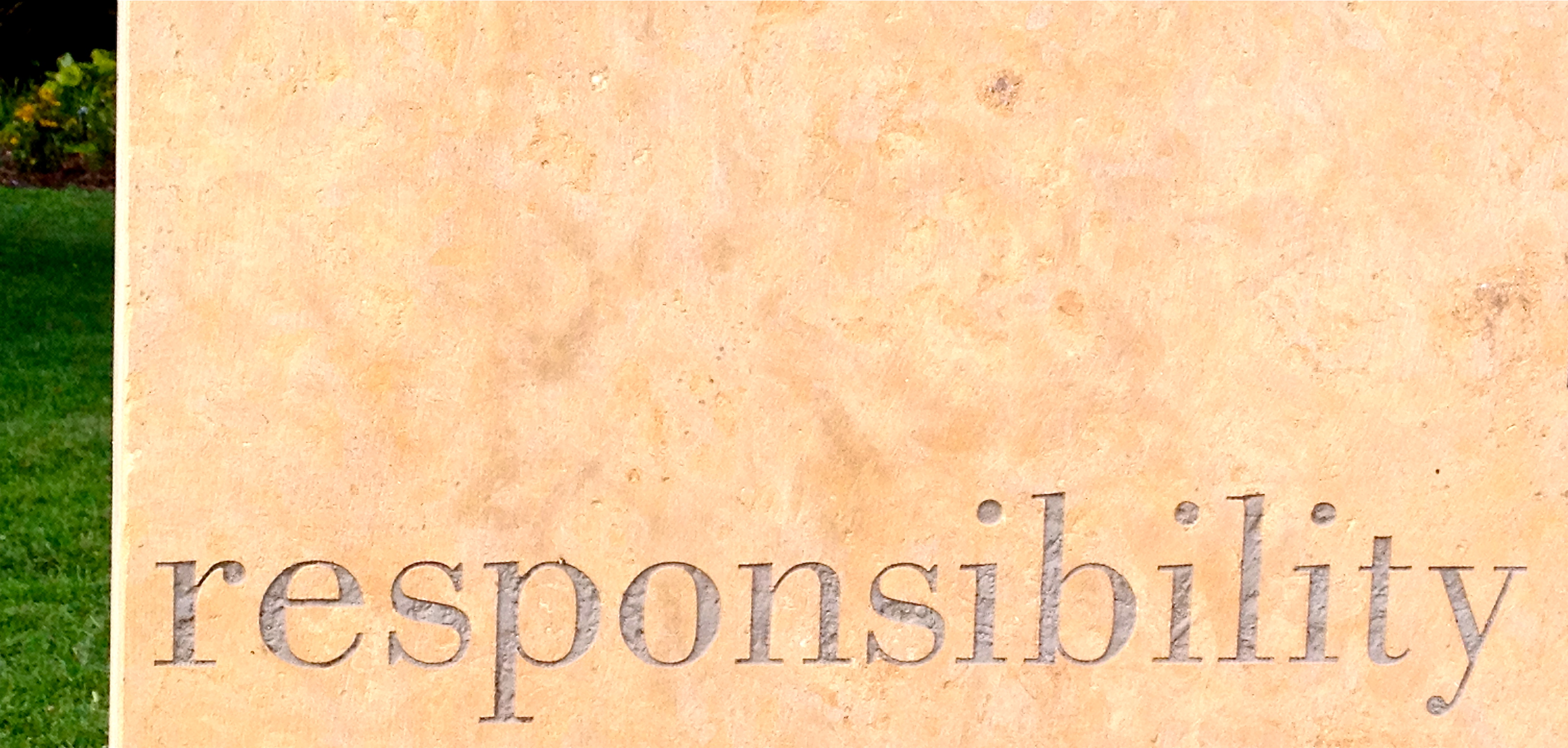
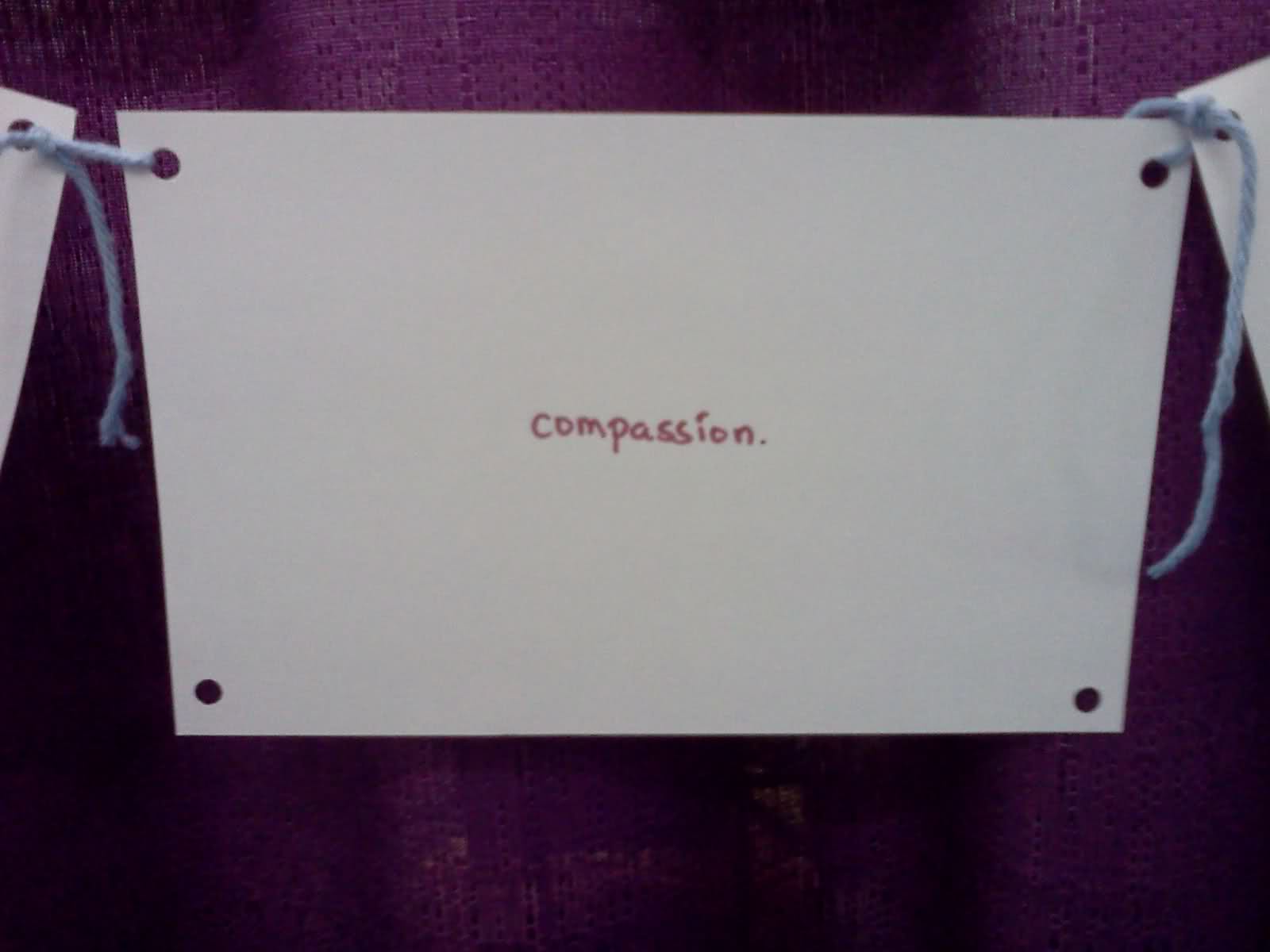
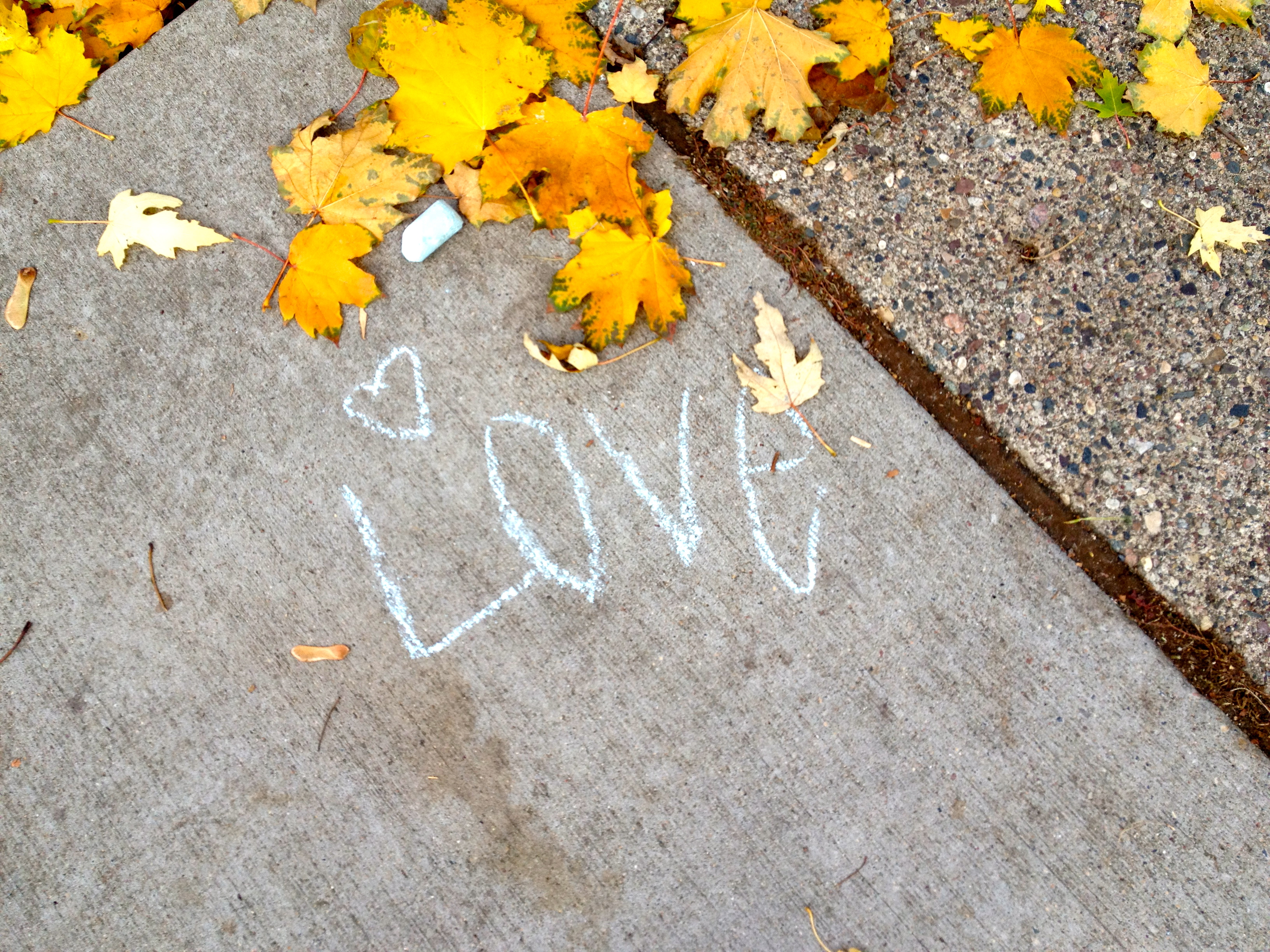
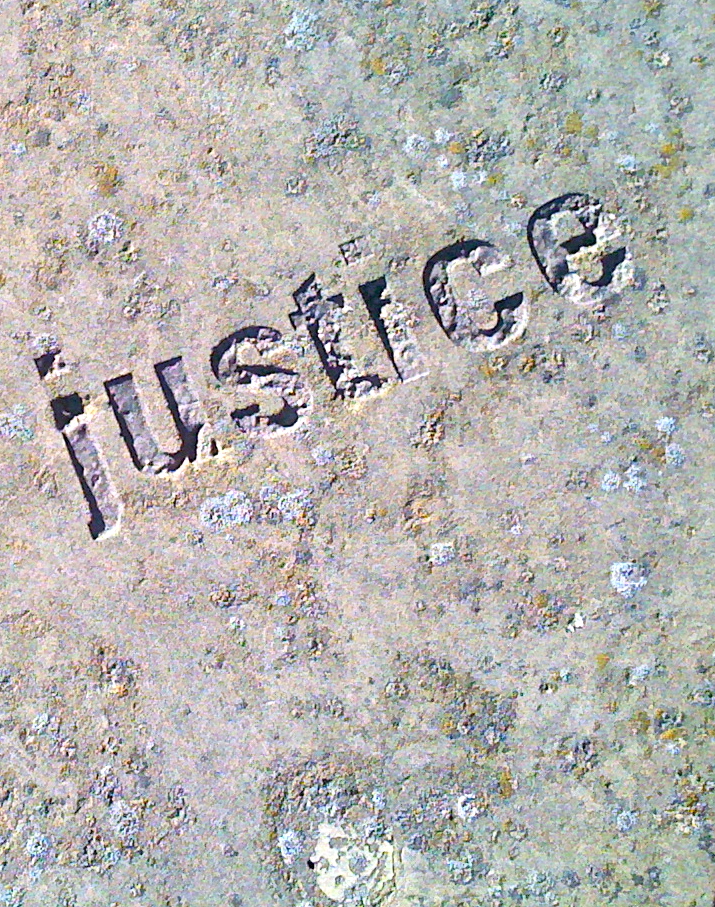
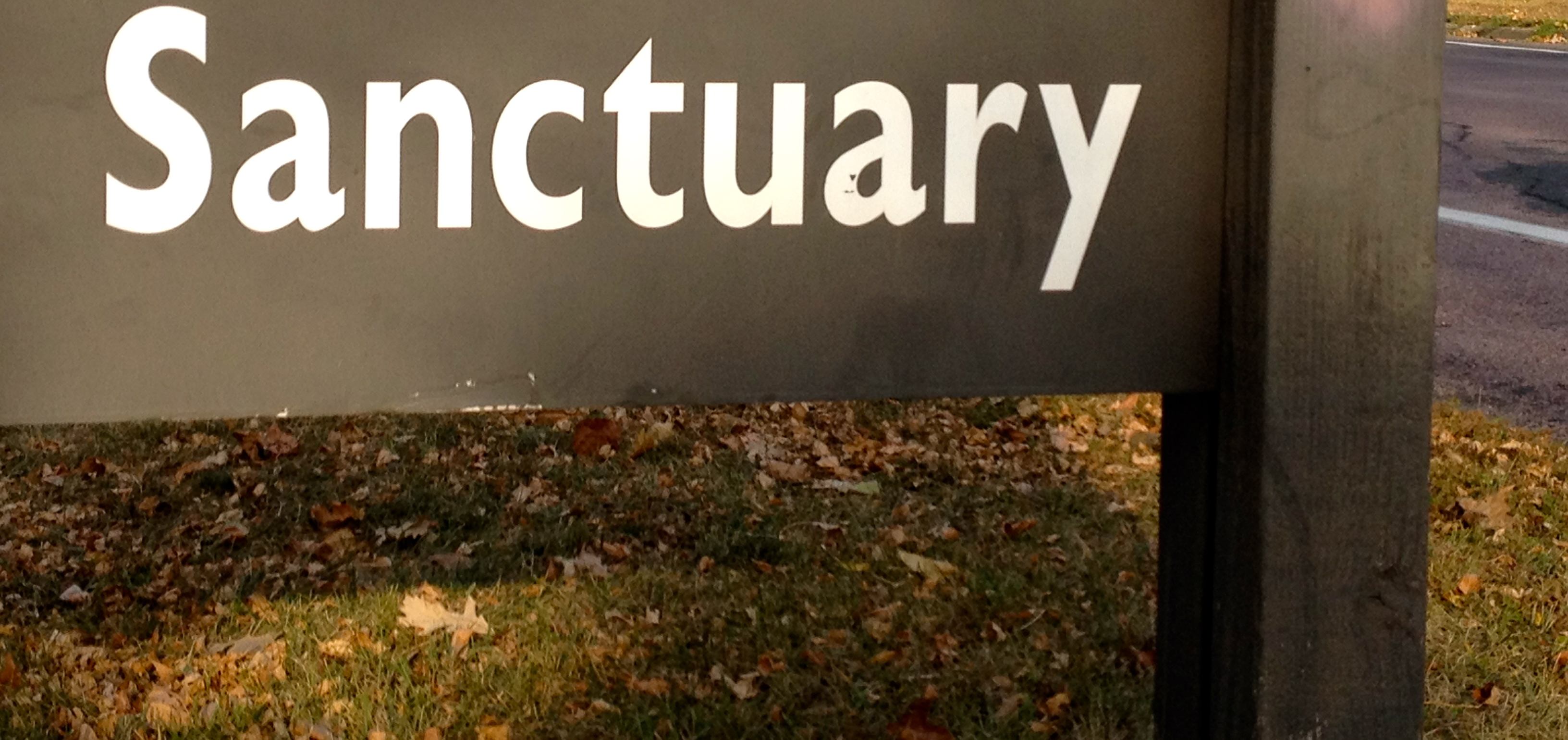
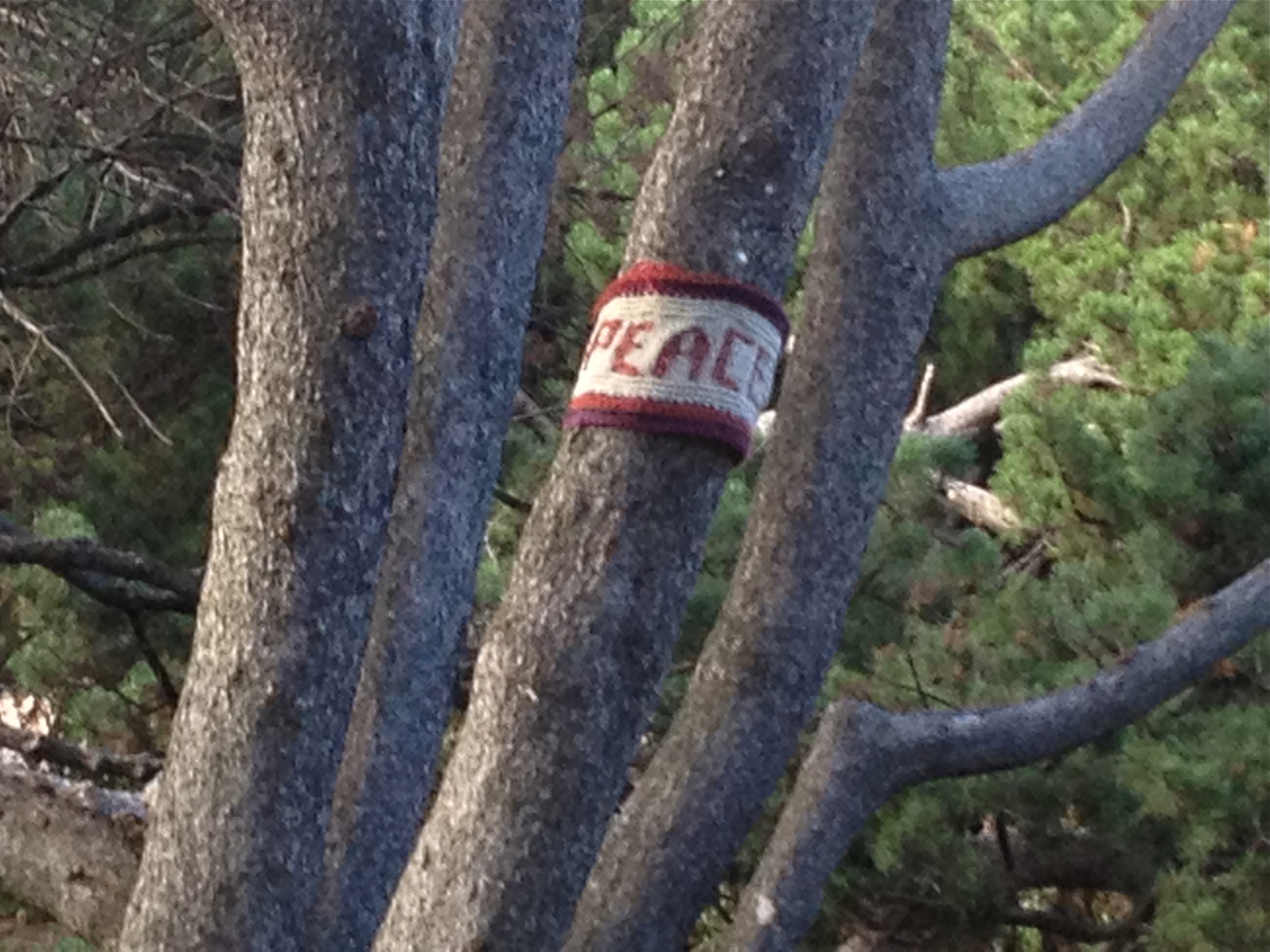
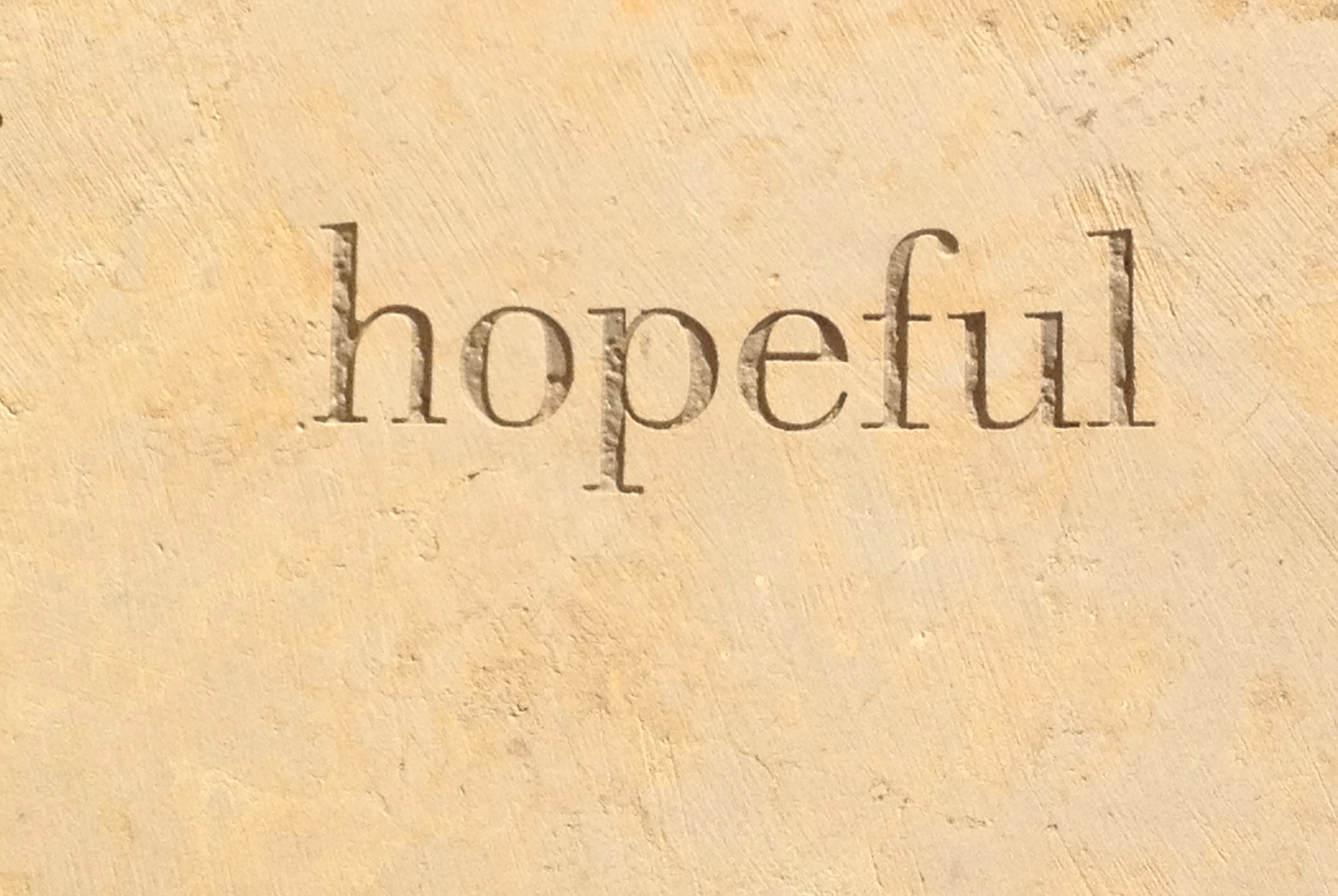
6.  Go on a hunt for the human rights words around you.  Human rights is not about complicated concepts; human rights is about the core values that everyone needs to live fully in this world.  In talking about human rights with my own kids, I realized that I needed to start with the basic building blocks of language: words. Read more about how, once I realized that, I started to see human rights words all around me in HUMAN RIGHTS: Speaking The Language.

Love

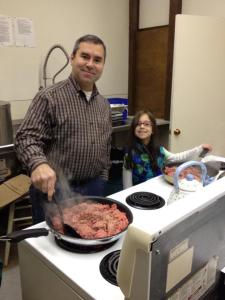
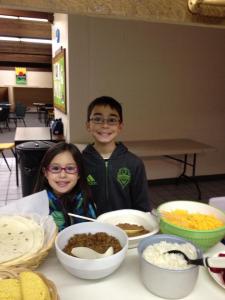
7.  Start a tradition of doing a family service project on Human Rights Day.   There are many opportunities to volunteer, such as preparing and serving meals at a local homeless shelter.  The Lappin family has done this for two years in a row now in their community in Washington state.
Lappins
Dad Nathan describes it as “Such a humbling and at the same time rewarding experience. Feels really good to concretely help others and appreciate what we have as well. Our kids did a great job helping and participating, and interacting with the kids we were hosting.”
Lappins2
Even if your family isn’t able to volunteer in an established project, you can still do something as a family to address the economic and social rights in your community.  For example, put together care packages with warm socks or mittens, a water bottle, individually wrapped snacks (and maybe even decorate a card to stick inside) and offer them to homeless men and women who you may encounter during the day.  Or have your kids decorate a few grocery bags and fill them with non-perishable food items, then bring your kids with you when you drop them off at the food shelf.
Most importantly, spend some time talking with your kids about your family’s service experience.  Talk about what you did and why you did it. Ask your kids, “How did it feel?” and “What did you learn from doing this project.”
8.  Play a game that helps kids understand human rights.  Blind Trust (from ABC – Teaching Human Rights):  In pairs, have one child blindfold the other and have the sighted member of the pair lead the “blind” one about for a few minutes. Make sure the leading child is not abusing the power to lead, since the idea is to nurture trust, not to destroy it. The “leader” of the pair should try to provide as wide a variety of experiences as possible, such as hav- ing the “blind” partner feel things with his or her feet or fingers, leading with vocal directions or even playing a game. After a few minutes have the children reverse the roles and repeat the process so that the “leader” is now the led, and the “blind” partner is now the sighted one.

Once the activity is over, allow the children to talk about what happened. Discuss how they felt – not just as “blind” partners but their feelings of responsibility as “leaders” too. This can lead not only to a greater awareness of what life is like for people with sight (or hearing) disabilities, but to a discussion of the importance of trust in the whole community. This can lead in turn to a discussion of world society, how it works and how it can fail to work too.  (teaches about Universal Declaration of Human Rights article 28; Convention on the Rights of the Child articles 3, 23)

9.  Ask the question “What Does a Child Need?”  Have your child lie down on a large piece of paper and trace their outline on the paper.  Ask your child(ren) to name this paper child. Discuss and decide on the mental, physical, spiritual and character qualities they want this ideal child to have as an adult (e.g. good health, sense of humour, kindness) and write these qualities inside the outline. They might also make symbols on or around the child to represent these ideal qualities (e.g. books to represent education). Talk about what human and material resources the child will need to achieve these qualities (e.g. if the child is to be healthy, it will need food and health care); write them down on the paper outside of the outline.  You can also read a simplified version of the Convention on the Rights of the Child.  When children hear an article that guarantees a child each of the needs they have listed, they can write the number of the articles next to that item. Circle any needs identified but not covered by the Convention.

10.  Check out the Amnesty International You Tube channel.  Amnesty has uploaded more than 500 short videos on a wide variety of global human rights issues. Many videos are in multiple languages, including Spanish and Arabic.  (Given the subject matter, many are more suitable for older kids and teenagers than younger kids. Be sure to preview for anything that might be upsetting to your own children.)

The Price of Silence – A music video that brings together 16 of the worlds top musicians—some of whom have fled oppressive regimes—in a rousing musical plea to guarantee human rights for all.

Wyclef Jean sings One Love in this slideshow about Children’s Rights

 ADDITIONAL RESOURCES:  You’re on your way to a great Human Rights Day!  If you are a classroom teacher or homeschooling your kids (or if you just want to dig deeper), you can find tons more ideas through the following resources:

MY 2013 HUMAN RIGHTS DAY POST HUMAN RIGHTS DAY ACTIVITIES TO DO WITH YOUR KIDS

MY 2014 HUMAN RIGHTS DAY POST HUMAN RIGHTS DAY ACTIVITIES FOR YOU & YOUR KIDS

ABC – Teaching Human Rights – practical activities in English, French, Russian, Arabic, Chinese, and Spanish

The Advocates for Human Rights’ Discover Human Rights Institute – human rights education lesson plans and curriculum

Human Rights Here and Now  – human rights lesson plans and resources

Raising Children With Roots, Rights and Responsibilities – activities for preschool and young elementary children

UNRIC’s Human Rights Education website –  great source for multimedia on human rights!

The Thankful Turkey

It is Thanksgiving Day here in the United States.  This uniquely American holiday is supposed to remind us of all that we have to be thankful for, both as individuals and as a nation, but I fear that this sometimes gets lost in our collective national appetite for overindulgence (we don’t stop eating until we feel remorse) and entertainment (Macy’s Parade, football, holiday TV specials).  That we carry out these traditions in the company of our closest friends and family members is important and perhaps even the saving grace of the day, but have we lost the true spirit of Thanksgiving?

I was at my daughter’s school last week for Turkey Bingo. At this event, 25 lucky families won a turkey.  We did not, although we came within a B11 of winning.   As we were leaving, she grabbed my hand and said, “I want to show you something.” She led me out into the hall to a giant, colorful turkey on the wall.  She explained that each of the students had written what they were thankful for on a feather.

The thoughts expressed on the feathers give a picture of the typical things for which the average American kid is thankful.  I saw feathers that said things like:

“I am thankful for friends and family.”  “I am thankful for my mom.” “I am thankful for my sisters.”

“I am thankful for my grandma and grandpa.” “I’m thankful for my daddy.”

Other feathers said things like:

“I’m thankful for my cat” and “I am thankful for my xBox.”

I noticed a couple of feathers, though, that said things like:

“I’m thankful to be here”  and “I am thankful for America.”

“I am thankful to live in a place with no war.”

My daughter goes to a school that has a large number of English Language Learner students.  Many came to this country as refugees from Somalia or other countries in East Africa, but she also has friends who came to this country as refugees from Tibet or were adopted from orphanages in China.  There are also kids at her school from Central and South America.

Sometimes we forget that the Pilgrims were refugees.  In England, they were persecuted on account of their religious beliefs.  They took the tremendous risk of coming to this new land in order to be free to practice their own religion.  And giving thanks for their freedom was a big part of the first Thanksgiving.

As I looked at that turkey on the wall of my daughter’s school, I had a moment of inspiration. When all of those individual feathers, childishly and colorfully decorated, are put together, you get a lovely image.  But you also get much more.  When all of those truthful and thankful thoughts are put together, you feel the true spirit of Thanksgiving.

And that is the inspiration and the spirit in which I hope to celebrate this holiday.

Happy Thanksgiving to you and yours, from me and (one of) mine!

HUMAN RIGHTS: Speaking the Language

I’m over at World Moms Blog with this post today.  Check it out!

Sometimes I have trouble finding the words to talk to my kids about the violence that hear about in the news, the injustices that they see in our own community.  As a human rights lawyer, it is my job is to document and expose human rights abuses. But I have always struggled with how to communicate to my kids what human rights are and why they should care about them.

Recently, however, I was preparing for a project that involved interviewing children about their experiences.  Experts advise that interviewers use simple language when speaking with children about difficult topics.  “Simple language” means avoiding big words, of  course, but it also means using simple, direct sentences.  Straight-forward grammar – subject and predicate in sentences; basic speech parts – nouns and verbs and adjectives.  I suddenly realized what I was doing wrong in talking about human rights with my kids. Rather than explaining complicated concepts, what I needed to do was break it down to the core values that everyone needs to live fully in this world. I needed to start with the basic building blocks of language: words.

Once I realized this, I started to see human rights words all around me!  Words like:

and

and

Verbs like

and


and

and

Nouns were all around me!

and

and

and

I saw adjectives, too!

and

I started pointing out these words to my daughter, who is seven. Just last week, she was running past the table in the entryway where we put our mail.  Suddenly, she came to a screeching halt in front of the stamps.

“Look, mommy,” she said.  “The stamps are speaking the language of human rights!”

My daughter was exactly right.  The stamps said: equality, justice, freedom, liberty.  Powerful words that convey basic human rights concepts.

What human rights words do you see around you? Take a picture and post them on the World Moms Blog facebook page.

We can’t wait to see the human rights words in your community!

Weekly Photo Challenge: A Parable of Renewal

I practiced asylum law for the first seven years of my career, representing refugees who were fleeing persecution and human rights abuses in their home countries and seeking safety in the U.S.  These are people who are not easy to forget and whose stories shouldn’t be forgotten.  Many of their stories – the details of their lives, their losses, their dreams – have stayed with me over the years.  The remarkable thing about the refugees I have known is not only their ability to survive incomprehensible losses, but also the strength and hope and determination they have to remake their lives in an entirely new country.  To learn new skills, speak new languages, adapt to new cultures.  To me, the refugee experience symbolizes this week’s Photo Challenge theme:  Renewal

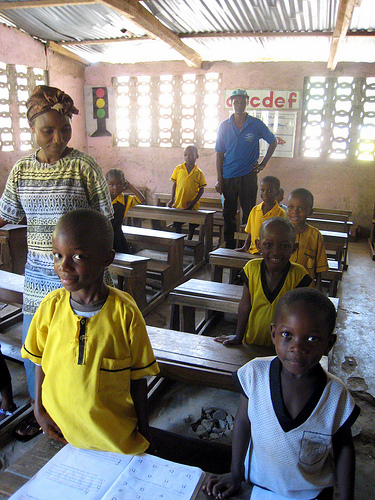
 The picture above was taken in Buduburam Refugee Settlement in Ghana, which I visited three times between 2007 and 2010. Buduburam was home for 20 years to more than 30,000 Liberians who fled the bloody conflict in their West African country.  Officially closed this year, Buduburam was a small, bustling Liberian city in the countryside outside of Accra.  Life was hard on the camp, where refugees even had to pay for water to drink and for access to the latrines. To improve their opportunities, many of the refugees at Buduburam enrolled in skills training courses; the photo shows some of classes offered by the New Liberian Women Organization (macrame being one of them, as you can also tell by the colorful plant hangers).  Even in a time of limbo, the refugees at Buduburam were striving for renewal. Those refugees who could afford it sent their children to school as education offers a chance for a new life.

I still hold many former asylum clients in my heart. I’d like to share the story of one refugee family I represented.  For me, it is a parable of renewal.

 James and Julia (not their real names) had been politically active in their native Kenya. Julia, in particular, had been very active in speaking out against an oppressive government.  They had a young son, who I’ll call William, who had huge, solemn eyes.  When the police came to their house to arrest Julia, a police dog bit William on the head. You could still see the jagged scar on his scalp more than a year later when, having left everything they owned behind to escape Kenya, they were seeking legal assistance with their asylum claim in the U.S.  

 In police custody, Julia had been brutally beaten.  She was also repeatedly raped in custody, including with objects such as the muzzle of a rifle and a Coke bottle.  This testimony was critical to the success of their asylum case, so we had worked with Julia to prepare her to tell her full story, with as much accuracy as possible and as many details as she could remember.  “Just tell the truth about as much as you can remember of those weeks,” I urged. We all knew it would be painful.

 Julia testified about her experiences in a straightforward manner and in excruciating detail, but with such poise and dignity that both the asylum officer and I were in tears. Asylum officers are specially trained federal officials who make decisions about asylum cases based on a written application and an in-person interview.  During my time practicing asylum law, I rarely saw an asylum officer actually cry during an asylum interview. 

 I remember well how James sat next to her, utterly still. Not touching her, not looking at her, but supporting her as she spoke. Anguish is the only word that could possibly describe the look on his face as he listened to her testimony.  I had to look away. Even in my role as their attorney, a role which requires a special intimacy, I felt the need to give their family some small space of privacy as they recalled those terrible days.

 Years later, after they got their citizenship, James and Julia had a party to say thank you to all of the people who had helped them. In addition to their attorneys, there were people from their church and other members of the Kenyan community. They now lived in a big, new house out in the suburbs. Julia was close to graduation from nursing school. William, who I hadn’t seen since he was three, was now in middle school.  He was a straight-A student and talented musician who had just gotten braces.  They had another child, too – a daughter born here in America. She was wearing a pink tutu.

It had taken a lot of hard work for James and Julia to get to where they were.  They had experienced many challenges and frustrations with adapting to life in this strange, new country.  But they persisted and, through sheer effort and determination and a bit of creativity, slowly but steadily they moved forward, finding healing for themselves and building a new life for their family.   It wasn’t easy, but James and Julia had managed to make something new out of nothing. 

INTERNATIONAL DAY OF THE GIRL: Kanchi’s Story

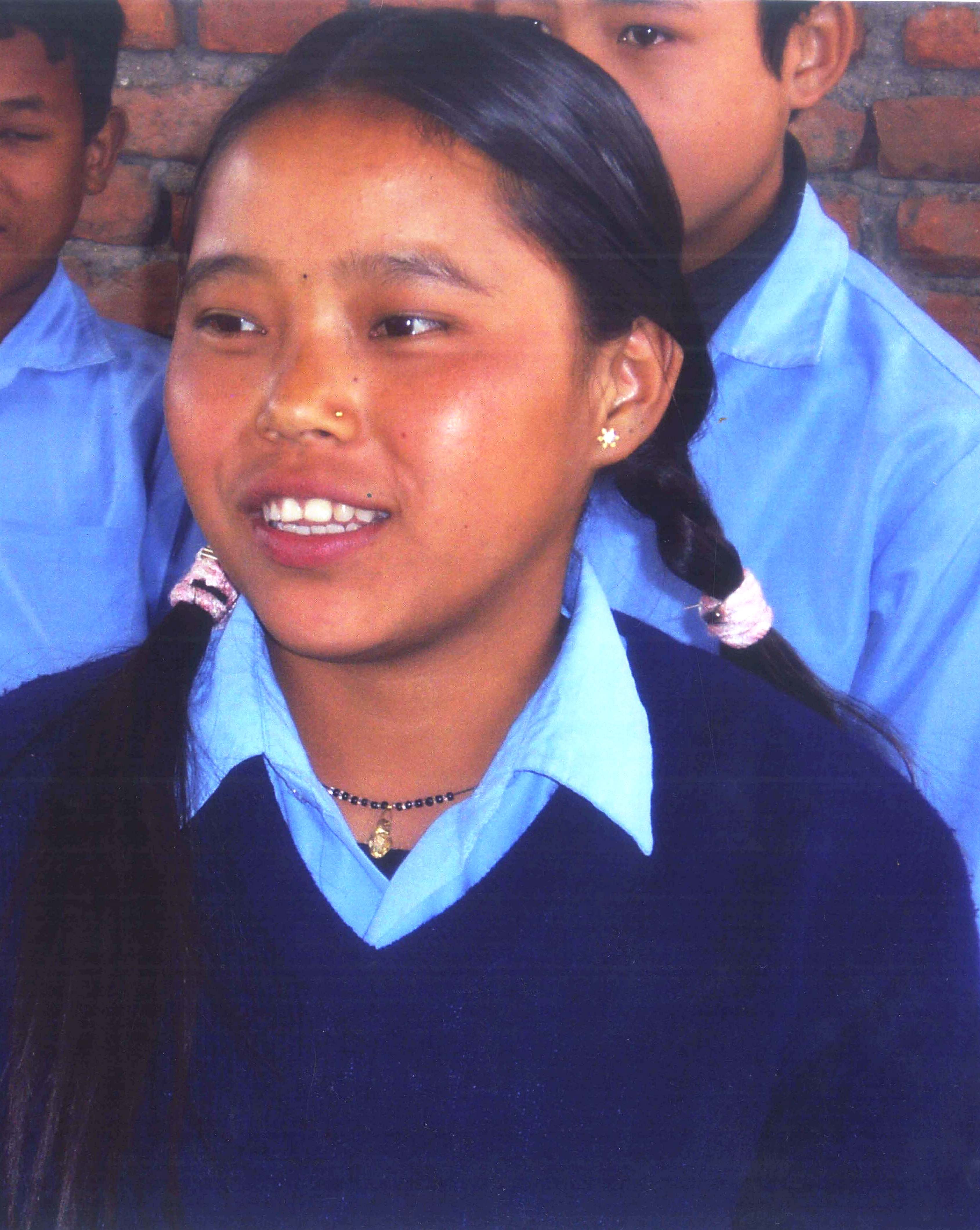
Every morning when I come into work, I am greeted by the smiling face of a young girl. Her hair is pulled neatly back into two braids, glossy black against her pink hairbands.  Her eyes, dark and alert, shine at me – I swear I can see them twinkle.

She wears the blue uniform of her school, the Sankhu-Palubari Community School in rural Nepal.  The Advocates for Human Rights supports the school to provide the right to education to the most disadvantaged kids in the area and to prevent them from becoming involved in child labor.  Photographs from the school hang on the walls of our office, reminders to us of the lives that we impact with our human rights work.

Even though I see her every day, until last month I had never met this cheerful young girl, a girl whose smile – even in a photo – comes from her core, seems to light her entire being. Until last month, I did not know that her name was Kanchi.  And I had never heard her incredible story.

*****

In 1999, Kanchi was six years old.  She lived with her family in a village in the Kathmandu Valley.  Her parents were poor farmers; they had only a little land and some cattle and they struggled to feed their family.  Kanchi was the youngest of six sisters.  She and her sisters (and also her  brother) had to help their parents in the fields and with household chores.  Kanchi’s job was also to take the cattle to the forest to graze.   Kanchi did not go to school.   There were many children in Nepal that did not go to school at that time, but girls, like Kanchi, were more likely than boys to work rather than go to school – particularly in rural areas like the Suntole district where she lived.

Kanchi was a very smart and determined little girl.  She wanted to go to school.   So when she heard that a new school was opening in the Sankhu-Palubari community – a school for kids who were not able to go to school because they couldn’t pay or were discriminated against – she was very excited.  She rushed off to tell her parents.  But her parents, who had never themselves been educated, were not as excited as Kanchi.  Why should they let her go to school?  Who would help feed the family? Why should they send her to school if she was only going to get married in a few years anyway?

Kanchi says that she cried for a month and begged her parents to let her go to school.  One day, teachers from the new school came to visit Kanchi’s parents to talk to them about the school. The teachers explained that it would help THEM if Kanchi could read and write.  They explained why it was important for all children to go to school, even girls.  They told them that all children – even the poorest, the lowest-caste, members of indigenous groups – had a right to education.

Kanchi’s older sisters, who had never had the opportunity to go to school, took her side. Instead getting an education, they had all married young and were working in the fields.  Kanchi’s sisters argued that Kanchi should go to school, take this opportunity for a life that would be different from theirs.  Finally, their parents agreed to let Kanchi go to school.

Kanchi started at the Sankhu-Palubari Community School in 1999, one of 39  students in the first kindergarten class.  To get to school, Kanchi had to walk one and a half hours each way.  There were many other obstacles along the way, too.  At various times, her parents wanted her to stop school and help them with farming.  But she stayed in school and worked hard. She told her parents,  “I want to do something different from the others.”

Kanchi liked her teachers and felt supported by them.  She felt that the best thing about the school was the teaching environment.  She stayed in school and was one of only two girls in the first class to graduate from 8th grade.  She continued on to high school and completed 12th grade at  Siddhartha College of Banepa in 2012.  The first in her family to go to school, Kanchi is also the first girl from the Sankhu-Palubari Community School to graduate from 12th grade.

I met Kanchi for the first time in September.  Almost exactly 13 years after this brave little girl started kindergarten, she is a lovely young woman who is preparing for her university entrance exams.  She plans to study agriculture  starting in January.   Her parents are proud of her and they are happy now – she has chosen the family profession – but Kanchi is interested in learning more about organic farming so she can bring techniques back to her village.  “I want to live a healthy life and give a healthy life to others,” she says.

Sitting in the principal’s office at Sankhu-Palubari Community School, I asked her what the school meant to her.  Kanchi said, “I gained from this school my life.  If I hadn’t learned to read and write, I would be a housewife.”  When asked about her sisters, she told me that they had made sure to send their own children to school.

In her free time, Kanchi likes to sing and dance and make handicrafts to decorate her room.  She likes to play with her sisters’ children.  She has a smile that lights the whole world.  She told me her nickname, Himshila.  She smiled when she told me it means “mountain snow, strong rock”.  Strong rock.  That seems just about right.

*****

October 11, 2012 is the first International Day of the Girl Child.  The United Nations has designated this day to promote the rights of girls, highlight gender inequalities and the challenges girls face, and address discrimination and abuse suffered by girls around the globe.  In many ways, the story of Kanchi and her sisters reflects the experience of girls in many countries throughout the world.  All over the world, girls are denied equal access to education, forced into child labor, married off at a young age, pressured to drop out of school because of their gender.

There are many good reasons to ensure access to education for girls like Kanchi, however. Educating girls is one of the strongest ways to improve gender equality.  It is also one the best ways to reduce poverty and promote economic growth and development.

“Investing in girls is smart,” says World Bank President, Robert Zoellick. “It is central to boosting development, breaking the cycle of intergenerational poverty, and allowing girls, and then women—50 percent of the world’s population—to lead better, fairer and more productive lives.”

The International Day of the Girl is a day to recommit ourselves to ensuring that girls like Kanchi have the chance to live their lives to their fullest possible potential.  To redouble our efforts to promote the rights of girls wherever they live in the world.   This first International Day of the Girl is also a day to honor girls like Kanchi.  A day to take the story of her success in one tiny corner of Nepal and shout it out, an inspiration for girls all around the world.  Girls like Kanchi with the strength, the bravery, the determination to change the world, but who  just need the opportunity.

Originally published on The Advocates Post.

NEPAL: Visiting the Sankhu-Palubari Community School

Some students walk – up to 2 hours each way – to the Sankhu-Palubari Community School to access their right to education.

I’ve been in Nepal for the past ten days with a team of staff and volunteers.  We are here to visit the Sankhu-Palubari Community School (SPCS) in the rural Kathmandu Valley.  The Advocates for Human Rights, the organization I work for, has supported the school since it was founded in 1999 to prevent child labor, encourage gender parity in education, and improve the lives and well-being of the most disadvantaged children in the area.  The school in Palubari village is only about 40 km outside of Kathmandu, but the peaceful, green valley in which it is nestled feels worlds away. The drive out is nerve-wracking (in the terrible Kathmandu traffic), then bone-jarring (on the bumpy, rutted roads). But the sight of these bright, alert children makes it all worthwhile.

In the United States, where education is both compulsory and free, we often forget that the right to education is not meaningfully available in many parts of the world – especially for girls.  The UN estimates that there were more than 67 million primary school-age and 73 million lower secondary school-age children out of school worldwide in 2009.  In addition, an estimated 793 million adults lack basic literacy skills. The majority of them are women.

Most of the students’ families work in agriculture.  They are farmers with little or no money to spare on school fees, uniforms and supplies.   Frequently, the adults in the family are illiterate. Many of them are from marginalized groups such as the Tamang. An indigenous group with their own culture and language, the Tamang students must learn Nepali as well as English when they come to school.  A pre-K program was added in 2011 to provide pre-literacy eduction to better prepare the students for school.

This week, The Advocates’ team has been conducting a site visit which includes interviewing students in grades 5 through 10 about their experiences at the school and their plans for the future.  It has been a treat to interview these kids and learn more about their lives, their hopes, their dreams for the future.

We’ve been inspired to hear from so many of the girls about their commitment to getting a good education. Since the school’s founding in 1999, the teachers have conducted outreach to parents and worked hard to encourage female students to attend and stay in school in spite of societal pressure to get married, work in the fields or enter domestic work.
Their efforts have definitely paid off.  While girls worldwide generally are less likely to access, remain in, or achieve in school, 52% of the students in K-8th grades at the school this year are girls. And a girl is at the top of the class in every single grade at SPCS.
Students had so much to tell us about their hopes and dreams for the future.  Some wanted to be doctors and nurses. Some wanted to be teachers. Some even wanted to be professional football (soccer) players! (Football is very popular here in Nepal, especially among boys. The Nepali national football championship is coincidentally going on right now in Kathmandu.  The national police team has won for the past three years.)  This student demonstrated for me his prowess at left forward.
The Sankhu-Palubari Community School may be a small school in a remote valley, but it is a place where the human right to education is alive and well, providing a better future for these children.  The impact that they have on their community, their country and – hopefully, the world – will be thrilling to watch.
Pre-K students enjoying their noodles at lunch.
7th graders in one of my English conversation practice small groups.
THIS POST WAS ORIGINALLY PUBLISHED IN THEADVOCATESPOST.
PHOTO CREDITS:  Robin Phillips, Jennifer Prestholdt and Laura Sandall
Jennifer Prestholdt is the Deputy Director of The Advocates for Human Rights

The Other Greek Crisis: Xenophobia and Mass Detention

Landing at Elefthérios Venizélos in Athens, you can’t miss the sprawling blue and gold IKEA near the airport.  While tourists arriving  in Greece may recognize the siren call of cheap and trendy furniture, they are not likely to notice that there are also detention centers in Athens.  The brand-new Amygdaleza migrant detention center was opened in April in western Athens, shortly before the election. There are plans to build many more detention camps – and quickly.  Greek police reported this week that they have arrested thousands and temporarily detained more than 17,000 migrants, mostly from Asia and Africa, since August 4, 2012.

I traveled to Greece for the first time in May.  I was there briefly and only as a tourist. I stayed in tourist areas, encountering very few Greeks who didn’t work in the tourism industry. Perhaps this is an occupational hazard, but I can’t help but look for human rights violations – even when I’m on vacation.   So I listened carefully when my brother, who had been living in Greece for some months, mentioned that recently the government had started arresting, detaining and deporting migrants.  In fact, the first 56 migrants arrived at the new Amygdaleza migrant detention center on April 29 – only a week before the national election. Undocumented migration had become a major issue in the May 6 election, with several parties pledging to crack down on migrants. Based largely on this issue, the far-right Golden Dawn party gained seats in Parliament for the first time.

While Greece may be idyllic for the foreigners who are tourists, many migrants and asylum seekers have a very different experience.

Since the early 2000s, Greece has been a major entry point to the west and Europe for migrants and asylum seekers from Asia and Africa.  Many of them cross the border with Turkey, which up until August was fairly porous.  By some estimates, a million immigrants live in Greece, which has a population of barely 11 million.  Add to this demographic change the deepening economic crisis and rising social tension and you get a volatile situation in which undocumented migrants and asylum seekers have become the targets of xenophobia.  According to a July 2012 report from Human Rights Watch, “Xenophobic violence has reached alarming proportions in Greece, particularly in the capital city of Athens.”

None of this was apparent to me when I was a tourist in Athens in May.  Even the economic crisis in Greece was surprisingly – shockingly, in fact – invisible.  I tried asking a couple of people about it.  People seemed annoyed with the politicians, but unconcerned that Greece would leave the Euro zone.   The waitress at the take-out place where I got my Greek salad just rolled her eyes when I asked about it.  “Try a FIX Hellas,” she said, proffering a pale Greek beer in a clear plastic cup.  “You can walk around with it.”  So I walked around Plaka like I was on Bourbon Street, thinking about the ironic name of my beverage. Lots of people were shopping.  The Barbie store was doing a particularly brisk business.
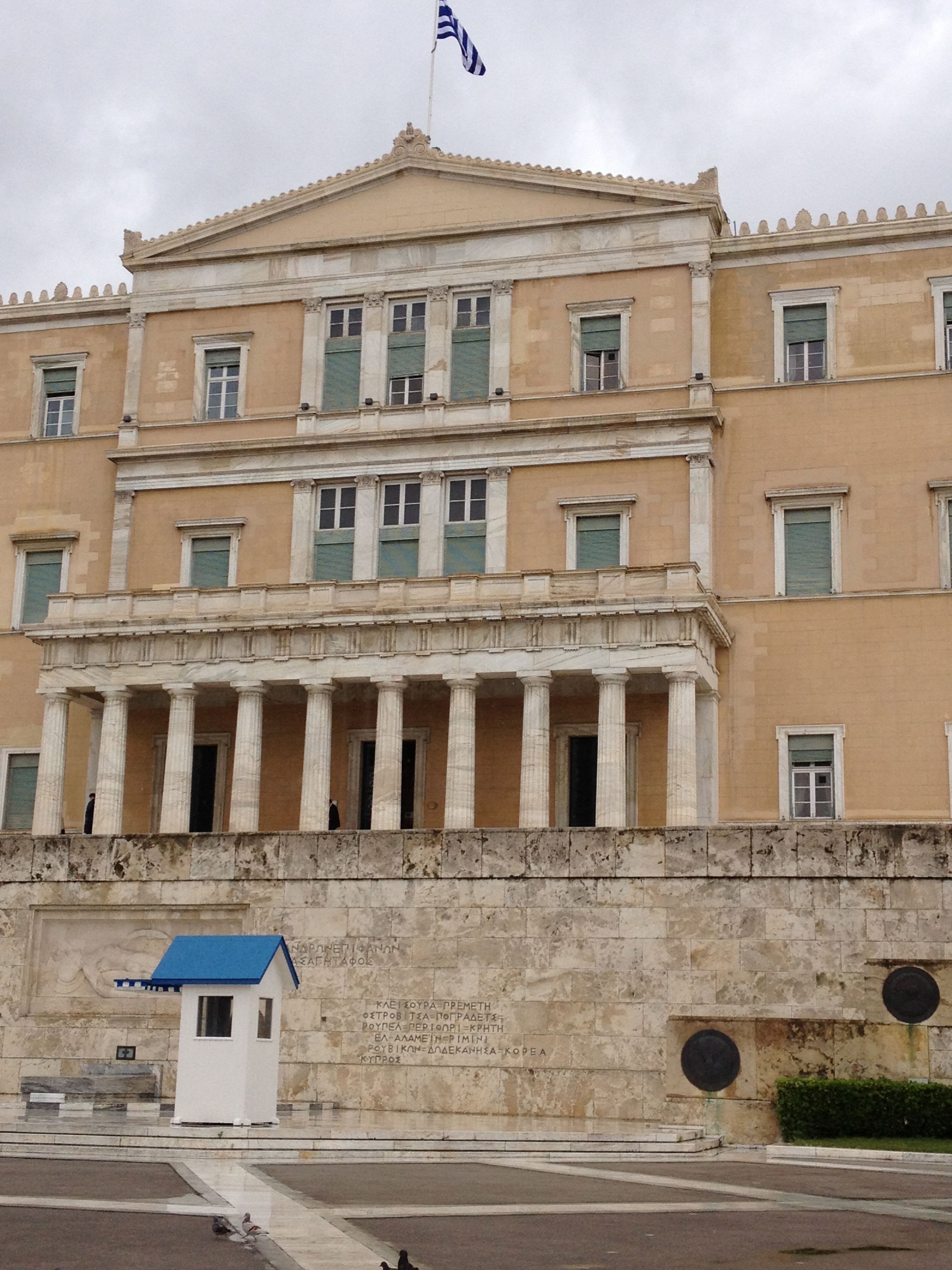
Later, I walked over to the Parliament.  Even though it was the middle of a workday, it was as still as a tomb.  I started to understand the Greek frustration with politicians.

I followed the news on the “other Greek crisis” after my return.  In early August, there was a mass crackdown on “irregular migrants”.  Greek authorities deployed 4,500 police around Athens to arrest and detain more than 7,000 migrants in less than 72 hours.    In another example of ironic naming, the Greek authorities called the operation Zeus Xenios after the Greek god of  hospitality and guests.  The Greek office of the United Nations High Commissioner for Human Rights expressed concern that legitimate refugees and genuine asylum seekers could be among those who are summarily deported, but the round-ups have continued.  On September 5, Greek police reported that 17,000 migrants have been temporarily detained in these round-ups, with 2,144 of them arrested. One of the concerns is that the ongoing sweeps target suspected migrants based on little more than their physical appearance; the proportion of temporarily detained to arrest numbers seem to bear that out.  In addition to the problem of arbitrarily detaining migrants, visits to some of the migrant detention centers have documented inhuman and degrading conditions. 

Of course Greece has the right to control migration, to set and enforce their country’s immigration laws.  But Greek authorities must comply with their international and European human rights obligations.  Above all, they should not arrest, detain, and deport foreigners based on appearance or ethnicity – in contrast to the the welcome received by an American tourist like me.  The left-wing main opposition Syriza party has been critical of the crackdown and claims that the migration issue is being used to divert attention from the more difficult and unpopular issues of the economic crisis and the spending cuts that the EU and IMF require in exchange for assistance out of the economic quagmire.  From my limited observation of the situation in Greece, I have to agree.