A Union of Opposites

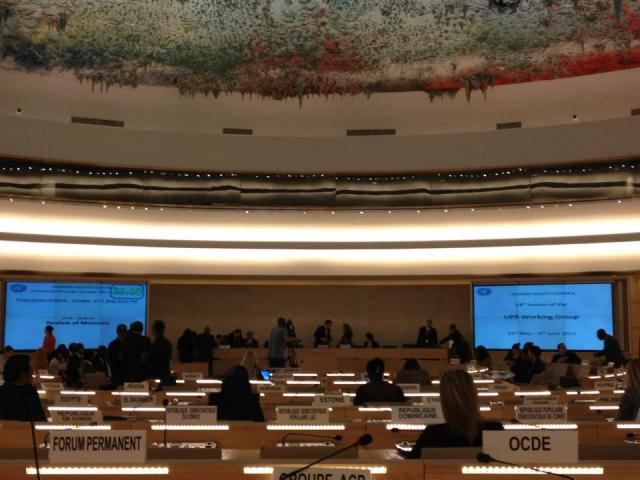
Inaugurated on 18 November, 2008 in honor of the 60th anniversary of the Universal Declaration of Human Rights, the “Human Rights and Alliance of Civilizations” room (better known as Room XX) is the home of the United Nations Human Rights Council  at the Palais des Nations in Geneva.  Part of my work involves advocacy at the United Nations’ human rights mechanisms, so Room XX  is a place I visit regularly.  (Photos are not allowed, but I snuck these photos with my phone anyway.)

May:  At the UN Human Rights Council in Geneva, Switzerland
At the UN Human Rights Council in Geneva, Switzerland

Spanish abstract artist Miquel Barceló created a a massive work of art for the ceiling of the room with paint composed of pigments from around the world.  More than 30 tons of paint were sprayed on the 1,500-square-meter dome ceiling, with the many layers of paint creating a textured rainbow of stalactites.  Depending on where you are in the room, the colors of the stalactites change based on perspective.

Barceló  describes his work in this way:

“All of it is a sea upside down, but it is also a cave.

The complete union of opposites,the ocean surface of the Earth and its most concealed cavities.”

Raising My Voice To #BringBackOurGirls

IMG_0849
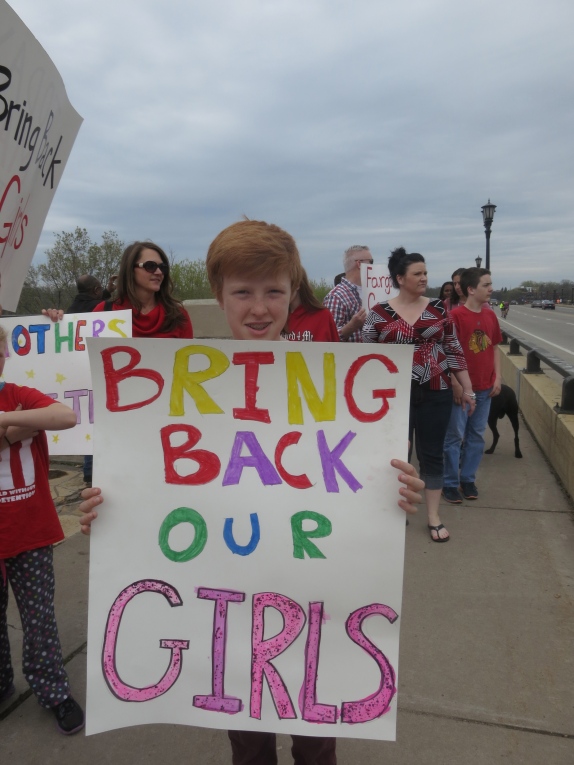
My son in a local march to Bring Back Our Girls

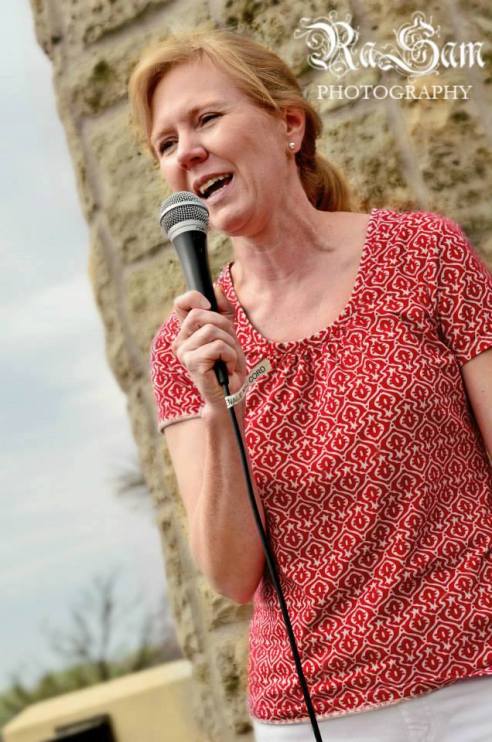
On Mother’s Day, I spoke at a local march and rally to show support for the nearly 300 school girls abducted a month ago in Nigeria.

IMG_0856

Here’s what I said:

Bring Back Our Girls Twin Cities March

May 11, 2014

Thanks to organizers and to all of you for being here.

I’m here as a lawyer and Deputy Director of The Advocates for Human Rights, a non-profit based in Minneapolis that works on human rights issues around the world.

But I’m also here as a mother.  My kids Simon and Eliza are here today as well to stand in honor of the nearly 300 girls abducted simply because they were pursuing their human right to education.  I think that’s pretty much the best Mother’s Day gift they could give me.

There are a lot of things that we don’t know about the situation in Nigeria.  We don’t know where the girls are or what is happening to them.  We don’t even know the exact number abducted and we only know a few of their names.  We can only imagine the agony their families are going through.

But the tragedy of the nearly 300 girls in Chibok shines a spotlight on the systemic human rights abuses against faced by women and girls worldwide.

And there are many things we do know about violations of the rights of girls and women:

  • We know that girls around the world lack equal access to basic education  (in the NE region of Nigeria where these girls lived, girl enrollment is the lowest in the country –  only 22%.  In part, they were targeted because they were seeking an education that would change their lives.
  • Educating girls, we know, is one of the strongest ways to improve gender equality.  It is also one the best ways to reduce poverty and promote economic growth and development
  • We know that girls and women are not valued equally as boys and men in many parts of the world.  The Nigerian government’s lack of action both before and after certainly makes it seem that these girls were not deemed worthy of protection.
  • We know that when these girls are found and hopefully rescued, they will need support in the form of psychosocial and health care.  Women’s access to health care is woefully limited.
  • We know that 1 in 3 girls under age 18 are still being forced into marriage too early.  By some estimates, that’s about 14 million girls a year. Too many girls still endure harmful traditional cultural practices such as FGM.
  • We know that girls and women suffer the most in times of conflict.  What these girls have experienced is likely a war crime.  Trafficking remains a huge problem around the world and in our own community.
  • We know that 1 in 3 of the world’s women experience violence, including domestic violence (The Advocates for Human Rights works on domestic violence legal reform around the world);

And we know that these are all things that have to change.

We need to do more to push our governments to make this change a priority.  We can’t stop with just these 276 girls.

Now these are human rights abuses that may seem intractable.  It may seem like you are powerless to make a difference.  But you can:

  • Continue to educate yourself about girls and women’s rights.  Here in the Twin Cities, there are many opportunities.   Through The Advocates for Human Rights alone, you can attend the free St. Paul Public Library Women’s Rights Film series, learn more about the issues on www.StopVAW.org, or participate in our Human Rights Book Club.
  • Support the NGOs that work on issues you care about. No amount is too small – a little money really does go a long way in this area.
  • Write to our members of Congress and the President to encourage support for women’s rights as a critical part of our US foreign policy.
  • For those of you with young people in your lives, teach them about the world around them so that they will grow up to continue the fight to ensure that every child, wherever he or she lives in the world, has the chance to live in safety and dignity and to achieve their greatest human potential.

For those of you doubting whether sharing this story on social media really makes a difference, I’d like to share a message I got on my blog from a woman named Winnie in Nigeria:

we here in nigeria are so angry and feel very helpless, the government and opposition leaders have politicized this, while our daughters are still in captivity. the government officials do not want to listen to ‘ordinary’ people. and word  has it that the Nigerian press have been ordered to kill the story (as the have killed other stories in the past).  pls this is a passionate plea to the international community to keep this story alive until our girls are returned home safely.

Here in the Twin Cities and all around the world, we are working to keep this story alive until our girls are returned home safely.

And after our girls come home, I hope we can keep working together for a future where all girls around the world can go to school in safety and grow up to reach their full human potential.

10288798_10203311603978274_2795202505824041415_n
Image used with permission of RaSam Photography. Thank you!


See also:  Nightmare For Nigeria’s School Girls   originally published on The Advocates Post.

Paving Pathways for Justice & Accountability: New Tools for Diaspora Communities

House party_HighRes-2

This post originally appeared on The Advocates Post.

Human rights advocacy takes many forms, and human rights activists can be found in every corner of the world.  Tremendous advancements in technology and communication have allowed activists to form strong international networks and to share emerging information about human rights abuses almost as soon as they happen.  These advancements have fundamentally changed the way human rights organizations work, including how they engage in human rights advocacy with broader communities beyond a country’s borders.

Yet the unique role diaspora communities can play in improving human rights around the world has largely been overlooked in the human rights field. It’s time for that to change.  

Diaspora: The Migration Policy Institute defines the term “diaspora” as “emigrants and their descendants who live outside the country of their birth or ancestry . . . yet still maintain . . . ties to their countries of origin.”

Members of diaspora communities play an increasingly important global role and can be a bridge between individuals, governments, and international legal and political mechanisms.  Diaspora communities are a critical link in changing social institutions and structures to hold governments accountable.   Many migrants – refugees and asylum seekers in particular – leave their homes because of human rights abuses.  Many were political and human rights activists in their home countries and they bring their experiences with them.  In some countries with repressive governments, security concerns mean that diasporans must take the lead in speaking out.  From their new home base, they can bring change in their countries of origin.

Members of diaspora communities agree.  Chanravy Proeung, a member of the Cambodian diaspora and Co-Director of the Providence Youth Student Movement, said:

“We have the privilege to see those countries from a different perspective. We need to have the people who are the most marginalized and affected by issues at the forefront of creating change not only here in the United States, but having influence in their countries of origin, too.”

For more than 30 years, The Advocates for Human Rights has witnessed the powerful role that diaspora civil society organizations play in documenting human rights abuses, influencing policy, and advocating on behalf of victims of human rights violations in their countries of origin.

As a legal service provider, The Advocates is often the first connection that asylum seekers have to their new community in the United States.  Because of this special relationship, diasporans from dozens of countries have requested assistance from The Advocates in documenting human rights violations “back home.”  With diaspora communities, The Advocates has conducted groundbreaking work, such as the Liberian Truth and Reconciliation Commission Diaspora Project, ensuring that public hearing testimony and the statements of 1,200 Liberians living outside of Liberia were included in the formal history of the conflict.

The report,  Human Rights in Ethiopia: Through the Eyes of the Oromo Diasporaproved the significance of involving individuals who have left a country in work to hold governments accountable and affect human rights in their home countries.  The Advocates has also collaborated with the Indian American Muslim Council on advocacy on issues concerning religious minorities at the both the U.S. Congress and the United Nations, demonstrating that diaspora voices can have an impact on human rights in India.

The Advocates recently completed a two-year project to identify needs and create tools to help tap the underexplored resources of diaspora involvement in human rights.  The result is a groundbreaking resource called Paving Pathways for Justice & Accountability: Human Rights Tools for Diaspora Communities.

diaspora-cover-final

This manual, available for download at no cost, provides a full menu strategies and resources designed to empower diaspora communities to be more effective advocates for human rights in their countries of origin.

With practical tools and step-by-step guidance shaped by input from multiple diaspora communities, Paving Pathways can be used to help individuals and organizations to:

  • monitor and document human rights abuses;
  • advocate for change in their country of origin and country of residence, as well as at international and regional human rights mechanisms;
  • address impunity and hold governments accountable using national and international law; and
  • build their capacity to improve human rights conditions.

While the tools and resources presented in this manual were specifically created for use by diaspora communities, this manual can also benefit and be used by human rights defenders and civil society organizations throughout the world.

The international community needs to do more to recognize the unique contributions that diaspora communities can make to building respect for human rights around the world.  Rather than treating diasporans solely as economic sources of remittances,  investment, and philanthropy, countries of origin and countries of residence should  facilitate engagement in long-term social change.  With this new resource, The Advocates is taking an important step in supporting diaspora communities in their efforts to improve human rights around the world.

Download your free copy at: TheAdvocatesForHumanRights.org/pathways  

Individual chapters can also be downloaded for free.

Don’t know where to start?Quick Reference Guide cropped

Use our Quick Reference Guide!


[1] International Organization for Migration and Migration Policy Institute, Developing a Roadmap for Engaging Diasporas in Development (Washington DC and Geneva: IOM and MPI, 2012), 15. Also available online at http://www.migrationpolicy.org/pubs/thediasporahandbook.pdf.

By:  Jennifer Prestholdt, Deputy Director and Director of  the International Justice Program at The Advocates for Human Rights


Pete Seeger & Rise Up Singing!

I can’t remember a time before I knew his voice.  Pete Seeger’s songs are part of the soundtrack of my childhood.  When my own children were young, we sang together his songs “Goodnight, Irene” and “We Shall Overcome” and  “If I Had a Hammer.  Yet, in spite of the fact that Pete Seeger gave thousands of performances, I only saw him in person one time.   He was not on a stage.  He was not with a crowd.  Pete Seeger was standing alone in the rain on the side of the highway near his home in New York’s Hudson River Valley.   Pete Seeger was holding neither a banjo nor a guitar, but instead a large sign protesting the Iraq War.   As we drove by, I noticed that his mouth was open and moving.  “Hey, I think that’s Pete Seeger!”  I said, turning in my seat to continue watching him through the foggy car window.

And I realized that his mouth was moving because – alone in the rain, on the side of a highway – Pete Seeger was singing.  He was singing his heart out for peace in our world.

What I saw that day made me especially thankful to Pete Seeger, not only for his music and his activism, but for his courage and conviction. Pete Seeger is someone who really does make me believe, deep in my heart, that we SHALL  overcome one day.

For Pete Seeger (May 13, 1919 – January 27, 2014)

Rise Up Singing!

(Originally published on October 14, 2011 and updated on January 28, 2014)

History shows the incredible power of music to inspire and influence, to energize and heal.  The power of song can be seen in its impact on movement-building,  from the anti-slavery and  labor union movements in the 1800s to the civil rights and anti-war movements in the 1960s.  Liberation music has been important throughout the world, including songs of resistance during the anti-Apartheid struggle in South Africa.  Most recently, music has been part of this year’s Arab Spring.  In protests against Hosni Mubarak in Egypt, for example, music was a powerful way to convey the voice of the people.  (NPR story did a great story on The Songs of The Egyptian Protest)

I absolutely love Rise Up Singing, the folk music group singing songbook.  The book contains the chords and lyrics to more than the 1200 songs.  When you flip through it, you get a sense of how many songs there are out there that speak to such a wide variety of social justice issues.  Rise Up Singing grew out of Peoples Songs, Inc., Sing Out! The Folk Song Magazine and the post-World War II American folk song movement led by Pete Seeger and Woody Guthrie, and many others who sought to combine political activism with music.

But music that inspires me to stand up for human rights is not just about protest songs or folk music.  Music speaks to the individual. Inspiration is personal.   In 2006, I was in Geneva with representatives from dozens of U.S. human rights groups to participate in the UN’s review of  US compliance with the International Covenant on Civil and Political Rights.  We were all working on different issues and we came from all over the country, from Florida to Hawaii.

As an icebreaker at our first meeting, we were asked, “What is your favorite human rights song?”  I remember being amazed as we went around the room at the tremendous variety in terms of songs, genres, languages, meanings that had inspired this group of activists.   I told the group that my song was “If I Had a Hammer”.  (My kids were still quite young at the time and we were listening to a lot of Pete Seeger, who is my own personal antidote to Barney.)

Since then, I’ve been making a mental playlist of the songs that have inspired me over the years.   My list of songs is actually long enough for several playlists, but I decided to pull out just a few songs from each of the eras of my life so far.  This was a real challenge and there are a lot of obvious omissions.  Maybe I’ll just have to do another playlist someday.  In the meantime, I’ve got the HUMAN RIGHTS WARRIOR PLAYLIST for you on YouTube.  You can also link to each song individually below.   Enjoy!

From My Childhood

  1. If I Had a HammerPete Seeger      (See above. Pete >Barney.)
  2. Free to Be You and Me   – Marlo Thomas & Friends     In my opinion, one of the best things about being a kid in the 70s.
  3. The PreambleSchoolhouse Rock      Did you know that the U.S. Constitution is one of the first documents to establish universal principles of human rights?
  4. Star Wars Main Title/Rebel Blockade Runner – John Williams   People say Star Wars was a Western set in space, but I saw the Empire for the police state that it was. Extrajudicial execution of Luke’s family,  arbitrary detention of Han Solo et al. Not to mention the genocide on Alderaan.
  5. FreedomRichie Havens         My parents had the Woodstock album.  I think I know this and every other song on it by heart.
From My Youth 
  1.  Sunday Bloody SundayU2       I first heard this on my high school radio station WBRH. I went right to the library and looked up the 1972 Bloody Sunday Massacre in Northern Ireland. (Yes, I’m a nerd. I know.)
  2. Holiday in CambodiaDead Kennedys      I went through a big DK phase in high school.  Also, I knew a family that had fled the Pol Pot regime.  I still think of them when I hear this song.
  3. Talkin’ Bout a Revolution Tracy Chapman    Growing up in Louisiana, I had seen poverty.   But it didn’t prepare me for the mid-80s urban poverty I saw when I went to college in New Haven.  This song still rings true 25 years later.
  4. Tell Me Why  – Bronski Beat      I remember this as the first song I heard that directly addressed prejudice against homosexuals. Rock on!
  5. Waiting for the Great Leap ForwardBilly Bragg     The lyrics have changed since I first bought Worker’s Playtime (on cassette!) in college, but I think it is possible that I have listened it to 1,000,000 times.
From My Adulthood
  1. All You Facists (Are Going to Lose) – Lyrics by Woody Guthrie, Music by Billy Bragg & Wilco     From the Mermaid Avenue album.  Yes, the Facists are bound to lose some day.
  2. HurricaneBob Dylan       Rubin “Hurricane” Carter did an event for us to help raise money for our Death Penalty project.   If anyone ever wants to make a movie about your life, he highly recommends that you ask that they get Denzel Washington to play you.
  3. Living Like a Refugee –  Sierra Leone’s Refugee All Star Band                     I spent the first 5 years of my career working with asylum seekers.   This song captures many of the things I heard about their experiences.
  4. Face Down  – Red Jumpsuit Apparatus     Violence against women is the most common human rights violation in the world – 1 in 3 women will experience abuse in her lifetime.   In the US, a woman is beaten or assaulted every 9 seconds.  Kudos to these guys for singing about it.
  5. MinorityGreen Day      Sometimes I have to remind myself that not everyone thinks the way I do about human rights – yet.
  6. Sons & DaughtersThe Decemberists        This is kind of where I am right now.  With sons and daughter.  Hoping to “Hear all the bombs fade away.”

Morocco: Human Rights Violations Under Article 475

Originally published on The Advocates Post

In Morocco, a 15 year old girl experienced constant harassment and threats from a 35 year old man in her town.  He waited for her each day outside of her school and on several occasions told her, “I will force you to marry me.”  One day, he abducted and raped her at knifepoint.  The victim made a complaint to the gendarmes, who arrested the man.  In his statement to the police, the rapist admitted his crime, declaring that he did it “because it was the only way I would be able to marry her.”  In order to avoid scandal, the victim dropped out of school and married him.  “I am raped now every day,” she told members of the local association that works with women survivors of domestic violence.

This tragic story is one of many included in a joint submission The Advocates for Human Rights and our Moroccan partner Mobilising for Rights Associates (MRA) made recently to the United Nations’ Committee on the Rights of the Child.  The submission  draws attention to the serious human rights violations resulting from the application of Article 475 of the Moroccan Penal Code, which  provides that whoever “abducts or deceives” a minor, without using violence, threat or fraud, can escape prosecution and imprisonment if (i) the abductor marries the victim, and (ii) those persons who have a right to request annulment of the marriage do not file a complaint.[1]

Organizations and news reports from Morocco indicate that Article 475 has been applied in cases of sexual abuse of minors in order to preserve the “honor” of the victim and her family.  Notably, this issue has received widespread coverage following the 2012 suicide of Amina Filali, a sixteen year-old girl who killed herself after being forced to marry a man – ten years older than her – who had raped her.[2] Additional news reports confirm that the use of Article 475 continues.[3]  Further, associations working at the local level in Morocco report that girls married under Article 475 continue to suffer rape and domestic violence after the marriage.

Information from our Moroccan partners illustrates the extent of the problems with the application of Article 475. One local association that works with women reported that, of 11 cases involving rape of a minor that they handled in 2013, Article 475 was raised in 6 cases; the age of the victims ranged from 14-17, while the age of the rapists ranged from 23-28.[4]  In one case, a 14 year old girl was raped by her 28 year old cousin, and she became pregnant as a result.  She sought help from the association to file a criminal complaint, and there were several court hearings.  DNA testing established that the accused was the rapist.  Under Article 475, the two families agreed on a temporary marriage between the rapist and the victim to avoid shame, with a predetermined divorce date after one month of marriage.[5]

Associations working at the local level in Morocco report that the young victims experience tremendous pressure to abandon criminal prosecution and agree to the application of Article 475  from law enforcement, justice system personnel, as well as the families of the perpetrators. Even their own families pressure them to agree to marriage under Article 475 in order to avoid shame. Because all sexual relations outside of marriage are illegal under the Moroccan Penal Code,[6] victims also fear prosecution and imprisonment under Penal Code Article 490.[7] In fact, one Moroccan association reported several cases of rape victims who filed complaints to initiate criminal prosecution but were prosecuted themselves under Article 490.[8]

In one instance, a 15 year old girl was raped by a 25 year old man.  She became pregnant as a result of the rape, which is considered proof of illicit sexual relations.  She did not want to file a criminal complaint because she feared prosecution under Article 490, so she fled her home and sought shelter through a local Moroccan association.  The rapist’s family made threats against the victim’s mother, however, and she was pressured to not file a criminal complaint and to marry the rapist under Article 475 instead.[9]

Article 475 must be understood in the context of early marriage in Morocco.  While the legal age of marriage for both men and women is now 18 in Morocco,[10]the Family Code allows the marriage of minors when “justified” and after substantial control by the Family Affairs judge.[11]Both the number of petitions for authorization to marry minors and the approval rate are high and increasing.  In 2007, 10.03% of marriages were of minors, and 86.8% of the 33,596 petitions were authorized.[12]  In 2011, the rate had risen to 11.99% of all marriages and 89.56% of 46,927 petitions for authorization to marry a minor were granted.  33.58% of petitions in 2011 were for minors ages 14-16[13].  The overwhelming majority of the minor spouses, 99.31%, were girls.[14] The Family Code provides no threshold minimum age below which authorization to marry may never be granted.  Local NGOs report marriages of girls as young as thirteen, fourteen and fifteen.[15]

In practice, judges often issue authorizations based on their own cursory visual examination of the minor girl’s physical appearance and determination that she is capable of assuming “marital responsibilities,” rather than resorting to the required expertise.[16]  Reasons advanced by judges for authorizing underage marriage include saving family honor, avoiding scandal, protecting the girl’s chastity and preventing her from debauchery.  Some even cite marriage as a solution to poverty.  At times judges do not even substantiate their decisions in writing.  Corruption among public actors and the ease by which medical certificates attesting to the minor girl’s “maturity” can be obtained are also factors allowing circumvention of the law.[17]

In spite of the reality of early and forced marriage for young Moroccan girls, the Moroccan Government made statements in recent United Nations submissions that Article 475 does not apply to, and has not been applied in, cases of sexual abuse of minors.  For example, in response to the most recent concluding observations of the Committee Against Torture, the Moroccan Government stated that Article 475 does not apply in cases of sexual abuse and that there is no statutory text in Morocco that exempts the “perpetrator of child rape from punishment when he makes the child concerned his wife, because anyone who commits rape is punished in all instances, even when he marries the victim of rape.”[19]  The Moroccan Government further stated that Article 475 “is not applicable to rape but rather to the crime of the abduction of a minor who leaves the parental home to be with someone and agrees to marry him.”[20]

In other words, in the Moroccan Government’s view and in contrast to the many reports originating from Morocco, Article 475 is intended to address situations involving marriage without the consent of the family where the prosecution for abduction of a minor can be dropped if the victim’s family withdraws the complaint to “maintain good family relations and to protect the make-up of the family if arresting the husband could lead his minor wife to lose any chance of a normal life.”[21]

On January 22, 2014, Morocco’s Parliament voted to abolish paragraph 2 of Art. 475.  While this is a positive step, and certainly a victory to be celebrated, the bill that was approved unanimously this week only abrogates the exoneration through marriage provision.   It does not change the rest of Art. 475 which provides that a man convicted of statutory rape in Morocco is still only subject to a few years in prison and a small fine.   It does nothing to impact the larger problems faced by minor girls who experience sexual abuse or early marriage in Morocco.

The Moroccan government must go further to protect the rights of women and girls.   Given the factual situation on the ground in Morocco and the clear violations of Morocco’s obligations under the Convention on the Rights of the Child, the Moroccan government must:

  • Amend Morocco’s Penal Code and Penal Procedure Code to facilitate procedures for bringing sexual abuse and rape of minors cases, including eliminating discriminatory legal provisions that require proof of actual physical injury and place heavy burdens of proof solely on the victim.
  • Amend Morocco’s Penal Code to abolish criminal prosecutions under Article 490 for “illicit sexual relations.”
  • Develop and implement a plan for educating the judiciary and public that criminal proceedings against rapists will not be terminated if they marry their victims and that Article 475 is not to be applied in cases of sexual abuse and rape of minors.
  • Penalize all acts to encourage, pressure, or threaten minors to marry, whether by public or private actors.
  • Amend Morocco’s Family Code to establish clear and objective criteria under which judicial authorizations for the marriage of minors may be granted in only exceptional cases, and in all events establish a threshold minimum age under which authorization to marry may never be granted.

Related post:  Amina Filali and Violence Against Women in Morocco


[1]Dahir n° 1-59-413 du 28 joumada II 1382 (26 novembre 1962) portant approbation du texte du code pénal, as amended, (« Penal Code »), Art. 475: 1) Quiconque, sans violences, menaces ou fraudes, enlève ou détourne, ou tente d’enlever ou de détourner, un mineur de moins de dix-huit ans (Article modifié par l’article premier de la loi n° 24-03 modifiant et complétant le code pénal, précitée), est puni de l’emprisonnement d’un à cinq ans et d’une amende de 200 (cf. supra note correspondant à l’article 111)  à 500 dirhams. 2) Lorsqu’une mineure nubile ainsi enlevée ou détournée a épousé son ravisseur, celui-ci ne peut être poursuivi que sur la plainte des personnes ayant qualité pour demander l’annulation du mariage et ne peut être condamné qu’après que cette annulation du mariage a été prononcée.

available at http://adala.justice.gov.ma/FR/Legislation/TextesJuridiques.aspx.

[3]See, e.g.,http://www.illionweb.com/larticle-475-tue-toujours/, http://www.illionweb.com/bouchra-victime-gang/, and http://www.yabiladi.com/articles/details/21035/tetouan-fille-suicide-apres-avoir.html.  In addition, one association working with MRA reported that their region of Morocco alone, three girls married under Art. 475 had recently tried to kill themselves. Written Communications to MRA and The Advocates for Human Rights from Moroccan NGOs (5 December 2013).

[4]Written Communications to MRA and The Advocates for Human Rights from Moroccan NGOs (5 December 2013).  In the same Written Communications, another association from a different region reported that Article 475 was raised in 3 of 5 rape cases that they handled where the victim was a minor.  A third association reported their experience that in 6 cases where Article 475 was raised since 2011, the average age difference between the victim and the rapist was 10 years (with victims ranging in age from 14-17 and rapists from 23-28). Id.

[5]Id.

[6]Dahir n° 1-59-413 du 28 joumada II 1382 (26 novembre 1962) portant approbation du texte du code pénal, as amended, (« Penal Code »)art. 490.

[7]Written Communications to MRA and The Advocates for Human Rights from Moroccan NGOs (5 December 2013).

[8]Id.

[9]Id.

[10] Dahir n° 1-04-22 du 12 hija 1424 (3 février 2004) portant promulgation de la loi n° 70-03 portant Code de la Famille («Family Code ») art. 19.

[11] The authorization is not subject to appeal. Id. art. 20.  Article 21 also requires the legal tutor’s (guardian’s) consent.Id. art. 21.

[13]Id.  Note that these numbers are consistent with information from the local level.  One local association that works with MRA reported that from January to November 2013, the First Instance Court in Khemisset granted 325 of 442 petitions for authorization to marry minors.  Written Communications to MRA and The Advocates for Human Rights from Moroccan NGOs (5 December 2013).

[15]Ligue démocratique de défense des droits des femmes (LDDF), Droits des femmes et code de la famille après 4 ans d’application(2007).

[16]Interviews with Local Morocco NGOs, (May 2012 – December 2013).

[17]Abdellah Ounnir, Les justiciables dans le circuit judiciaire relatif au contentieux de la famille, inLe Code de la famille: Perceptions et pratique judiciaire, pp. 89-139 (Morocco: Friedrich Ebert Stiftung, 2007);Démocratique des Femmes du Maroc(ADFM), Implementation of the CEDAW Convention: Non-Governmental Organisations’ Shadow Report to the Third and the Fourth Periodic Report of the Moroccan Government(Nov. 2007).

[18]In January 2013, the Justice Minister made a statement to the effect that he would not oppose proposed modifications to 475. A bill (sponsored by MPs) to modify and complete article 475 was adopted by the Council of the 2nd Chamber of Parliament and  transferred to the relevant Committee on legislation within that Chamber for review on January 29, 2013.  This bill would increase the penalties, eliminate the 2nd paragraph of 475, and reinforces the link between 475 and the later sexual abuse of minors articles in the Penal Code.  A second bill (sponsored by MPs) presented in the 1st Chamber would eliminate the 2nd paragraph of 475 (among other modifications to the articles on sexual abuse), but the version adopted by the legislation committee had eliminated these reforms.  Another bill (sponsored by MPs) for a VAW law in 1st chamber that would cancel 475 among its 35 articles was transferred for review to the legislation committee in February 2013.  The current status of these three bills is unknown and it is unclear what subsequent steps if any have been taken on these three bills.  A proposed VAW bill submitted by the Family Minister to the Government Council (and tabled) did not contain any modifications to Article 475. See http://www.medias24.com/POLITIQUE/5975-Benkirane-desavoue-Bassima-Hakkaoui.html.  Most recently, on January 8, 2014, the Committee on Justice, Legislation and Human Rights in on of the Parliament’s chambers voted to abolish paragraph 2 of Art. 475.  See http://www.aujourdhui.ma/maroc-actualite/societe/viol-des-mineures-au-maroc-une-loi-debattue-au-parlement-107202.html www.yabiladi.com%2Farticles%2Fdetails%2F22289%2Fviols-mineures-deputes-annulent-l-alinea.html&h=1AQFFOSTM

[19]U.N. Committee Against Torture, Consideration of Reports Submitted by States Parties Under Article 19 of the Convention, Information Received From the Government of Morocco in Response to the Concluding Observations of the Committee Against Torture, para. 111, CAT/C/MAR/CO/4/Add.1(9 September 2013).

[20]Idpara. 112.

[21]U.N. Committee Against Torture, Consideration of Reports Submitted by States Parties Under Article 19 of the Convention, Information Received From the Government of Morocco in Response to the Concluding Observations of the Committee Against Torture, para. 112, CAT/C/MAR/CO/4/Add.1(9 September 2013).

Human Rights Day Activities To Do With Your Kids

This post was originally written for World Moms Blog.

IMG_1800Every December 10, people around the world celebrate Human Rights Day.  The date was chosen to honor the United Nations General Assembly‘s adoption on 10 December 1948 of the Universal Declaration of Human Rights (UDHR), the first global statement of international human rights principles.  As we have done on World Moms Blog before (see 10 Things to Do With Your Kids on Human Rights Day), we’re sharing some ideas for simple yet meaningful ways for your family to celebrate the rights and responsibilities that we all share as human beings.

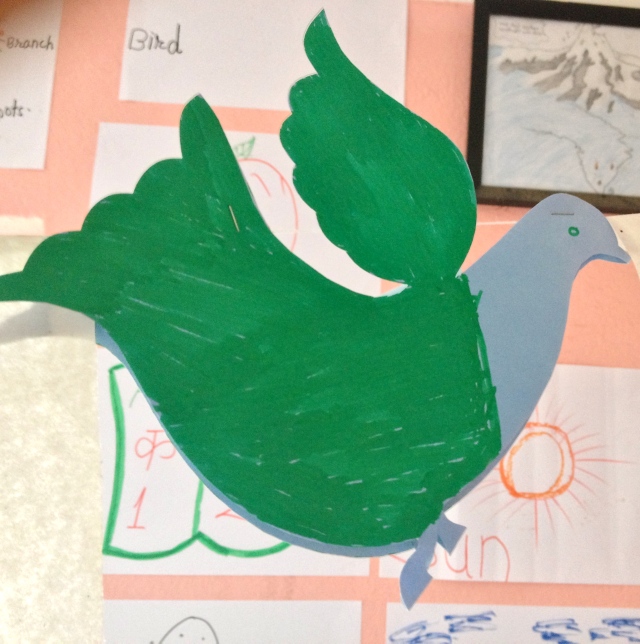
1.  Make a World Wishes Dove with your family.  Cut feathers from white paper or colored construction paper.  Have everyone in the family decorate and write their wish for the world on a feather.    Cut out the body of a dove or other bird and glue all the feathers on it.  Once decorated, your bird will be a beautiful and hopeful expression of your family’s hopes for our world.

Template for a doveImage Source
Template for a dove
Image Source
2.  Play a game that helps kids understand human rights.  Blind Trust (from ABC – Teaching Human Rights):  In pairs, have one child blindfold the other and have the sighted member of the pair lead the “blind” one about for a few minutes. Make sure the leading child is not abusing the power to lead, since the idea is to nurture trust, not to destroy it. The “leader” of the pair should try to provide as wide a variety of experiences as possible, such as hav- ing the “blind” partner feel things with his or her feet or fingers, leading with vocal directions or even playing a game. After a few minutes have the children reverse the roles and repeat the process so that the “leader” is now the led, and the “blind” partner is now the sighted one.

Once the activity is over, allow the children to talk about what happened. Discuss how they felt – not just as “blind” partners but their feelings of responsibility as “leaders” too. This can lead not only to a greater awareness of what life is like for people with sight (or hearing) disabilities, but to a discussion of the importance of trust in the whole community. This can lead in turn to a discussion of world society, how it works and how it can fail to work too.  (teaches about Universal Declaration of Human Rights article 28; Convention on the Rights of the Child articles 3, 23)

3.  Learn about how children live in other countries.  For example, you can learn what kinds of food children in East Africa grow and eat from the Lessons from Africa resource created by the British non-governmental organization Send A Cow (also check out their website http://www.cowforce.com).  You can download the  powerpoint  about typical East African food.   You can also print out some of the recipes for things like chapatis and pepper soup to make and try for yourself.

4.  Find out what kids and teens can do to help stop child labor.  The ILO’s Youth in Action against Child Labour campaign has ideas, information,  videos and other resources to help young people take action to end child labor.

5.  Play Human Rights Twister to teach about cooperation, respect and inclusion.   Make a “Twister” game in which kids spell out key human rights words using their feet and hands.  Draw a grid with 6 columns and 5 rows with marker on a  large piece of cloth (like an old sheet) or plastic (like a plastic tablecloth). You can also use chalk to draw it on the ground. Write the following letters in the grid:

(blank) W X Y Z(blank)


Q R S T U V

K L M N O P

E F G H I J

(blank space)A B C D(blank)

Ask the children to name some rights and list them on a large piece of paper or whiteboard. Underline a key word in each right from this list of rights in one word:

Dignity            Education            Equality             Food            Freedom            Home            Love (from parents)            Name

Nationality          Opinion          Participation (in decisions that affect us)          Play          Protection          Religion

When you have listed at least 3 or 4 rights, have the children spell out the key word in the human right from the list by placing their hands and feet on the  appropriate letters of the “Twister” game.  When 1 child’s hands and feet are in place and the word is not yet completed, ask another child to join in  to complete the word. If the hand or foot of another  child already covers a letter, the player just has to touch the child that is on that letter.  When a letter is too far to reach, invite another child to join in.  (This activity and dozens of others to teach about human rights values and peaceful conflict resolution are available for free download in the Canadian organization EquitasPlay It Fair Toolkit. )

6.  Make toys and play games that children play in other countries.  Many kids throughout the world live in poverty and don’t have money to buy toys and games.  They make their own toys out of recycled materials that they find.  Your kids can try making a football (soccer ball) out of recycled plastic bags or a toy car made from a plastic bottle.

http://vimeo.com/39763894

You can also  make and play the Sudanese game “Dala” (the Cow Herder Game).  In many parts of the world, games mimic everyday life; this game mimics the Sudanese practice of bull herding.  Sudanese people play it on the ground, using sticks to make the lines and pebbles or seeds as “bulls”.

7.  Ask the question “What Does a Child Need?”  Have your child lie down on a large piece of paper and trace their outline on the paper.  Ask your child(ren) to name this paper child. Discuss and decide on the mental, physical, spiritual and character qualities they want this ideal child to have as an adult (e.g. good health, sense of humour, kindness) and write these qualities inside the outline. They might also make symbols on or around the child to represent these ideal qualities (e.g. books to represent education). Talk about what human and material resources the child will need to achieve these qualities (e.g. if the child is to be healthy, it will need food and health care); write them down on the paper outside of the outline.  You can also read a simplified version of the Convention on the Rights of the Child (available in English, French, Spanish, Russian, German, etc.)  When children hear an article that guarantees a child each of the needs they have listed, they can write the number of the articles next to that item. Circle any needs identified but not covered by the Convention.

DSC_0599


8.  Read some books with strong female characters.   Non-discrimination and equality are key concepts in international human rights law.  Yet girls and women are generally not been portrayed as equals to boys and men in literature.  A Mighty Girl has compiled several great lists of girl-empowering books, including Top Read Aloud Books Starring Mighty Girls,  Top 100 Mighty Girl Picture BooksTop Graphic Novels Starring Mighty Girls, and Top Mighty Girl Books & Films on Women’s History.

9.   Get creative and enter your work in a contest with a human rights theme.   Local, regional or international contests are powerful activities for getting youth involved and learning about human rights.  Take action by entering some of the contests listed here on the Youth For Human Rights website.  (You can also learn more on the website about their educational programs, projects, awareness campaigns and human rights outreach campaigns.)

10.  Make a Human Rights Day card.  You can give the card to a friend or member of your family.  Or you can make multiple cards to decorate your house.   My eight year old daughter (that’s her self-portrait in the background) made this card for all the children of the world.

IMG_1502


ADDITIONAL RESOURCES:  You’re on your way to a great Human Rights Day!  If you are a classroom teacher or homeschooling your kids (or if you just want to dig deeper), you can find tons more ideas through the following resources:

My past posts on Human Rights Day activities:

United Nations Cyber Schoolbus – human rights activities and information about the United Nations’ work

ABC – Teaching Human Rights – practical activities in English, French, Russian, Arabic, Chinese, and Spanish from the UN Office of the High Commissioner for Human Rights

The Advocates for Human Rights’ Discover Human Rights Institute – human rights education lesson plans and curriculum

Human Rights Here and Now  – human rights lesson plans and resources

Raising Children With Roots, Rights and Responsibilities – activities for preschool and young elementary children

UNRIC’s Human Rights Education website –  great source for multimedia on human rights!

Long Walk to Freedom

20131206-105208.jpg

“No one is born hating another person because of the color of his skin, or his background, or his religion. People must learn to hate, and if they can learn to hate, they can be taught to love, for love comes more naturally to the human heart than its opposite…

Man’s goodness is a flame that can be hidden but never explained.”

 (From Long Walk to Freedom, 1995)

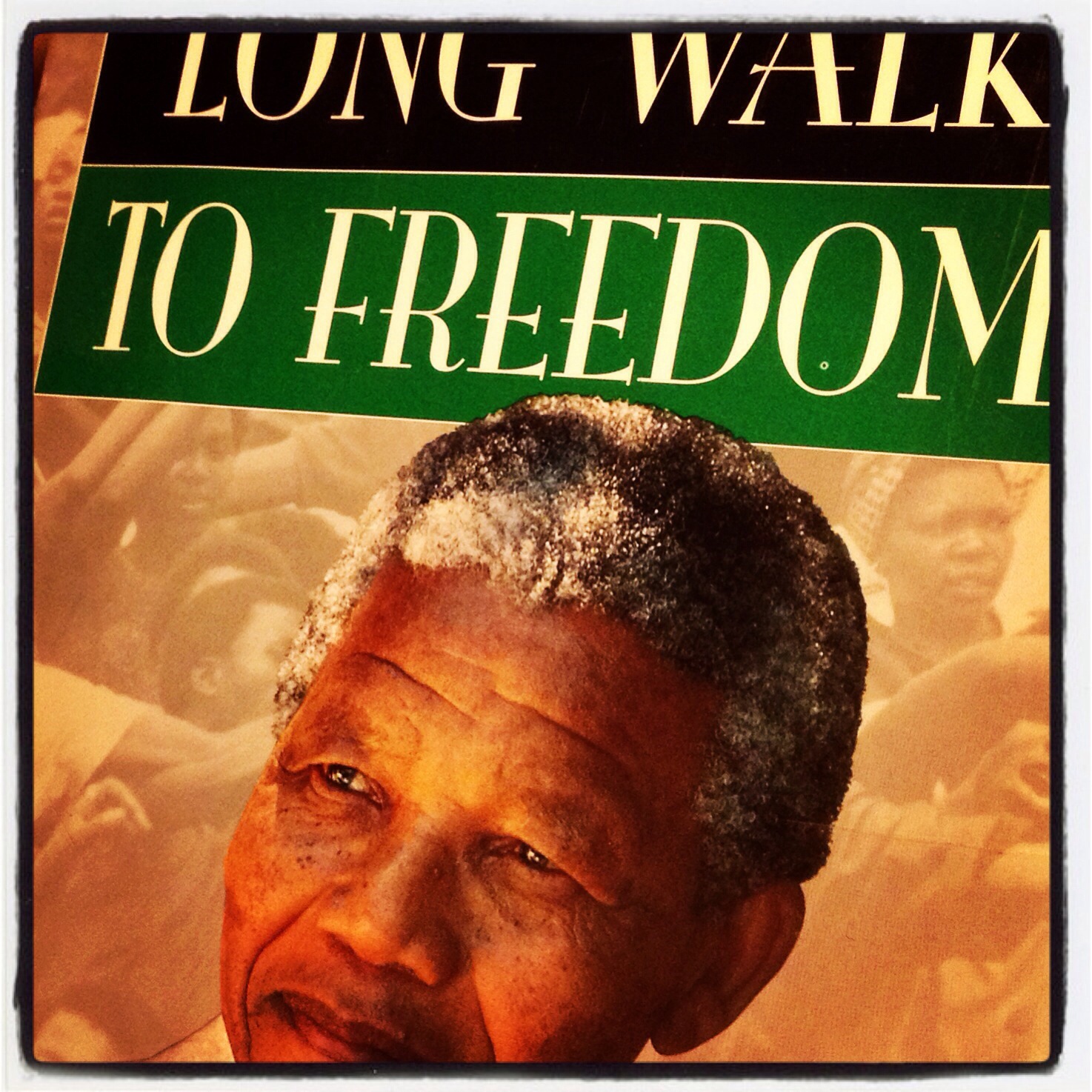
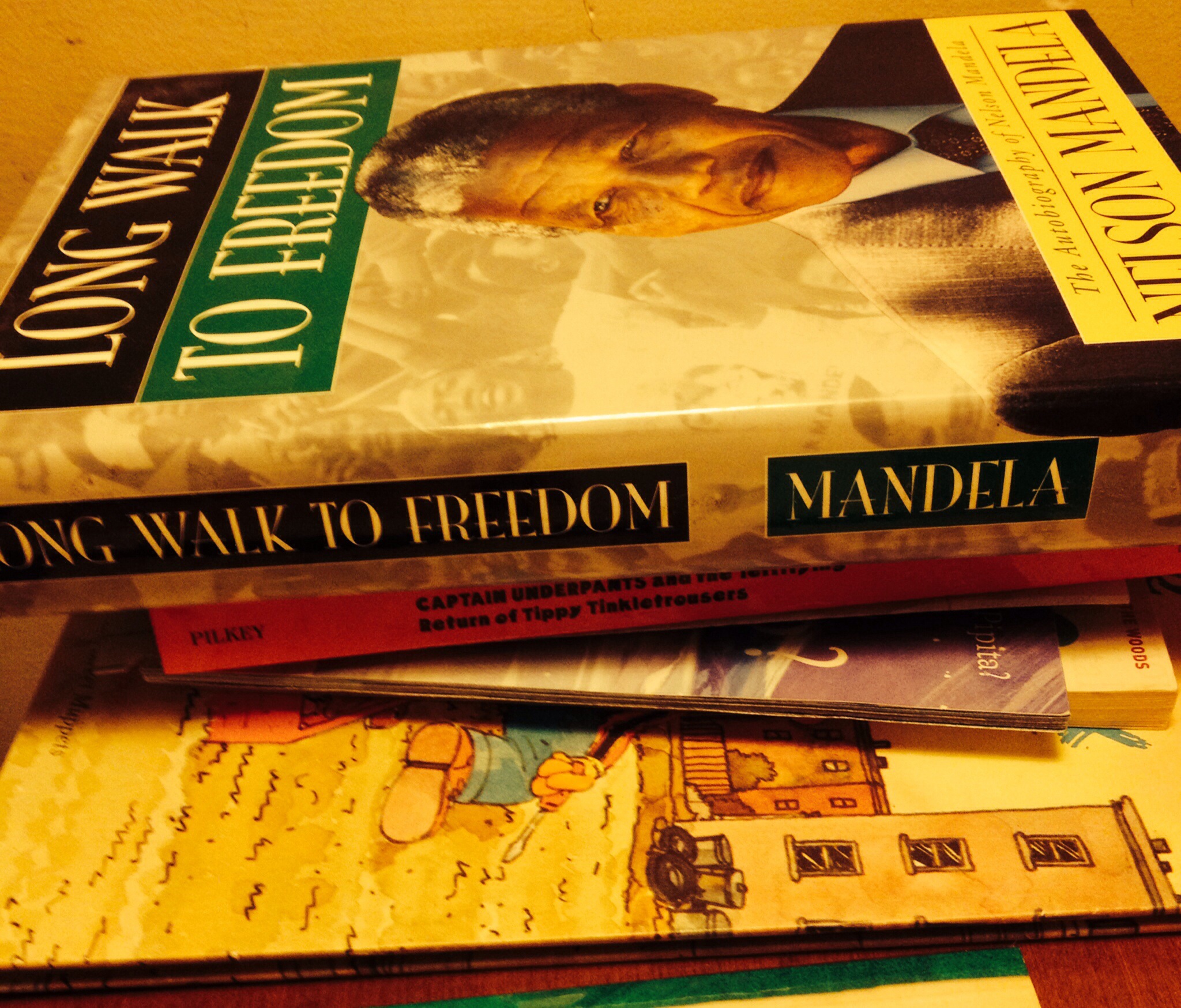
For many years, I have kept a copy of Nelson Mandela’s autobiography Long Walk to Freedom on my bedside table.  I don’t keep it there because I am in the process of reading it (I have read it twice), but because I keep the words of this great human rights hero in my heart.   I like waking up in the morning and knowing that it  is there.   Sometimes I just lay there and look at the title on the binding for a few seconds.  It helps me remember the good in this world.

Long Walk to Freedom was published in 1995, just a few years after Nelson Mandela was released from his nearly three decades of imprisonment on Robben Island and Pollsmoor Prison for leading the ANC.    I was in law school at the time.  I think that when  I first read it, I was especially looking for information from his early years about how and why he became a human rights warrior.  (Yes, Nelson Mandela was a lawyer, too.)   I love that as a child, he was called  “Rolihlahla” , which means “pulling the branch of a tree ” (i.e. “troublemaker”).

Here are a few of the things that he wrote in the book that rang true for me.

“I had no epiphany, no singular revelation, no moment of truth, but a steady accumulation of a thousand slights, a thousand indignities and a thousand unremembered moments produced in me an anger, a rebelliousness, a desire to fight the system that imprisoned my people. There was no particular day on which I said, Henceforth I will devote myself to the liberation of my people; instead, I simply found myself doing so, and could not do otherwise.”

and

“I have never cared very much for personal prizes. A person does not become a freedom fighter in the hope of winning awards.”

and

“I am fundamentally an optimist. Whether that comes from nature or nurture, I cannot say. Part of being optimistic is keeping one’s head pointed toward the sun, one’s feet moving forward. There were many dark moments when my faith in humanity was sorely tested, but I would not and could not give myself up to despair. That way lays defeat and death.”

Tonight, when I heard the news that Nelson Mandela had died, I was not surprised.   Nelson Mandela was 95 years old and had been ill for a long time.  His human body had become a painful prison from which his soul deserved freedom.    I remembered that he had written about freedom in his autobiography.  I don’t know which parts of  Long Walk to Freedom were written clandestinely on Robben Island and which were written after his release, but long-term detention must have had an impact on his views of freedom.  When Nelson Mandela talked about freedom, it was not limited to his own person.  Rather, for Nelson Mandela, freedom was inextricably linked to the freedom of other human beings.

“For to be free is not merely to cast off one’s chains, but to live in a way that respects and enhances the freedom of others.”

and

“Freedom is indivisible; the chains on any one of my people were the chains on all of them, the chains on all of my people were the chains on me.”

Freedom from imprisonment was not the end of the story for Nelson Mandela.  It was only the beginning of his work in leading South Africa towards a new, post-apartheid era.  What he says about leadership  in Long Walk to Freedom is also instructive.

“A leader. . .is like a shepherd. He stays behind the flock, letting the most nimble go out ahead, whereupon the others follow, not realizing that all along they are being directed from behind.”

and

“A Nation should not be judged by how it treats its highest citizens, but it’s lowest ones”

When Nelson Mandela wrote his autobiography, he still had many years left in his long life and many miles yet to walk.

“I can rest only for a moment, for with freedom come responsibilities, and I dare not linger, for my long walk is not yet ended.”

Your long walk is ended now and the world is a better place because of it.    Rest well, Rolihlahla!  I will keep your words in my heart and –  on my bedside table.

  While I understand that a movie based on the autobiography has just been released, I hope that others will take the time to read Long Walk to Freedom.   Nothing can inspire admiration of this great human rights leader than the words written by Nelson Mandela himself.

20131206-105223.jpg


“U Have To Struggle More”: A Poem for International Day of the Girl

Kanchi Photo - Young

Last year on the International Day of the Girl, I wrote about a girl named Kanchi and her determination to overcome all obstacles and obtain an education in rural Nepal.  The first in her family to go to school, Kanchi is now studying horticulture in university. She also writes poetry in her spare time and asked me to share the following poem that she wrote about her life.

It is a poem that seems particularly fitting on this,  the second  International Day of the Girl.

When I was born in small hut,

i’d be a heavy load,

i’d be a heavy load,

Anyhow i have to accept all the things

which were asked by father & mother

because i’m a daughter,

because i’m a daughter.

Father& Mother always used to say

that i don’t have any right to read & write

because 1 day i have to leave birth place

& i have to be someone’s wife,

i have to be someone’s wife.

They says that i cannot do anything in my life because

my life is like an egg which can

Creak at anytime if it falls,

Which never be join back,

which never be join back.

They say that to do household work,

that’s my big property &

during the time of my marriage

when i get more dowry,

during the time of my marriage

when i get more dowry.

These heart pinches words

collided in my ear,

my heart nearly go to burst,

,my heart nearly go to burst.

At that time my 1 heart says

that u have to leave this selfish world.

But another heart says that don’t get tired

to achieve goal u have to struggle more,

u have to struggle more.

INTERNATIONAL DAY OF THE GIRL:  KANCHI’S STORY

Originally published October 11, 2012 on The Advocates Post.

Every morning when I come into work, I am greeted by the smiling face of a young girl. Her hair is pulled neatly back into two braids, glossy black against her pink hairbands.  Her eyes, dark and alert, shine at me – I swear I can see them twinkle.

She wears the blue uniform of her school, the Sankhu-Palubari Community School in rural Nepal.  The Advocates for Human Rights supports the school to provide the right to education to the most disadvantaged kids in the area and to prevent them from becoming involved in child labor.  Photographs from the school hang on the walls of our office, reminders to us of the lives that we impact with our human rights work.

Even though I see her every day, until last month I had never met this cheerful young girl, a girl whose smile – even in a photo – comes from her core, seems to light her entire being. Until last month, I did not know that her name was Kanchi.  And I had never heard her incredible story.

*****

In 1999, Kanchi was six years old.  She lived with her family in a village in the Kathmandu Valley.  Her parents were poor farmers; they had only a little land and some cattle and they struggled to feed their family.  Kanchi was the youngest of six sisters.  She and her sisters (and also her  brother) had to help their parents in the fields and with household chores.  Kanchi’s job was also to take the cattle to the forest to graze.   Kanchi did not go to school.   There were many children in Nepal that did not go to school at that time, but girls, like Kanchi, were more likely than boys to work rather than go to school – particularly in rural areas like the Suntole district where she lived.

Kanchi was a very smart and determined little girl.  She wanted to go to school.   So when she heard that a new school was opening in the Sankhu-Palubari community – a school for kids who were not able to go to school because they couldn’t pay or were discriminated against – she was very excited.  She rushed off to tell her parents.  But her parents, who had never themselves been educated, were not as excited as Kanchi.  Why should they let her go to school?  Who would help feed the family? Why should they send her to school if she was only going to get married in a few years anyway?

Kanchi says that she cried for a month and begged her parents to let her go to school.  One day, teachers from the new school came to visit Kanchi’s parents to talk to them about the school. The teachers explained that it would help THEM if Kanchi could read and write.  They explained why it was important for all children to go to school, even girls.  They told them that all children – even the poorest, the lowest-caste, members of indigenous groups – had a right to education.

Kanchi’s older sisters, who had never had the opportunity to go to school, took her side. Instead getting an education, they had all married young and were working in the fields.  Kanchi’s sisters argued that Kanchi should go to school, take this opportunity for a life that would be different from theirs.  Finally, their parents agreed to let Kanchi go to school.

Kanchi started at the Sankhu-Palubari Community School in 1999, one of 39  students in the first kindergarten class.  To get to school, Kanchi had to walk one and a half hours each way.  There were many other obstacles along the way, too.  At various times, her parents wanted her to stop school and help them with farming.  But she stayed in school and worked hard. She told her parents,  “I want to do something different from the others.”

Kanchi liked her teachers and felt supported by them.  She felt that the best thing about the school was the teaching environment.  She stayed in school and was one of only two girls in the first class to graduate from 8th grade.  She continued on to high school and completed 12th grade at  Siddhartha College of Banepa in 2012.  The first in her family to go to school, Kanchi is also the first girl from the Sankhu-Palubari Community School to graduate from 12th grade.

I met Kanchi for the first time in September.  Almost exactly 13 years after this brave little girl started kindergarten, she is a lovely young woman who is preparing for her university entrance exams.  She plans to study agriculture  starting in January.   Her parents are proud of her and they are happy now – she has chosen the family profession – but Kanchi is interested in learning more about organic farming so she can bring techniques back to her village.  “I want to live a healthy life and give a healthy life to others,” she says.

Sitting in the principal’s office at Sankhu-Palubari Community School, I asked her what the school meant to her.  Kanchi said, “I gained from this school my life.  If I hadn’t learned to read and write, I would be a housewife.”  When asked about her sisters, she told me that they had made sure to send their own children to school.

In her free time, Kanchi likes to sing and dance and make handicrafts to decorate her room.  She likes to play with her sisters’ children.  She has a smile that lights the whole world.  She told me her nickname, Himshila.  She smiled when she told me it means “mountain snow, strong rock”.  Strong rock.  That seems just about right.

*****

October 11, 2012 is the first International Day of the Girl Child.  The United Nations has designated this day to promote the rights of girls, highlight gender inequalities and the challenges girls face, and address discrimination and abuse suffered by girls around the globe.  In many ways, the story of Kanchi and her sisters reflects the experience of girls in many countries throughout the world.  All over the world, girls are denied equal access to education, forced into child labor, married off at a young age, pressured to drop out of school because of their gender.

There are many good reasons to ensure access to education for girls like Kanchi, however. Educating girls is one of the strongest ways to improve gender equality.  It is also one the best ways to reduce poverty and promote economic growth and development.

“Investing in girls is smart,” says World Bank President, Robert Zoellick. “It is central to boosting development, breaking the cycle of intergenerational poverty, and allowing girls, and then women—50 percent of the world’s population—to lead better, fairer and more productive lives.”

The International Day of the Girl is a day to recommit ourselves to ensuring that girls like Kanchi have the chance to live their lives to their fullest possible potential.  To redouble our efforts to promote the rights of girls wherever they live in the world.   This first International Day of the Girl is also a day to honor girls like Kanchi.  A day to take the story of her success in one tiny corner of Nepal and shout it out, an inspiration for girls all around the world.  Girls like Kanchi with the strength, the bravery, the determination to change the world, but who  just need the opportunity.

End Child Labor: An Estimated 215 Million Children Still Need Alternatives

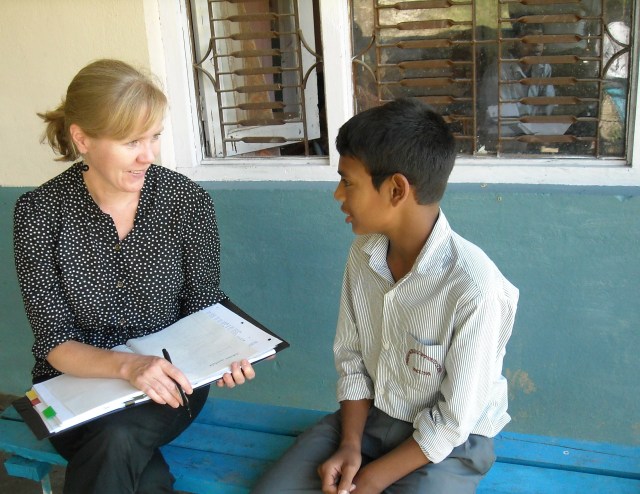
September:  Interviewing students at the Sankhu-Palubari Community School in Nepal
September: Interviewing students at the Sankhu-Palubari Community School in Nepal

What do you say to a child who has experienced child labor? I found myself in this position in Nepal recently. I was interviewing a teenager, who I will call Shree.  He described how as a little boy he had worked with his parents in the brick factories of Bhaktapur, rising at 1 a.m. to carry mud and mix bricks. Luckily, when he was 7, a school opened in in his community to provide Shree and other children at risk of child labor a free education, as well as the chance for a childhood and a promising future.

The Sankhu-Palubari Community School (SPCS) was launched in 1999 by The Advocates for Human Rights, a nonprofit organization based in the Twin Cities, to provide an alternative to child labor. Now, 14 years later, about 350 students are enrolled in grades pre-K through 10 at the school, which is located about an hour from the capital city of Kathmandu. Many of the students are from families that are low-caste, indigenous, or other marginalized groups.

The International Labour Organization (ILO) estimates that 215 million girls and boys around the world are swept up into child labor, some into human trafficking. Children, like Shree, are engaged in work that not only deprives them of their rights and an adequate education, but also is hazardous to their health and commits them to a life of poverty.

The ILO launched the first World Day Against Child Labour in 2002 to highlight the plight of these children. Observed on June 12, the day works as a catalyst for the growing worldwide movement against child labor.

When in his final year at Sankhu-Palubari, Shree, one of the best students in the area, passed his 10th grade School Leaving Certificate exam with distinction. When I met him recently, he was in his his last year of high school.  He likes to write poetry and listen to music. In the afternoons, he volunteers at SPCS, the school that changed the course of his life and where his two younger brothers now study instead of working in the brick factories. He helps the teachers in the classroom and encourages the students to study hard. When they get discouraged, he tells them, “Choose the road that makes your future very bright.”

The bright future Shree envisions for himself is to continue his education after high school and become a math and science teacher to work in rural Nepal with children who, without a school and teachers, would most likely work instead of learn.

So, what do you say to the young girl beading blouses with tiny fingers in a suffocating textile sweatshop in India? What do you say to the little boy in Gambia working in an auto-repair garage or selling items on the street? What do you say to the young girl who is working as a petite bonne (domestic servant) in Morocco?  To the child  sold into human trafficking?

Through his deeds and goals, Shree is telling these children that he is working to break this cycle of abuse.

For you and me, I say that we speak with a loud, unified voice today and proclaim, “We are committed to protecting you, the world’s children, by ending child labor.”

Then, we put our words into action.

Originally published in MinnPost on June 12, 2013.

The Human Rights Lesson

20130525-083050.jpg

I spent some time in my daughter’s classroom last week talking to the second graders about human rights.  I’ve been a guest speaker in all of my kids’ classrooms and have done this presentation (a kind of human rightsy mash-up of show-and-tell and career day) pretty much every year since my oldest was in second grade.  But this time was different.  I discovered the night before I was scheduled to speak in her class that my daughter, who just turned 8, was planning to do the presentation on human rights WITH me.

I have a more-or-less standard routine and she knew it well.  (I wrote a post called Same and Different about doing this human rights lesson in my sons’ classrooms.)  First, I do an activity that I call Same and Different.  I have several photos from West Africa that I had blown up and mounted on foamcore.  I show the kids a photo and have them point out what they see in the picture that is the same in their lives and what is different.  It always generates great discussion and often the kids see things in the photos and make connections that I never did.  Hopefully, by showing that all humans have similarities in spite of our differences, it also plants some seeds of respect and tolerance.

When I got to her classroom, my daughter brought her small plastic chair to the front of the class and set it down firmly right next to mine.  After introducing me (with the class microphone), she sat down beside me.  She had assigned herself the assistant’s job of holding the photos for all to see while I led the discussion.  A couple of times I had to remind her to hold the photo out so that all the kids could see, but overall she did a great job.

The next activity I do is to pass around a selection of items that I have picked up on my travels for work.  As we pass them around so that everyone gets a chance to touch them, we again discuss what is the same and different in our lives.  This time, I didn’t gather a thing for the activity; my daughter collected everything the night before our presentation.  A yak wool blanket from Nepal, a wooden statue of  a traditional palava hut from Liberia, coins and bills from Cameroon – all went into a bag I had brought her from Ghana.  She even added her pink beaded pointy-toed slippers from Morocco.  When I reminded her that she would have to share and let everyone touch them and try them on,  she hesitated for a moment.  In the end, though, her slippers went into the bag.

To close out the presentation, I usually read a children’s book or two about human rights.  I have a couple of favorites.  For Every Child, A Better World by Kermit the Frog is one that we own two copies of, but of course we couldn’t find either when we needed it.  I went to library to check out a copy and discovered shelved right beside it I Have the Right to Be a Child by Alain Serres.  This beautifully illustrated book presents the concept of human rights, especially those of children as set out in the UN Convention on the Rights of the Child.

When I brought the books home from the library, I asked my daughter,

“Which do you want me to read to your class?”

“I want to read them both,” she said.

She did a beautiful job of reading both books to the class.  I was so proud that I teared up, right there in front of all the second graders and their teacher.

In some ways, it is easier to talk to kids about human rights than adults.  Because children generally see things in terms of black and white, right and wrong, it is easy for them to understand that we all have rights – the right to voice our opinions, to go to school, to be free from violence.  The right to have food and shelter and clean air and water.  The thing about kids is that they have a very strong natural sense of justice (as it applies to them, at least) they understand the inequities of a world where not everyone is able to access those rights.

One girl  came up and hugged me after the human rights lesson.

“It makes me sad,” she said, “to think that not all kids have enough to eat.”

“What you are feeling is empathy,” said the teacher.  “And that’s good.”

Knowing about the problem – caring about it and wanting to do something about it – is the first step towards change.

The last thing I heard as I left the classroom was another little girl saying,

“I think I am going to write a letter to President Obama and ask him why we are not part of the Convention on the Rights of the Child.”

There are a lot of things about working in human rights that are not easy, but this was a very  good day!

More ideas for human rights activities to do with children:

10 Things to Do With Your Kids on Human Rights Day

10 More Things to Do With Your Kids on Human Rights Day

Same and Different