One Day in Zanzibar

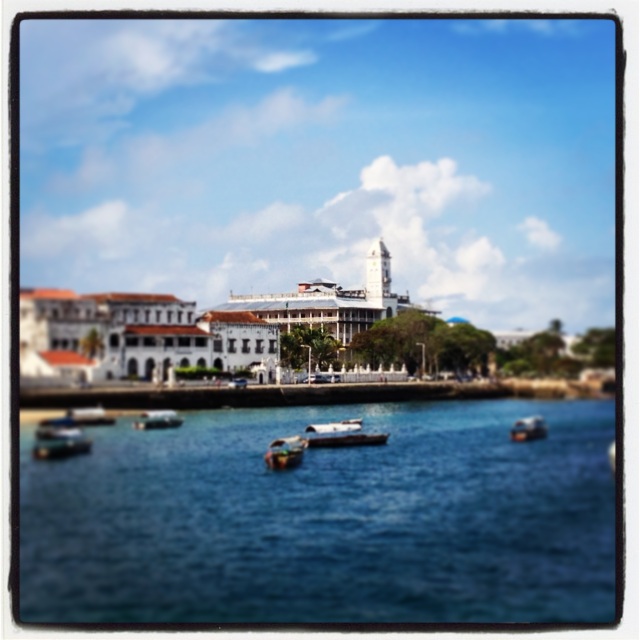
House of Wonders and Stone Town waterfront, Zanzibar

A little more than 10 years ago, I had a rare moment of clarity.  I was sitting with my second child, who was 9 months old, on my lap while my 2-year-old danced and swayed around me.  Everyone else in the Mommy and Me class was singing – with gusto – the Barney song “I Love You”.  Glancing at the clock, I realized that the week before – at exactly this time – I was being interviewed live on national TV in Peru about that country’s truth and reconciliation commission.

The stark contrast made me realize that I had chosen a life in which there might never really be a “typical” day.   Setting aside the insipidity of Barney, I realized that these small moments with my young sons were as important and valuable as the other, more high-profile moments of my career, which often takes me to exotic locales.  I learned not to compare my days.  Not to sift through the experiences of each day and measure the worth of one against another, but to see them all as a whole.  To acknowledge that each endeavor for work and for family gives me strength for the other. To realize that I am fortunate to have these varied experiences, which, woven together form the rich tapestry of my life.

So for the Weekly Photo Challenge: A Day in the Life, I am choosing to share one day that I recently spent in Zanzibar for work.  As I write this, my daughter is sitting beside me, looking at the photos and talking about them with me.  One day in Zanzibar, one day of spring break at home. Days and experiences, knitted together – so many days to be thankful for!


(See more Weekly Photo Challenge entries here.)

Marriage Equality, Through the Eyes of a 10-Year-Old

20130328-160336.jpg

With the Supreme Court hearing arguments in two cases related to same-sex marriage, much has been written – and said and thought – this week about marriage equality in the United States. No matter how these particular nine justices rule (and there is speculation that, unlike the Warren Court which in 1967 issued a sweeping ruling on the unconstitutionality of state bans on interracial marriage, this court might actually punt), I am convinced that it is only a matter of time before same-sex marriage is a recognized as a right in this country.

This week, I re-read Hockey Moms, a post I wrote last summer about my 10-year-old son and his discussions with his hockey team about marriage equality. It was a lesson to me at the time about the importance of engaging people in the conversation about same-sex marriage. In re-reading it, however, I am struck by how much forward movement there has been in just the past six months. Not only was the proposed amendment (which would have defined marriage as between one man and one woman in the Minnesota state constitution) that Simon was lobbying against defeated last November, but it was defeated handily. In fact, it went down in flames. Even my 98 year-old grandmother voted NO! In a huge reversal, this year there is a real chance that our Minnesota state legislature will pass legislation legalizing same-sex marriage. The number of states with same-sex marriage jumped on election day in November when three states – Maryland, Maine and Washington – legalized same-sex marriage through popular vote. Recently, it seems like politicians have been “coming out” in favor of marriage equality on a daily basis.

The momentum in favor of same-sex marriage appears to be increasingly rapidly and there are signs that the trend will not be reversed. I asked my 13-year-old what he thought about the recent ABC/Washington Post poll that found that 81% of Americans aged 18-29 supported legal same-sex marriage, he said, “Well ,that makes sense. Although I am disappointed in the 20%. At my school, there are only two kids who oppose same-sex marriage.” They didn’t poll Americans under the age of 18, but anecdotally at least, support for marriage equality may be even higher among his peer group.

My kids are part of a generation which, although it doesn’t have an official name yet, is already saying, “Of course same-sex marriage should be legal. Why was this even an issue?” They have grown up with favorite teachers, beloved camp counselors, trusted neighbors, friends and classmates who are openly LGBT. They go to school and church with kids from families with parents who are in same-sex relationships, some but not all legally sanctioned by state law. Men kissing men, men kissing women, women kissing women – my kids don’t care. Frankly, it is disgusting to them when ANY adults kiss!

I’m sharing an excerpt from Hockey Moms to illustrate my kids’ perspective on marriage equality, a peek into the future.

***

My 10-year-old son comes out of the ice arena, swaggering despite the heavy hockey bag that he carries like a giant backpack. His hockey stick and water bottle he wields before him like a rod and staff. I’m sitting on a picnic table in the sun and, yes, I am facebooking on my iPhone. His cheeks are flushed, his bright ginger hair is damp-dark with sweat. He has an announcement to make.

“I’ve got everyone but one kid on my team to be in favor of same-sex marriage.

AND two of the coaches.”

He beams at me. I can feel my jaw as it drops.

I’ll be the first to admit that I’m a terrible hockey mom. I hate almost everything about the sport. I’ve got two sons who play, so I did put a decent amount of effort into learning the basic rules and terminology. My biggest problem is that I grew up in the Deep South, so my natural impulse when winter strikes is to hibernate. The whole concept of driving (in the cold) to sit (in the cold) to watch a sport played (on ice, in the cold) boggles my mind.

Going inside to watch hockey on a cold winter day is one thing. Going inside to watch hockey on a beautiful summer day is completely inconceivable to me. But here in Minnesota, hockey is a year round sport. Serious players play AAA from March to September and, unlike the regular season, players are not required to play where they live. There are kids on my 10-year-old’s team from throughout the Twin Cities Metro and even some kids who travel here for the weekend practices and tournaments from as far away as Florida and Texas.

But my two sons are way, way into hockey. They LOVE this sport! I respect that, so I suck it up and wash their stinky gear and drive them to the rink.

Until last winter, I went into the locker room when I took my boys to hockey – even though I have been banned from years from tying their skates because I (quote, unquote) “don’t do it right.” When my oldest son moved up to PeeWees, however, there was an unfortunate incident. I burst into the locker room, my 6-year-old daughter (wearing a pink jacket and sparkle ballet flats) in tow, only to find a gaggle of 12 year-olds in their underwear listening to loud music and talking trash. “Mom!” my son hissed. “I’m good.”

Given my locker room banishment, I was completely floored to hear that the hockey team was having a discussion about same-sex marriage while putting on their pads and breezers. Here is the story, from the perspective of my 10 year old: “One kid brought it up. He said it was gross, a man with a man or a woman with a woman.” So I said,

“ARE YOU CRAZY? That’s their choice who they love. It doesn’t affect you. Why does it matter to you? No one can tell you who to love.”

That launched the discussion which later led to the purported locker room conversions. It is a timely discussion in Minnesota, where there is a proposed constitutional amendment on the November ballot: “Shall the Minnesota Constitution be amended to provide that only a union of one man and one woman shall be valid or recognized as marriage in Minnesota?” VOTE NO signs have sprouted throughout our neighborhood; they line the roads on the way to the hockey rink.

Simon had been late getting to practice (my fault – more evidence for the Worst Hockey Mom title). A coach came in to hurry along the stragglers and Simon asked, “You’re voting NO on the marriage amendment, right?” “I don’t know yet,” he admitted. Simon laid out his arguments again, to which the coach responded, “You make a good point. I think I probably will vote No. Now get out on the ice.”

My son can be like a dog with a bone, so he brought it up again at the next practice. This time he was on time, so when he brought it up in the locker room, everyone on the team was there. One kid, a player who Simon describes as a “tough guy” got really upset when the other kid described same-sex marriage as “gross”. He stood up, half his gear on, and said,

“That’s my family you are talking about! I have two moms and they are married. It hurts my feelings when you say that my family is gross!”

Well, that sure got the team’s attention. According to Simon, he was too emotional to say much more but Simon was able to pick up where he left off.

See? He’s got two moms. So what? Why should his family be treated any differently than yours?

***

The US Supreme Court justices, who appear to be gnashing their teeth about the appropriate timing of a ruling on marriage equality, could benefit from the point of view of my 10 year-old.

People are just people; we are all equal. People love each other and benefit from loving, committed relationships.

We should all be able to marry who we love. Families should all be treated the same.

Marriage equality, through the eyes of a 10-year-old, is just not complicated.

Love

As the United States Supreme Court considers cases related marriage equality, you can read more – including the Top 100 Marriage Equality Blogs – here.

A Mother In A Refugee Camp

Photo by my colleague Rosalyn Park, taken during our trip to Sierra Leone in 2004

Nelson Mandela read Chinua Achebe when he was in prison and reportedly described him as a writer “in whose company the prison walls fell down.”  I read Chinua Achebe’s Things Fall Apart in college, three decades after it was written, required reading on a syllabus that only included one African author.  I read his other books later, as well as some of his essays.  The obituaries describe him as an African Literary Titan and a “towering man of letters”.  True words, but he was more than that.  Much has and will be written about Chinua Achebe as the writer that wrested writing about Africa – that vast and varied Africa, as if one writer could ever represent it – back from the West.

There is one poem by Chinua Achebe that has stayed with me for many years, not because it captures the global themes of colonialism or tradition v. Western values, but because it captures so perfectly the small moments of heartbreak and love that I myself have seen in the refugee camps I have visited in Sierra Leone and Ghana.  That Chinua Achebe could capture the small moments of human connection along with the global themes was a mark of his genius.  Upon reading the news of Chinua Achebe’s passing today, I read A Mother In A Refugee Camp again.  I share it now, my own way of  saying thank you, “like putting flowers on a tiny grave”.

A Mother In A Refugee Camp

No Madonna and Child could touch
Her tenderness for a son
She soon would have to forget. . . .
The air was heavy with odors of diarrhea,
Of unwashed children with washed-out ribs
And dried-up bottoms waddling in labored steps
Behind blown-empty bellies. Other mothers there
Had long ceased to care, but not this one:
She held a ghost-smile between her teeth,
And in her eyes the memory
Of a mother’s pride. . . . She had bathed him
And rubbed him down with bare palms.
She took from their bundle of possessions
A broken comb and combed
The rust-colored hair left on his skull
And then—humming in her eyes—began carefully to part it.
In their former life this was perhaps
A little daily act of no consequence
Before his breakfast and school; now she did it
Like putting flowers on a tiny grave.

—Chinua Achebe

16 November 1930 – 22 March 2013

Weekly Photo Challenge: Lunchtime

Dar es Salaam, TanzaniaMarch 2013
Dar es Salaam, Tanzania
March 2013

This week’s WordPress Photo Challenge theme is “Lunchtime”.  Since it’s also phonoegraphy month, I’d like to share a series of memorable food/menu photos that I have taken with my iPhone 4.  To quote the menu at the Red Onion Restaurant in Dar es Salaam, “Bone Appetite”!

Scrumbled Egg or Egg Porch for breakfast?  Decisions…

New Delhi, IndiaJanuary 2012
New Delhi, India
January 2012

I think I’ll have the cheeken burger.

Yaounde, CameroonFebruary 2013
Yaounde, Cameroon
February 2013

Thirsty?

Kathmandu, NepalSeptember 2012
Kathmandu, Nepal
September 2012

This sugar is not just pure.  It is DHAM pure!

New Delhi, IndiaSeptember 2012
New Delhi, India
September 2012

UMMMM …Deep Fried Squid Feelers!

Dar es Salaam, TanzaniaMarch 2013
Dar es Salaam, Tanzania
March 2013

Jupped Rabbit? Magret Duck? Toulouse Poele?

I can’t even understand the English translation.

Douala, CameroonFebruary 2013
Douala, Cameroon
February 2013

No. Just no.

Dar es Salaam, TanzaniaMarch 2013
Dar es Salaam, Tanzania
March 2013

The secret of Cajun cooking – revealed!

Stone Town, ZanzibarMarch 2013
Stone Town, Zanzibar
March 2013

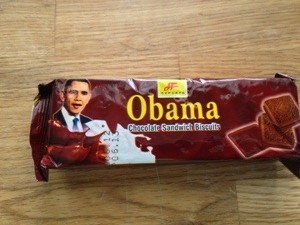
Should have bought a case of these!

Dar es Salaam, TanzaniaMarch 2013
Dar es Salaam, Tanzania
March 2013
(Made in Pakistan)

In Morocco

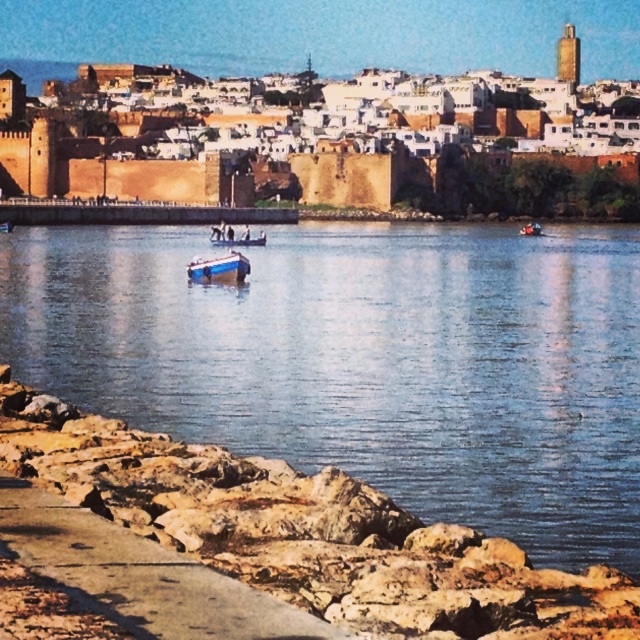
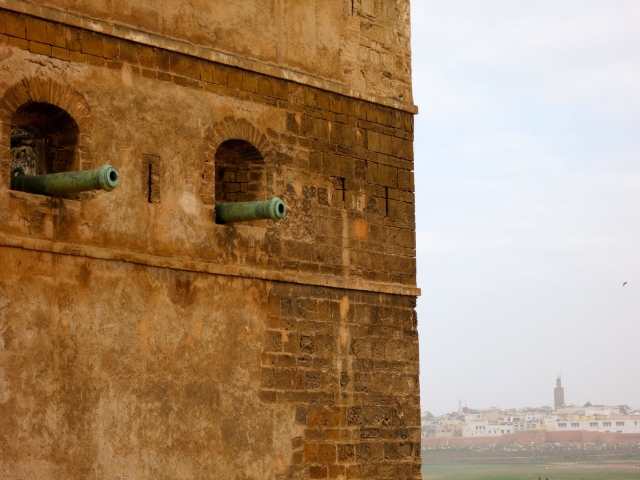
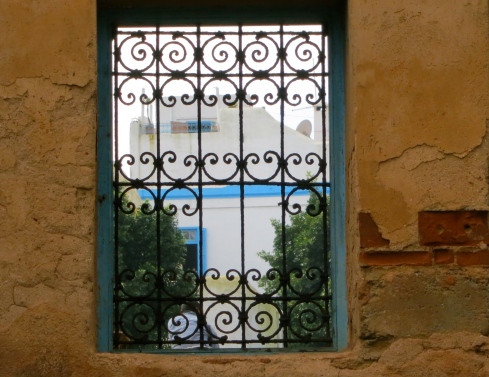
View of the Kasbah in Rabat
January 2013

There is no guidebook to Morocco, and no way of knowing, once one has left Tangier behind, where the long trail over the Rif is going to land one, in the sense understood by any one accustomed to European certainties.  The air of the unforeseen blows on one from the roadless passes of the Atlas.

I recently visited the Kingdom of Morocco for the first time.  Looking for reading material before my trip, I discovered a book about Morocco by Edith Wharton.  This came as a deep surprise to me, a longtime Wharton fan.  I thought that I had read every Edith Wharton publication in print, from her ghost stories right down to her interior design book (I wrote a paper on that one in college).  I knew, of course, that she had written some travel books; I had even read some of them.  But until I saw it listed as a free title on Kindle, I had never heard of In Morocco.  

Published in 1920 (the same year as Age of Innocence), In Morocco is widely considered the first travel guide to Morocco.  (Wharton certainly thought so, as she states, “Having begun my book with the statement that Morocco still lacks a guide-book, I should have wished to take a first step toward remedying that deficiency.”)

I’ve always admired Wharton’s  highly descriptive style, which lends itself exceptionally well to travel writing.  In Morocco is the account of Wharton’s motor trip across Morocco in the fall of 1917, at the tail end of the First World War.  Much of Morocco had become a French protectorate in 1912, so she made the trip at the invitation of the French Resident-General Hubert Lyautey.  It is no secret that Wharton was a committed supporter of French imperialism (she described herself as a “rabid imperialist”) and this comes across strongly in In Morocco.  (Unless you want read a love letter to colonialism, skip the chapter on Gen. Lyautey’s Work In Morocco.)  Equally hard to take is her paternalistic attitude towards and use of  racist terminology to describe Moroccans and their culture.

In spite of this, I enjoyed the historical perspective provided by In Morocco. More than anything,  In Morocco is a series of sketches of a place where past and present are intermingled, at a moment when the country was on the verge of change.  Wharton was very cognisant of the fact that post-war tourism would alter Morocco forever.

IMG_0111

Morocco is too curious, too beautiful, too rich in landscape and architecture, and above all too much of a novelty, not to attract one of the main streams of spring travel as soon as Mediterranean passenger traffic is resumed.

Visiting Morocco nearly 100 years after Wharton, I found it interesting to read her admiring documentation of this specific moment in time, which she has preserved in prose as solidly as if in amber.

To see Morocco during the war was therefore to see it in the last phase of its curiously abrupt transition from remoteness and danger to security and accessibility …

IMG_0112

Yet I also found the Morocco of 2013 to be a place where the boundaries between past and present are still slightly blurred.  Visiting many of the same places that Wharton had visited nearly a century before, I discovered that her descriptions were, in many cases, still brilliantly apt. The following photographs were taken by me but the words were written by Edith Wharton.

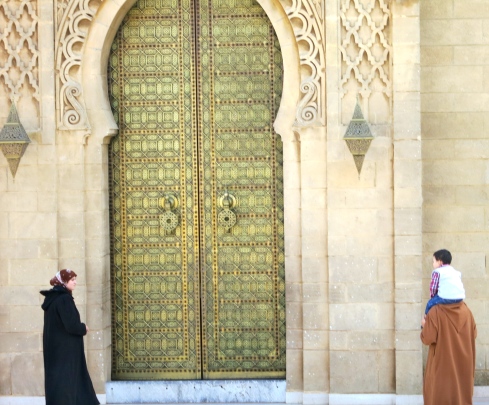
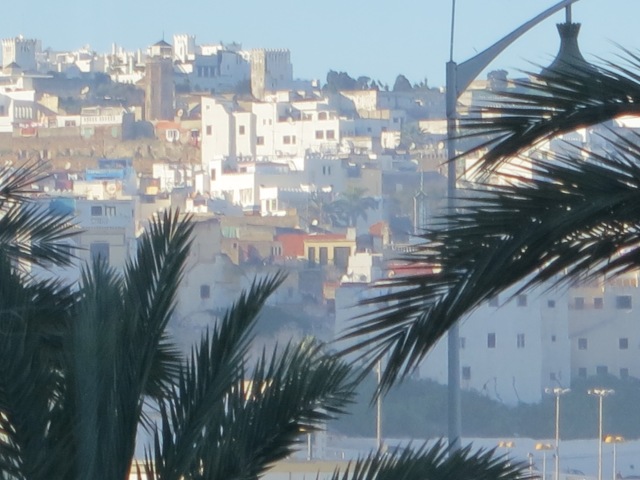
Tangier

View of the Medina in Tangier

This feeling of adventure is heightened by the contrast between Tangier – cosmopolitan, frowsy, familiar Tangier, that every tourist has visited for the last forty years – and the vast unknown just beyond.

 Rabat

IMG_0099

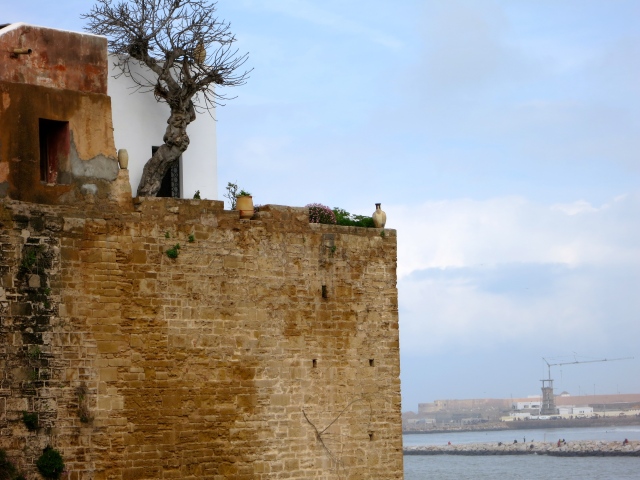
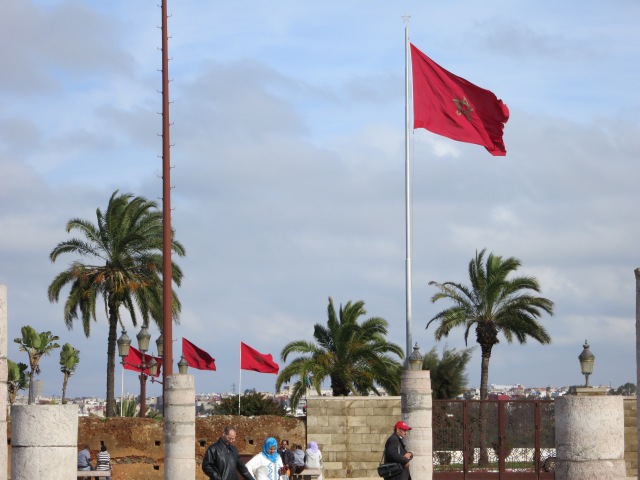
The European town of Rabat, a rapidly developing community, lies almost wholly outside of the walls of the old Arab city.  The latter, founded in the twelfth century by the great Almohad conqueror of Spain, Yacoub-el-Mansour, stretches its mighty walls to the river’s mouth.  Thence they climb the cliff to enclose the Kasbah of the Oudayas…. Great crenallated ramparts, cyclopean, superb, follow the curve of the cliff.

Kasbah of Rabat
Kasbah of Rabat

Salé the white and Rabat the red frown at each other over the foaming bar of the Bou-Regreg, each walled, terraced, minareted, and presenting a singularly complete picture of the two types of Moroccan town, the snowy and the tawny.  To the gates of both, the Atlantic breakers roll in with the boom of northern seas, and under a misty northern sky.

Kasbah in Rabat
View of Salé from the Kasbah in Rabat

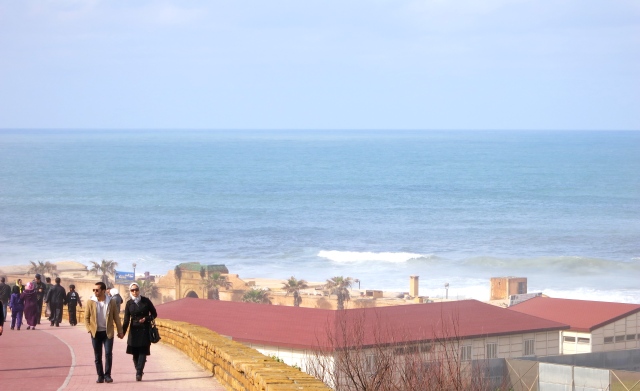
It is one of the surprises of Morocco to find the familiar African pictures bathed in this unfamiliar haze. Even the fierce midday sun does not wholly dispel it – the air remains thick, opalescent, like water slightly clouded by milk.

Seawalk in Rabat
Seawalk in Rabat

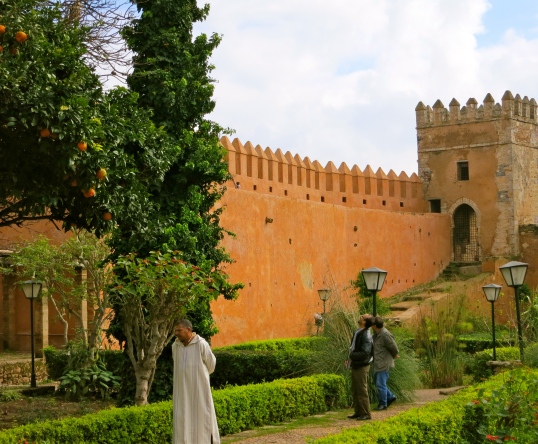
Kasbah of the Oudayas

Garden of the Oudayas

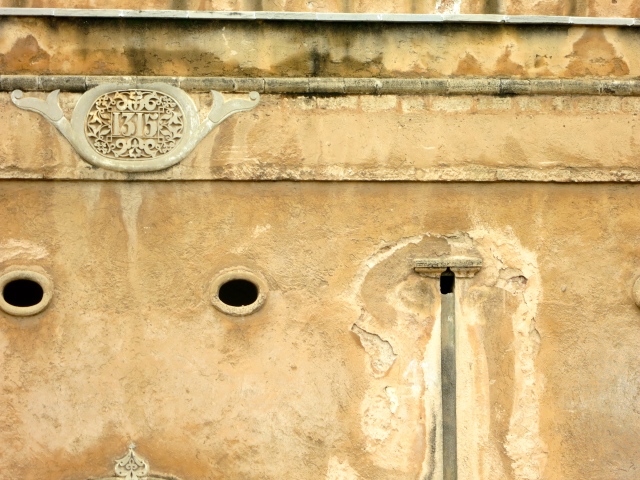
Inside the gate of the Kasbah one comes on more waste land and on other walls – for all Moroccan towns are enclosed in circuit within circuit of battlemented masonry.  Then, unexpectedly, a gate in one of the inner walls lets one into a tiled court enclosed in a traciered clositer and overlooking an orange-grove that rises out of a carpet of roses.  This peaceful and well-ordered place is the interior of the Medersa (the college) of the Oudayas.

IMG_0098

IMG_0094

The Tower of Hassan

Tower of Hassan, Rabat

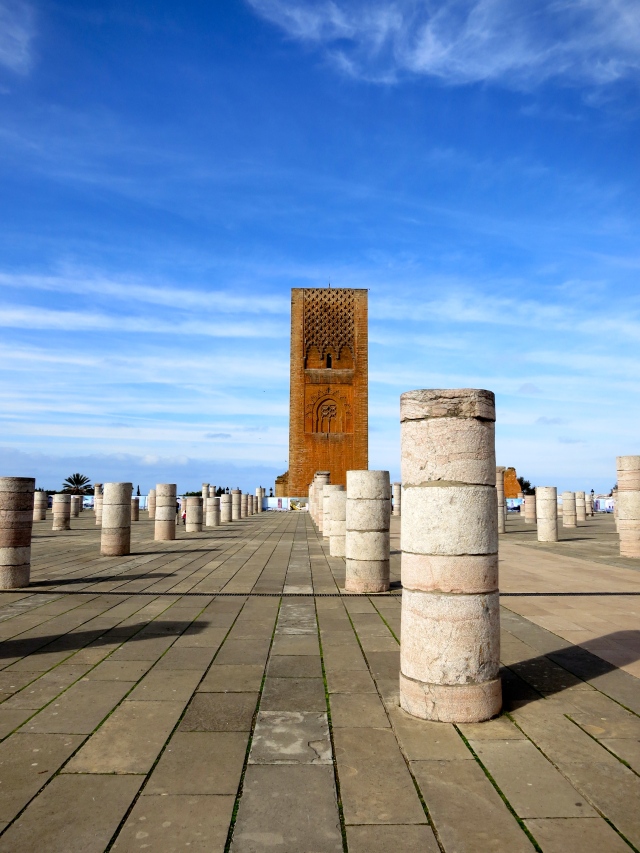
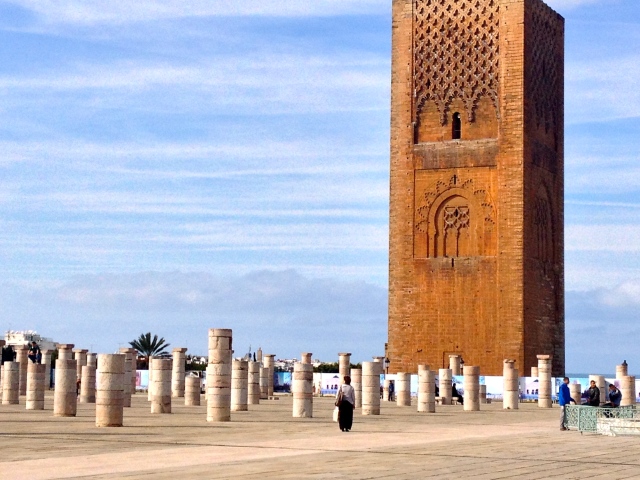
The “Tower of Hassan,” as the Sultan’s tower is called, rised from the plateau above old Rabat, overlooking the steep cliff that drops down to the last winding of the Bou-Regreg. Truncated at half its height, it stand on the edge of a cliff, a far-off beacon to travellers by land and sea.  It is one of the world’s great monuments, so sufficient in strength and majesty that until one its fellow, the Koutoubya of Marrakech, one wonders if the genius of the builder could have carried such perfect balance of massive wall-spaces and traceried openings to a triumphant conclusion.

IMG_1158

Near the tower, the red-brown walls and huge piers of the mosque built at the same time stretch their roofless alignment beneath the sky. This mosque, before it was destroyed, must have been one of the finest monuments of Almohad architecture in Morocco: now, with its tumbled red masses of masonry and vast cisterns overhung by clumps of blue aloes, it still forms a ruin of Roman grandeur.

IMG_0115

The founder of Rabat, the great Yacoub-el-Mansour, called it, in memory of the battle of Alarcos, “The Camp of Victory” (Ribat-el-Path), and the monuments he bestowed on it justified the name in another sense, by giving it the beauty that lives when battles are forgotten.

Casablanca

On the west coast, especially, where the Mediterranean peoples, from the Phenicians to the Portuguese, have had trading-ports for over two thousand years, the harm done to such seaboard towns as Tangier, Rabat and Casablanca is hard to estimate.  The modern European colonist apparently imagined that to plant his warehouses, cafes, and cinema-palaces within the walls which for so long had fiercely excluded him was the most impressive way of proclaiming his domination.

Casablanca
Casablanca

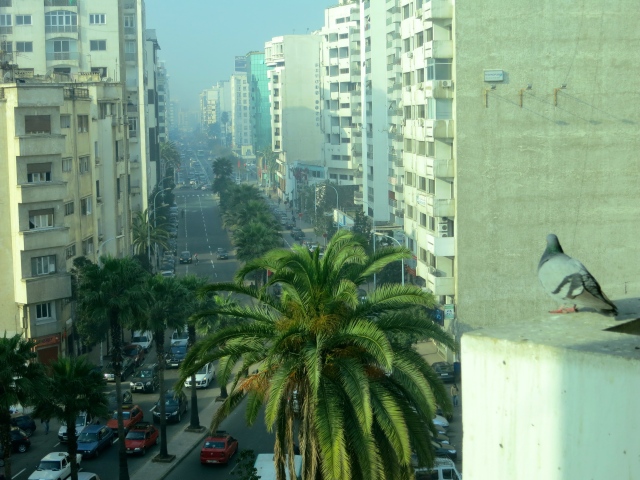
These are just a few of the words and images I found on my recent trip to Morocco.  I was in Morocco for work, however, so my own version of In Morocco will not be a guidebook or travelogue. My version of In Morocco will be a series of sketches, too, but it will the stories of people who are working to improve human rights in their country.  I am not a writer with Edith Wharton’s powers of description, but these are stories that can and should be told.

IMG_0108

Phoneography Challenge: My Neighborhood

Taken from the southeast shore of Lake Harriet with Instagram on my iPhone 4s.

I live in Minneapolis, the City of Lakes.  The story is that the first schoolteacher named the city after mni, the Dakota Sioux word for water, and polis, the Greek word for city.  The city is aptly named, with wetlands, creeks and the Mississippi river in addition to twenty-two lakes within the city limits. Truly, a wonderful blend of nature and urbanity.

Of course, most of this water is still frozen at this time of year in Minneapolis.  I took this photo of my neighborhood lake – Lake Harriet – while I was out on a run a couple of evenings ago. Enjoy!

Forward Movement: LGBT Rights in Cameroon

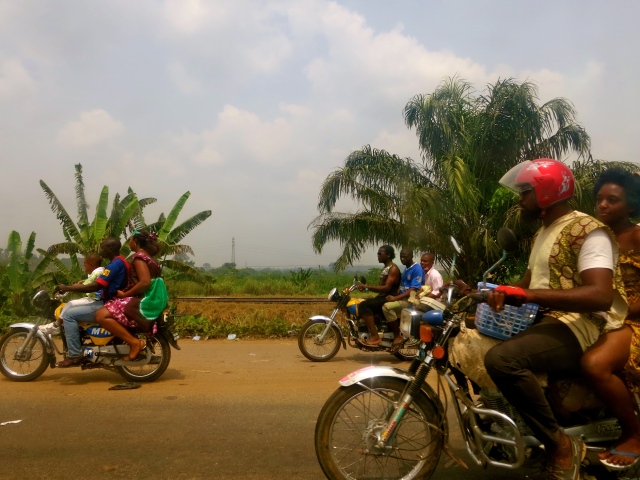
Motorcycle taxis speed toward Douala, Cameroon's major port and commercial center
Motorcycle taxis speed toward Douala, Cameroon’s major port and commercial center

In response to this week’s Photo Challenge: Forward, I thought I would simply post this photo, taken two weeks ago today, of motorcycle taxis speeding towards Douala, Cameroon.  But there is another kind of movement going on right now in Douala, one that is attempting to move the country forward towards acceptance of the rights of LGBT persons.  These courageous activists, who are risking their lives to end discrimination and persecution based on sexual orientation or gender identity in Cameroon, deserve more than a photo.  They deserve to have their stories told.

In Cameroon, people who are LGBT face pervasive societal stigma, discrimination,and  harassment.  They also face the possibility of imprisonment – Article 347 of the Cameroonian penal code criminalizes “sexual relations with a person of the same sex”.  At least 28 people have been prosecuted under the law since 2010. One of them is Roger Jean-Claude Mbede, who was arrested and convicted of homosexuality in March 2011 after sending another man a text message reading, “I’ve fallen in love with you.”  In December 2012, the Cameroonian court of appeals upheld the conviction and sentenced him to three years in prison.

Gay, lesbian, bisexual, and transgender people have a high risk of HIV/AIDS infection.  They are often rejected by their families, who force them out of the home.  When targeted by law enforcement, they have more difficulty in obtaining legal protection.Due to the social stigma and intense climate of fear, most LGBT people are forced to live out their lives in secrecy.  Yet there are several impressive non-governmental organizations  – Alternatives-Cameroun, the Association for the Defense of Gay and Lesbian Rights (ADEFHO), Cameroonian Foundation for AIDS (CAMFAIDS), and Evolve, to name a fewwhich are working hard to raise awareness about and provide services to the LGBT community.

When I was in Douala, I was able to visit Alternatives-Cameroun.  Security is, understandably, a big concern.  There is no sign that marks their center on boulevard de la Liberté, and when you arrive, you have to sign in and show your ID.  Alternatives-Cameroun has one doctor at the center who provides HIV/AIDS treatment and medical services to approximately 75 patients.  In addition, Alternatives-Cameroun provides a small community pharmacy, as well as safe, confidential and free HIV testing.  In 2012, they provided 720 HIV tests.

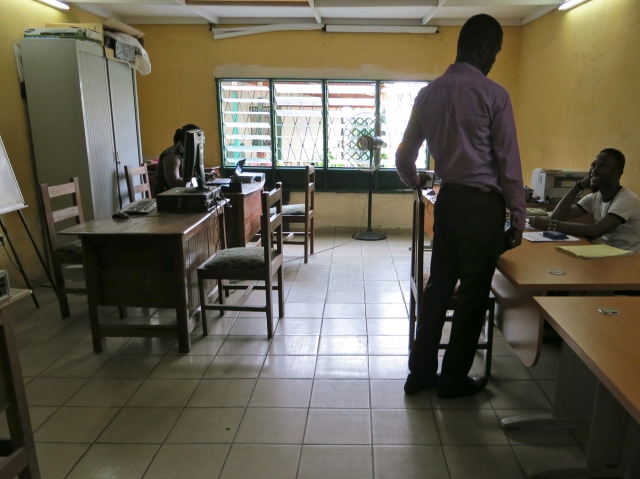
Staff at Alternatives-Cameroun centre in Douala

Equally important are the services provided by a psychologist and two social workers.  Alternatives-Cameroun also provides public education and outreach, both at the center and through peer educators.  On the day I visited, all of the peer educators were at work out “in the field” in Douala.

What touched me most, though, was the real sense of community that is provided by Alternatives-Cameroun.  I saw a small group of young people sitting on plastic chairs around a table in “William’s Hall” (named after one of the organization’s founders, who died in the Kenya Air plane crash).  I could feel that they were providing each other with comfort and support, a feeling so strong that I could see the connection between them almost as clearly as I could see the young man holding the hand of the woman beside him.

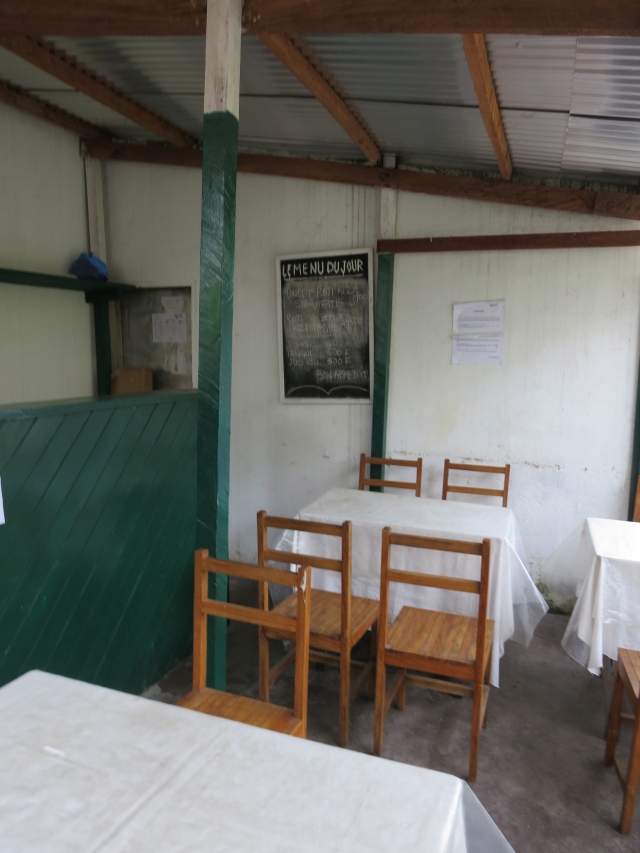
As a way to join the community and to connect with the neighbors around them, Alternatives-Cameroun started a small restaurant that serves a very inexpensive daily lunch. This anti-discriminatory gambit has paid off; the neighbors now come to the restaurant to eat and talk together with the staff and patients.  Often the patients are very poor, so the restaurant means they can offer them a meal or two a day.  The restaurant also provides meals for LGBT detainees in prison.  Prison conditions in Cameroon are notoriously bad, with severe overcrowding and inadequate food.  Most detainees rely on family members to bring them meals.  As LGBT detainees have often been rejected by their families, they have no other access to food.

Restaurant

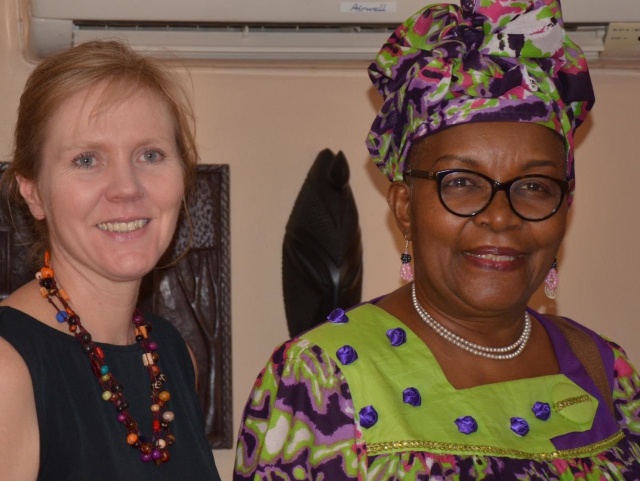
Activists working on LGBT issues in Cameroon told me that one of their main needs is for more lawyers. One of the very few Cameroonian lawyers who is willing to take on these “homosexuality” cases is Alice Nkom.  The first black woman admitted to the Cameroonian bar, Alice has been courageously fighting for the rights of LGBT Cameroonians for many years.  In spite of serious death threats, Alice Nkom continues her work.  “Threats like these show us that the fight must continue,” said Nkom.

with alice in douala

Cameroon has been receiving a lot of criticism recently from the international community, particularly the European Union. The issues of LGBT rights will certainly come up again at the Human Rights Council’s Universal Periodic Review of Cameroon this spring.  On January 31, Cameroonian President Paul Biya told reporters that attitudes are changing in his country about the criminalisation of homosexuality.  “Now I can say that discussions are under way. People are talking, minds can change one way or another but currently it’s a crime.”  

The government of Cameroon must do more than discuss.  The government must protect the rights of all Cameroonians, regardless of sexual orientation or identity. And when things do change, as they will one day, the credit will go to the brave men and women who have put their heart and souls – not to mention their lives – into moving their country forward on LGBT rights.

To read more about LGBT rights in Cameroon:

Human Rights Watch, Criminalizing Identities (2010)

Joint Stakeholder Submission on LGBT Rights for the Universal Periodic Review of Cameroon (2012)

International Gay & Lesbian Human Rights Commission, Cameroon

Letter from Liberia

Great post by my colleague Amy Bergquist on the pro bono needs assessment work we are doing this winter through our Africa Advocacy Project in four countries: Liberia, Morocco, Cameroon and Tanzania. Amy writes about the first country our team visited – Liberia.

Weekly Photo Challenge: Home

IMG_0205

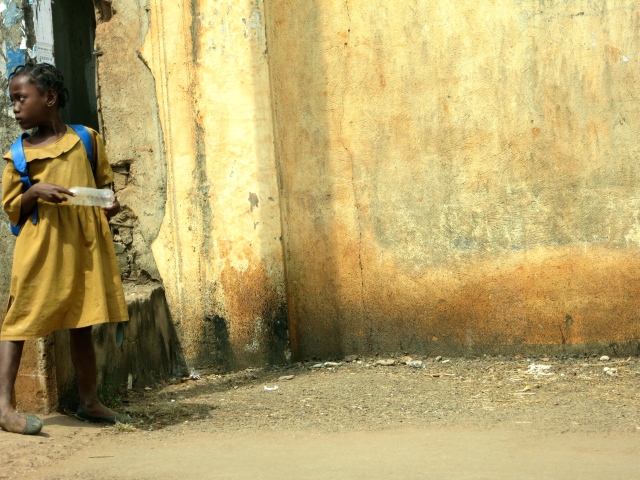
Girl walking home from school

Yaoundé, Cameroun

February 3, 2013

IMG_0183

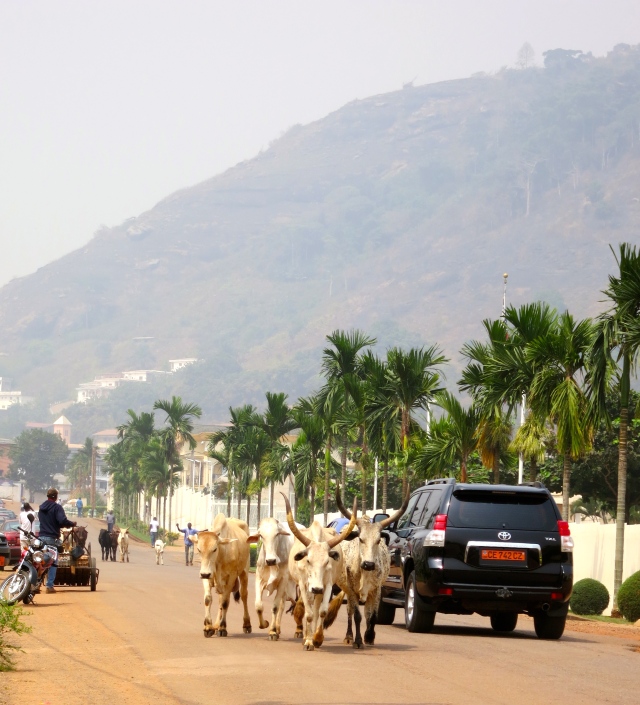
Cattle head home past the US Embassy

Avenue Rosa Parks, Yaoundé, Cameroun

February 4, 2013

IMG_0269

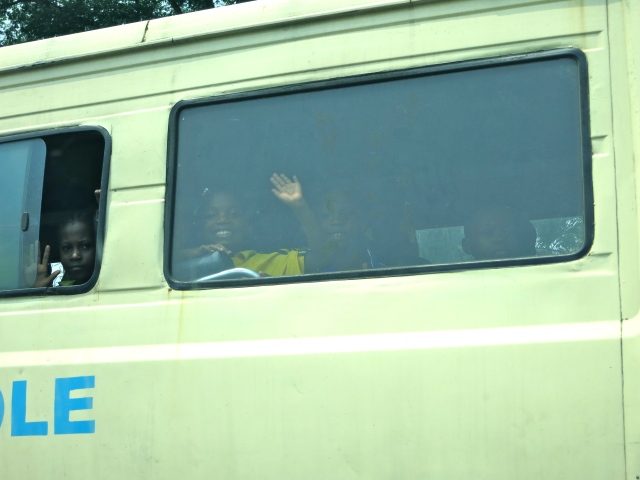
Incredibly unsafe school bus (NO SEATS!) brings school kids home

Douala, Cameroun

February 8, 2013

IMG_0309

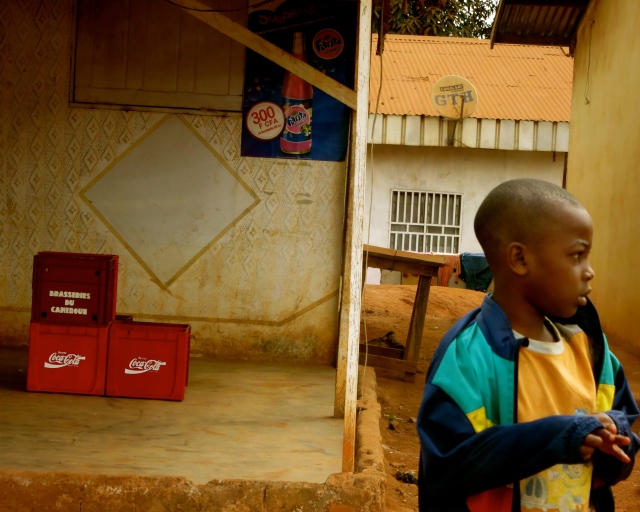
A young boy plays in front of his home, which has a small shop on the front porch

Nkolfoulou, Cameroun

February 9, 2013

IMG_1168

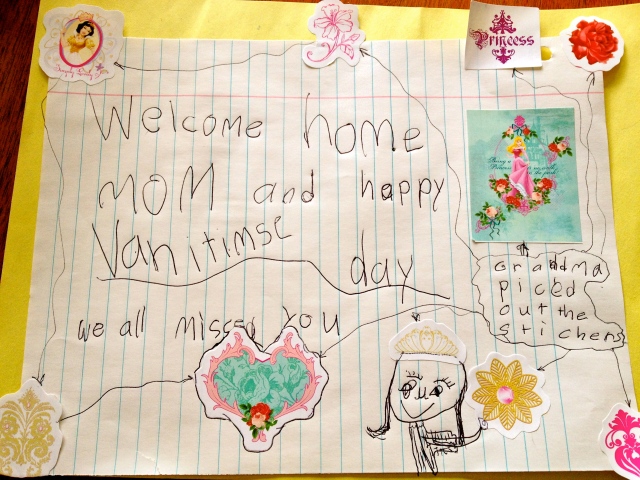
Welcome home (and happy Vanitimse day)!

Minneapolis, MN

February 10, 2013

This week’s Photo Challenge calls for photos that evoke “home”.  See more Weekly Photo Challenge: Home posts.

Celebrating Rosa Parks’ 100th on Avenue Rosa Parks in Yaounde, Cameroon

IMG_0179

This morning, I had a meeting at the US Embassy in Yaounde to discuss human rights in Cameroon.  The US Embassy, it turns out, is located on Avenue Rosa Parks.  Past security, in the lobby where visitors wait for their escort, the walls were hung with photos and text documenting the life of Rosa Parks, a true American hero.

I realized later in the day that today is Rosa Parks birthday.  If she were alive, she would be 100 years old today.  Could she have imagined the impact – wide and deep – that her actions would have, not only in her country but around the world?  Or that one day there would be streets named after her in places like Yaounde?

I met Rosa Parks once, on the Ellis Island ferry.  I wrote about it last February and am reposting it here in celebration of her 100th birthday.

Me and Rosa Parks on the Ellis Island Ferry

(Image source)

My oldest son is studying the life of Rosa Parks in his 6th grade history class.  “I actually met Ms. Rosa Parks once,” I say.  He’s already halfway up the stairs, heading back to the sanctuary of his room. “Did I ever tell you about that?”  On the cusp of his teens, he has no interest in being trapped by a pontificating mother.  “Yes,” he replies.  He pauses, half-turned towards me, left leg on a higher step, poised for flight.  I see my opening and I take it.

***

In 1986, my grandfather Orville Prestholdt was recognized with an Ellis Island Medal of Honor for his contributions as a “Norwegian activist”.  I was a sophomore in college and I took a Metro North train down to New York to meet my grandparents the night before for the gala event.   The honorees were staying at a fancy hotel, one those midtown landmarks that is long on history but short on space in the guestrooms.  As I entered the lobby, I walked straight into the sonic boom of Lee Iaccoca (chair of the Statue of Liberty-Ellis Island Foundation, honorary medal recipient).  If I remember correctly, I next walked straight into the back of Donald Trump (Scottish-German).  Fortunately, “The Donald” was engaged in animated conversation with Mr. Iacocca and didn’t notice my faux pas.

Established in 1986 by the National Ethnic Coalition of Organizations, the Ellis Island Medals of Honor “pay tribute to the ancestry groups that comprise America’s unique cultural mosaic”.   Walter Cronkite (Dutch), Jacqueline Kennedy Onassis (French-Irish), Joe DiMaggio (Italian) – the Ellis Island medalists were a veritable Who’s Who of American immigration.  Of course, this was back in the Reagan era when Americans still celebrated the fact that we are a nation of immigrants.   The 80 inaugural Ellis Island Award winners had been selected from more than 15,000 nominations following the controversy over the Medals of Liberty. Announced in the spring of 1986, the Medals of Liberty had honored 12 naturalized citizens, including  Bob Hope (English), I.M. Pei (Chinese), Irving Berlin (Russian) and Elie Wiesel (Romanian).   Numerous ethnic groups had objected that they were not represented among the winners of the Medals of Liberty, however, and had threatened protests during the “Liberty Weekend” (July 4, 1986) award festivities.  So the Ellis Island Medals were created more or less as a compromise.

That’s when they went looking for the lesser-knowns with more obscure national origins.  People  like my grandfather, who had changed his name from Olaf to Orville when he immigrated from Norway in order to “be more American”.  My grandfather had charted a successful political career in the Sons of Norway, from lodge president to International Board of Directors.  He got his Ellis Island Medal for his “contributions in preserving  Norwegian- American culture”.  Too late for “Liberty Weekend”, the Ellis Island awards were to be presented on the actual 100th anniversary of the dedication of the Statue of Liberty in late October of 1986.  That date fell on a Monday, but I figured it was worth skipping one day of classes to be a small part of history.

Having finally located my grandparents among the honorees at the reception, we headed to the elevator to go up to their room to drop off my bag and change for dinner.  Muhammad Ali (African) was in the elevator with some family members; they held the elevator door for us.  Mr. Ali tapped me on the shoulder and, when I turned, began performing a magic trick with a polka-dot silk scarf.  At the time, I didn’t know that he had Parkinson’s.  Or maybe I had heard he had Parkinson’s, but I didn’t really know what that meant.  In any event, I watched in horror as the man – who had been such an icon in the 70s when I was a kid – struggled, with trembling hands, to slowly stuff the scarf into a fake plastic thumb.  That’s how I found out how they do that disappearing scarf trick.  No kidding – Muhammad Ali!  The fake plastic thumb was several shades different from the color of his skin and looked dangerously close to falling off his real thumb, but he was focused like a laser on making that scarf disappear.  I remembered playing chase at recess on the playground at Magnolia Woods Elementary School.  The one who was  “it” would yell,  “Float like a butterfly, sting like a bee! I am the mighty Muhammed Ali!”  As “The Greatest” slowly performed his magic trick for me, I watched the single, crystalline drop of drool that hung suspended from the corner of his mouth.   I thought for sure I was going to cry.

My grandfather handled the whole thing much better than I did.  Maybe he was just feeling pretty good after a couple of highballs and a chat with Victor Borge (Danish), but he clapped his hands when the scarf finally disappeared and chortled with glee. “Woo-hee-hoo-hoo!!!”  He may have danced a little jig in that elevator, too – he was that kind of guy. But I can’t be sure because I had gotten really good at ignoring him when he did that kind of thing in public.  At 19, I saw only the weaknesses, the frailties, the embarrassments of my elders in that elevator.  Now I see that I missed the courage, the determination, the encouragement, the shared joy in the accomplishment of a difficult task.

That night, as I lay in my narrow rollaway bed listening to my grandparents snore a few feet away from me, I thought about who I might meet the next day.  I hoped to see  John Denver (German) and Cesar Chavez (Mexican).  Maybe also Gregory Peck (English) and Andy Williams (Welsh).  Bob Hope was going to be there, too, as his wife Dolores (Irish-Italian) was receiving an award.  But the person I most wanted to meet was Ms. Rosa Parks (African-American).

Rosa Parks had been a larger than life figure for me growing up in the post-Jim Crow South.  The East Baton Rouge Parish school system underwent court-ordered desegregation when I was in high school, so I had some sense of the courage it must have taken her to do what she did.  I thought she was an American hero.

(Image source)

The awards ceremony was to take place on Ellis Island, so in the morning we were all bussed down to Battery Park and the chartered ferry.  Most people stayed up on deck for the short ferry ride, cameras at the ready to take photos of the Statue of Liberty.  About halfway through the ride, I went inside to look around.  And there she was!  A tiny, birdlike woman with large glasses sitting alone on a bench by the window.  In my mind’s eye, she is wearing a hat, coat and gloves but I can’t be sure I haven’t borrowed that memory from other images.  She sat prim and erect, her hands folded on her purse in her lap, looking straight ahead. It is exactly how I always pictured her on the bus. I walked over and asked, “Can I sit here?”  She looked up at me and nodded briefly and I sat down.  Then my courage failed me.  I can’t think of what to say next.  As we approached the Statue of Liberty, she turned for a better view out the window so, of course, I did, too.  “She’s smaller than she looks in pictures,” remarked Rosa Parks to me. Or maybe just to herself, but I smiled and nodded anyway.  Then we approached Ellis Island and her family came to collect her.  I went back up on deck to look for my grandparents.

***

“Maybe a famous person like Rosa Parks didn’t really want to talk to you.  You were a stranger,” my son speculates.

“Maybe,” I say.  “But I wasn’t thinking about that. I was just sitting there, trying to think of what to say to her and how I was wasting my one chance to talk to her.  It was like I was frozen.  I never did say anything else to her, other than ‘Can I sit here’?”

“So what would you have wanted to ask her on the ferry?”  my son wonders.

“Well, I guess I would have asked what it was like to ride that bus.”

Twenty-five years later, I realize that Rosa Parks was probably asked some variation of that question nearly every day of her long and beautiful life.  She was probably asked it more times than she could count.  Asked and answered; you can google it.

“I don’t recall that I felt anything great about it,” Ms. Parks remembered in an interview with the Montgomery Advertiser. “It didn’t feel like a victory, actually. There still had to be a great deal to do.”

This conversation with my son made me realize that I didn’t need to ask her anything that one time I met her.  I didn’t waste my one chance to talk to Ms. Rosa Parks.  It was enough to be able  to sit quietly in her presence for a few minutes. An African-American and a Norwegian-American, sitting side by side on the ferry and gazing together at the Statue of Liberty.

***