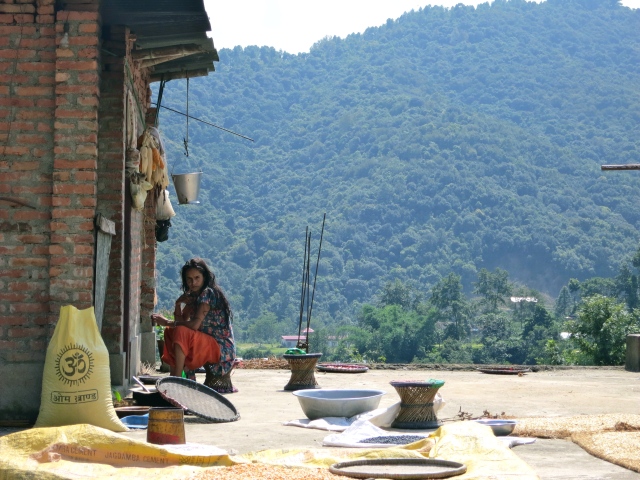
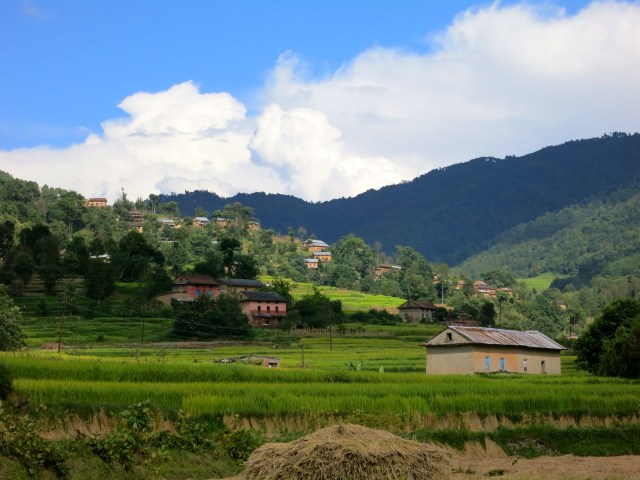
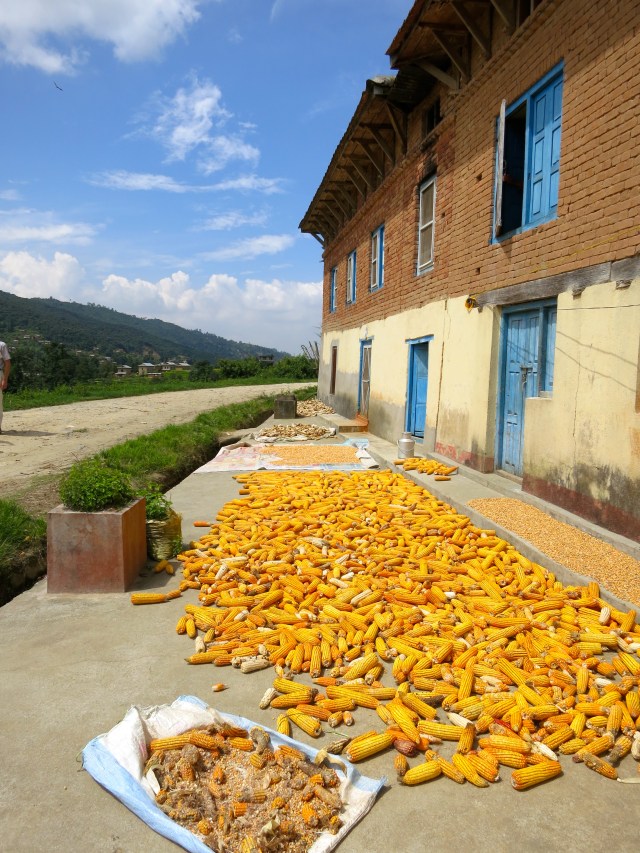
I took this photo last week in the Kathmandu Valley, near the village of Palubari, in Nepal. The monsoon season has just ended in Nepal, so the colors of the vegetation are especially vibrant right now. And the people of Nepal are always vibrant, both in their personalities and their dress.
Palubari took its name for the ginger that was once grown here, but this area in the eastern end of the Kathmandu Valley is fertile enough to grow rice, maize (corn), wheat, potatoes and many other vegetable crops.
The corn crops have been harvested already, the cobs and kernels drying in the sun along the roads that run through the valley.
Corn drying in the sun.
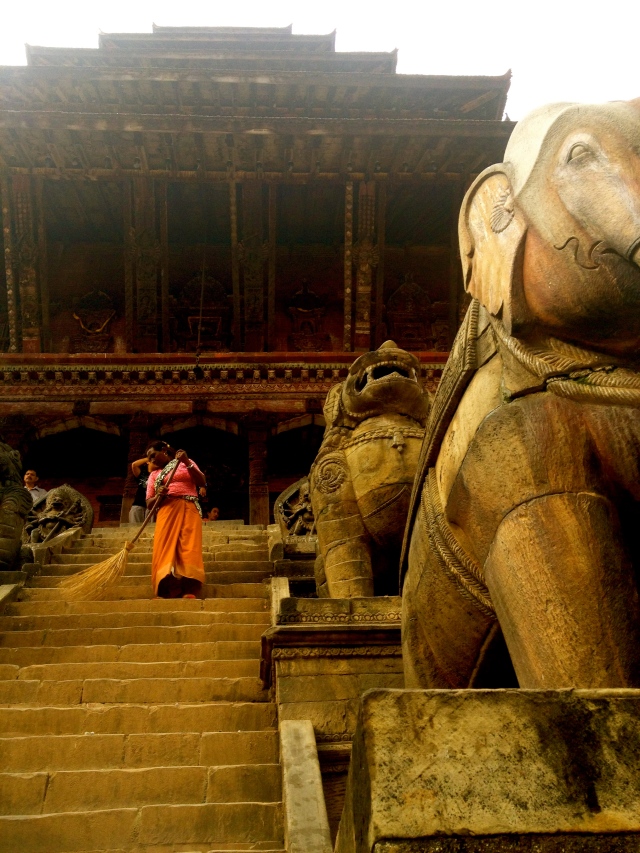
Now the rice crop must be brought in. All the harvesting is done by hand (you can see the scythe in the hand of the woman in the first picture). It is hard, labor intensive work and it must all be done before the major festivals next month of Dashain and Tihar.
The WordPress Weekly Photo Challenge this week calls for photos that show an unusual perspective on a subject. I chose a fairly traditional subject – a flagpole -and experimented with several different points of view. Enjoy!
Close-up photo taken in early afternoon.A more conventional point of view.
A “legelege” fishing boat rests on the shore of the Atlantic Ocean in Ghana. The sea is very powerful off the coast of Ghana, yet Ghanaian fishermen battle the powerful currents and mighty breakers day after day in their small, wooden boats. They often personalize their boats with inspirational sayings.
“But man is not made for defeat,” he said.
“A man can be destroyed but not defeated. ”
― Ernest Hemingway, The Old Man and the Sea
This post is a response to the theme “Sea”. Follow the link to see more entries in the Weekly Photo Challenge: Sea.
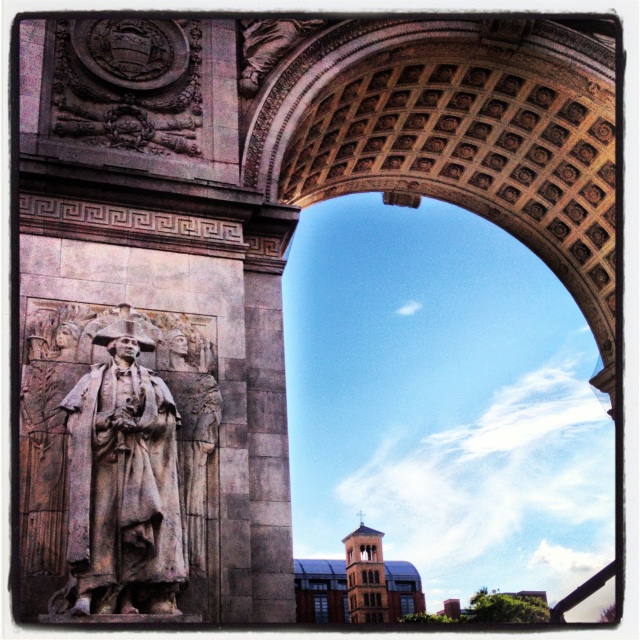
The Washington Arch, Washington Square Park New York City
When I travel to other countries, I find that I am almost always on hyper-alert lookout for the interesting, the beautiful, the unique, the historical. Sadly, it is not always so in my own country. I can walk past a masterpiece a dozen times without truly seeing it. Take, for example, Washington Square Park. I’ve been to Washington Square Park dozens of times, but it wasn’t until this very week that I stopped and looked and truly saw the beauty in the Washington Arch.
It was a beautiful summer evening this past Wednesday, the city just beginning to breathe easy again after long hot spell. The park, green and shady under the towering old elms and sycamores, seemed especially cool and refreshing as I hurried past along Washington Square North. There’s a fountain at the heart of the park, and its dancing water was catching the rays of the setting sun. The cheerful sound of splashing water mingled with joyful shouts of children in the nearby play area.
Maybe it was those co-mingled sounds, filtering down through all the other sounds of traffic and people and city, that caught my attention as I hurried from West Village to East. Whatever it was, something made me stop and turn just past Fifth Avenue. Looking back, I pulled out my phone and caught the above view of the Washington Arch. For which, I am eternally grateful.
With no people in the photo, the Washington Arch seems almost timeless. It made me think of all the millions of humans who have spent time on this small patch of island – and curious to learn its history. It turns out that, as with so many places in our world, the history of Washington Square Park contains a human rights narrative. Native Americans lived here in the early 17th century before the Dutch attacked them and drove them out. The Dutch farmed the land, on both sides of the brook called Minetta that once ran through area. Later, the Dutch gave the land to freed slaves to create a kind of human buffer zone between the Native Americans and the white colonial settlements. The area that is now Washington Square Park was in possession of African-Americans from 1643-1664; at the time, it was called “The Land of the Blacks”. (See the New-York Historical Society of Manhattan for more history of slavery in New York.)
It remained farmland until 1797, when the Common Council of New York purchased some of the farmland (which was still outside city limits) for a new potter’s field to bury unknown or indigent persons. Most of those who died from yellow fever during New York’s epidemics of the early 19th century were also buried here. The public cemetery was closed in 1825 and the City bought the rest of the land shortly after, turning the area into a military parade grounds. To this day, the remains of more than 20,000 bodies rest under Washington Square Park.
By the time the City reworked the parade grounds into a park in 1849-1850, the streets around the park had already become one of New York’s most desirable residential areas. The park underwent several improvements, including the addition of the first fountain in 1852. To celebrate the centennial of George Washington‘s inauguration as president of the United States in 1889, a large plaster and wood Memorial Arch was erected over Fifth Avenue just north of the park. It proved so popular that a permanent arch, designed by architect Stanford White, was commissioned. Made of Tuckahoe marble and modeled after the Arc de Triomphe, this is the Washington Arch that I know today. It was dedicated 1895. In 1918, two statues of George Washington were added. You see one of them – George Washington At War – in my photo.
Washington Square Park has also been the site of countless protests, testaments to the right of freedom of assembly and expression. The first labor march in New York took place there in 1834 when stonecutters protested New York University’s decision to use cheap prison labor from Sing Sing instead of professional stonecutters to build a university building along the park. In 1912, approximately 20,000 workers (including 5,000 women) marched to the park to commemorate the Triangle Shirtwaist Factory fire, which had killed 146 workers the year before. By some reports, more than 25,000 people marched on the park demanding women’s suffrage in 1915. Beginning around the end of World War II, the park became a gathering area for the Beat generation, folk, and Hippie movements. On April 9, 1961, about 500 folk musicians and supporters gathered in the park and sang songs without a permit, then held a procession from the park beginning at the Washington Arch. The New York Police Department Riot Squad, sent in response to this “Beatnik Riot”, attacked civilians with billy clubs and arrested ten people.
And yes, even the tireless human rights advocate Eleanor Roosevelt has a connection to the area. Around the time that she was helping to draft the Universal Declaration for Human Rights, she was a resident of Washington Square Park West.
Like so many others, I was just passing by Washington Square Park on a recent evening past. But I’m glad I took the time to stop and look. And to learn.
The inscription on the Washington Arch reads:
Let us raise a standard to which the wise and the honest can repair. The event is in the hand of God. — Washington
For more information about Washington Square Park:
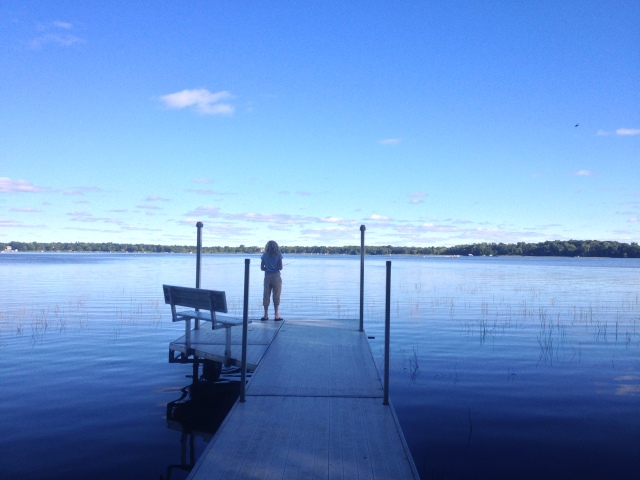
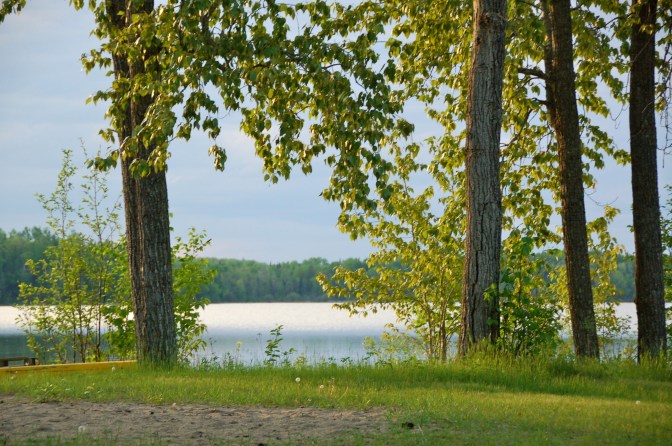
The Golden Hour on Turtle River Lake Bemidji, Minnesota USA
E.B. White once said:
“I arise in the morning torn between a desire to improve the world and a desire to enjoy the world. This makes it hard to plan the day.”
Note that he didn’t say that it was impossible to balance these seemingly competing impulses, but rather that it creates some planning challenges. As a human rights lawyer, I believe that is is crucial to find that balance on a daily basis. I try to show my kids that every day you can find a way to improve the world, in big ways and small. It may not seem like much, but when you say something nice instead of something mean or share your lunch with a friend who forgot his, you really are making an affirmative choice to improve the world around you.
At the same time, it is important to look for beauty in the world around you. It’s there, we just sometimes forget to look. Or listen. I pulled up short during my run the other day to listen to a robin. The robins have been back for months, so I usually don’t even hear their songs, but this particular robin was balanced on a telephone wire over an alley, stretching her (or his – I guess I can’t tell) body high to belt out a string of clear whistles. “Cheer up! Cheer up! Cheer up!” sang this avian Aretha Franklin. Beautiful!
When I was 11 or 12, one of my favorite books was Never Miss A Sunset by Jeannette Gilge. Told from the perspective of a 13-year-old girl, it is part of a series about a large family struggling to survive on a homestead in the early 1900s. It has been decades since I read it, but I still follow the advice of the father. No matter how hard the day’s work has been, you should take a moment every day to enjoy the sunset. For me, it is not so much the sunset that I try to take time to enjoy, but The Golden Hour before the sun sets.
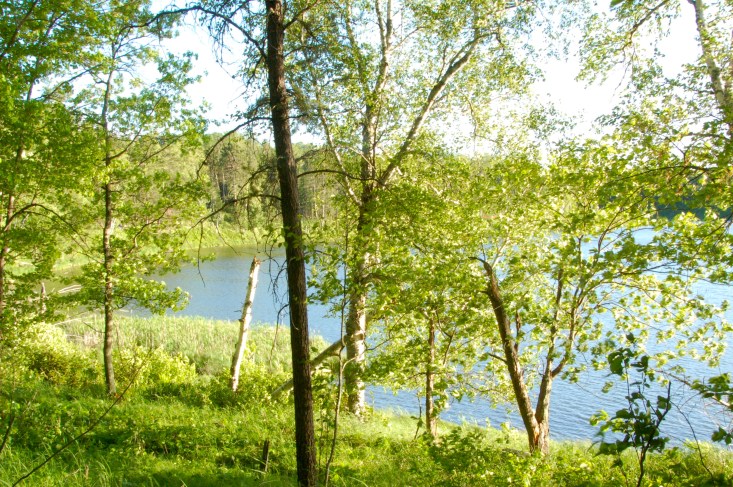
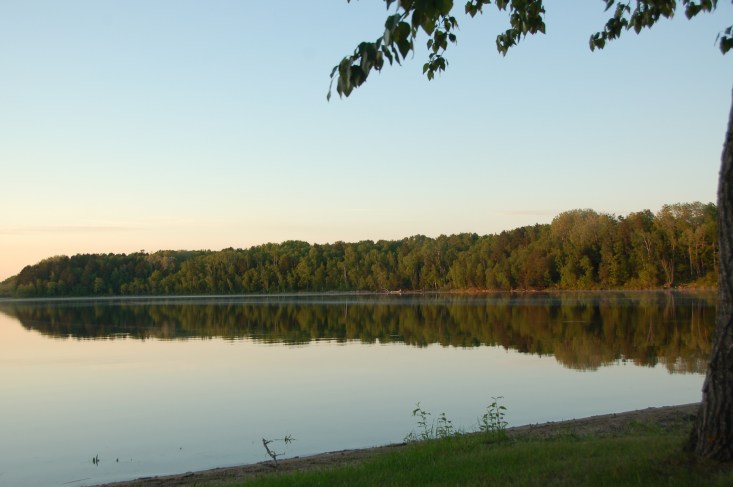
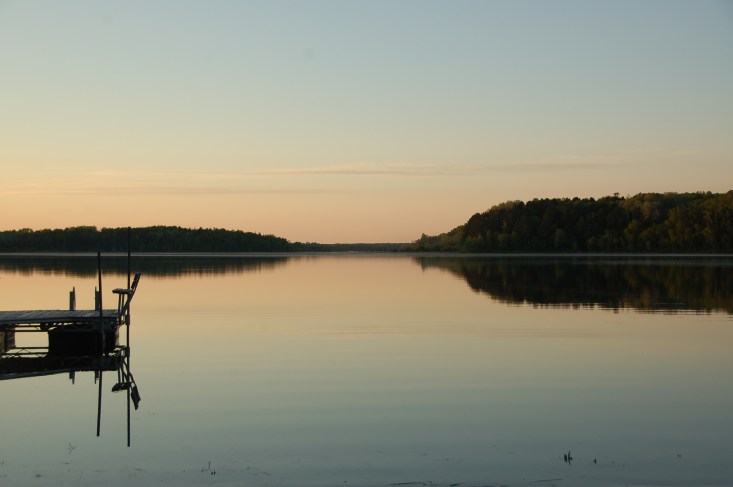
Maybe E.B. White had trouble planning his day, but there is a fixed moment on my daily schedule to enjoy the world. For the Weekly Photo Challenge this week, I am sharing some photos of The Golden Hour that I took in northern Minnesota recently.
Sunset at Bukkesjøen near Bemidji, Minnesota USAThe path to BukkesjøenThe Golden Hour at BukkesjøenMy daughter dances with friends from her cabin. Skogfjorden Norwegian Language Village, Bemidji Minnesota USASunset on Turtle River Lake Bemidji, Minnesota USATurtle River Lake Bemidji, Minnesota









 The Human Rights Warrior
You must be logged in to post a comment.