
Street scene in a town near Yaounde in Cameroon
For more responses to the Weekly Photo Challenge: Street Life, click here.
"There is some good in this world…and it's worth fighting for." ~ J.R.R. Tolkien

Street scene in a town near Yaounde in Cameroon
For more responses to the Weekly Photo Challenge: Street Life, click here.
My oldest son went on a school trip a few weeks ago. The main purpose was to participate in the Barnebirkie, the children’s version of the largest cross-country ski race in North America. It takes place in northern Wisconsin every February. This is the twentieth year that the school has done this trip with middle grade students, so they have become experts at making it an enriching experience. In addition to skiing in the race with more than 1,000 other kids, they spend some time doing joint educational programming at the local middle school (this year, there was some kind of amazing science theme) and have a traditional meal with a Native American tribe. They also somehow fit swimming at the local community center into the packed agenda.
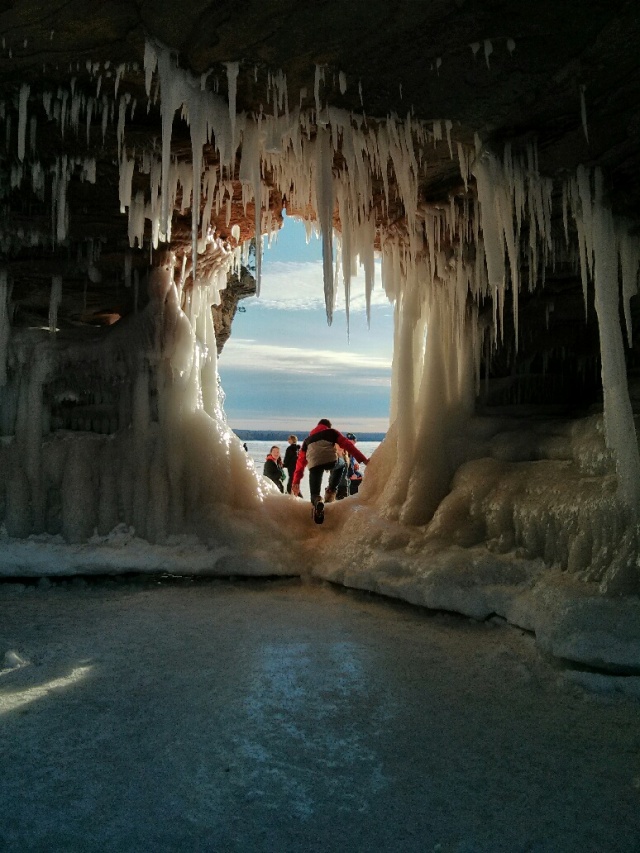
A week before the trip, a note came home in my son’s backpack that there would be a slight alternation to the schedule. The group would be able to visit the ice caves on Lake Superior’s Apostle Islands. For those not familiar with the Upper Midwest, the Apostle Islands National Lakeshore in northern Wisconsin is a true gem of a national park. There are 21 islands, windswept beaches, rocky cliffs, and lighthouses. In the summer, you can hike the 12 miles of lakeshore wilderness and paddle or boat around the islands. You can even camp on 18 of the islands, which are only accessible by water. You can even explore by kayak the amazing sea caves at the western end of the mainland part of the park.
In winter, the sea caves become ice caves. And in extremely cold winters, when Lake Superior freezes over, the national park service allows people to walk out over the ice and experience the ice caves from the inside.

As I have never been to the Apostle Island ice caves, I was excited that my son had this opportunity to visit them. It has been five years since the ice caves were last open to the public. One of the impacts of climate change has been that Lake Superior hasn’t been frozen enough to make access possible. Since the ice caves opened to the public on January 15, more than 125,000 people have made the two mile roundtrip trek over frozen Lake Superior to experience the ice caves.
My son sent took these pictures of his visit and texted them to me.
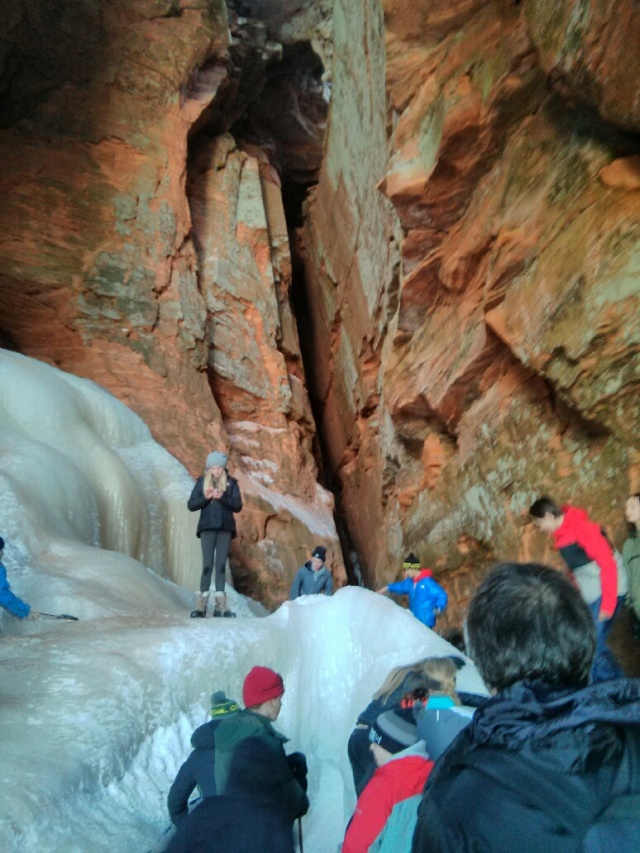
It’s an odd feeling – usually I’m the one who is traveling and sending the pictures back home to the rest of the family. But I really appreciated his willingness to share the experience of being inside the Apostle Islands ice caves with me.

With warmer weather, the ice is degrading and it is becoming unsafe to be on the lake. The National Park Service plans to close the Apostle Island ice caves to the public by 12:01 am on Monday, March 17.

With special thanks to my son Sevrin for the photos!
For more responses to the Weekly Photo Challenge: Inside, click here.
I have a complicated relationship with International Women’s Day (IWD). On the one hand, it vexes me greatly that we have only one day a year – designated by the United Nations General Assembly in 1977 as March 8 – to celebrate the many contributions of women around the world. On the other hand, we still need to focus attention on the fact that women, who make up half of the world’s population, still face almost incomprehensible inequality in societies throughout the world. Not just inequality, but inexcusable pain and violence.
One in three women in the world still experience violence (including rape and marital rape, spousal abuse, and child abuse) in their lifetime. The numbers are closer to one in four in the West – numbers that are still shockingly high.
Even before birth, preference for male children leads to feticide and infanticide in many parts of the world. Millions of girls and women around the world face obstacles to education, access to health, freedom of choice in marriage and divorce, land ownership and political participation. Even in the West, women continue to face inequality, including professional obstacles.
The UN theme for IWD 2014 is “equality for women is progress for all”. And there is no question that that statement is true. As UN Secretary-General Ban Ki-moon said in a statement for IWD 2014:
“Countries with more gender equality have better economic growth. Companies with more women leaders perform better. Peace agreements that include women are more durable. Parliaments with more women enact more legislation on key social issues such as health, education, anti-discrimination and child support. The evidence is clear: equality for women means progress for all.”
IWD means different things to different people around the world. For some, it is a day to celebrate the strength of personal relationships with mothers, grandmothers, daughters and friends. Some choose to celebrate the overall contributions of women; in 2014, I noticed a particular interest in celebrating the “bad ass” women in our collective history (which I do applaud). For others, it is the opportunity to highlight all that still remains to be done.
For me, IWD is all these things. It is also about wanting a world where my daughter and my sons are treated equally without thought or legal requirement. It is about teaching them that this is what they – both boys and girl – should expect in their future. But it is also about celebrating the strong community of women that has brought us this far.
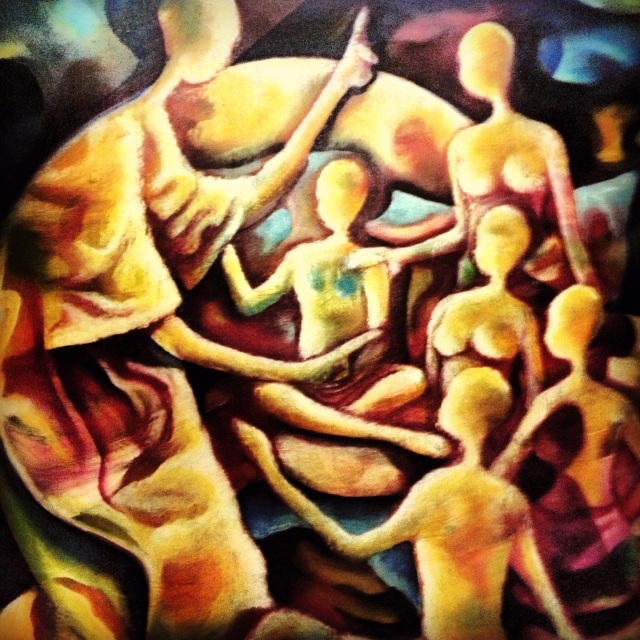
I took this photo of a painting that hung in the stairwell of a hotel I stayed in last year in Yaounde. It was dark in the stairwell, but I paused every time I passed it. The painting appeared original, but there was no name given to it. No artist was listed. But for me, it captures the spirit of International Women’s Day. We still have a ways to go, but we are together in this effort. We learn from each other and we support each other. Here is my perspective on International Women’s Day 2014:
It may take us time, but when women work together, nothing can stop us.
 Hotel Africa in Virginia, Liberia
The Hotel Africa, built in a beach resort area north of Monrovia, was once a 5-star grand hotel. It was built to impress as the location of the 1979 Organisation of African Unity summit. (The pool was made in the shape of the African continent.) Just a few months after the Hotel Africa hosted the OAU, however, Liberia’s President William R. Tolbert, Jr. was overthrown by Samuel Doe. From 1979 to 2003, Liberia was engulfed in violent conflict too complicated to detail here.
Stories about the historic Hotel Africa abound; many of them parallel the violence that was happening in the country at large. For example, the hotel’s owner was kidnapped in 1990 by the rebel Independent National Patriotic Front of Liberia. They allegedly murdered him by throwing him off the fourth floor balcony.
By the time I visited the Hotel Africa in 2008, it had been bombed, burned, and stripped bare of everything that could possibly have a value.
Abandoned.
 Kono District, Sierra Leone
This is a photo of the remains of a building in the Kono district that was burned by the rebel Revolutionary United Front during the conflict in Sierra Leone. I’ve heard so many personal stories of escape and of loss that I assume this was once the private home of a family with means. But it could just as easily have been a government building.
The conflict in Sierra Leone left so many destroyed buildings. Not to mention lives.
 Monrovia, Liberia
In Monrovia, buildings destroyed in the conflict loom gloomily as people go about the process of rebuilding their lives in the midst of the rubble. This photo was taken at a gas station. Like many resourceful Liberians, they were also selling “pure and safe drinking water”. But the thing I like about this photo is this – if you look closely at the larger building above, you can see laundry hanging out to dry. Life springs up inexorably, like blades of grass in the spring.
In post-conflict West Africa, the abandoned buildings hold more than just memories.
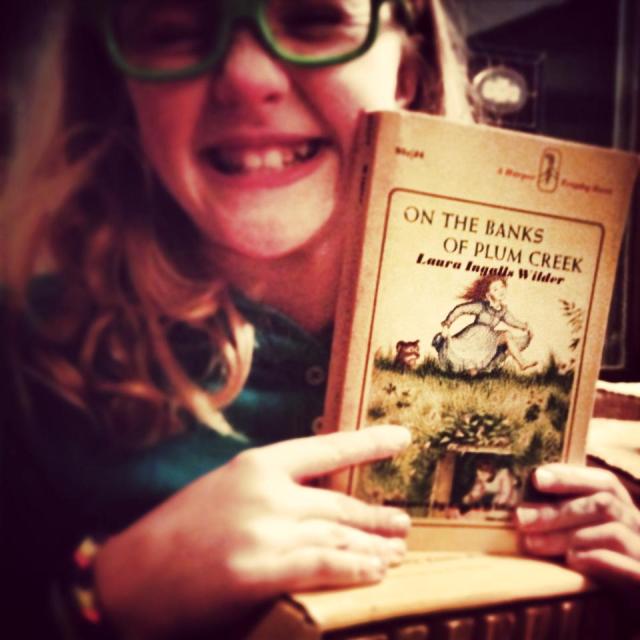
Recently, I bequeathed one of my childhood treasures to my eight year-old daughter – my box set of Little House books by Laura Ingalls Wilder. My daughter Eliza had to first prove herself worthy; I refused to pass it on to her until she had finished reading both Little House in the Big Woods and Little House on the Prairie.
Little House in the Big Woods is the first “real” book that I can recall reading. My grandmother Lillian started off reading it to me, but somehow, somewhere around the family goes to the “sugaring off”, I found myself reading it to her instead. For the rest of my childhood, I read all the books in this pale yellow box again and again.
Even as a child, I picked up on the fact that Ma’s attitude towards Native Americans was racist and cruel. It seemed wrong to me that Laura’s only occupational choices were schoolteacher or wife. My daughter and I have been talking about these things as well. It is a part of our history that is better to acknowledge than to ignore. But my daughter likes the books because they include so many details about life in a very different time. The books aren’t about heroes, but about ordinary people. Laura and Mary, Carrie and Grace, Ma and Pa, even Jack the dog are vividly alive for her. Maybe next summer we will have to take a mother-daughter field trip to Walnut Grove, MN to visit the Laura Ingalls Wilder Museum.
The real treasure for me has been watching her discover the same joy in reading these books that I experienced as a child. Maybe one day, she will pass this treasure on to her own children.
This post is a response to the Weekly Photo Challenge: Treasure.

I first learned to cross-country ski when I was 19 and living in Norway. Learning to ski in a country where skiing is the national pastime was both a blessing and a curse. (The national slogan”Nordmenn er født med ski på beina” or “Norwegians are born with skis on their feet” may help you understand why little Norway is so dominant in the Winter Olympics.) The curse part was that I was 19 the first time that I strapped on skis; I think I spent most of that first afternoon either falling down or trying to get up. To add insult to injury, as I struggled to complete the “beginner” 2K loop, dozens of skiers zipped right by me – including both a 90+ year old pensioner and a baby. I would call him a toddler, but not for the fact that later I saw him crawling around on a blanket in picnic area by the parking lot. Nothing bursts your bubble quicker than the realization that even a kid who can’t walk yet can ski better than you can.

The blessing part is that cross-country skiing can be such a joyful experience. I learned in Norway that it is cross-country skiing is a sport that just about everyone can do. I also learned that skiing allows you to get out and experience nature in a way that is very different from the rest of the year. The stillness of the snowy woods can be breathtaking. In the silence, you hear your breathing and the rhythmic sh-sh-sh-sh-sh-sh of your skis, interrupted occasionally by the sound of an animal or a bird. Unlike summer’s cacophony, in winter each sound is individualized and accentuated, carrying alone across long distances. From afar, I heard the yank-yank-yank-yank of the red-breasted nuthatch while skiing on Lake Harriet last week; it was still calling when I skied up to it 10 minutes later. When you are out in the cold, but not feeling it because your arms and legs are working hard, pumping heat through your body – that’s when cross-country skiing makes you feel the power for conquering winter.
And then there is this. The unique light and colors of a deep winter day that perhaps can only be experienced on skis.

It’s been years now since I learned to ski. I rarely fall down anymore, although I am still passed on the trail by faster skiers. Truthfully, I haven’t been out on skis much in the recent past. Climate change and the warmer winters of the past decade have meant the snow conditions have been less than perfect in Minnesota. This winter, however, the snow conditions are wonderful. And I have rediscovered my joy in cross-country skiing.

This post is a response to the Weekly Photo Challenge: Selfie. See additional posts here.
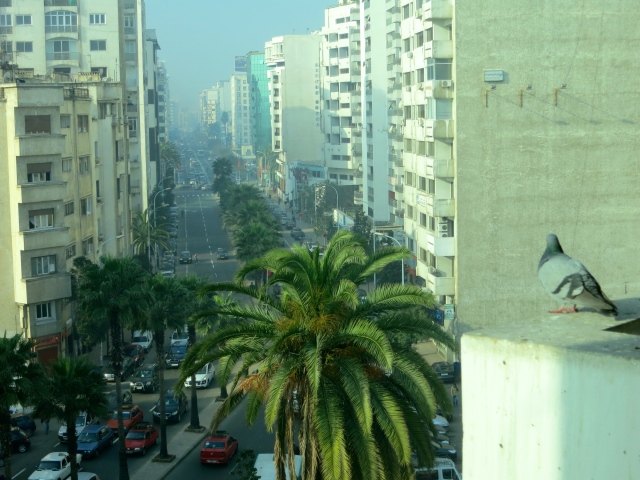
On this particular morning in Casablanca, I arrived early for a meeting with a women’s rights association. This pigeon, basking in the sun high above the bustle of Casablanca, kept me company while I waited for the others to arrive. When the meeting ended, I looked to see if my friend was still on the ledge outside the window. The pigeon had moved on. And so must I.
This post is a response to the Weekly Photo Challenge: Object. To see other responses, click here.
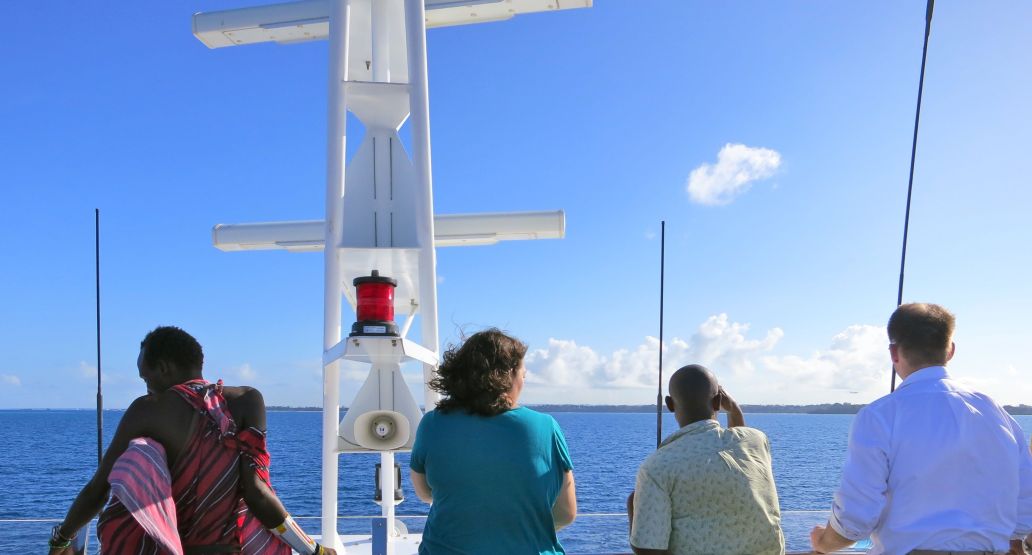
See also Juxtaposition I: Coke vs. Pepsi in Old Baneshwor, Kathmandu, Nepal.
For more responses to the Weekly Photo Challenge theme Juxtaposition, click here.
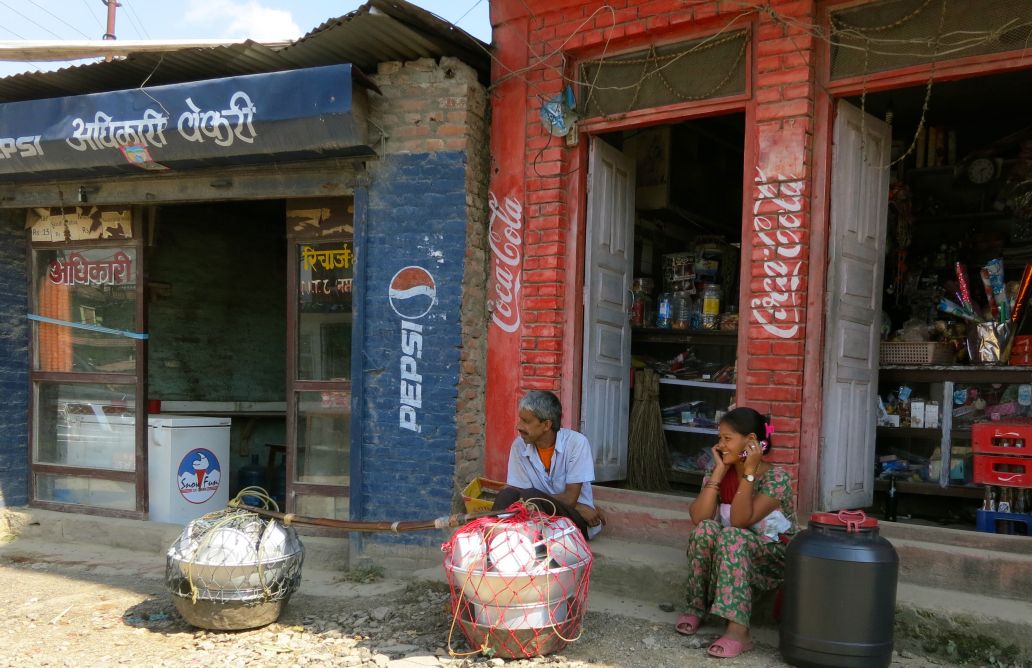
See also Juxtaposition II: Tourists and Tanzanians on the ferry to Zanzibar.
For more responses to the Weekly Photo Challenge theme Juxtaposition, click here.
A Few Reflections On How We Define “Family”
We had just dropped off my old friend Erik and his unwieldy crew at the airport, when my daughter Eliza let out a dramatic sigh from the back of the minivan.
“It’s pretty much BORING without our cousins!”
Curious, I launched into a lengthy cross-examination to determine why she thought they were our blood relations. She went along with the questioning for a while, mumbling one syllable responses out of the corner of her mouth as she gazed morosely out the window at a long, undulating line of sunflowers. Some kind person, in the interest of beauty, had planted them along the highway. Now they were more than six feet tall, so large that you could almost see the Fibonacci sequences in their bright spirals. Even from a minivan with a six-year-old pouting in her booster seat in the back.
After several miles of this, Eliza suddenly sucked in air until her cheeks were full. She then blew it all out, frustration personified. I watched her in the rearview mirror as she put everything in her small, defiant being into these words:
“Because! I just FEEL like they are.”
How do you define family? Is it common ancestry? Shared experiences? Mutual commitment? Living in the same household? Common values? The people you know you can count on for support? The people you know you can get into a knock-down-drag-out fight with but they’ll still love you? People who you feel deeply connected to even though you rarely see them? All of the above? Or none of them at all?
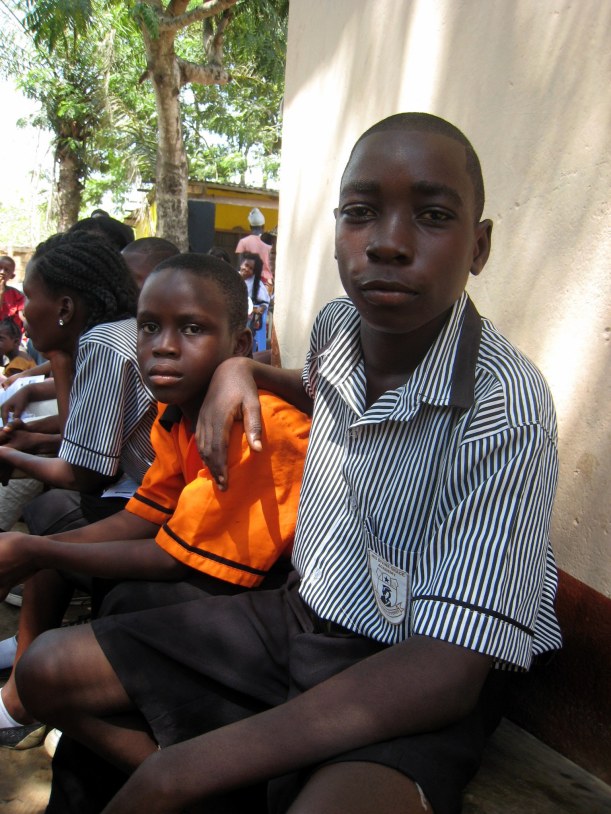
The boys in the photo above are brothers I met at the Buduburam Refugee Settlement in Ghana. Their mother Kebbeh considers them her sons, although only the oldest is her biological son. The younger boy and his little brother (not pictured) are her neighbor’s sons. The neighbor had gone back to Liberia with the first wave of resettled refugees, with the promise to send for the boys after she got settled. They never heard from her again. Post-conflict Liberia was dangerous, so they fear the worst. But they really don’t know what happened to her. So Kebbeh is raising the boys as her own, feeding and caring for them, sending them to school. They are family.
When I was in Buduburam, I met a woman called Ma Fatu who ran a cook shop on the main thoroughfare of the camp where many of the refugee-owned businesses were. The street had no name, of course, but the Liberian refugees called it “Wall Street” because so many financial transactions were made there. Ma Fatu has a feisty personality. I think she would have been equally at home as the proprietor of a saloon in the Wild West or a grogshop in Regency England. She took a lot of pride in her cooking and in knowing her customers. She’d eye me critically as I tucked into my jollof rice and say, “I know what you white people like to eat.” Then, the next day, she would dish me up a heaping serving of jollof vermicelli.
I had noticed that there were several young people helping in the cook shop, washing dishes, waiting tables, whatever needed to be done. It was only on my second trip to Buduburam that someone told me that they were not actually her children. During the war in Liberia, her husband and her biological children – her entire family – had been killed. Over the years at Budububuram, she had taken in several young people who had also lost everyone. In the face of all this loss, Ma Fatu had created a new family. In a refugee camp – miles from home and without even the possibility of legal recognition – she had forged familial bonds of love and support.
Like every parent, I’ve got a stockpile of my kids’ drawings of our family – stick figures showing Mom and Dad, Brother and Sister. Sometimes Grandma and Grandpa and/or Cat and Hamster.
When you are young, the definition of family is very narrow and also very immediate. But as you get older, you develop deeper relationships with people who are not related by blood. In many ways, you create your own family of the people who give you what you need to flourish. Like the heliotropic sunflowers, you turn to the light, needing full sun to thrive. If you don’t, you wither away.
I’ve had this discussion about the definition of family with a number of my former asylum clients. Under U.S. immigration law, your family is defined as your spouse (only one – your first spouse), your children by birth or legal adoption, and your parents. Of course, many people in the world use a broader definition, with half-siblings, cousins, and children adopted without legal recognition counting as immediate family members.
One of my asylum clients once said to me,
“I feel so sorry for you Americans. Your families are so very small!”
I had never really thought about it that way before. But I could see her point.
Article 16(3) of the Universal Declaration of Human Rights states that,
“The family is the natural and fundamental unit of society and is entitled to protection by society and the State.”
Back when the UDHR was adopted in 1948, it is doubtful that the drafters envisioned even biracial marriage, much less same-sex marriage and the multiple forms of family that exist today.
But the bigger point, I think, is that no matter how you define “marriage”, the push for the changes in the legal definition has happened because of thousands – maybe millions – of personal decisions by individuals to define their closest relationships as “family”. The reality is that there is a very human need to live in a family social structure – the natural and fundamental group unit of society. The law can better accommodate that reality but regardless of what the law says, people – like Kebbeh and Ma Fatu – will create their own families.
Maybe my young daughter is right. The true definition of family is a very personal one, self-defined by each of us. The definition of family maybe really IS the people who you feel like are your family.
So I think the real questions for each of us then become:
How do you define your family?
What does your family mean to you? and
Wouldn’t we all be better off if society and the State protected and supported all of our families?
 The Human Rights Warrior
You must be logged in to post a comment.