A Beastie Boy’s Surprising Legacy

I had a bad feeling when Adam Yauch was a no-show for the Beastie Boys‘ induction into the Rock n’ Roll Hall o’ Fame in April. So, while I was not surprised, I was saddened to learn of his death from cancer at the age of 47.

The Beastie Boys were not my favorite band growing up. (That would be The Police.) They had an impact on my generation (X), however, that is worth acknowledging. Only a few years older than me, the Beasties burst onto the national scene when I was still in high school. As girl from the suburbs of a small Southern city, whose first album was REO Speedwagon’s Hi Infidelity  and first concert was the J. Geils Band (with Hall & Oates!), I found the Beastie Boys to be something of a breath of fresh air.  For me, they symbolized New York and the urban, East Coast, post-racial America that I had yet to experience.

I did see the Beastie Boys once, when they toured with Madonna in 1985 on the Virgin Tour, but that was purely by accident since I was going for Madonna and didn’t even know who was opening. Quite honestly, I couldn’t really tell Beastie Boys apart. They all had dark hair and, what with the VW gold chains and sunglasses and baseball caps and hats and all, they weren’t that distinguishable. They were named either “Mike” or “Adam”, so take your pick.  Sure, they had nicknames – “MCA” was Adam Yauch and “Ad-Rock” was Adam Horovitz – but unlike Sting and The Police, it didn’t really matter too much to me who was who in the Beastie Boys.

“Enough of this hip hop! Bring on the Material Girl!” That’s what I mostly remember thinking during their set.

License to Ill came out in 1986. I didn’t own it on cassette or LP but plenty of people at my college must have, because (You Gotta) Fight for Your Right (to Party) was de rigueur for dorm room parties.  Along with UB40’s Red, Red Wine and Bon Jovi’s Livin’ on a Prayer, it was the soundtrack for my early college social life. I can still close my eyes and flashback through the entire MTV video, complete with the nerds saying, “We’ll invite all our friends and have soda and pie!” and “I hope no bad people come!” The Beasties’ exuberant “KICK IT!” still echoes in my head 25 years later.

Never what you would call a fan, I pretty much lost interest in the Beastie Boys after License to Ill.  Frankly, pulling stunts like having girls dancing around in cages at their concerts didn’t help much.

I came back to the Beasties in the mid-1990s. But not really because of their music.

Beastie Boy Adam Yauch (MCA a.k.a. Nathanial Hörnblowér) had become a human rights activist.  He started a non-profit called the Milarepa Fund in 1994 to support Tibetan independence from China.  Royalties from the Beastie Boys’ 1994 songs Shambala and Bodhisattva Vow (from the Ill Communication album) were dedicated to the Milarepa Fund and the fight for freedom for Tibet. They sponsored an information tent on Tibetan human rights at Lollapalooza and performed concerts to raise money for the cause.  In 1996, Yauch organized the Tibetan Freedom Concert.  The largest benefit concert in the US since 1985’s Live Aid, it attracted 100,000 people and raise more than $800,000.  Additional Tibetan Freedom Concerts were held on four continents in 1999.

It turns out that the Beastie Boys had principles and they were not afraid to use them.  Shortly after the bombings at US Embassies in Kenya and Tanzania, Adam Yauch used his time at the microphone at the 1998 MTV Music Awards ceremony to talk about stereotyping Muslims as terrorists. “It’s kind of a rare opportunity that we get to speak to this many people at once,” he said. “So, if you guys will forgive me I just want to speak my mind for a while.”   He went on – prophetically, it seems now – to speak about the U.S. government’s military aggression in the Middle East and the growing climate of racism towards Muslims and Arabic people. “The United States has to start respecting people from the Middle East in order to find a solution to the problem that’s been building up over many years.

Another issue that the Beastie Boys took on directly was the rights of women.  They’ve been rapping against domestic violence (“Why you got to treat your girl like that?”) at least since Paul’s Boutique. When it was announced that Adam Yauch had died, my friends on Twitter lit up the night with lyrics like “I’m gonna say a little something that’s long overdue/The disrespect of women has got to be through/ To all our mothers and our sisters and our wives and friends/ I want to offer my love and respect to the end” (from Sure Shot).    Song For The Man was written after Adam Horovitz observed the overt sexism – and blatant harassment of a woman – by a couple of guys on a train. If more men spoke out like the Beasties, the world would be a better place.

At the 1999 MTV Video Music Awards, when the Beastie Boys won the award for Best Hip Hop Video for Intergalactic, Adam Horovitz spoke about the problem of sexual assaults and rapes at Woodstock 99.  He made the pitch for bands and concert venues to provide more security to better protect women.

The Beastie Boys have continued their political activism into the 2000s. After the September 11, 2001 attacks, for example, they organized and headlined the New Yorkers Against Violence Concert in October 2001. The concert proceeds went to the New York Women’s Foundation Disaster Relief Fund and the New York Association for New Americans.

Adam Yauch with his daughter at Amnesty International's 5th Annual Media Spotlight Awards in New York in 2002

Adam Yauch with his daughter at an Amnesty International Event

Image Source

I’ve been thinking about the life of Adam Yauch, which ended far too soon, and have come to realize that the Beastie Boys not only helped define the formative experiences of my generation but they are also representative of many of the traits of Generation X. Wikipedia has this to say about us: “When compared with previous generations, Generation X represents a more heterogeneous generation, exhibiting great variety of diversity in such aspects as race, class, religion, ethnicity, and sexual orientation.” The Beasties, in freely crossing music boundaries between punk and hip hop and alternative, certainly are illustrative of this heterogeneity and diversity.

But I think that another of our generational traits is the ability to change. (I love this quote from Wikipedia:  “Change is more the rule for the people of Generation X than the exception.[citation needed]”)    The Beastie Boys were no different from many of us who were, in our youth, racist, sexist, and/or homophobic dorks. America was just a less tolerant place when we were growing up in the 70s and 80s. Not that that is an excuse for the many of us who stayed silent and went along with the crowd rather than speaking up for what was right.

Like the Beasties, however, most of us have grown up and figured out that our actions – and our inactions -have consequences.  As Adam Yauch once pointed out, “Every one of us affects the world constantly through our actions.”  To not take advantage of second chances would be a mistake.  Like Adam Yauch and the Beasties, we should take advantage of every opportunity to take action for good.

Most of the Gen Xers I know will, like the Beastie Boys, freely acknowledge our past immaturity, our arrogance and stupidity, and accept it without embarassment.  Most of us embrace change as the only way forward, even though it sometimes means also accepting criticism.  Adam Horovitz has a great quote that pretty much sums up this point:

“… (Y)ou might say that the Beastie Boy ‘Fight For Your Right to Party’ guy is a hypocrite. Well, maybe; but in this f***ed up world all you can hope for is change, and I’d rather be a hypocrite to you than a zombie forever.”

That’s a pretty good lesson for anyone, regardless of what generation you come from.

The other thing that I think that Adam Yauch and the Beasties symbolize for my generation is the ability to age with nimble good humor and some small modicum of coolness.  To acknowledge we are aging, to joke about it, but to still be self-confident enough to hang with the young ‘uns – this I see as a generational shift.  (Nothing, by the way, in the definition of Generation X on Wikipedia mentions this particular trait.)  Maybe this is just another aspect of our ability to change, but the first minute or so of this video of the Beasties playing POW and Shambala live will give you an idea of what I’m talking about:

I’m sorry that Adam Yauch, a.k.a.MCA, a.k.a. Nathaniel Hornblower, won’t be continuing this Gen X journey with the rest of us. I hope he knows that he left a legacy here on Earth that is bigger than his music. Wherever his soul resides now, I hope that Adam Yauch is still kickin’ it.
Talking To My Kids About Death

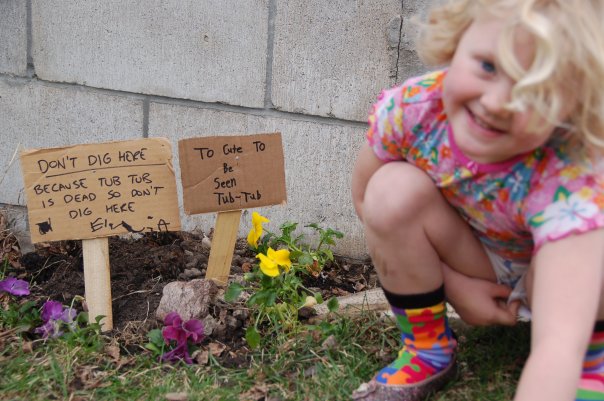
Pet Graveyard

The recent demise of Fat Stanley was met with far fewer tears than that of Kevin Bacon (the gerbil) and definitely far less anguish than that of Tub-Tub, our first dearly departed rodent pet.  It did however, necessitate a discussion about death with my three children.   The easiest answer to the question “Where is Stanley now?” would have been to describe a dwarf hamster heaven, where Stanley roams freely among a vast surfeit of yogurt treats and well-oiled wheels.  While it was somewhat tempting to give them an easy and soothing answer, I can not  in good conscience pitch that pablum to my kids.  You see, in my line of work, I talk to people about death all the time.

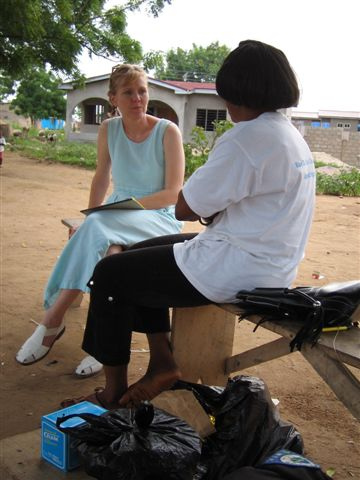
As a human rights lawyer, my job is to document human rights abuses.   So there have been many days over the course of my career when I have asked  people to describe to me in very precise detail how someone they loved died.  In one week alone in 2007, I took statements from more than 45 Liberian refugees at Buduburam Refugee Settlement in Ghana for Liberia’s Truth and Reconciliation Commission.  The very first person I interviewed at Buduburam was a teacher.  The teacher was wearing a pink polo shirt that was remarkably clean and crisp, given the hot, dusty conditions on the camp.  He had come into the Refugee Welfare Office, where we were piloting the interview process, to watch a football match on the TV.  When I asked if he wanted to give a statement, he said, “Sure.  Why not?”

It was late May and the equatorial sun had beat down relentlessly all day long.  As we went into one of the private offices to do the interview, however, a pleasantly cool late afternoon breeze was coming through the barred window.  I discovered later that the location of the camp was very close to the Prime Meridian, as well as  the notional center of the world – 0°, 0°.  The sun sets early and fast near the equator.  As we talked, the shafts of light from the setting sun were low and long, glinting off the gold in his round, wire-framed glasses.

I had an interview protocol to follow and certain biographical data to collect.  We talked about what he did in Liberia, where he had lived.  It was going well.  We established a rapport, buzzing through the facts of his life.  I’ve done many similar interviews with the survivors of human rights abuses. You know immediately when a question is going to cause someone to break down.  But the trigger questions are not always the obvious ones and usually you can only tell as you ask the question.  As you see the pain  in their eyes, the anguish in the lines of their mouth.   The moment I asked the teacher if he had ever been married, I knew.  I knew we would both soon be crying.

People who have experienced trauma and loss often think it is behind them, that they have put it in the past.  But of course, that is never really possible.  The teacher and his fiance were not yet married when the fighting came to Monrovia in July 1990.  When Charles Taylor’s NPFL rebels came to their neighborhood, they separated the men from the women. She talked back.  He yelled for her to hold her tongue, to just cooperate!  He didn’t know if she heard him.  The teacher had been herded into the back of a pick-up truck with other young men.  It was from that vantage point – above and unable to help – that he saw the rebel hit her with the butt of his rifle.  He knocked her to the ground, turned the gun around and shot her.  The whole thing happened fast, so fast.  Then the truck pulled away.

There was much more to his story.  He escaped the rebels eventually, made his way onto a leaky tanker with thousands of other refugees, made it to safety in Ghana.  Got a teaching job and lived in a refugee camp for 17 years.  But those parts of his story came later, after he had wiped the tears from his glasses.  After we took the time to honor the memory of his fiance.  To dedicate his statement to her, so that her story would not be lost among all the others in the terrible Liberian civil war.

As a parent, I know there is a natural impulse to try to shield our children from the sad and terrible details of both life and death.  I believe each parent has to make his or her own decision about what is best for their children, so I am not presuming to give advice.  I do believe in God and the potential of an afterlife, but I have no idea what actually happens after you die.  But I know that bad things – terrible things – happen all the time and, as my kids grow into their tweens and teens, I think I would be doing a disservice to them not to be honest about that.  And I am absolutely certain that, like the teacher, you carry your loved ones in your heart long after they leave this life.  The best thing you can do when you lose someone you love is to keep their memory close and honor them in whatever way you feel is right.

Sometime shortly after my third child was born, I gave up trying to be the perfect parent.  I made peace with the fact that the best I can do is try – try as hard as possible – to do my best.  I stopped obsessively reading parenting books and desperately seeking “expert” advice on how to do things like talk to my kids about serious issues like death.   I started following my own parenting guidestar.  For lack of a better way to put it, I started listening to my gut instincts.

So when my 9 year old son asked me to tell him a story from my work, I looked at him silently for a while as I listened to that little voice inside my head. It was telling  me that he was ready to hear the story of Victoria.

Victoria was the last refugee I interviewed at Buduburam on that trip in 2007.  She was a poised and intelligent young woman who rushed back to the camp from her classes at nursing school in Accra in order to give her statement.  We sat outside, away from the buildings on the edge of the camp, face to face with each other on white plastic chairs set on the hard-packed red dirt.  Victoria’s mother had died when she was young, so as a child in Liberia she had lived alone with her father.  Her story began later than the teacher’s; two civil wars raged in Liberia between 1989 and 2003.  She was only 8 or 9 – the same age as my son – when the fighting reached her house.

Her father told her to hide in the bushes by the side of the house while he went out to talk to the rebels.  She lay on her belly in the bushes, saw the rebels argue with her father.  She watched as they shot him in the head and he fell to the ground, unmoving.  The rebels went into the house and took food and anything of value.  But they didn’t find Victoria in her hiding place and eventually they lit the house on fire and left.   “I didn’t know what to do,” Victoria told me.  “My father never moved so I knew he was dead.  I just didn’t know what to do next.   So I stayed in the bushes, crying, near my father’s body all night.”   The next day, as the sun rose, she kissed her father goodbye and went to a neighbor’s house.  The neighbor brought Victoria with her to Ghana.

After Victoria told me her story and left for her home, I sat for a long time on that white plastic chair, on the edge of a refugee camp near the latitudinal and longitudinal center of the world.  A cool breeze stirred the sweat-damp hair on the back of my neck as the sun sank rapidly. The sunset was brilliant with colors – the muted pink of an impossibly crisp polo shirt, the bright orange of my small son’s hair, the deep purple of a bruise left by a rifle butt.

My son had listened to the story quietly.  I hadn’t been sure how he would react, so it was a surprise when he said.  “That was interesting.  I feel sorry for Victoria.  It is sad that all of that happened to her.  But she found a way to survive without her dad.  The neighbor and other people took care of her.  It kind of makes me less afraid of what would happen if you died.”

The kid makes good point.  One which I hadn’t thought of before I told him about Victoria.   Talking to my kids about death is also talking to them about life and how to live it.

So here’s to you, Fat Stanley.

And to you,  Kevin Bacon.


I honor your memory and the time you spent with us.

Me and Rosa Parks on the Ellis Island Ferry

My oldest son is studying the life of Rosa Parks in his 6th grade history class.  “I actually met Ms. Rosa Parks once,” I say.  He’s already halfway up the stairs, heading back to the sanctuary of his room. “Did I ever tell you about that?”  On the cusp of his teens, he has no interest in being trapped by a pontificating mother.  “Yes,” he replies.  He pauses, half-turned towards me, left leg on a higher step, poised for flight.  I see my opening and I take it.

***

In 1986, my grandfather Orville Prestholdt was recognized with an Ellis Island Medal of Honor for his contributions as a “Norwegian activist”.  I was a sophomore in college and I took a Metro North train down to New York to meet my grandparents the night before for the gala event.   The honorees were staying at a fancy hotel, one those midtown landmarks that is long on history but short on space in the guestrooms.  As I entered the lobby, I walked straight into the sonic boom of Lee Iaccoca (chair of the Statue of Liberty-Ellis Island Foundation, honorary medal recipient).  If I remember correctly, I next walked straight into the back of Donald Trump (Scottish-German).  Fortunately, “The Donald” was engaged in animated conversation with Mr. Iacocca and didn’t notice my faux pas.

Established in 1986 by the National Ethnic Coalition of Organizations, the Ellis Island Medals of Honor “pay tribute to the ancestry groups that comprise America’s unique cultural mosaic”.   Walter Cronkite (Dutch), Jacqueline Kennedy Onassis (French-Irish), Joe DiMaggio (Italian) – the Ellis Island medalists were a veritable Who’s Who of American immigration.  Of course, this was back in the Reagan era when Americans still celebrated the fact that we are a nation of immigrants.   The 80 inaugural Ellis Island Award winners had been selected from more than 15,000 nominations following the controversy over the Medals of Liberty. Announced in the spring of 1986, the Medals of Liberty had honored 12 naturalized citizens, including  Bob Hope (English), I.M. Pei (Chinese), Irving Berlin (Russian) and Elie Wiesel (Romanian).   Numerous ethnic groups had objected that they were not represented among the winners of the Medals of Liberty, however, and had threatened protests during the “Liberty Weekend” (July 4, 1986) award festivities.  So the Ellis Island Medals were created more or less as a compromise.

That’s when they went looking for the lesser-knowns with more obscure national origins.  People  like my grandfather, who had changed his name from Olaf to Orville when he immigrated from Norway in order to “be more American”.  My grandfather had charted a successful political career in the Sons of Norway, from lodge president to International Board of Directors.  He got his Ellis Island Medal for his “contributions in preserving  Norwegian- American culture”.  Too late for “Liberty Weekend”, the Ellis Island awards were to be presented on the actual 100th anniversary of the dedication of the Statue of Liberty in late October of 1986.  That date fell on a Monday, but I figured it was worth skipping one day of classes to be a small part of history.

Having finally located my grandparents among the honorees at the reception, we headed to the elevator to go up to their room to drop off my bag and change for dinner.  Muhammad Ali (African-American) was in the elevator with some family members; they held the elevator door for us.  Mr. Ali tapped me on the shoulder and, when I turned, began performing a magic trick with a polka-dot silk scarf.  At the time, I didn’t know that he had Parkinson’s.  Or maybe I had heard he had Parkinson’s, but I didn’t really know what that meant.  In any event, I watched in horror as the man – who had been such an icon in the 70s when I was a kid – struggled, with trembling hands, to slowly stuff the scarf into a fake plastic thumb.  That’s how I found out how they do that disappearing scarf trick.  No kidding – Muhammad Ali!  The fake plastic thumb was several shades different from the color of his skin and looked dangerously close to falling off his real thumb, but he was focused like a laser on making that scarf disappear.  I remembered playing chase at recess on the playground at Magnolia Woods Elementary School.  The one who was  “it” would yell,  “Float like a butterfly, sting like a bee! I am the mighty Muhammed Ali!”  As “The Greatest” slowly performed his magic trick for me, I watched the single, crystalline drop of drool that hung suspended from the corner of his mouth.   I thought for sure I was going to cry.

My grandfather handled the whole thing much better than I did.  Maybe he was just feeling pretty good after a couple of highballs and a chat with Victor Borge (Danish), but he clapped his hands when the scarf finally disappeared and chortled with glee. “Woo-hee-hoo-hoo!!!”  He may have danced a little jig in that elevator, too – he was that kind of guy. But I can’t be sure because I had gotten really good at ignoring him when he did that kind of thing in public.  At 19, I saw only the weaknesses, the frailties, the embarrassments of my elders in that elevator.  Now I see that I missed the courage, the determination, the encouragement, the shared joy in the accomplishment of a difficult task.

That night, as I lay in my narrow rollaway bed listening to my grandparents snore a few feet away from me, I thought about who I might meet the next day.  I hoped to see  John Denver (German) and Cesar Chavez (Mexican).  Maybe also Gregory Peck (English) and Andy Williams (Welsh).  Bob Hope was going to be there, too, as his wife Dolores (Irish-Italian) was receiving an award.  But the person I most wanted to meet was Ms. Rosa Parks (African-American).

Rosa Parks had been a larger than life figure for me growing up in the post-Jim Crow South.  The East Baton Rouge Parish school system underwent court-ordered desegregation when I was in high school, so I had some sense of the courage it must have taken her to do what she did.  I thought she was an American hero.

The awards ceremony was to take place on Ellis Island, so in the morning we were all bussed down to Battery Park and the chartered ferry.  Most people stayed up on deck for the short ferry ride, cameras at the ready to take photos of the Statue of Liberty.  About halfway through the ride, I went inside to look around.  And there she was!  A tiny, birdlike woman with large glasses sitting alone on a bench by the window.  In my mind’s eye, she is wearing a hat, coat and gloves but I can’t be sure I haven’t borrowed that memory from other images.  She sat prim and erect, her hands folded on her purse in her lap, looking straight ahead. It is exactly how I always pictured her on the bus. I walked over and asked, “Can I sit here?”  She looked up at me and nodded briefly and I sat down.  Then my courage failed me.  I couldn’t think of what to say next.  As we approached the Statue of Liberty, she turned for a better view out the window so, of course, I did, too.  “She’s smaller than she looks in pictures,” remarked Rosa Parks to me. Or maybe just to herself, but I smiled and nodded anyway.  Then we approached Ellis Island and her family came to collect her.  I went back up on deck to look for my grandparents.

***

“Maybe a famous person like Rosa Parks didn’t really want to talk to you.  You were a stranger,” my son speculates.

 “Maybe,” I say.  “But I wasn’t thinking about that. I was just sitting there, trying to think of what to say to her and how I was wasting my one chance to talk to her.  It was like I was frozen.  I never did say anything else to her, other than ‘Can I sit here’?”

“So what would you have wanted to ask her on the ferry?”  my son wonders.

“Well, I guess I would have asked what it was like to ride that bus.”

Twenty-five years later, I realize that Rosa Parks was probably asked some variation of that question nearly every day of her long and beautiful life.  She was probably asked it more times than she could count.  Asked and answered; you can google it.

“I don’t recall that I felt anything great about it,” Ms. Parks remembered in an interview with the Montgomery Advertiser. “It didn’t feel like a victory, actually. There still had to be a great deal to do.”

This conversation with my son made me realize that I didn’t need to ask her anything that one time I met her.  I didn’t waste my one chance to talk to Ms. Rosa Parks.  It was enough to be able  to sit quietly in her presence for a few minutes. An African-American and a Norwegian-American, sitting side by side on the ferry and gazing together at the Statue of Liberty.

Honoring The Defenders

I wrote this post for Bloggers Unite.

On Human Rights Day 2011, we pay tribute to all human rights defenders.  What is a human rights defender?  The UN Declaration on Human Rights Defenders describes them as people who act to address any human right (or rights) issue, anywhere in the world, on behalf of individuals or groups.  Human rights defenders can be individuals acting in their professional capacity or volunteering their time to work with an association or group.  If you add it all up, there are thousands – maybe millions – of human rights defenders in the world.  Each of us that takes action to promote and protect human rights is a defender.

As a human rights defender working in the United States, I have the freedom to work without fear of reprisal. For many defenders around the world, however, this is not the case.  Because of they act for human rights, human rights defenders are often targeted for human rights violations, including executions, torture, beatings, arbitrary arrest, trial without due process, detention, death threats, harassment and discrimination.  They face restrictions on their freedom of movement, expression, association, and assembly. In addition to targeting human rights defenders themselves and the organizations through which they work, the human rights violations frequently target members of defenders’ families.   Women human rights defenders confront risks that are gender specific.

What happens to human rights defenders when the targeting gets to be too much? For more than seven years, I represented human rights defenders who were fleeing persecution and seeking asylum in the U.S.   Though I may not have seen them for years, I often think about my former clients.  On this Human Rights Day, I am thinking about James and Julia (not their real names). James and Julia were human rights defenders in their native Kenya, speaking out against an oppressive government.  They had a little boy who I’ll call William.  When the police came to their house to arrest Julia, a police dog had bitten William on the head.  You could still see the wound a year later when, having left everything they owned behind to escape Kenya, they were seeking legal assistance with their asylum claim in the U.S.

In police custody, Julia had been brutally and repeatedly raped.  Julia testified about her experiences in a straightforward manner and in excruciating detail, but with such poise and dignity that both the asylum officer and I were in tears.  It is one of the very  few times that have I seen an asylum officer (specially trained federal officials who make decisions about asylum cases based on a written application and an in-person interview) actually cry during an an asylum interview.  I remember well how James sat next to her, utterly still. Anguish is the only word that could possibly describe the look on his face as he listened to her testimony.

Years later, after they got their citizenship, James and Julia had a party to say thank you to all of the people who had helped them.  In addition to their attorneys, there were people from their church and other members of the Kenyan community. They now lived in a big, new house out in the suburbs. Julia was close to graduation from nursing school  William, who I hadn’t seen since he was three, was now in middle school.  He was a straight-A student and talented musician who had just gotten braces.  They had had another child, too – a daughter born here in America.

The ending is not always this happy for all human rights defenders.  That is why, this Human Rights Day, we all need to honor the work of human rights defenders and promote human rights both at home and in other countries.  One way to honor the work of the defenders is to be a defender yourself – take action.  The UN is asking you to Make a wish for human rights today!

To learn more about protecting human rights defenders:

http://www.ohchr.org/EN/Issues/SRHRDefenders/Pages/SRHRDefendersIndex.aspx

http://www.protectionline.org/-Home-.html

http://www.fidh.org/-Human-Rights-Defenders,180-

How To Live To 101

My Grandpa Olaf at 99

When people asked him his secret to living past 100, my Grandpa Olaf  had a standard response:  “Don’t die!”  But truth be told, he had more going for him than just his sense of humor and hardy Norwegian genes.  My grandpa actually DID have a secrets, rules he lived by that help explain his long and good life.

My Grandpa Olaf – who would have turned 104 this week – was born in 1907 and died in his sleep right before Christmas 2008.    My middle son cried even more than I did when we got the news.  I’m so thankful that my children knew him well, the man with the Winnie-the-Pooh voice. The man full of joie de vivre who taught me to ride a bike and twirled me on the dance floor at my wedding.  The loving man who made the doll bed that my daughter’s Americal Girls “sleep” in today.

The amazing thing is that, not only did my Grandpa Olaf live to be 101, but he was still going so strong.  When he was 99, my mom had to ask him to (please!) stop travelling .  He did –  internationally, at least – but he still got a huge kick out of showing people his ID with the 1907 birthdate.  He did not get much of a kick, however, out of the fact that after he turned 100,  the box marked “1907”  disappeared as a birthdate choice on most online forms.  That made him mad.

Some secrets are just not meant to be kept and I’m sure my Grandpa Olaf wouldn’t mind me sharing a few of his.  So here goes:

Two almonds a day keep cancer away.  From the time of my earliest memories, he had a big jar of raw almonds in the kitchen.  When I stayed with my grandparents, he made me eat them, too.  Turns out tat there is ongoing research on the phytochemicals in almonds which may have potential health benefits, including preventing cancer.  In any event, almonds are cholesterol-free, a good source of dietary fiber, and high in monounsaturated fat (which lowers LDL cholesterol).

Show up!!!  This was the guy who never missed a graduation – or any other important event in our lives, for that matter.  He even bore witness to my brief stage career, which ended after a single performance of Alice in Wonderland in 5th grade at Wildwood Elementary School in Baton Rouge, La. (Guess who played Alice? Guess who memorized everyone else’s lines and said them for them – sotto voce –  if they missed their cue? Afterwards, Grandpa Olaf said to me, “Well, Jen, you really gave it your all!”)  As I grow older, I realize more and more how important it is to show up for the important events.  My regrets definitely center more on things that I have not done and weddings I have missed than things that I have done.

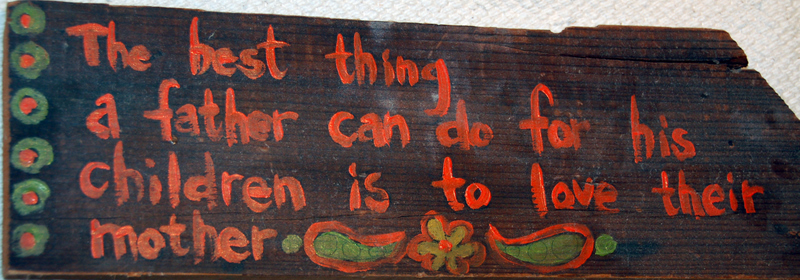
Appreciate your spouse.  Husband, wife, life partner, whatever. “The best thing a father can do for his children is to love their mother.” My grandpa made this sign for my dad, who later gave it to my husband.

Never stop learning.    He had a tough childhood in a poor,  immigrant family.  The kind where your Norwegian mama makes you take castor oil but you have to line your holey shoes with cardboard.  He had to drop out of school to work and never made it past about sixth grade.   But he valued education above all else, and sent his daughters to the best schools he could.  He was so proud of my mother, the first in her family to get a PhD.  As an adult, he chose to learn through experience.  Between the ages of 65 and 99 – and particularly after age 80 – he traveled the world.  (If you have a bucket list – Grandpa Olaf says to prioritize the Galapagos Islands.)

Make the effort to connect with people.  My grandpa was a pretty social guy, one who believed strongly in getting out there and talking with people. He also liked to help and volunteered his skills with a number of nonprofits, fixing things for seniors and building community theater sets.   He lived for the last decade or so of his life at the Holladay Park Plaza in Portland, Oregon; people there called him “The Mayor”.

Fight for what’s right.  A union member for nearly 70 years, my grandpa used to tell me stories about having to wear flannel pjs under his wafer-thin airplane mechanic uniform in the Minnesota sub-zero winter cold.  He was part of the fight for every benefit and workplace protection, from insulated uniforms and hearing protection to paid vacation to safety regulations.  He was really, really proud of that.

My daughter chatting with my Grandpa Olaf

Spend time with children.  I fondly remember my grandfather  reading the Brer Rabbit stories to me and my brother, but he also spun us wild yarns about a character of his own invention –  Redpants Cookie.  From what I remember of this young, maroon-chaps-wearing cowboy, he always returned safely home from his adventures to find a glass of milk and a plate of cookies.  (If I ever write a children’s book, this is it, so don’t go stealing my Redpants Cookie!)  What I didn’t realize until his memorial service was that, in addition to me, my brother, and our cousins, he had been Grandpa to his second wife’s grandchildren as well.

Talk about things, don’t bottle them up inside.  My grandfather was an airplane mechanic in the Pacific during World War II.  He saw a lot of stuff, but what really troubled him was taking the returning POWs  off the planes.  Like most of his generation, he didn’t talk about it for years.  In his 90s, however, he would recount in vivid detail the helpless and  emaciated bodies of these human rights victims. “I should have talked about this years ago,” he told me. ” I shouldn’t have kept it inside for so long.”

Don’t postpone joy.  After my grandmother died, he went on an Elderhostel trip to Russia; my step-grandmother was on the same trip.  When they returned, they decided to get married.  They had only known each other for about a month, but at their age (he was 80, she was 70) – they figured, why wait?  They were married for 21 years.

"Father of Waters" statue, complete with the toe to rub for good luck and the stairs my grandpa used to run up when delivering papers

Seek your luck.   As a boy in the late 1910s, he delivered papers in City Hall in Minneapolis.  His job required that he run, carrying a heavy bag of newspapers, up many flights of stairs to the offices.  There is a large marble sculpture, called “Father of Waters” after the nearby Mississippi River. According to legend, rubbing his big toe brings good luck.  My Grandpa Olaf paused every day on his paper route to rub the big toe of the “Father of Waters”.  Later in life, we visited the statue together.  This week, on the 104th anniversary of his birth, I went by myself to City Hall and I rubbed that marble toe.  I thought of my grandpa and all that he taught and me.  And all he continues to teach me.

Celebrating Grandpa Olaf's 100th birthday!

In Small Places, Close to Home

This is my first original post on World Moms Blog

Eleanor Roosevelt once said,

“Where, after all, do universal human rights begin? In small places, close to home – so close and so small that they cannot be seen on any maps of the world.”

She knew what she was talking about.  Eleanor Roosevelt was the chair of the UN Human Rights Commission and even wrote part of the text of the Universal Declaration of Human Rights (adopted by the UN General Assembly on December 10, 1948).  Eleanor Roosevelt was also the mother of six children.

Mothers have an important role to play in making the world a better place for all children.   This is not to minimize the roles of fathers or grandparents or guardians or anyone charged with the responsibility of raising children. But I do believe wholeheartedly that mothers have a special role.  It is our job to change the world, one kid at a time.

Often mothers are the most vocal advocates for the rights of their children.  This is true whether you are a mom trying to get your special needs child the services she deserves or trying to get your child out of arbitrary detention in Iran (like Shane Bauer’s mom).  There are many examples of mom/human rights advocates-  Mothers of the Disappeared in Argentina, Mothers of Soldiers in Russia .

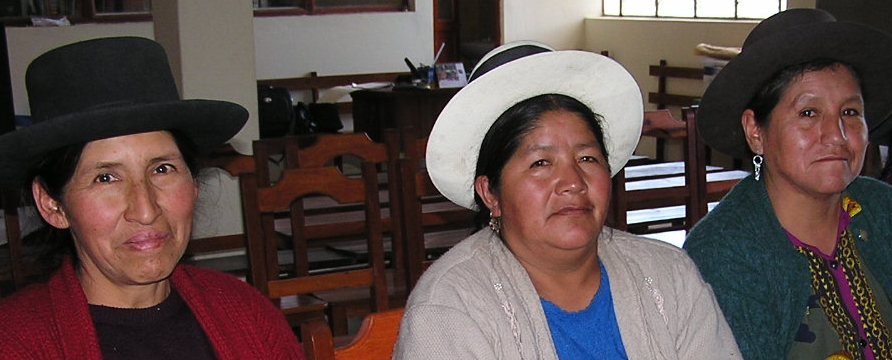
I personally have had the chance to meet and interview mothers involved with the organization ANFASEP in Ayacucho, Peru.  These are mothers whose sons were disappeared during the long, violent conflict in Peru.   For nearly 30 years, these women have been trying to find out what happened to their family members and where their remains are.  One of the women we talked to had four family members who were disappeared.  She wants to know where they are and who killed them.  “We’re looking for justice,” she said, “and we want to know the truth.”  As Mama Angelica Mendoza, President of ANFASEP, told us, “We’ll never forget about all the killings.  We’ll fight to the end.”

Mothers of the disappeared (ANFASEP) in Peru.As Eleanor Roosevelt implied more than 50 years ago, the most important place for human rights to begin is at home.

Human rights are the standards that allow all people – each and every one of the 7 billion of us on this planet- to live with dignity, freedom, equality, justice and peace.

Aren’t these the principles that govern the way we want our children to be treated?  And, in a nutshell, aren’t these also the core values that every parent wants to instill in their children?

The secret to a better world is not only protecting our children from human rights abuses inflicted on them by others, but also by making them better citizens of the world.  Caring about others, judging right from wrong, standing up against bullying or racist comments or sexist jokes. These are the human rights that are essential to the full development of each child as an individual, as well as to the community in which they live. This is the human rights work that changes the world.

Here are my three reasons to work for human rights.  I’d love to see and hear about yours!

My Suffragist Grandmother

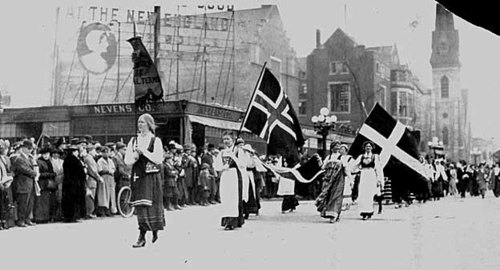
Suffrage procession in Minneapolis on May 2, 1914
From the collections of the Minnesota Historical Society
Source: thomaslowrysghost.tumblr.com


Election Day is coming up Tuesday and you can be damn sure that I am going to cast my vote.  

I’m doing it for my Grandma Lillian and all the inspirational people that I’ve met over the years who have risked everything to secure their right to participate in government.

My Grandma Lillian was raised by her grandmother, Thorina Melquist.  Thorina was an immigrant from Norway whose oldest daughter (my great-grandmother) died of typhoid fever just weeks after she gave birth to my grandmother. Thorina’s youngest child was only nine months older than my grandmother.  She weaned him in order to nurse my newborn grandmother, who had also contracted typhoid but somehow – miraculously – survived. (And, yes, “Thorina” is the female version of the name of the Norse god of thunder.)

In addition to farmwork and child-rearing, Thorina was a dedicated suffragist.  She believed strongly in equal voting rights for women and she often participated in demonstrations advocating for the right to vote for women. Women received full suffrage rights in Norway in 1913, so Norwegian immigrant women (along with their Finnish, Swedish and Danish counterparts) played a notable role in the suffrage movement at the local level in Minnesota and other states with large Scandinavian immigrant populations.  The photo at left shows women from several Scandinavian countries in traditional dress marching against inequality and for universal women’s suffrage on Hennepin Avenue in downtown Minneapolis.
My Grandma Lillian grew up as a suffragist.  She was still pretty young in 1919 when the Nineteenth Amendment was passed by Congress and ratified by Minnesota.  Women’s suffrage became national law on August 18, 1920 when Tennessee became the 36th state to ratify the Constitutional amendment.In some ways, it is surprising to think that less than 100 years ago, women in America could not vote.  I was a toddler in Louisiana when that state ratified the 19th Amendment in 1970 – 50 years after initially rejecting it.   And Mississippi didn’t ratify the 19th Amendment until 1984!

Now the right to participate in government is one that we Americans take for granted – so much so that less than half of the population votes unless it is a Presidential election year.  In 2008, the voter turnout was 63%, a high water mark that is low in comparison with most countries.  In U.S. local elections, the voter turnout is even lower.  Many of the mayors of major U.S. cities are elected with single-digit turnout. That’s just shameful.

I love to vote.  In fact, I vote every chance that I can – legally at least. I always try to bring my kids with me when I vote, so they can see that having a voice in the democratic process is something both important and valuable.

But when I’m standing in the voting booth, I feel like there are others there in the voting booth with me.  They are some of the inspirational people that I’ve met over the years who have risked everything to secure their right to participate in government.

Standing with me is the young Haitian asylum seeker who was beaten by police at a polling place in order to discourage him from voting for Jean-Bertrand Aristide in 1990.  He held his own, though, and stood there bleeding and bandaged for several hours before he finally had the opportunity to put his check next to Aristide’s rooster symbol on the ballot.  It was the first time he had ever voted – and it was a remarkable act of courage and endurance.  In telling me about it, he summed it up by saying,

“I voted!  It was a very good day.”

In the voting booth with me are also many of the amputees in Sierra Leone in 2004.  It was common practice during the conflict there for members of the Revolutionary United Front (RUF) to hack off the hands or arms of people with machetes.  Some of them had been targeted during elections so that they couldn’t vote by leaving their fingerprint mark on the paper ballot.  I also heard that the RUF brutally amputated hands during one election because the government’s slogan was that,”The power is in the hands of the people.”

I visited Sierra Leone in 2004, after the conflict had ended and just prior to the first post-conflict elections.  As I traveled through the countryside, I saw people coming together for meetings to discuss the upcoming elections.  In spite of the horrors that they had endured, they were coming together in villages big and small, to exercise their right to participate in their government.  Here is a photo I took of a gathering in a village far out in the bush in the Kono district, an area that endured particularly brutal human rights abuses.  Yet now, as the country was slowly emerging from the conflict, the villagers were coming together to discuss the upcoming local election process.

My Suffragette Grandmother

Although my grandmother gained the right to vote, she was never able to go to college.   She was certainly smart enough, but her family couldn’t see the point in wasting good money on educating a girl.  Grandma Lillian never expressed bitterness about this to me. But one afternoon when I was in high school, I stopped by to say hello and to get her thoughts on my top college picks.  I remember sitting in my grandparents’ darkened living room.  A mantel clock ticked and the air conditioner hummed.  It now seems impossibly calm and quiet, so different from my current raucous and messy living room. My Grandma Lillian told me that the most important thing was to follow my dreams.

 “You can do whatever you want to with your life. Be what you want to be.  
But never forget those of us who weren’t able to follow our dreams.                
Follow your dreams for us.”


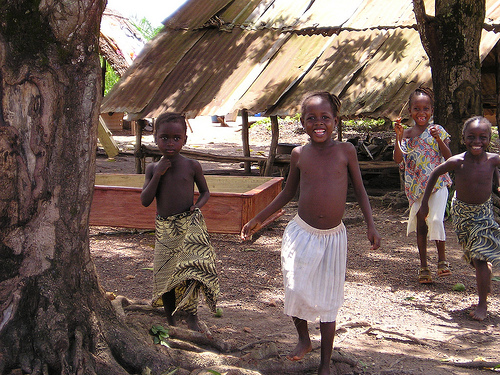
Upcountry girls in Sierra Leone.  Photo by my colleague Rosalyn Park.
Upcountry girls in Sierra Leone. Photo by my colleague Rosalyn Park.

So that’s why I never miss the chance to vote.  I’m doing it for my Grandma Lillian.  And for everyone else who can’t follow their dreams.

Every election day is an opportunity.  An opportunity to have a say in the decisions, big and small, that impact the lives of you and everyone around you.  Don’t make excuses, don’t be discouraged.  This is a right that is too valuable to waste.  On Tuesday, please get out there and VOTE!  If you need help finding your polling place, go here:


The photo at the top is of the Scandinavian Women’s Suffrage Association marching in a parade in Minneapolis in 1914.

I keep it in my office in honor of my Grandma Lillian.

The Definition of Family

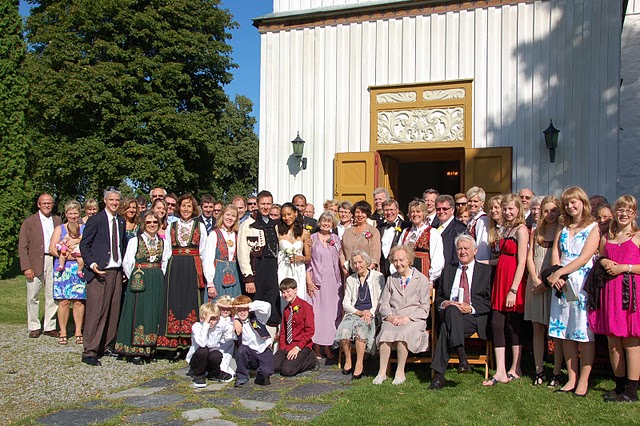
Extended family from 3 continents at my brother’s wedding
(Nes kirke, Norway, August 2010)

I’ve been thinking a lot about family recently.  We had just dropped off my old friend Erik and his “unwieldy crew” at the airport, when my daughter Eliza sighed, “It’s pretty much BORING without our cousins.”  Knowing there was no actual blood relation, I cross-examined her on why she thought they were our cousins.  (It must sometimes stink to have a lawyer for a mom.) Finally she said in frustration, “Because, I just FEEL like they are.”

How do you define family?  Is it common ancestry? Shared experiences?  Mutual commitment? Living in the same household? Common values?  The people you know you can count on for support?  The people you know you can get into a knock-down-drag-out fight with but they’ll still love you?  People who you feel deeply connected to even though you rarely see them?  All of the above?  Or none of them at all?

When I was at the Buduburam Refugee Settlement in Ghana, I met a woman who runs a cook shop there.  Called Ma Fatu, her feisty personality would have been equally at home as the proprietor of a saloon in the Wild West or of an inn in medieval England.  She took a lot of pride in her cooking and in knowing her customers.  She’d eye me critically as I tucked into my jollof rice and say, “I know what you white people like to eat.” Then, the next day, she would serve me up a heaping serving of jollof vermicelli.  

I had noticed that there were several young people helping in the cook shop, washing dishes, waiting tables, whatever needed to be done.  It was only on my second trip to Buduburam that someone told me that they were not actually her children.  During the war in Liberia, her husband and children – her entire family – had been killed.  Over the years at Budububuram, she had taken in several young people who had also lost everyone.   In the face of all this loss, Ma Fatu had created a new family.  In a refugee camp – miles from home and without even the  possibility of legal recognition – she had forged familial bonds of love and support.

Like every parent, I’ve got a stockpile of my kids’ drawings of our family – stick figures showing Mom and Dad, Brother and Sister.  Sometimes Grandma and Grandpa and/or Cat and Hamster.   When you are young, the definition of family is very narrow and also very immediate.  But as you get older, you develop deeper relationships with people who are not related by blood.  In many ways, you create your own family of the people who give you what you need to flourish.

I’ve had this discussion about the definition of family with a number of asylum clients.  Under U.S. immigration law, your family is defined as your spouse (only one – your first spouse), your children by birth or legal adoption, and your parents.  Of course, many people in the world use a broader definition, with half-siblings, cousins, and children adopted without legal recognition counting as immediate family members.  I once had a client say to me, “I feel so sorry for you Americans.  Your families are so very small!” 

Article 16(3) of the Universal Declaration of Human Rights states that, “The family is the natural and fundamental unit of society and is entitled to protection by society and the State.” Back when the UDHR was written in 1948, it is doubtful that the drafters envisioned even biracial marriage, much less the multiple forms of family that exist today.

Now, I am a strong supporter of same-sex marriage.  I also believe that the equal rights of LGBT persons to marry, file joint taxes, visit partners in hospital, raise children, etc.  will be guaranteed by law sooner rather than later.  But the bigger point I’d like to make is that, no matter how you define “marriage”, the push for the change in law happened because of thousands – maybe millions – of personal decisions by individuals to define themselves as “family”.  The reality is that there is a very human need to live in a family social structure – the natural and fundamental group unit of society.  The law can better accommodate that reality but regardless of what the law says, people –like Ma Fatu – will create their own families. 

Maybe my six-year-old Eliza is right – the true definition of family is a very personal one, self-defined by each of us.  The definition of family maybe IS really the people who you feel like are your family.  And if that is so, wouldn’t we all be better off if society and the State protected our families? 

So I think the real questions are: How do you define your family?  What does your family mean to you?  And what could our society and State do better to support YOUR family?

Forgiveness

I am just about the last person who should be lecturing on the subject of forgiveness.  I’ve always tended to savor the little niggling injustices in my life, holding onto them and working them over the way you worry a sore spot in your mouth with your tongue.

I’ve noticed that my children are constantly denying responsibility for wrongdoings.  Or, to state it more accurately, they are always claiming innocence and then laying the blame on someone else.  All three of them will pipe up with “I didn’t do it! It was (fill in the blank)!” in response to questions about who left the door open, who spilled the milk, who left gum on the floor, who threw that bread at me (just to give some examples from the last 20 minutes).

That says something to me about human nature. Our first instinct is to shift the blame, deny responsibility.  Admitting you are wrong is one of the most difficult things you can do.  It’s so much easier to deny or make excuses or pretend like you didn’t know what was going on.  And while it takes a lot to acknowledge blame, it takes even more to ask for forgiveness.

What does it take to really, truly grant forgiveness to someone who did something that hurt you?  My son came home from Sunday School with one of those sheets where you have to decode the hidden message, which turned out to be Colossians 3:13  “If someone does wrong to you, then forgive him.  Forgive each other because the Lord forgave you.”  “So you should forgive your brother for eating your candy, right?” I said.  “It’s not that easy,”  he replied.


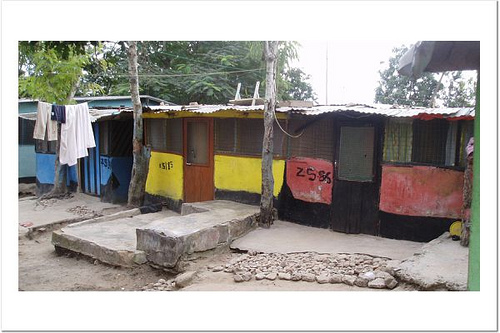
Houses at the Buduburam Refugee Settlement

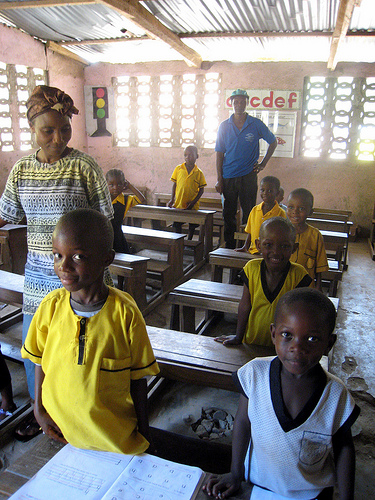
No, forgiveness is NOT that easy.  But when we were working with the Truth and Reconciliation Commission of Liberia back in 2007 and 2008, I interviewed a surprising number of people who said that they had forgiven the people who had hurt them and killed their loved ones.   We made two trips to Buduburam Refugee Settlement in Ghana to take statements.  At the time, there 38,000 refugees living there, some of whom had been there for almost twenty years.  The conditions on the camp were very difficult. It was hot and crowded, with inadequate sanitation and electricity.  All the water for drinking and washing had to be purchased; most people didn’t have enough money to do both and a lot of people only ate one meal a day.  There weren’t a lot of job opportunities in Ghana, so most of the refugees relied on remittances from relatives in the U.S. or Europe.  Educational opportunities were also limited.

Also, as in many refugee situations, there were ex-combatants and perpetrators living there along with the victims of human rights abuses.  Many of the people we talked to had encountered the perpetrator their on the camp.  One woman I interviewed told me that she saw the men who had raped her every single day.  In spite of the harsh conditions of daily life at Buduburam, however, I saw firsthand not only the possibility of forgiveness, but the necessity of forgiveness.

A kindergarten class at Buduburam

The TRC asked us to gather information about how statement givers felt about reconciliation so, unlike most of my work in documenting human rights abuses, I was asking questions about forgiveness in addition to questions about what happened.  Not everyone was ready to forgive and only a handful were willing to meet with the perpetrators, but many said that they had in their hearts already forgiven the perpetrators.  As one woman told me, “I had to forgive him, once I realized that if I didn’t, I would never move on with my life.”

Forgiveness does not in any way minimize the gravity of the wrong that was done.  It does not mean forgetting what happened or ignoring the need for justice.  Archbishop Desmond Tutu said, “Forgiving means abandoning your right to pay back the perpetrator in his own coin, but it is a loss that liberates the victim.”  Forgiveness, at its core, is a choice to take action.  It is something that you do for yourself, because you cannot be happy and healthy if you hold on to the anger and bitterness.  It’s kind of like eating your vegetables – sometimes you have to force yourself to do it, but you know that you are better off in the long run if you do.  Forgiveness doesn’t happen overnight. It is a process, but it is a process of change that takes you out of the role of victim and puts you in control.

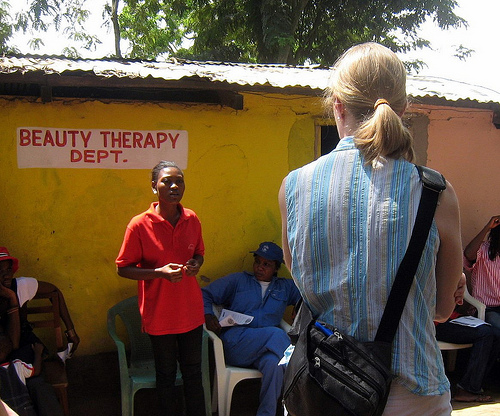
Listening to refugees tell their stories at
a skills training school at Buduburam

Recently, a woman told me this story about forgiveness.  During the war in Liberia, she witnessed the killing of her – by a neighbor who they had known for many years. She had so much anger for him for long, long time. Years later, after much praying, she decided that she needed to try to forgive him.  Eventually, again with much praying, she began to feel as if she really had truly forgiven him.

Last year she returned to Liberia for the first time.  She wasn’t sure how she would feel if she actually saw the man, but when she did, she went right up to him.  This is how I recall her describing what happened next:

“I gave him a big smile and I said, ‘Mr. ___, do you remember me?’  I want you to know that I saw what you did to my father.  But I forgive you for it. I forgive you and I’m praying for you.’  He didn’t know what to do, he couldn’t look me in the eye!  After that, if he saw me coming, he would avoid me.  Imagine that! An old man running away from me.  But now I’m out of it.  It is between him and God now.”

Making Something Out of Nothing

If you knew me in my twenties, you probably remember me as a KOW (Knitting Obsessed Woman).  I didn’t learn how to knit until I was 19, but after that I was rarely without a pair of knitting needles in my hands.  My PR is knitting a pair of mittens in 5 hours the night before Valentine’s Day as a gift for my future (and current) husband. Because I learned to knit as an adult, I distinctly remember how difficult it is.  You feel awkward as you struggle to make the needles do what you need them to do. It’s difficult to make sense of the stitches and frustrating to decipher the patterns, which seem to be written in secret code.  If you make a mistake, you have to rip out your work and start over.  But what I absolutely love about knitting is the satisfaction that comes from taking what is basically a couple of sticks and a ball of string and, through sheer effort and determination, turning a bunch of knots into something that is beautiful and useful. You are making something out of nothing.

I haven’t done much knitting in the past decade.  There are several half-finished projects at the back of my closet,  hidden behind my boots so I can’t see them and feel guilty about them.   But last weekend my friend Amy showed me some mittens that she is making for her son.  They are My Neighbor Totoro mittens and they seriously could not be cuter.  I saw them and my fingers started itching – literally – to knit them.   You can find the pattern for Totoro Mittens on Ravelry.com or by clicking on this pdf. (Special thanks to brella for allowing me use both the image and the pattern in this blog!)


For the first seven years of my career, I represented people who were fleeing persecution and seeking asylum in the U.S.  Though I may not have seen them for years, I often think about my former clients.  On the day that Amy showed me the My Neighbor Totoro mittens, I happened to think of James and Julia (not their real names). James and Julia were politically active in their native Kenya, speaking out against an oppressive government.  They had a little boy who I’ll call William.  When the police came to their house to arrest Julia, a police dog had bitten William on the head.  You could still see the wound a year later when, having left everything they owned behind to escape Kenya, they were seeking legal assistance with their asylum claim in the U.S.  

In police custody, Julia had been brutally and repeatedly raped.  Only a few times have I seen an asylum officer (specially trained federal officials who make decisions about asylum cases based on a written application and an in-person interview) actually cry during an an asylum interview.  Julia testified about her experiences in a straightforward manner and in excruciating detail, but with such poise and dignity that both the asylum officer and I were in tears.  I remember well how James sat next to her, utterly still. Anguish is the only word that could possibly describe the look on his face as he listened to her testimony.


Years later, after they got their citizenship, James and Julia had a party to say thank you to all of the people who had helped them.  In addition to their attorneys, there were people from their church and other members of the Kenyan community. They now lived in a big, new house out in the suburbs. Julia was close to graduation from nursing school  William, who I hadn’t seen since he was three, was now in middle school.  He was a straight-A student and talented musician who had just gotten braces.  They had had another child, too – a daughter born here in America.

It had taken a lot of hard work for James and Julia to get to where they were.  I’m sure that they were frustrated at times with life in this strange, new country.  But they persisted and, through sheer effort and determination, made a new life for themselves and their family.  In some ways, they had even followed a pattern – the American Dream.  It wasn’t easy, but James and Julia had done it.  They had made something out of nothing.