NEPAL: Visiting the Sankhu-Palubari Community School

Some students walk – up to 2 hours each way – to the Sankhu-Palubari Community School to access their right to education.

I’ve been in Nepal for the past ten days with a team of staff and volunteers.  We are here to visit the Sankhu-Palubari Community School (SPCS) in the rural Kathmandu Valley.  The Advocates for Human Rights, the organization I work for, has supported the school since it was founded in 1999 to prevent child labor, encourage gender parity in education, and improve the lives and well-being of the most disadvantaged children in the area.  The school in Palubari village is only about 40 km outside of Kathmandu, but the peaceful, green valley in which it is nestled feels worlds away. The drive out is nerve-wracking (in the terrible Kathmandu traffic), then bone-jarring (on the bumpy, rutted roads). But the sight of these bright, alert children makes it all worthwhile.

In the United States, where education is both compulsory and free, we often forget that the right to education is not meaningfully available in many parts of the world – especially for girls.  The UN estimates that there were more than 67 million primary school-age and 73 million lower secondary school-age children out of school worldwide in 2009.  In addition, an estimated 793 million adults lack basic literacy skills. The majority of them are women.

Most of the students’ families work in agriculture.  They are farmers with little or no money to spare on school fees, uniforms and supplies.   Frequently, the adults in the family are illiterate. Many of them are from marginalized groups such as the Tamang. An indigenous group with their own culture and language, the Tamang students must learn Nepali as well as English when they come to school.  A pre-K program was added in 2011 to provide pre-literacy eduction to better prepare the students for school.

This week, The Advocates’ team has been conducting a site visit which includes interviewing students in grades 5 through 10 about their experiences at the school and their plans for the future.  It has been a treat to interview these kids and learn more about their lives, their hopes, their dreams for the future.

We’ve been inspired to hear from so many of the girls about their commitment to getting a good education. Since the school’s founding in 1999, the teachers have conducted outreach to parents and worked hard to encourage female students to attend and stay in school in spite of societal pressure to get married, work in the fields or enter domestic work.
Their efforts have definitely paid off.  While girls worldwide generally are less likely to access, remain in, or achieve in school, 52% of the students in K-8th grades at the school this year are girls. And a girl is at the top of the class in every single grade at SPCS.
Students had so much to tell us about their hopes and dreams for the future.  Some wanted to be doctors and nurses. Some wanted to be teachers. Some even wanted to be professional football (soccer) players! (Football is very popular here in Nepal, especially among boys. The Nepali national football championship is coincidentally going on right now in Kathmandu.  The national police team has won for the past three years.)  This student demonstrated for me his prowess at left forward.
The Sankhu-Palubari Community School may be a small school in a remote valley, but it is a place where the human right to education is alive and well, providing a better future for these children.  The impact that they have on their community, their country and – hopefully, the world – will be thrilling to watch.
Pre-K students enjoying their noodles at lunch.
7th graders in one of my English conversation practice small groups.
THIS POST WAS ORIGINALLY PUBLISHED IN THEADVOCATESPOST.
PHOTO CREDITS:  Robin Phillips, Jennifer Prestholdt and Laura Sandall
Jennifer Prestholdt is the Deputy Director of The Advocates for Human Rights

The Other Greek Crisis: Xenophobia and Mass Detention

Landing at Elefthérios Venizélos in Athens, you can’t miss the sprawling blue and gold IKEA near the airport.  While tourists arriving  in Greece may recognize the siren call of cheap and trendy furniture, they are not likely to notice that there are also detention centers in Athens.  The brand-new Amygdaleza migrant detention center was opened in April in western Athens, shortly before the election. There are plans to build many more detention camps – and quickly.  Greek police reported this week that they have arrested thousands and temporarily detained more than 17,000 migrants, mostly from Asia and Africa, since August 4, 2012.

I traveled to Greece for the first time in May.  I was there briefly and only as a tourist. I stayed in tourist areas, encountering very few Greeks who didn’t work in the tourism industry. Perhaps this is an occupational hazard, but I can’t help but look for human rights violations – even when I’m on vacation.   So I listened carefully when my brother, who had been living in Greece for some months, mentioned that recently the government had started arresting, detaining and deporting migrants.  In fact, the first 56 migrants arrived at the new Amygdaleza migrant detention center on April 29 – only a week before the national election. Undocumented migration had become a major issue in the May 6 election, with several parties pledging to crack down on migrants. Based largely on this issue, the far-right Golden Dawn party gained seats in Parliament for the first time.

While Greece may be idyllic for the foreigners who are tourists, many migrants and asylum seekers have a very different experience.

Since the early 2000s, Greece has been a major entry point to the west and Europe for migrants and asylum seekers from Asia and Africa.  Many of them cross the border with Turkey, which up until August was fairly porous.  By some estimates, a million immigrants live in Greece, which has a population of barely 11 million.  Add to this demographic change the deepening economic crisis and rising social tension and you get a volatile situation in which undocumented migrants and asylum seekers have become the targets of xenophobia.  According to a July 2012 report from Human Rights Watch, “Xenophobic violence has reached alarming proportions in Greece, particularly in the capital city of Athens.”

None of this was apparent to me when I was a tourist in Athens in May.  Even the economic crisis in Greece was surprisingly – shockingly, in fact – invisible.  I tried asking a couple of people about it.  People seemed annoyed with the politicians, but unconcerned that Greece would leave the Euro zone.   The waitress at the take-out place where I got my Greek salad just rolled her eyes when I asked about it.  “Try a FIX Hellas,” she said, proffering a pale Greek beer in a clear plastic cup.  “You can walk around with it.”  So I walked around Plaka like I was on Bourbon Street, thinking about the ironic name of my beverage. Lots of people were shopping.  The Barbie store was doing a particularly brisk business.

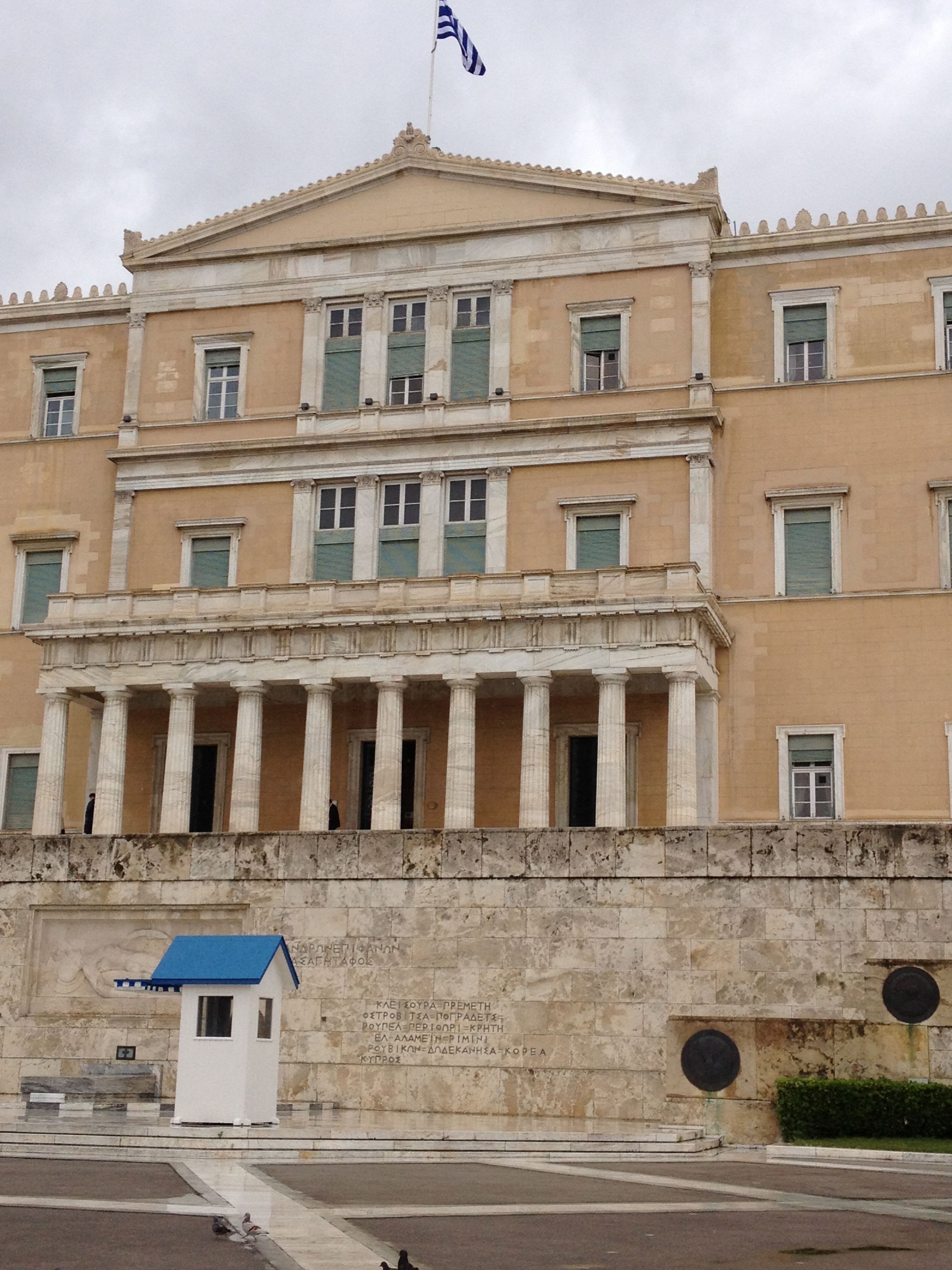
Later, I walked over to the Parliament.  Even though it was the middle of a workday, it was as still as a tomb.  I started to understand the Greek frustration with politicians.

I followed the news on the “other Greek crisis” after my return.  In early August, there was a mass crackdown on “irregular migrants”.  Greek authorities deployed 4,500 police around Athens to arrest and detain more than 7,000 migrants in less than 72 hours.    In another example of ironic naming, the Greek authorities called the operation Zeus Xenios after the Greek god of  hospitality and guests.  The Greek office of the United Nations High Commissioner for Human Rights expressed concern that legitimate refugees and genuine asylum seekers could be among those who are summarily deported, but the round-ups have continued.  On September 5, Greek police reported that 17,000 migrants have been temporarily detained in these round-ups, with 2,144 of them arrested. One of the concerns is that the ongoing sweeps target suspected migrants based on little more than their physical appearance; the proportion of temporarily detained to arrest numbers seem to bear that out.  In addition to the problem of arbitrarily detaining migrants, visits to some of the migrant detention centers have documented inhuman and degrading conditions. 

Of course Greece has the right to control migration, to set and enforce their country’s immigration laws.  But Greek authorities must comply with their international and European human rights obligations.  Above all, they should not arrest, detain, and deport foreigners based on appearance or ethnicity – in contrast to the the welcome received by an American tourist like me.  The left-wing main opposition Syriza party has been critical of the crackdown and claims that the migration issue is being used to divert attention from the more difficult and unpopular issues of the economic crisis and the spending cuts that the EU and IMF require in exchange for assistance out of the economic quagmire.  From my limited observation of the situation in Greece, I have to agree.

PHOTO ESSAY: Cartooning for Peace

Cartoon by Kianoush

In May, I was in Geneva to participate in the United Nations’ Universal Periodic Review of Morocco and India.  I went for a run one day along Quai Wilson on Lake Geneva and discovered an exhibition of political cartoons. The exhibition was sponsored by Cartooning for Peace/Dessins pour la paix, an initiative conceived of by French political cartoonist Plantu and launched at the United Nations in 2006.  The goal of Cartooning for Peace is to promote better understanding and mutual respect between people of different faiths and cultures.  Cartooning for Peace also works to promote freedom of expression and to protect the rights of cartoonists.

Cartooning for Peace and the City of Geneva created the new International Prize for Editorial Cartoons to honor cartoonists for their talent, outstanding contribution and commitment to the values of tolerance, freedom and peace. On May 3, 2012  – the World Day of Press Freedom – the prize was awarded for the first time to four Iranian political cartoonists.

Cartoon by Mana Neyestani

The exhibition Dessins Pour La Paix  2012 displayed the work of the award-winning Iranian artists Mana Neyestani, Kianoush,  Firoozeh Mozaffari and Hassan Karimzade.

In addition, the exhibition included dozens of political cartoons by cartoonists around the world on the themes of freedom of expression, the Arab spring and the rights of women.

The exhibition in Geneva ran from May 3 to June 3, 2012.  The full catalogue of the cartons featured in the exhibit is now available online.

Take a stroll with me along Quai Wilson and witness the power of the cartooning for peace!

ARAB SPRING 

FREEDOM OF EXPRESSION

ET LES FEMMES? (AND THE WOMEN?)

Photo credits to Amy Bergquist

Originally posted on 8/7/12 on

The Advocates for Human Rights’  blog

The Advocates Post.

India’s Politics Without Principles

Raj Ghat,  Mahatma Ghandi Memorial

New Delhi, India

Note:  This essay was originally published on The Advocates Post.

Last year, on my first trip to India, I visited Raj Ghat in New Delhi.   Raj Ghat (or Rajghat) is the Mahatma Gandhi Memorial and, as Gandhi has long been one of my human rights heroes, I was glad to have this opportunity to pay my respects to the man whose lessons of non-violence and human rights have had such an impact on our world.  Gandhi is known of the “Father of the Nation” because of his pivotal role in India’s independence movement.  But how far has Gandhi’s beloved India come in fulfilling his vision for humanity?  From Raj Ghat, I went to directly a meeting with Indian human rights activists. They told us that, while important reforms have been made recently to protect the human rights of its 1.21 billion citizens, India still has a long way to go to adequately protect the rights of its religious minorities.

Gandhi was cremated at Raj Ghat on the Yamuna River on January 31, 1948, the day after he was assassinated. Raj Ghat is  a solemn space, a large, walled enclosure purposefully left open to the air and the white-hot sun of central India. It is set within an even larger park, with flagstone paths and shade trees – grandeur and greenery that surprised me in a city as crowded as Delhi.  Yet Raj Ghat itself is true to the simple life that Gandhi himself chose.  As you walk around the upper level, on a path bordered by flowers and creeping vines, you can see the square platform in the center that marks the site of Gandhi’s cremation. The black marble is so smooth that it reflects and extends the eternal flame that burns at one end of the monument, like a torch lighting the way forward in the dark of night.  The red soil of his dear homeland surrounds the marble samadhi, as in life Gandhi rejected the green lawns of the English colonialists, choosing instead to leave the grounds of his residences in their natural state.

To enter Raj Ghat, you must remove your shoes.  This is a sign of respect, one that I honor, but I admit to never having pictured myself meeting my idol in sock feet.  It was in sock feet, however, that, in the cool shade of the thick stone walls, I walked the perimeter of the memorial.  On the walls of the memorial are quotes from Gandhi, inscribed in the many languages of the Indian people as well as other world languages. Raj Ghat is a contemplative place; in concert with this, visitors are encouraged to circle the memorial three times.  My first time around, near the marble platform,  I stopped short.  Before me, inscribed in black on the red sandstone wall, were words of deep truth.  Gandhi was a prolific writer who first published his “Seven Social Sins” in 1926 in Young India, one of several newspapers he edited.
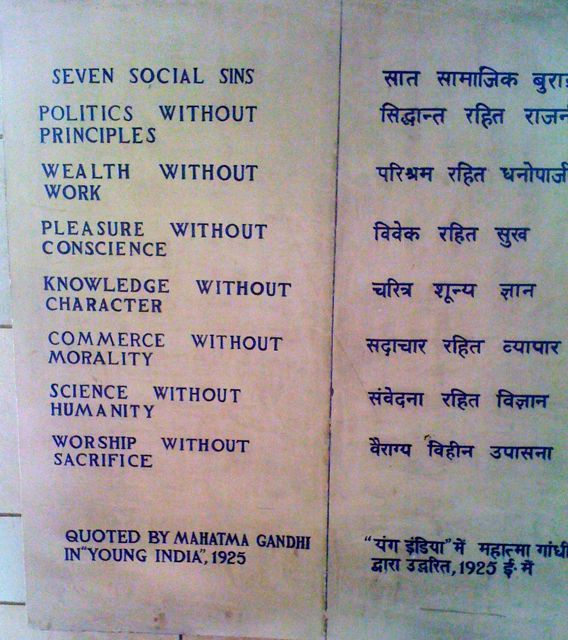
Seven Social Sins

Quoted by Mahatma Gandhi in “Young India”, 1925

Gandhi’s Seven Social Sins – complicated concepts remarkably expressed with a few simple words – remain apt nearly 100 years later.  They are:

POLITICS WITHOUT PRINCIPLES

WEALTH WITHOUT WORK

PLEASURE WITHOUT CONSCIENCE

KNOWLEDGE WITHOUT CHARACTER

COMMERCE WITHOUT MORALITY

SCIENCE WITHOUT HUMANITY

WORSHIP WITHOUT SACRIFICE

Mahatma Gandhi’s words have stayed with me.  Unlike the numerous foreign dignitaries who visit Raj Ghat, I did not receive a khadi scroll imprinted with the Seven Social Sins.  But they are written in my heart as distinctly as they are carved on the sandstone wall of Raj Ghat. Certainly, the words were fresh in my mind later that afternoon at a meeting with Indian human rights activists. Over cups of masala tea, these human rights defenders told us about the alarming rise in discrimination and violence against religious minorities – particularly Muslims and Christians – in various states across India, including Gujarat, Orissa and Karnataka. While discrimination and violence against Muslims has long been a problem in India (including communal attacks targeting Muslims in Gujarat in 2002 that killed nearly 2000 and displaced as many as 140,000), these courageous human rights activists have documented the increasingly systematic discrimination and violence in the name of counter-terrorism since a series of bombings in 2007 and 2008.  One group, Act Now for Harmony and Democracy (ANHAD), published a report in 2011 containing the testimony of scores of Indian Muslims at a People’s Tribunal on the Atrocities Committed Against Muslims in the Name of Fighting Terrorism.  As they described their experiences, as well as the impunity enjoyed by security forces and non-state actors that targeted religious minorities in the name of counter-terrorism, I thought again of Gandhi.   Allowing human rights abuses to be committed against a broad category of in the name of fight against terrorism is indeed practicing “Politics Without Principles”.

Later in 2011, and partly as a result of what we learned at this meeting, The Advocates for Human Rights made a submission to the Human Rights Council for the 2012 Universal Periodic Review (UPR) of India.  Our submission, made jointly with the Indian American Muslim Council in the US and the Jamia Teacher Solidarity Association (along with input from other Indian human rights organizations) in India, addresses India’s failure to comply with its international human rights obligations to protect members of minority groups. Major human rights challenges in India today include extrajudicial executions committed by security personnel as well as non-state actors, arbitrary and unlawful detentions, torture and cruel, inhuman and degrading treatment of terrorism suspects in police custody, and harassment of human rights defenders (including lawyers who defend Muslims accused of terrorist acts), whistleblowers and journalists.

Additionally, our submission highlights the failure of the Indian government to adequately investigate and effectively prosecute perpetrators of these human rights violations against members of minority groups.  The UN Special Rapporteur on freedom of religion or belief reported in 2009 that the Indian government’s failure to adequately investigate and prosecute individuals and government officials involved in human rights violations exacerbates tension between India’s political and religious groups.  Discrimination against religious minorities extends to all facets of life, including access to education, employment and housing.  Religious minorities also face violence and discrimination due to state level “Freedom of Religion Acts”, which fail to clearly define an “improper conversion” – a lack of clarity which gives the authorities the power to accept or reject the legitimacy of a conversion.

Under the UPR, the human rights record of every member of the UN is reviewed once every four and one-half years.  Indiawas one of the first countries to be reviewed in 2008 following the creation of this new human rights mechanism. I was in Geneva on May 24 for the Second Universal Periodic Review of India. The Indian government sent a large, 20 member  delegation, headed by the Attorney General and including representatives from several ministries, and clearly viewed the UPR process as both serious and important.  The Human Rights Council is a human rights mechanisms designed to be an interactive dialogue between governments.  I was gratified to see Human Rights Council delegates from 20 countries address the issues raised in our submission, including the recommendation from the United States to “Ensure that laws are fully and consistently enforced to provide adequate protections for members of religious minorities…”

The Human Rights Council made 169 recommendations toIndia, but the government chose not to adopt them at the June 2012 session. Instead, they government promised to respond “in due time” but no later than September 2012.


India’s large and religiously diverse population makes it one of the most pluralistic societies in the world. The Indian Constitution provides all citizens with the “right to equality before the law,” the right to “the prohibition of discrimination on grounds of religion, race, caste, sex or place of birth”, and the “right to freedom of speech and expression”. Further, it specifies that “no person who is arrested shall be detained in custody without being informed, as soon as may be, of the grounds for such arrest” and that every person arrested be presented to the nearest magistrate within 24 hours of the arrest.

India has made great progress in setting up a domestic legal framework to protect human rights and must be commended for that. India must now end the practice of  “Politics Without Principles” and implement and effectively enforce these laws in a manner that protects the rights of members of its religious minority communities.

Statue of Gandhi at the United Nations

Geneva, Switzerland

Le Respect

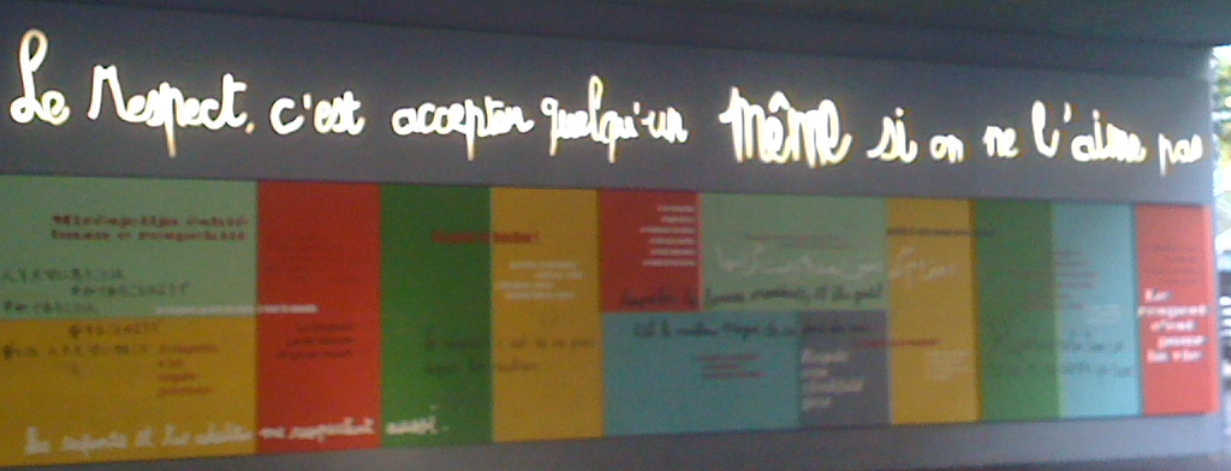
I was in Geneva last week and happened upon this bit of public art on my way to the tram.  “Le respect, c’est accepter quelqu’un même si on ne l’aime pas”. Translated loosely: “Respect is accepting someone even if you don’t like him.”
This was displayed on the wall of a school in the Pâquis neighborhood of Geneva (which you may recall is in the francophone part of la Suisse/Switzerland).  I lived in les Pâquis twice when I was in law school and have stayed there several times since when I have had work to do at the United Nations.

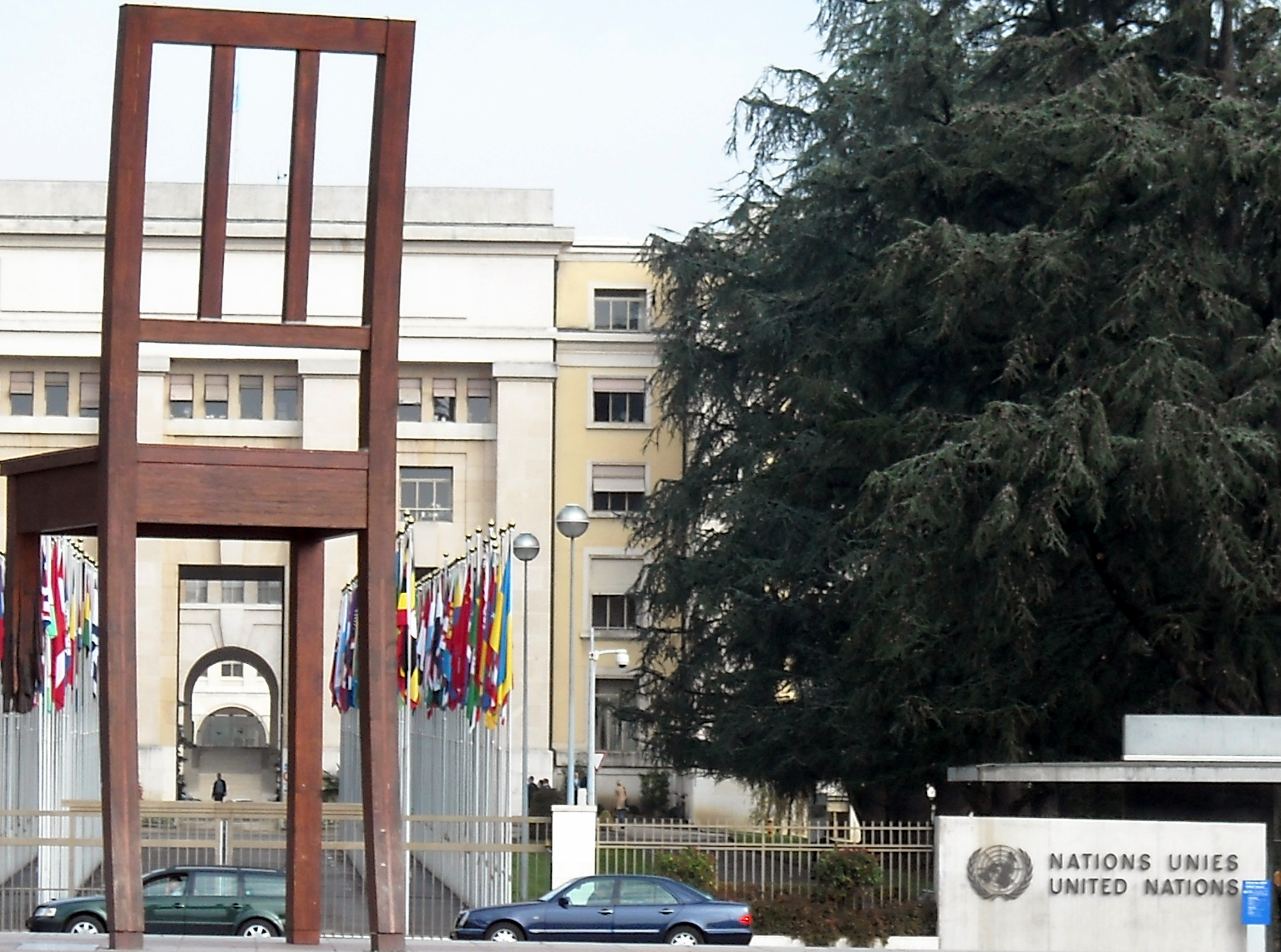
Palais des Nations, the former home of the League of Nations. The three-legged chair sculpture honors the victims of landmines worldwide.

In all my experiences in the neighborhood, however, I had failed to discover:

1) Tea Room la Vouivre (The Wyvern Tea Room) where Cary Grant’s sweet smirk is reflected in gilded mirrors as you enjoy your pain au chocolat and sip your cafe au lait from a Maoist pug dog cup;

2) Buvettes des Bains, the nude-beach-by-summer turns out to be (quelle surprise!) the best-fondue-place-in-the-world-by-winter;

3) the fabulous second hand shops (!!!!), where you can find vintage French dresses, designer Italian shoes, and hand-knit baby hats for 2 Swiss francs (this really deserves a separate post); and

4) the meaning of the word respect.

The school and the artwork is easy to find – it’s on Rue de la Navigation, just past the Melting Pot Ethiopian/Eritrean restaurant (which, in theory, also serves crêpes, although not the night I ate there).   On the other side of the mural, the sidewalk actually passes right through an elementary school playground.  Not a responsible adult in sight during recess, I almost got hit by a dodgeball and, sadly, couldn’t help pondering the stark contrast with the locked doors and color-coded alerts at my own children’s American schools.

There is a second mural as well:  Pour avoir des amis il faut les respecter.”    “To have friends you have to respect them.”   Both of these sayings make sense to me, but that wasn’t the real lightbulb moment for me.

The word respect, as the pictures of these walls illustrate, is both a noun and a verb.  According to the Random House Dictionary, Le respect – the noun – means “esteem for or a sense of the worth or excellence of a person, a personal quality or ability, or something considered as a manifestation of a personal quality or ability.”  Respecter, the verb, means “to hold in esteem or honor” or ““to show regard or consideration for.”   French dictionaries add a slightly different twist: “Le respect est une attitude qui consiste à ne porter atteinte à autrui.”  In other words, an attitude of not harming others.

The lightbulb moment I had on Rue de la Navigation, as I dodged balls on the place de jeux d l’école de Pâquis-Centre, was this:  respect requires both the noun and the verb.  You need the essential, positive, affirming elements of the subject/object (the noun). And you need to take action (the verb), including the action of NOT doing something harmful.

As the sign below says, much smaller and not in neon:

“The respect is a precious gift.”

You Really Can’t Make This Stuff Up – Part II

In our office, we have a mantra: “You have to laugh or else you would cry.”   Maybe working in the field of human rights exposes us to more situations where crazy and ridiculous things happen, but my hunch is – probably not.  All you have to do is read the newspaper (how about that woman who tried to mail a puppy?) or watch an episode of  “The Office” to come to a different conclusion.  The common element here is that we are all humans.  We can all be petty and mean and make a big deal about things that seem to be critically important to us at the time, but which, in the grand scheme of things, don’t really matter. We don’t always think through the consequences of our actions and we’re usually not very self-aware. That means that we cause crazy and ridiculous things to happen in our interactions with each other.  What I’ve learned – and what I’m trying to teach my kids – is that you can’t control what other people do.  But you can control how you handle your reaction to the crazy and ridiculous things that happen to you.  


Let me tell you a story about one of my asylum clients who had to deal with something crazy and ridiculous and totally out of her control.  Asylum seekers are fingerprinted as part of the asylum application process so that the fingerprint can be checked against the millions of fingerprints in the government’s electronic database.   After her asylum interview, my client was instructed to put her index finger on small pad to take an electronic fingerprint.  The asylum officer, looking at the computer monitor, got a strange look on her face.   “Try it again,” she instructed.   My client did so.  “You have to look at this,” she said to me.   

I could see that my client was getting more and more nervous by the second.  She was an older woman from a country in West Africa.   She had a valid asylum claim, but it wasn’t the strongest case in the world.  To be granted asylum in the U.S., you have to show that you have suffered past persecution or have a well-founded fear of persecution on the basis of race, religion, nationality, political opinion, or social group.   That definition comes from the 1950 Refugee Convention, and it reflects the experience of World War II rather than the modern experience of conflict.  The biggest problem I saw when I was doing asylum work was not that people were coming to the U.S. and fraudulently applying for asylum.   The biggest problem was that there were a lot of people who had experienced persecution but couldn’t show why there was a connection to one of the five grounds.  In other words, if you were a victim of random violence in a war in your home country, that isn’t enough to get you asylum in the U.S.  We had worked hard to put together a case for my client that showed that the killing of her family and the burning of her home was connected to her tribe (social group) being targeted by one of the fighting factions.  She had testified honestly and well.  And now, from her perspective, she was going to be denied the safety of staying in the U.S. because of something completely out of her control.  Something was wrong with her fingerprint.  

My client and I went around to the other side of the desk and looked at the computer screen.   There was the digital image of a fingerprint.  Right next to it was a photograph of a young, surly-looking man.  Under the photo was a caption that said,  “Guatemalan Recidivist”.   The asylum officer and I looked at each other, paused, and then just burst out laughing.   My client didn’t laugh, though.  “But that’s not me!” she insisted.   “No, of course not,” said the asylum officer.  “But that’s not me!” my client said again.   “It’s picking up only part of your fingerprint and matching you with the Guatemalan guy,” said the asylum officer.  “Sometimes that happens, especially if you’ve got dry skin.  I’ll get you some lotion and we’ll try again.”  My client looked relieved.  “OK, because if there is one thing I know, it is that I am NOT from Guatemala.”  As I was driving her back to her house, I told my client, “Sometimes you have to laugh about these things or else you would cry.”  Maybe I said it before that day, but that is the first time I remember saying it.  

As a coping strategy, humor has come in handy for me when dealing with the absurdities of parenthood.  It’s probably safe to say that having a sense of humor about the crazy and ridiculous things my children have done has saved my sanity.  I’ll close with a few examples of situations where I had to laugh or else I would cry.  


This photo of my ruined front lawn was selected for the “Sh*t My Kids Ruined” book.  I couldn’t find a photo that was high enough resolution for the publishers, so I’m not sure that it will be included.  


I posted this photo on Facebook a couple weeks ago with the caption “Sometimes I’m not sure how I’m gonna make it through the next 9 winters.”


Finally, here is a video of my family in Olso, shortly after we had to leave the Nobel Peace Prize Center because my children were fighting too much.  It’s going to come in handy if one of them ever wins the Nobel Peace Prize.


You really, really can’t make this stuff up!


You Really Can’t Make This Stuff Up – Part I

Ever notice that human rights lawyers are almost never characters in romantic comedies?  If there does happen to be a human rights lawyer character, he is portrayed as a stuffy old stick-in-the-mud like Mark Darcy in Bridget Jones’ Diary.  (There’s also the guy that Ricky Gervais is supposed to get Tea Leoni to break up with  in Ghost Town, which probably also proves that you really only even have a human rights lawyer as a character because there was a Brit involved.)  But the reality is that I would never be able to do this work if I didn’t have a sense of humor.  The subject matter may be serious, but the fact is that bizarre and funny things happen all the time to us human rights lawyers.  Here are just a couple of examples:
1.  The “Did I Accidentally Stumble Into a Comedy Sketch?” Moment.  During an interview on Sierra Leonean television, the chair I was sitting in started to fall apart.  It didn’t crash to the ground or anything, but all the parts (legs, arms, seat) just started to shift slowly towards the left.  I had to increasingly lean the other way to keep from sliding to the ground.  You try answering questions about women’s rights when you’re sitting on Fun House furniture.
2.  The “Did I Just Hear That?” Moment, a.k.a. the “What Is this, Monty Python?” Moment.  Last year, during an interview with a government official about conditions on a refugee camp, the guy suddenly stops the discussion and just randomly throws out, “So … does anyone here speak … NORWEGIAN?”  After the interview, I also learned that this guy was “the number 3 film idol in Ghana.”  Apparently, being #3 on the Ghanaian film scene doesn’t make you a big enough star to quit your day job.


I’ve learned to look for and relish the humor in every situation.  My penchant for absurdity has brought me a lot of joy. Here are a few photos from various countries in West Africa.

Caution: Grown Ups!

El Sabor del Perú

3.  The “I Can’t Believe I Brought My Breast Pump to a Prison” Moment.  I was once visiting a prison in Peru to observe the conditions of detention.  During the first part of the visit, we had been given refreshment in the form of very, VERY large glasses of Inca Kola.  We’re talking Big Gulp, Trenta sized beverages.


Never had Inca Kola before?  It is a shocking electric yellow color.  Supposedly, it is flavored with lemon verbena but to me it tastes like super-syrupy, bubblegum flavored cream soda. The Inca Kola in my very large glass on this late spring day was also very warm.   But Inka Kola is a national icon and, since it would have been rude and ungracious not to accept it, I managed to do the right thing and drink it all. Which meant, of course, that I soon had to go to the bathroom. Since this was a men’s prison, this created a pretty big problem.   Luckily, there was a private bathroom that I could use at the checkpoint to the high-security part of the prison.  When I came out of the bathroom, the guard was going through my briefcase.
Now, I spent a cumulative total of about 40 months of my life breastfeeding my 3 kids and I had this small, battery-operated breast pump for when I traveled. When I came out of the bathroom, I discovered that the guard had taken the breast pump apart.  He had all the pieces laid out and, one by one, was carefully holding them up to the light to examine them.  He was obviously trying to figure out exactly what kind of  weapon this strange object was. Could it be a bomb?   Let’s just say he had never even heard of breast pump and it took some time to explain.  Once he understood, the guard dropped the piece he was holding like it was a hot potato.  He even started blowing on his fingers.  The security check came to a speedy conclusion and we went on with our visit. By the time we came back out, though, the guard was laughing about it.  Perhaps, like me,  he is still telling that story and laughing about it to this very day.