![]() |
| Simon and me in our bunads |
![]() |
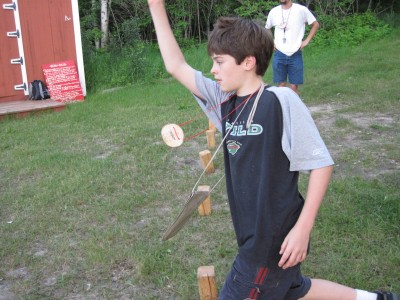
| Sev playing kubb (that’s a navnskilt/nametag) |
"There is some good in this world…and it's worth fighting for." ~ J.R.R. Tolkien
Stories from my life.
![]() |
| Simon and me in our bunads |
![]() |
| Sev playing kubb (that’s a navnskilt/nametag) |

I generally cringe at the term “self-care”. Yet I also know that in my line of work, burnout is a very real occupational hazard. Those of us who work regularly with refugees and other survivors of trauma often experience something called “secondary” or “vicarious” traumatization. Even though we may never have had a traumatic experience ourselves, just listening to so many stories of loss and suffering can lead us to experience some of the effects of Post-Traumatic Stress Disorder. And because secondary traumatization is a slow, cumulative process, it can sometimes be hard to detect until it’s too late and the stress has already burnt you up to a crackley crisp.
To reduce secondary traumatization, we are advised to follow the ABCs: Awareness, Balance and Connection. The thing about it is that these are actually good principles to follow to reduce the stress that we all have in our lives. Remembering the ABCs has been particularly helpful to me in performing my other job – caregiver of three children. Parenting is long term, stressful work; I know from experience that I am better able to to that work if I invest the time in taking care of myself as well. Here’s a brief introduction to the ABCs:
Awareness: This means paying attention to yourself and how you are feeling. It means acknowledging that you are not Superwoman (or whatever) and that it is OK not to be perfect. It means identifying the signs and symptoms of stress in your life. There is a long list of symptoms of PTSD and secondary traumatization, but I will give only a few examples of the ones I have identified in myself.
Balance: This means taking care of yourself by doing activities that provide what YOU need to be at your best mentally, physically and spiritually. Generally, this means finding a balance of activities in your personal and work life that provide you with the opportunity to rest, play and physically or mentally escape from the stress. It’s hard sometimes, with kids around, to find that balance but sometimes you just have to do it. That’s exactly what I did on January 1, 2011.
On New Year’s Day, I had a bunch of overtired, bored and cranky kids hanging on me. So I decided to make pralines. Not necessarily logical, but I felt that it was appropriate to start off the new year doing something that I had never done before. It’s true – I had never made pralines before! Even though I spent the first 18 years of my life in south Louisiana. Even though, for more than 20 years, I have owned a cookbook by the American Sugar Cane League that includes an entire section on praline recipes. I decided that I wanted to make pralines that day, so I opened up that cookbook. There were more than 20 praline recipes made with essentially the same 5 or 6 ingredients. I understand why now, because I ended up fiddling with the ratio of brown sugar to white sugar to come up with my very own pralines recipe. The pralines I made (with some “assistance” from my sons) turned out great. Most importantly, they made me really happy. Making these New Year’s Day Pralines was something that I did for myself alone, putting some balance in what had originally had all the makings of a crappy day.
Connection: It is so important to have supportive relationships with friends, family, and community in your life. It is also important to communicate with others about your experiences, so that’s what I’m doing now. My New Year’s Day Pralines recipe follows – enjoy a little “self-care”!
If you knew me in my twenties, you probably remember me as a KOW (Knitting Obsessed Woman). I didn’t learn how to knit until I was 19, but after that I was rarely without a pair of knitting needles in my hands. My PR is knitting a pair of mittens in 5 hours the night before Valentine’s Day as a gift for my future (and current) husband. Because I learned to knit as an adult, I distinctly remember how difficult it is. You feel awkward as you struggle to make the needles do what you need them to do. It’s difficult to make sense of the stitches and frustrating to decipher the patterns, which seem to be written in secret code. If you make a mistake, you have to rip out your work and start over. But what I absolutely love about knitting is the satisfaction that comes from taking what is basically a couple of sticks and a ball of string and, through sheer effort and determination, turning a bunch of knots into something that is beautiful and useful. You are making something out of nothing.
I haven’t done much knitting in the past decade. There are several half-finished projects at the back of my closet, hidden behind my boots so I can’t see them and feel guilty about them. But last weekend my friend Amy showed me some mittens that she is making for her son. They are My Neighbor Totoro mittens and they seriously could not be cuter. I saw them and my fingers started itching – literally – to knit them. You can find the pattern for Totoro Mittens on Ravelry.com or by clicking on this pdf. (Special thanks to brella for allowing me use both the image and the pattern in this blog!)
For the first seven years of my career, I represented people who were fleeing persecution and seeking asylum in the U.S. Though I may not have seen them for years, I often think about my former clients. On the day that Amy showed me the My Neighbor Totoro mittens, I happened to think of James and Julia (not their real names). James and Julia were politically active in their native Kenya, speaking out against an oppressive government. They had a little boy who I’ll call William. When the police came to their house to arrest Julia, a police dog had bitten William on the head. You could still see the wound a year later when, having left everything they owned behind to escape Kenya, they were seeking legal assistance with their asylum claim in the U.S.
In police custody, Julia had been brutally and repeatedly raped. Only a few times have I seen an asylum officer (specially trained federal officials who make decisions about asylum cases based on a written application and an in-person interview) actually cry during an an asylum interview. Julia testified about her experiences in a straightforward manner and in excruciating detail, but with such poise and dignity that both the asylum officer and I were in tears. I remember well how James sat next to her, utterly still. Anguish is the only word that could possibly describe the look on his face as he listened to her testimony.
Years later, after they got their citizenship, James and Julia had a party to say thank you to all of the people who had helped them. In addition to their attorneys, there were people from their church and other members of the Kenyan community. They now lived in a big, new house out in the suburbs. Julia was close to graduation from nursing school William, who I hadn’t seen since he was three, was now in middle school. He was a straight-A student and talented musician who had just gotten braces. They had had another child, too – a daughter born here in America.
It had taken a lot of hard work for James and Julia to get to where they were. I’m sure that they were frustrated at times with life in this strange, new country. But they persisted and, through sheer effort and determination, made a new life for themselves and their family. In some ways, they had even followed a pattern – the American Dream. It wasn’t easy, but James and Julia had done it. They had made something out of nothing.
![]() |
|
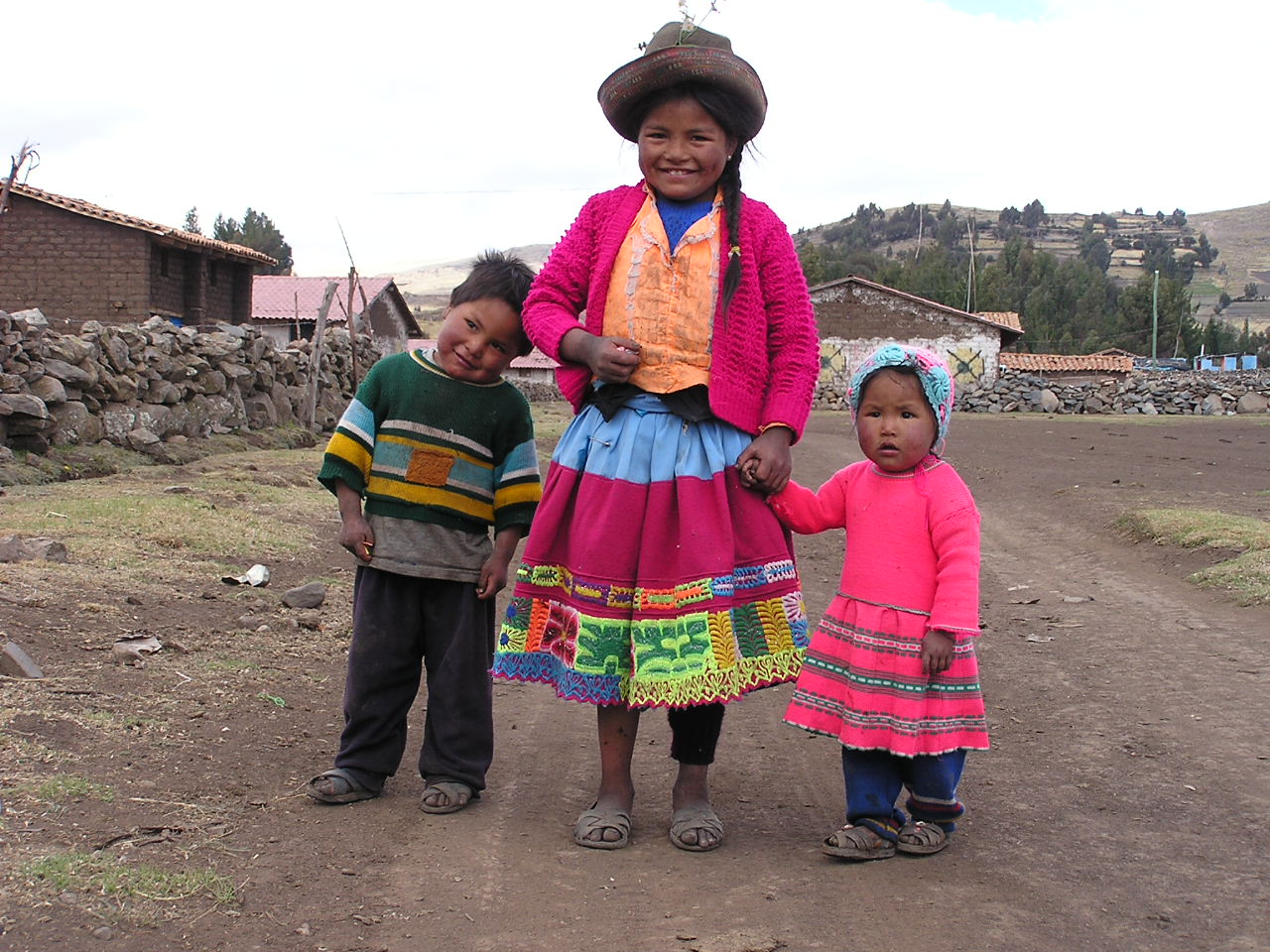
Kids in Pampamarca, Peru. The majority
of those killed during the conflict were from indigenous communities like this in the highlands |
It was November 2002 and I was sitting in a small conference room in Lima, taking notes as a woman tearfully relayed the story of her 9 years in detention. As she spoke, low and soft, the woman (who I’ll call Lourdes) cradled a newborn baby bundled in a pink blanket.
I had left my own 9 month old baby at home to lead a volunteer team on a one week trip to Peru to monitor the work of that country’s Truth and Reconciliation Commission (Comisión de la Verdad y Reconciliación or CVR). I had just recently returned to work after an extended maternity leave and, I have to say, I count those months of being at home with a potty-training toddler and a nocturnal infant as some of the toughest of my life.
Our team was interviewing Lourdes and several other inocentes or “innocents”. Between 1980 and 2000, the conflict between the Peruvian government and the Sendero Luminoso (Shining Path) and Tupac Amaru Revolutionary Movement (MRTA) rebel groups resulted in approximately 69,000 people killed and disappeared. As many as 600,000 were internally displaced; I remember seeing the tent cities on the outskirts of Lima where thousands of people who had fled the political violence in the highlands had lived for twenty years.
Lourdes was one of more than 14,000 Peruvians who were detained, tortured, and denied a fair trial under 1992 anti-terrorism decrees. She told us about the day she was arrested in early 1993. She and her husband were students. They had a three-and-a-half year old son who had health problems, so she had left the house before daybreak to get medicine for him. As she was returning to her house, she was stopped and arrested by the National Directorate Against Terrorism. It turns out that the Shining Path had bombed a nearby part of Lima. Lourdes and four other women who also happened to be out early that morning were arrested, blindfolded and interrogated. “One police officer told us that all of us would die,” she said quietly. Two hours after they were arrested, they were exhibited to the media at a press conference. The arrest was presented as a triumph over terrorism.
For the first several months, Lourdes was detained on a military base. The conditions were very bad and she was tortured. She didn’t go into the details and we didn’t ask her to tell us more. I remember her saying that she was allowed to use the bathroom only once a day – with 3-4 soldiers pointing their rifles at her. She was only allowed to bathe once a week. Lourdes was later moved to a prison, which she described as looking “like a paradise” compared to the military base.
Lourdes’ husband, who we also interviewed that day, had been arrested a month later. His father had to go to the police station to recover their little son, who was cared for by relatives for the next 9 years. Six months later, one of Peru’s “faceless” courts (called that because a one-way mirror concealed the identity of the prosecutors and judges) found Lourdes and her husband guilty of treason and sentenced them to life in prison.
Lourdes and her husband were not allowed to see each other during their detention and their letters to each other were read. For one whole year during her detention, after her sentence was reduced to 30 years, she was not allowed to have visits from anyone. Eventually, Lourdes and her husband were able to submit their cases to a Presidential pardons panel. She was pardoned in 2001, just a few weeks before the ninth anniversary of her arrest.
The interviews went on for more than six hours, but either Lourdes or her husband held that baby for the entire time. They didn’t put her in her carrier or pass her to the others who offered to hold her. They just took turns holding her close. I remember Lourdes saying to me afterwards, “We lost so much time with our son. Now he is a teenager and we’re strangers to him.”
Lourdes’ story highlights some of the problems of a government response to terrorism that doesn’t provide adequate protections for due process and other rights in the administration of justice. The Peruvian experience with terrorism seemed strikingly relevant back in 2002, when the US human rights community was very concerned about just how far the War on Terror might go. But I also learned an important personal lesson that day.
My friend Jim once had to share an office with an extremely annoying coworker. My friend kept a yellow post-it note stuck under his desk that said, “IGNORE ANTHONY”. Whenever the guy was bugging him, he would stick his head under the desk and read that post-it note. I don’t have a post-it note, but I do have a strong visual image of interviewing Lourdes that day in Lima. Whenever I feel that parenthood is more than I bargained for (which, frankly, was twice yesterday), I pluck that image from my garden of memories and think to myself: “REMEMBER LOURDES”.
If you’d like to learn more:
![]() |
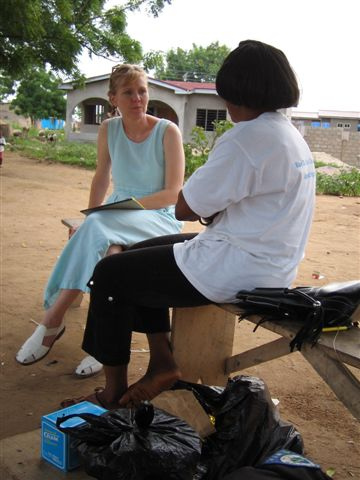
| Interviewing refugees in Ghana |
![]() |
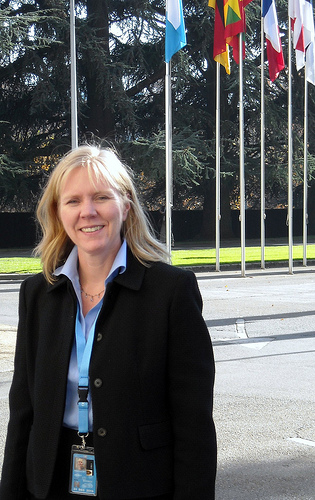
| At the UN in Geneva |