- Thanksgiving Day
Less than some, yet more
Than most have I. For this, I
Am truly thankful.

This post, Haikus With My Daughter and Haikus With My Daughter II are a response to the WordPress Weekly Writing Challenge.
"There is some good in this world…and it's worth fighting for." ~ J.R.R. Tolkien

Stories from my life.
- Thanksgiving Day
Less than some, yet more
Than most have I. For this, I
Am truly thankful.
This post, Haikus With My Daughter and Haikus With My Daughter II are a response to the WordPress Weekly Writing Challenge.

“I wrote a poem about you today,” I said. “Well, just a haiku. But actually, I wrote two.”
This caught my 8 year-old daughter’s attention. She put down her Monster High doll, the one she just bought with money hard-earned from chores like scooping the cat’s litterbox.
“What’s a haiku?” she asked. Apparently, they hadn’t yet covered this in her third grade class.
“It’s a kind of short Japanese poem. It has three lines, with a total of only seventeen syllables. The first line is five syllables, the second is seven and the third is five.”
As she read my haikus, I said, “I wrote about you, but usually haikus are about nature.”
“Like about animals?”
“Sure. ‘Animals’ is three syllables, so you need two more for the first line. Then seven, then five.”
“Syllables, like beats in music?”
“Exactly.”
She didn’t even pause to think. She launched right in.
“Animals live in …”
“You’re doing it! You’re writing your very own haiku! Now seven syllables. Where do animals live?”
“Jungle, forest and…” She counted out the syllables on the five fingers of her right hand. Then two more on the fingers of her left hand. She had painted her fingernails in an alternating pattern with red and blue nail polish. Red, blue, red, blue, red, blue, red, blue, red blue.
“City? Ocean?”
“That’s great! Which one? Ocean or city?”
“Nature everywhere.”
“You did it! You wrote your own haiku!”
She smiled – a small, proud smile – and then she picked up her doll again.
“That was really good. Let me write it down. Can you say it again?”
She shrugged, engrossed in brushing the doll’s hair.
“I forgot it already,” she said.
“But I’m your mom and I will always remember,” I thought.
Haiku by Eliza
Animals live in
Jungle, forest and city. (or ocean)
Nature around us!
This post, Haikus With My Daughter , Thanksgiving and Haikus With My Daughter III: Girls Rights are in response to the WordPress Weekly Writing Challenge.
 I haven’t written a poem since I was in elementary school.
But today I wrote tw0- not one, but TWO! – haikus in response to the WordPress Weekly Writing Challenge.
My eight year old daughter was the inspiration for the first.

Marginalia
Cleaning her backpack,
I found …my daughter’s wise words,
Scrawled in the margins.
She was also the inspiration for the second haiku of the day:
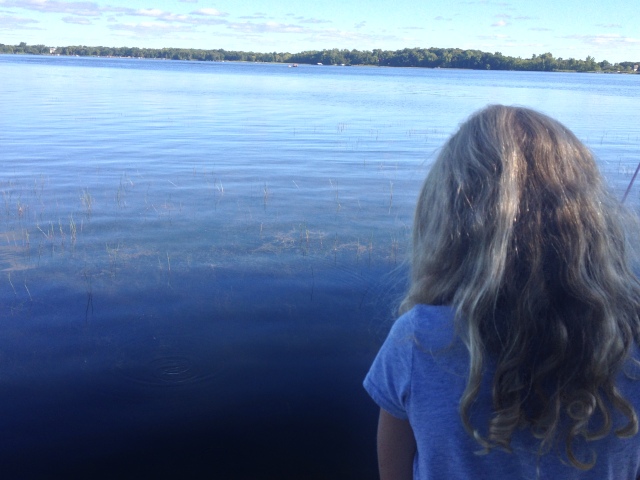
To My Daughter, Who Is 8
Eight years old, full of
Joy and bold discovery.
Stay this kind and strong!
Next up – my daughter writes her very first haiku! Haikus With My Daughter II
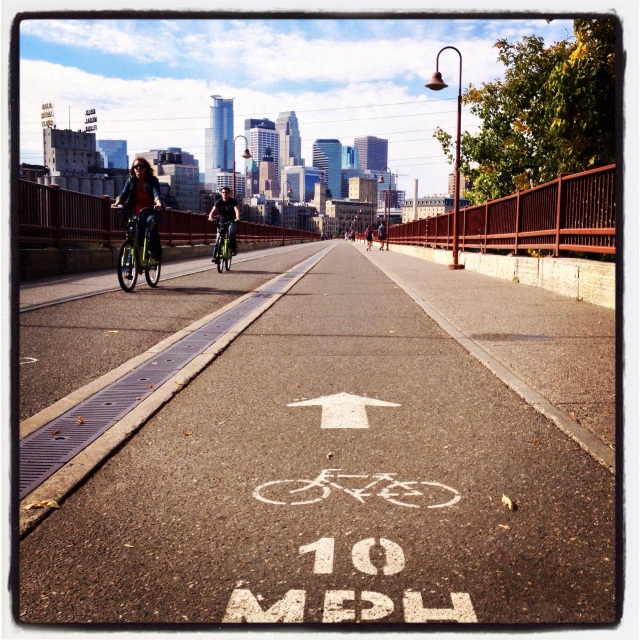
I’ve been a bike commuter on and off for twenty years. But it wasn’t until I began posting about it on Facebook recently that I began to realize that maybe biking is more for me than just transportation to and from work. I know that bike commuting impacts my daily life (I’m definitely grumpier when I have to drive), but is it possible that the simple act of riding a bike has also influenced me in other ways?
I started bike commuting back when I was in graduate school in the Boston area, motivated partly by the fact that I had no money and partly because driving, parking and everything associated with cars is a PAIN in that city. I biked to law school a lot, but I took a break during the long years of managing babies and daycare pick-up for young children. Although I don’t consider myself a serious cyclist, I have returned to steady bike commuting now that my children are older.
I have to admit that, living in Minneapolis – America’s most bike-friendly city, I have it easy as a bike commuter. It is only a 4 mile commute to my office downtown, with most of the ride in a dedicated bike lane (thanks to the 2008 economic stimulus package for cities). We even have a shower in our office building. While I don’t ride in the ice and snow of the Minnesota winters, I do bike commute almost every day from late March until early December.
Everybody knows that there are obvious benefits to bike commuting. Riding your bike to work increases your physical activity, thus helping you drop pounds, reduce the risk of heart disease and stroke, improves your mental health, etc etc. There is an environmental benefit as well in terms of reduced emissions. While I can’t do anything about my carbon footprint when I travel internationally, I can do this one small thing when I am at home. And, of course, there are economic benefits:
October 10, 2012: The financials are in! By bike commuting for 5 months, I saved more than $700 in gas and parking. (There’s probably a way to calculate the calories burned, too but that’s too complicated for me.)
Upon reviewing and reflecting upon my Facebook posts, however, I think I can identify some other benefits of bike commuting that are a little more intangible.
I have learned to be a little more organized. Bike commuting require some planning. I have a stash of work clothes in my office and a collection of shoes under my desk. Shopping when you have to transport things in your bike panniers really forces you to plan ahead. Many a time, I have felt like a Parisian, peddling home with a baguette in my bike pannier. Other times I have kind of pushed the limits…
July 17, 2012: I’m getting to be an expert bike commuter. Tonight I rode home with two bottles of wine and a litterbox in my pannier.
I definitely notice a lot more about the world around me. I think it may be the combination of the need to watch out for cars and the time to reflect, but I have become a bike seat philosopher.
April 29, 2013: I saw some interesting things on the bike ride home from work tonight: old guy strolling cheerfully down the street in his boxers and fedora; lady going for a walk with her cat in a Baby Bjorn; guy singing at the top of his lungs while driving a black Cadillac convertible, MN license ISLAM4U; guy tossing hot sopapillas out of his apartment window to delighted passers-by on the sidewalk below; lady biking with her little-dog-Toto (whatever breed that is) in a Camelbak; and a lady in a motorized wheelchair racing a lady pushing a baby in a pram, both laughing hysterically.
I guess spring brings out the crazy in all of us!
October 15, 2013: I’ve noticed that people in convertibles smile a lot more than people driving regular cars.
I feel more connected to my community. You interact with people much more when you are on a bike than when you are in a car.
October 2, 2013: On this gorgeous fall morning, the cop directing traffic near the Convention Center called out to me as I passed him, “Have a good ride, miss!”
October 3, 2013: I am chronically late, always rushing to get to the place I was supposed to be 5 minutes ago. So I had to laugh at the guy who called out to me as I passed him on his bike, “Slow down there, girlie! You’re gonna get yourself a speeding ticket!”
There are certain characters along my bike route that have become familiar to me. People that I once would have zipped by without noticing are now friendly faces. There’s a tall homeless guy who wears a gray polarfleece jacket regardless of the weather. I pass him walking near the Convention Center most mornings and he shouts a hello. I can tell by his accent that he is from West Africa. There’s a kid who goes to Whittier Elementary who I have ridden with several times for half a mile or so on his way to school. He’s saving up to buy a day-pass to Nickelodeon Universe at the Mall of America. There is an elderly Somali gentlemen who raises a hand to salute me every afternoon near the Horn Towers. And then there is Gandalf in Boxer Shorts, a grizzled old guy with a long flowing beard who generally strolls down Blaisdell Avenue wearing nothing but boxer shorts and dress shoes.
May 23, 2013: I spotted Gandalf in Boxer Shorts again on the bike commute home. Then, one block later, a new character – Smeagol, Tan and Extremely Cheerful!
Is it possible that bike commuting has made me into a more compassionate human being?
October 1, 2013: This morning, I stopped and helped a kid who took a wrong turn and got lost while biking to school. So I was in Good Samaritan mode, see. On the ride home, I stopped to help an old man lying face down on the sidewalk. Imagine my surprise when it turned out he was just taking a little rest between sets of push-ups.
Nope, I guess not.
October 11, 2013: If I were a”Spiritual Healer” (which admittedly, I am not), I do not think I would choose to solicit customers by standing in front of the White Castle on Lake Street and darting out to the the bike lane when the light is red. Also, I would be a little less judgmental when the bikers refuse to take my “Spiritual Healer” card. And I would definitely not say to them, “Ohhh-kaaaay. Your loss!”
Of course, bike commuting is not all smiles and sunshine.
October 3, 2013: On this misty morning, the whole city smells like wet dog.
October 7, 2013: This morning, I rode over a banana peel in the road and almost fell off my bike. Much funnier in the cartoons than in real life.
October 8, 2013: Strong winds on the ride home tonight. Once or twice, I was standing up and peddling as hard as I could but literally going nowhere. I felt like I was in the cyclone scene from the Wizard of Oz. (Cue the Wicked Witch of the West theme song!)
October 10, 2013: I was biking home from a lovely event on a perfect fall evening under a canopy of majestic elms, gloriously ablaze with color … when a bird pooped on my shoulder.
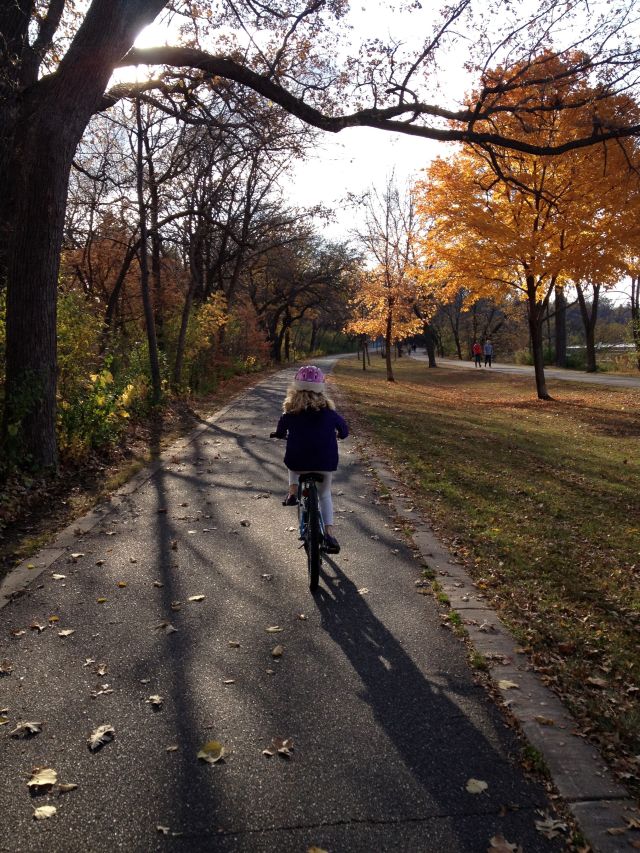

If you have following my CALL OF (Parental) DUTY series of posts, you will know that my 13-year-old son and I are in an ongoing dialogue about video gaming. It began last October when he asked for CALL OF DUTY: Black Ops II for his birthday – and did not receive it. (You can read more about that in the post Part I Introduction.) Over the past year, his father and I have stood by our decision not to allow our son to play violent M-rated games in our home. We feel that it is our own duty as parents to draw that line as to what is appropriate for our son to play. While we have reached a truce on the subject of Black Ops II and other M-rated games, we continue to have discussions about the pros and cons of gaming. Not surprisingly, Sevrin is more dedicated than I am to finding and sharing the pros of gaming.
Recently, Sevrin shared with me information about a charitable giving initiative in the gaming community through the Humble Bundle. I’ll let him describe it.
I originally learned about the Humble Bundle when I was on vacation, talking with my cousin Aidan. We were talking about one of the most common things known to teenage boys: video games. He mentioned an event going on in the gaming community where people donate as much as they want to charity and in return get 10 games. When I went home I decided to see what this whole thing was about. I was touched. Some parents do not approve of their kids playing video games for many reasons. Some think its a waste of time, others just straight up hate them. Then there are those who don’t see the point of buying them because they feel like it doesn’t benefit anybody. Well, for those people I introduce The Humble Bundle. The Humble Bundle is an organization that partners with game developers to help raise money for charity.
Basically, The Humble Bundle is a collection or (“bundle”) of digital games or media that are sold and distributed online at a price determined by the purchaser. This “pay what you want” model has proven very popular, and there have been Humble Bundles for music and eBooks as well as video games. With the Humble Origin Bundle, which launched on August 14, 2013, there was a twist: all sales from the bundle went to charity. Instead of “pay what you want”, it was “donate what you want”.
Here is Sevrin’s description
The best part of The Humble Bundle is that the choice is up to the buyer. You can donate as low as $1.01 to get the games. You can also choose what charity you are donating to. Best of all is, unlike most charities, YOU choose if you want to make a donation to the Humble Bundle organization or not. Personally, I found the whole idea ingenious. It’s beneficial to everybody involved in it. The organization itself gets the money to do these sales more often, the game developers involved get more publicity, the buyers get great deals on some of the best games of the time and the greatest part is that people get the satisfaction of knowing that all of the money they spend goes directly to charity.
And so, for the first time in my life, I bought a video game. A bundle of video games, that is. The only problem was that the Humble Origin Bundle contains some games that are M-rated and therefore not allowed in our house. Since there was no way to separate out the inappropriate games, Sevrin agreed that he would only play the games he is allowed to play. I agreed to trust him to keep his promise.
After talking it through with Sevrin, I decided that I would make a $10 donation for the bundle and let him choose which charities to support. He did some research into the charities and choose the following:

This provided a good opportunity to talk about charitable giving. (Since I work at a non-profit, I feel that this is an important thing to teach my kids about.) Sevrin chose to give the largest percentage of his donation to the Human Rights Campaign because equality and LGBT rights are issues that he cares about. He also chose to support Watsi, an organization that provides a global crowdfunding platform for medical care. What he liked about Watsi was that 100% of the donation directly supports medical treatment. The American Red Cross was so giant (number one on Charity Navigator’s 10 Super-Sized Charities list) and therefore must have so much administrative overhead that he decided not to support it. GameAid just didn’t grab him. But he thought it was reasonable to give Humble Bundle 50 cents of the $10 so they can keep up the good work.
The Humble Origin Bundle raised more than $3.5 million within a day of going live in August. As of August 28, 2013, the Humble Bundle has raised more than $22.5 million dollars for charity.
The current bundle sale is the Humble Comedy Bundle. With this bundle, however, you can support artists, charities or both. If you like standup comedy, you may want to check it out. But you have to hurry – as I write this, there are 5 days and 13 minutes remaining.
While we are not changing our policy on video gaming because of the Humble Bundle, it is good to see that the industry is taking steps to make a difference in the real world. I’m surprised that this kind of creativity in charitable giving has not been reported more widely in the mainstream media. So I will say it again:
Other posts in the CALL OF (Parental) DUTY series:
Part II “Freedom to Game is Important” – my son shares his point of view
Part III This Is Your Brain On Video Games – research on the impact of violent video games on brain function
A couple of days ago, my daughter asked me, “Do you ever have regrets?”
She asked me this in the bathroom, as I was drying my hair. No matter what I am doing, my two youngest kids seem to hover around me, fluttering like moths to a flame. The lack of privacy – not to mention personal space – doesn’t really bother me anymore. And often, as on this particular morning, it provides the opportunity to talk about whatever is bubbling to the surface of their young minds.
I weighed my possible responses. My daughter just turned eight. What could a second-grader possibly know about regret? In the end, I answered that, in general, my regrets were not about things that I had done but rather about things that I had NOT done.
“Do YOU have any regrets?” I asked.
After a pause, she admitted, “Sometimes I’m not so nice to some kids at school.”
“But recognizing that you aren’t always nice means that you can do something about it,” I pointed out. “Right?”
She shrugged and wandered off with her American Girl doll. Maybe the message would sink in.
But for me, a question remained, left hanging in the humid, post-shower bathroom air.
What do you do when you have regrets but you know that there is not a thing in the world that you can do about them?
The truth is that my daughter’s question brought me back to a conversation that I had in a very different context. Several years ago, I spent some time in the Buduburam Refugee Settlement in Ghana. I was with a team taking statements from Liberian refugees for the Truth and Reconciliation Commission of Liberia. It was almost exactly six years ago – May 2007 – and it was grueling, emotional work. I interviewed more than 40 people that week and every single one of them had suffered multiple layers of trauma and unimaginably tragic loss. One after another, in family groups and as individuals, they sat before me in a small, cramped office. Sometimes there was power for the ceiling fan to move the hot, heavy air; sometimes there was not. Each one of them was a survivor of horror, a testifier to the nightmare of war. (I’ve written about some of them before in Talking To My Kids About Death.)
Even though they had left their homeland of Liberia, what they had experienced was still very much with them. Even if they could push it down deep during the day, the terrors they witnessed would return to haunt their dreams. Many people I interviewed told me of how the nightmares startled them awake at night, sweating and crying. Many more told me of hearing others screaming in the night, neighbors who were trapped in their own PTSD- induced nightmares. There is no privacy in a refugee camp.
There was one woman who has always stayed with me. She was middle-aged, calm and collected. She told me her story in detail, almost scientifically exact. Clearly, she had relived the events many times over. She told me of her life before the war, the fighting and chaos that separated her from her husband and some of her children, the desperate weeks when she, her youngest children, and their neighbors hid in the bush, the treacherous journey to the border. The years – more than a decade- of limbo in this refugee camp.
At the end of any interview, I always ask, “Is there anything else you would like to tell me?”
This woman told me of that the only true regret that she had, the only regret of her life, was about something that she had not been able to do. What she told me went something like this:
We were hiding in the bush and the rebels passed close by. They attacked a village there. They didn’t see us, but we saw them. They killed a lot of people. We were too afraid to move, so afraid they would hear us. There was a baby crying; they must have killed the mother. The baby kept crying and crying and crying. I wanted to go get that baby, but what could I do? I knew the baby’s crying would give us all away to the rebels. The baby kept crying and crying and crying, all night long. And then it stopped. I knew that the baby had died. In the morning, we saw that the rebels had moved on and we left our hiding place. Now I hear that poor baby crying every night in my dreams.
Most people will never be put in a position like this, this untenable Hobson’s Choice. Most of us will never be faced with having to make the choice between our own life -and that of our children and neighbors – and that of an innocent baby. Many of us would like to assume that we would find a way to not make the choice; that we would find a way to save that baby.
I knew I could not save that baby. I wanted to, so much, but I knew I could not. Even so, I have always felt bad about it. I have never told anyone – not one single person – about this before. Just telling you now – it makes me feel better.
I don’t have any answers here, just as I had nothing to say to this woman other than “I am so sorry.” I can’t change the world. I can’t promise my daughter that she won’t experience pain or sorrow or guilt or regret. I don’t even have an image to go along with this post.
But if there is one thing that I took away from that hot, cramped interview room in that refugee camp in Ghana, it is that there is a value in bearing witness. I had worked with refugees and torture survivors for years, but it took this one woman to bring that point home to me. There is a value in simply listening, and in confirming for someone who suffered injustice that, “It is not right and I’m sorry that this happened to you.”
It may seem insignificant, but it is not. And it is a reminder that when you come in contact with someone who is suffering, in either a big or a small way, there is always something that you can do. You can listen.
So do it.

This morning, I had a meeting at the US Embassy in Yaounde to discuss human rights in Cameroon. The US Embassy, it turns out, is located on Avenue Rosa Parks. Past security, in the lobby where visitors wait for their escort, the walls were hung with photos and text documenting the life of Rosa Parks, a true American hero.
I realized later in the day that today is Rosa Parks birthday. If she were alive, she would be 100 years old today. Could she have imagined the impact – wide and deep – that her actions would have, not only in her country but around the world? Or that one day there would be streets named after her in places like Yaounde?
I met Rosa Parks once, on the Ellis Island ferry. I wrote about it last February and am reposting it here in celebration of her 100th birthday.
Me and Rosa Parks on the Ellis Island Ferry

My oldest son is studying the life of Rosa Parks in his 6th grade history class. “I actually met Ms. Rosa Parks once,” I say. He’s already halfway up the stairs, heading back to the sanctuary of his room. “Did I ever tell you about that?” On the cusp of his teens, he has no interest in being trapped by a pontificating mother. “Yes,” he replies. He pauses, half-turned towards me, left leg on a higher step, poised for flight. I see my opening and I take it.
***
In 1986, my grandfather Orville Prestholdt was recognized with an Ellis Island Medal of Honor for his contributions as a “Norwegian activist”. I was a sophomore in college and I took a Metro North train down to New York to meet my grandparents the night before for the gala event. The honorees were staying at a fancy hotel, one those midtown landmarks that is long on history but short on space in the guestrooms. As I entered the lobby, I walked straight into the sonic boom of Lee Iaccoca (chair of the Statue of Liberty-Ellis Island Foundation, honorary medal recipient). If I remember correctly, I next walked straight into the back of Donald Trump (Scottish-German). Fortunately, “The Donald” was engaged in animated conversation with Mr. Iacocca and didn’t notice my faux pas.
Established in 1986 by the National Ethnic Coalition of Organizations, the Ellis Island Medals of Honor “pay tribute to the ancestry groups that comprise America’s unique cultural mosaic”. Walter Cronkite (Dutch), Jacqueline Kennedy Onassis (French-Irish), Joe DiMaggio (Italian) – the Ellis Island medalists were a veritable Who’s Who of American immigration. Of course, this was back in the Reagan era when Americans still celebrated the fact that we are a nation of immigrants. The 80 inaugural Ellis Island Award winners had been selected from more than 15,000 nominations following the controversy over the Medals of Liberty. Announced in the spring of 1986, the Medals of Liberty had honored 12 naturalized citizens, including Bob Hope (English), I.M. Pei (Chinese), Irving Berlin (Russian) and Elie Wiesel (Romanian). Numerous ethnic groups had objected that they were not represented among the winners of the Medals of Liberty, however, and had threatened protests during the “Liberty Weekend” (July 4, 1986) award festivities. So the Ellis Island Medals were created more or less as a compromise.
That’s when they went looking for the lesser-knowns with more obscure national origins. People like my grandfather, who had changed his name from Olaf to Orville when he immigrated from Norway in order to “be more American”. My grandfather had charted a successful political career in the Sons of Norway, from lodge president to International Board of Directors. He got his Ellis Island Medal for his “contributions in preserving Norwegian- American culture”. Too late for “Liberty Weekend”, the Ellis Island awards were to be presented on the actual 100th anniversary of the dedication of the Statue of Liberty in late October of 1986. That date fell on a Monday, but I figured it was worth skipping one day of classes to be a small part of history.
Having finally located my grandparents among the honorees at the reception, we headed to the elevator to go up to their room to drop off my bag and change for dinner. Muhammad Ali (African) was in the elevator with some family members; they held the elevator door for us. Mr. Ali tapped me on the shoulder and, when I turned, began performing a magic trick with a polka-dot silk scarf. At the time, I didn’t know that he had Parkinson’s. Or maybe I had heard he had Parkinson’s, but I didn’t really know what that meant. In any event, I watched in horror as the man – who had been such an icon in the 70s when I was a kid – struggled, with trembling hands, to slowly stuff the scarf into a fake plastic thumb. That’s how I found out how they do that disappearing scarf trick. No kidding – Muhammad Ali! The fake plastic thumb was several shades different from the color of his skin and looked dangerously close to falling off his real thumb, but he was focused like a laser on making that scarf disappear. I remembered playing chase at recess on the playground at Magnolia Woods Elementary School. The one who was “it” would yell, “Float like a butterfly, sting like a bee! I am the mighty Muhammed Ali!” As “The Greatest” slowly performed his magic trick for me, I watched the single, crystalline drop of drool that hung suspended from the corner of his mouth. I thought for sure I was going to cry.
My grandfather handled the whole thing much better than I did. Maybe he was just feeling pretty good after a couple of highballs and a chat with Victor Borge (Danish), but he clapped his hands when the scarf finally disappeared and chortled with glee. “Woo-hee-hoo-hoo!!!” He may have danced a little jig in that elevator, too – he was that kind of guy. But I can’t be sure because I had gotten really good at ignoring him when he did that kind of thing in public. At 19, I saw only the weaknesses, the frailties, the embarrassments of my elders in that elevator. Now I see that I missed the courage, the determination, the encouragement, the shared joy in the accomplishment of a difficult task.
That night, as I lay in my narrow rollaway bed listening to my grandparents snore a few feet away from me, I thought about who I might meet the next day. I hoped to see John Denver (German) and Cesar Chavez (Mexican). Maybe also Gregory Peck (English) and Andy Williams (Welsh). Bob Hope was going to be there, too, as his wife Dolores (Irish-Italian) was receiving an award. But the person I most wanted to meet was Ms. Rosa Parks (African-American).
Rosa Parks had been a larger than life figure for me growing up in the post-Jim Crow South. The East Baton Rouge Parish school system underwent court-ordered desegregation when I was in high school, so I had some sense of the courage it must have taken her to do what she did. I thought she was an American hero.

The awards ceremony was to take place on Ellis Island, so in the morning we were all bussed down to Battery Park and the chartered ferry. Most people stayed up on deck for the short ferry ride, cameras at the ready to take photos of the Statue of Liberty. About halfway through the ride, I went inside to look around. And there she was! A tiny, birdlike woman with large glasses sitting alone on a bench by the window. In my mind’s eye, she is wearing a hat, coat and gloves but I can’t be sure I haven’t borrowed that memory from other images. She sat prim and erect, her hands folded on her purse in her lap, looking straight ahead. It is exactly how I always pictured her on the bus. I walked over and asked, “Can I sit here?” She looked up at me and nodded briefly and I sat down. Then my courage failed me. I can’t think of what to say next. As we approached the Statue of Liberty, she turned for a better view out the window so, of course, I did, too. “She’s smaller than she looks in pictures,” remarked Rosa Parks to me. Or maybe just to herself, but I smiled and nodded anyway. Then we approached Ellis Island and her family came to collect her. I went back up on deck to look for my grandparents.
***
“Maybe a famous person like Rosa Parks didn’t really want to talk to you. You were a stranger,” my son speculates.
“Maybe,” I say. “But I wasn’t thinking about that. I was just sitting there, trying to think of what to say to her and how I was wasting my one chance to talk to her. It was like I was frozen. I never did say anything else to her, other than ‘Can I sit here’?”
“So what would you have wanted to ask her on the ferry?” my son wonders.
“Well, I guess I would have asked what it was like to ride that bus.”
Twenty-five years later, I realize that Rosa Parks was probably asked some variation of that question nearly every day of her long and beautiful life. She was probably asked it more times than she could count. Asked and answered; you can google it.
“I don’t recall that I felt anything great about it,” Ms. Parks remembered in an interview with the Montgomery Advertiser. “It didn’t feel like a victory, actually. There still had to be a great deal to do.”
This conversation with my son made me realize that I didn’t need to ask her anything that one time I met her. I didn’t waste my one chance to talk to Ms. Rosa Parks. It was enough to be able to sit quietly in her presence for a few minutes. An African-American and a Norwegian-American, sitting side by side on the ferry and gazing together at the Statue of Liberty.
***
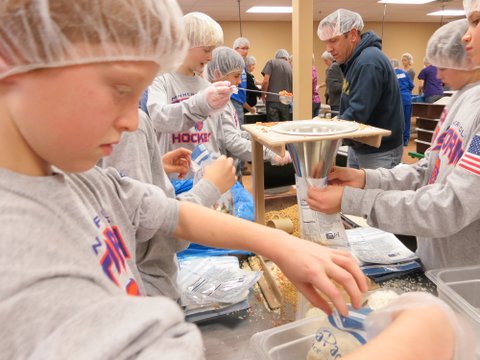
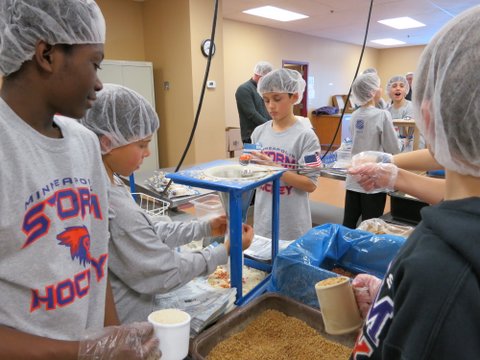
I spent the last few hours of a waning 2012 with my son Simon’s hockey team. Not on the ice, but instead in the nondescript, suburban warehouse where his Squirt hockey team was volunteering for a service project. In just a couple of hours, Simon and his teammates (and the dozens of other volunteers who were there that afternoon) packed more than 5,000 packets of meals for children in Haiti.
It was a small act, but it will have a tangible impact on the lives of some others, kids we don’t know and will never meet. On the way home, with the radio droning on about Congress and the looming fiscal cliff, Simon talked about what he had learned that afternoon about malnutrition and hunger. “Don’t you think that was a good time?” he asked. “I feel good about doing something to help out.”
It reminded me of one of my favorite lines from the movie Willy Wonka & The Chocolate Factory.
“So shines a good deed in a weary world. ” ~ Willy Wonka
In looking up the quote, I realized that it in fact a reference to a line from the Merchant of Venice.
“How far that little candle throws its beams! So shines a good deed in a naughty world.” ~ William Shakespeare
I don’t usually make New Year’s resolutions. I figure if something is important enough to take action, I should just do it regardless of the time of year. But this New Year’s Eve volunteer experience with my son, while brief, makes me think that I should make a resolution for 2013. This year, I will be on the lookout for opportunities to do good deeds, both small and big, at home and abroad, acknowledged and unacknowledged. In 2013, I resolve to see how far a little candle can throw its beams.
One of my concerns was the impact that violent video games might have on his brain. Maybe it is irrational, but I worry about things like that. (I can’t help it – I’m a mom! I worry about concussions in hockey and soccer, too.) I felt like I had read somewhere about the negative impacts of gaming, but couldn’t call up any facts.
I knew that there was a longstanding body of research on the negative impact that watching violence has on kids. For example:
Dr. Wayne Warburton said … that years of study across the world showed definite links between time spent watching dramatized violence and the likelihood of aggressive behavior in the young. “There are some key impacts of violent media on children that are very well demonstrated in research,” Warburton said. “They include increases in the likelihood of aggressive behavior, increases in desensitization to violence and an increase in the overall view that the world is more scary and hostile than it really is.” (Read more here.)
So it seemed likely that there would be some evidence that playing violent games would also have a negative impact. Right?
A quick and very unscientific Google search turned up several articles, one with the promising title Violent Games DO Alter Your Brain- and the effect is visible in MRIs in just one week.
The study took in 22 young men, and used magnetic-resonance scanning, as well as verbal psychological tests and counting tasks. One control group played a violent shoot ’em up for 10 hours during one week, then refrained afterwards. The other group did not play any games in either week. After one week, the ‘gamers’ showed less activity in certain regions of the brain when they were scanned. (Read more here.)
According to Science Daily, the parts of the brain affected were the frontal brain regions important for controlling emotion and aggressive behavior. “These findings indicate that violent video game play has a long-term effect on brain functioning, Dr. Wang said. “These effects may translate into behavioral changes over longer periods of game play.” (Read more here.)
Sevrin read the articles that I sent him. Then he did his own research, looking for data showing that playing violent video games can impact the brain positively. It turns out that some recent studies have actually shown an increase in creativity and in performing multiple tasks simultaneously. He sent me the following articles on the benefits of playing violent video games.
From Science Daily: “After playing the shooter game, the changes in electrical activity were consistent with brain processes that enhance visual attention and suppress distracting information,” said Sijing Wu, a PhD student in Spence’s lab in U of T’s Department of Psychology and lead author of the study.
“Studies in different labs, including here at the University of Toronto, have shown that action videogames can improve selective visual attention, such as the ability to quickly detect and identify a target in a cluttered background,” said Spence. “But nobody has previously demonstrated that there are differences in brain activity which are a direct result of playing the videogame.”
From Bloomberg (covering a report published in Current Biology): “Playing action video games primes the brain to make quick decisions and could be incorporated into training programs for surgeons or soldiers, a study found.”
The researchers tested 18- to 25-year-olds who weren’t regular video-game players. One group spent 50 hours playing the “The Sims 2,” a slow-paced strategy game published by Electronic Arts Inc. The other group took on “Call of Duty 2,” a combat game sold by Activision Blizzard Inc., or “Unreal Tournament,” a shooter game developed by Epic Games. The subjects then performed timed computer tasks, according to the report published today in the journal Current Biology.In the problem-solving exercise, the action-game players made decisions 25 percent faster than the strategy group, while answering the same number of questions correctly.
The findings suggest that games simulating stressful events or battles could be a training tool for speeding reactions in real-world situations, according to researchers at the University of Rochester in New York led by Daphne Bavelier, a cognitive scientist.“It’s not the case that the action game players are trigger-happy and less accurate: They are just as accurate and also faster,” Bavelier said in a statement. “Action game players make more correct decisions per unit time. If you are a surgeon or you are in the middle of a battlefield, that can make all the difference.”
The experiment builds on previous research by Bavelier showing that video-game players surveying a scene gather more- detailed visual information than non-gamers. The brain constantly uses sensory information to calculate probabilities. Action gamers collect visual and auditory data more efficiently than non-gamers, arriving at decisions faster, the authors said. As a result, playing fast-paced video games may improve everyday skills such as driving, tracking friends in a crowd and reading small print, the scientists concluded.
CONCLUSION?
Sevrin and I debated a bit about the relevancy of the studies (the small size of the negative brain function study, the 18+ ages of all of the study participants). But I think we both agreed that these were all interesting theories. Not necessarily inconsistent, either. It does makes sense to me that violent video game play could increase rapid decision-making skills, but still have a negative impact on other brain functions.
Even though we did not go deep into the research, it gave us a lot to think and talk about. In the end, it seems that there is still a lot that we have to learn about the impact – both positive and negative – of violent video games on the brain of young teenagers. In a sense, there is a giant, realtime experiment going on right now with millions of young participants – and no clear answers.
POSTSCRIPT: Since I wrote this, several friends and family members have sent me additional articles and websites about research into the impact of violent video games on young people. If you know of more, let me know and I’ll add them!
Grand Theft Childhood (thanks B!)
The contested field of violent video games: Research roundup
Ways for parents to ease tussle with teens over tech use by Julie Weed (thanks Julie!)
The CALL OF (Parental) DUTY series:
Part II “Freedom to Game is Important” – my son shares his point of view
More to come!
This is the second in my series of CALL OF (Parental) DUTY posts about the discussion we are having in our house about violent video games. Today is my 13 year-old son Sevrin’s chance to share his point of view. Below is a letter that he wrote to us (his parents) about his frustrations with not be able to get Call of Duty: Black Ops II.
I’m proud of you, Sev, for expressing your feelings so eloquently and – especially – for putting the time and effort into writing them down for us. When I read this, I remember precisely how frustrating it is to feel that you are no longer a child but yet are not allowed to make many choices for yourself. Thank you for writing this and allowing me to share it with others.
Freedom To Game Is Important
I want you to imagine, for a minute, that you are in a library. Or maybe a book store. There are rows and rows of books. Each book holds a story, unique and special in its own way. In this library filled with books you have the Fantasy row, the Action row, the Poetry row and then you come across the Childrens section. The library lady (or man) says that you are only allowed to check out books from the Childrens row because she (or he) doesn’t think that you are “ready” for the big boy books. Now I ask you, how would you feel? You have rows and rows of books and yet you are restricted to the small corner and you’ve just been told to deal with it. If you were me, you’d probably feel sad, maybe a little frustrated, and a little bit confused on why you have to read Elmo and Barbie when you could be reading Shakespeare and anything you could possibly dream of. Alas, this brings me to my point. Of course I am exaggerating when I say all I can do is read Elmo but I’m trying to make my point clear. Why is gaming any different from reading in terms of age restrictions?
If it’s because M games are too gorey then I wonder why I’m allowed to read A Long Way Gone: Memoirs of a Boy Soldier. The true horrors of war seep from that book. Kids get kidnapped, hopped up on drugs, and told to kill anybody who opposes their “Dad” (The General of the RUF). In the book, the character sees people get stabbed and shot all the time. He sees people with their fingers chopped off and the letters RUF scorched into their backs. He’s seen women running from the fight with babies on their backs, not knowing that their kin had just taken a bullet and saved their parent’s life. So now I’ve seen it too. And I know what war is like in real life. I know what war does to people and I understand how terrible it is. But I don’t see a problem with shooting a blob in the form of a human that is really just something on the screen. I’m not hurting anybody by playing an M game. That’s like saying that I can’t shoot a target at a shooting range because I might hurt the wooden carving of a person. Besides, do you really think that I’ll become some sort of stone cold killer if a kill something in a digital world?!
The bottom line is, I think that I can take it. If I don’t get to play M games now, I will probably have to wait two or three more years! We have no solid date or age in which I can play M games and I think that 13 is the perfect time to start. I want the ability to choose what games I should and shouldn’t play. And believe me, I know what games I want to get and don’t want. I sit here and search and search and search. I research games all the time and the reason I chose Black Ops II is because I honestly think that it would be fun. I didn’t choose this game just to be with the Kewl Kids. I’m not, as you may well know, a “hop on the bandwagon” kind of guy. Maybe one of the reasons the Call of Duty franchise got so big is because people had a really good time playing them. One other thing about Call of Duty is that Treyarch is the company making BLOPS II and they are known for making a much better story than Infinity Ward and with the futuristic setting, they have opened the floodgates to creative ideas and lots of options. I hope you at least consider what I’m asking for and thank you for reading.
 The Human Rights Warrior

You must be logged in to post a comment.