Children of the Rainbow v. Anders Breivik and Charles Taylor

Folksinger Lillebjørn Nilsen and a crowd of 40,000 sing Barn av regnbuen (Children of the Rainbow) at the trial of Anders Behring Breivik in Oslo (Source: NRK)

I thought I would write about the Charles Taylor verdict today.  The verdict by the Special Court for Sierra Leone marks an historic moment in international justice – the first conviction of a serving head of state for war crimes and crimes against humanity.     I thought today would be a day to write about the importance of holding Charles Taylor accountable for the war crimes that he aided and abetted in Sierra Leone, but also about  the remaining impunity for the war crimes he was responsible for in Liberia.  I’ve been spent time in both Sierra Leone and Liberia, so I’ve seen firsthand the horrific  impact that Charles Taylor and his National Patriotic Liberation Front have had on the people in those countries.  I’ve followed this trial at the Special Court for Sierra Leone – and waited for this verdict – for years.

But I found myself this morning more powerfully impacted by events surrounding another trial, in another country where I have spent time. I speak Norwegian, so have been following the Norwegian media coverage of the trial of Anders Behring Breivik in Norway.   Today, that coverage included an allsang with the well-loved Norwegian folksinger Lillebjørn Nilsen.   In a chilly spring rain in Oslo, a crowd of more than 40,000 people joined Mr. Nilsen in singing Barn av regnbuen.  

This is a song that Mr. Breivik, apparently, detests.  He testified recently that this song, with its concept of living together in a multicultural Norway (“sammen vi skal lever“) was brainwashing children into supporting immigrants. Norwegians throughout the country sang it as a form of protest against his hatred.

This is a song that I learned many years ago.  It is actually a Pete Seeger song called My Rainbow Race, translated into Norwegian by Lillebjørn Nilsen.   My rough translation follows – with apologies for inaccuracies! I use the translated version as there are a lot of aspects that make this song feel particularly Norwegian.  The references to nature, for example, and the disdain for “plastic and synthetic food”.

Written in the 1970s, Lillebjørn Nilsen’s song has an obvious anti-war theme.   The lyrics of the song, however, seem especially fitting today.  “Some steal from the young, who are sent out to fight…” could well apply to Charles Taylor, whose recruitment of child soldiers stole the lives of thousands in West Africa.  “Some steal from the many, who will come after us.” Anders Behring Breivik’s acts of violence stole not only the future of dozens of young people, but the innocence of a peaceful nation.

I won’t write about Charles Taylor today.  Neither will I write about Anders Behring Breivik.   Instead, I will write about the voices raised today throughout our world – in celebration of justice and in a call for peace in the face of hatred.  Because today I remembered that  Lillebjørn Nilsen -and Pete Seeger – were right.  We do need justice for the Charles Taylors and Anders Behring Breiviks of the world, but we also need to share our hope for the rest of us.

Si det til alle barna!
Og si det til hver far og mor.
Ennå har vi en sjanse
til å dele et håp på jord.

Say it to all the children!
And tell every father and mother.
We still have a chance
to share our hope for this world.

Barn av regnbuen

En himmel full av stjerner.
Blått hav så langt du ser.
En jord der blomster gror.
Kan du ønske mer ?
Sammen skal vi leve
hver søster og hver bror.
Små barn av regnbuen
og en frodig jord.

Noen tror det ikke nytter.
Andre kaster tiden bort med prat.
Noen tror at vi kan leve av
plast og syntetisk mat.
Og noen stjeler fra de unge
som blir sendt ut for å sloss
Noen stjeler fra de mange
som kommer etter oss.

Refreng:
Si det til alle barna!
Og si det til hver far og mor.
Ennå har vi en sjanse
til å del e et håp på jord.

Refreng:
Si det til alle barna!
Og si det til hver far og mor.
Ennå har vi en sjanse
til å dele et håp på jord.

Children of the Rainbow

A sky full of stars.
Blue sea as far as you can see.
A land where flowers grow.
Could you want more?
Together we will live
every sister and every brother.
Small children of the rainbow
and a flourishing world.

Some believe there is no point.
Others waste their time with talk.
Some believe that we can live on
plastic and synthetic foods.
And some steal from the young,
who are sent out to fight.
Some steal from the many
who will come after us.

Refrain:
Say it to all the children!
And tell every father and mother.
We still have a chance
to share our hope for this world.

Refrain:
Say it to all the children!
And tell every father and mother.
We still have a chance
to share our hope for this world.

With thanks also to Pete Seeger for his song My Rainbow Race.  Words and music by Pete Seeger (1967) © 1970 by Sanga Music Inc.

CHORUS:

One blue sky above us,

One ocean lapping all our shores,

One Earth so green and round,

Who could ask for more?

And because I love you,

I’ll give it one more try.

To show my Rainbow Race

It’s too soon to die.

Some folks want to be like an ostrich,

Bury their heads in the sand.

Some hope that plastic dreams

Can unclench all those greedy hands.

Some hope to take the easy way,

Poisons, bombs, they think we need ‘em.

Don’t you know you can’t kill all the unbelievers?

There’s no shortcut to freedom.

CHORUS

Go tell, go tell all—– the little children.

Tell all their mothers and fathers, too —

Now’s our last chance to learn to share

What’s been given to me and you.

CHORUS

For a related post on what I learned from the way Norwegians have dealt with the tragic events of July 22, see https://humanrightswarrior.com/2012/07/19/the-lessons-of-22-july/

Justice delayed may be justice denied for Minnesota Cambodians

Skulls of Khmer Rouge victims.
Skulls of Khmer Rouge victims. (Photo credit: Wikipedia)

Justice delayed may be justice denied for Minnesota Cambodians.

Monoram Hang was just 9 years old in April 1975, when Khmer Rouge soldiers forced his family from their home in Phnom Penh. His mother, weak from giving birth two days earlier, fell to her knees and begged for permission to wait for her husband to return from work so their family could leave together. The soldiers kicked her to the ground and ordered them out at gunpoint, forcing them to join the swollen river of people leaving Cambodia’s capital. As Hang related, “At that time we walk, we don’t know where we are going, we don’t know where we end up. We just walk and walk. …  And Khmer Rouge soldiers behind us and shoot from behind and force us to go.”

Hang was lucky to survive; as many as 2 million Cambodians died in the “killing fields” of the Khmer Rouge regime. He found refuge in the United States, one of nearly 10,000 Cambodians now living in Minnesota — the country’s sixth-largest home to Cambodians. Like Hang, most witnessed genocide and endured forced migration and labor camps under the Khmer Rouge.

1990: Minnesota puts the Khmer Rouge on trial

In 1990, Hang and other survivors testified at a mock trial of the Khmer Rouge leadershipthat was held at the State Capitol in St. Paul. The Advocates for Human Rights organized the mock trial with Minnesota’s Cambodian community to give voice to the victims of Khmer Rouge atrocities. The panel of public officials serving as judges at the mock trialfound the Khmer Rouge leaders guilty of genocide. The entire Minnesota Congressional Delegation issued a statement formally recognizing members of Minnesota’s Cambodian community for their testimony and joined “the appeal to establish an international inquiry into crimes of genocide perpetrated by the Khmer Rouge between 1975-79. Well-established principles of international law require accountability and punishment for those responsible for genocide, the Khmer Rouge being no exception.”


2012: Actual justice remains elusive
The mock trial was such a positive experience for the Cambodian community that The Advocates then created the Khmer Oral History Project, enlisting volunteer attorneys to interview Hang and other members of Minnesota’s Cambodian community about their experiences under the Khmer Rouge, their life in refugee camps, and their immigration to the United States. Transcripts and video recordings of those interviews are available through the Minnesota Historical Society.

Yet more than two decades after The Advocates put the Khmer Rouge on trial in Minnesota and Minnesota lawmakers called for accountability, one — and only one — Khmer Rouge leader has actually been brought to justice. In 2010, a hybrid United Nations-Cambodian tribunal, the Extraordinary Chambers in the Courts of Cambodia (ECCC), found Kaing Guek Eav responsible for the deaths of more than 14,000 people at the notorious S-21 prison and convicted him of crimes against humanity, murder, and torture. An ECCC appeals court last month increased his sentence to life imprisonment.

For survivors like Hang, justice delayed may be justice denied. Thirty-five years after the Khmer Rouge took power, only three additional leaders, all in their 80s, are answering charges in an ECCC “mini-trial.” Additional mini-trials against the same elderly defendants will follow — if their health holds out. Proceedings against a fourth defendant have been stayed as she battles age-related dementia.

Culture of impunity

A recent dispute between U.N. and Cambodian authorities threatens to bring the ECCC’s slow progress to a grinding halt. The Cambodian government, which is bidding for a rotating seat on the U.N. Security Council for 2013–2014, has made plain that it opposesany additional charges against other defendants. International co-investigating judge Siegfried Blunk resigned last October, complaining of government interference. According to the painstakingly negotiated agreement establishing the ECCC, Cambodia’s Supreme Council of the Magistracy was obligated to appoint reserve judge Laurent Kasper-Ansermet to replace Blunk. Kasper-Ansermet took his post in December, paying no heed to government efforts to obstruct justice and launching investigations against new defendants. In January, however,the Supreme Council rejected his appointment and Kasper-Ansermet’s Cambodian co-investigating judge has contested his authority to investigate cases. U.N. Special Expert to the ECCC, David Scheffer has emphasized to Cambodians on the court that Kasper-Ansermet has full authority to serve as the international investigating judge.

On March 19, frustrated with the recalcitrance of his Cambodian colleague and the resulting “dysfunctional situation within the ECCC,” Kasper-Ansermet tendered his resignation. He did so in view of “the victims’ right to have investigations conducted in a proper manner.” The UN has voiced “serious concern” at the developments prompting Kasper-Ansermet’s departure.

Time to get tough

Hang and other victims of the Khmer Rouge have waited too long for justice. For their sake, it is time to ensure that the work of the ECCC goes forward to hold the perpetrators of horrific crimes against humanity accountable. Minnesota’s lawmakers should joinCalifornia Rep. Ed Royce in calling for more trials and an end to the Cambodian government’s culture of impunity. The United States, which has contributed more than $6.7 million to the ECCC, should demand that the Cambodian government cease its interference in the proceedings. Unless the meddling ends, Cambodia has no place at the table on the Security Council.

Jennifer Prestholdt is the deputy director of The Advocates for Human Rights and the director of The Advocates’ International Justice Program. Amy Bergquist is a staff attorney for the International Justice Program.

Amina Filali and Violence Against Women in Morocco

Amina Filali was only 16 years old when she took her own life.  According to reports, Amina was raped last year at the age of 15 by an older man, but that crime alone was not what drove her to swallow rat poison. Instead of seeing her rapist punished for his crime, Amina was forced to marry him. A few months into an unconscionable marriage, her rapist/ husband was beating her, she told her mother. Her mother counseled her to try and bear it, according to the Moroccan daily al-Massa.  Amina must have seen no way out, no future worth living.

Why would a judge order – or even recommend – a young girl to marry her rapist? Under Article 475 of the Morocco Penal Code, a perpetrator of rape on a minor is allowed to escape punishment if he marries the victim.  While it may not be a provision of Moroccan law that is used frequently, it is a violation of human rights that has attracted international scrutiny both before and after Amina’s tragic death.  I saw this myself when I was in Geneva last November with a group of Moroccan human rights activists.  We were there to participate in the review of Morocco’s compliance with the United Nations Convention Against Torture.  Violence against women is considered torture under the Convention and the independent committee of experts charged with monitoring state compliance with the treaty had many pointed questions for the Moroccan delegation about Article 475 and other provisions related to the Moroccan government’s failure to protect women from violence.

There is no text that allows a rapist to escape prosecution or a “kidnapper” to escape punishment if he marries his victim, the Government assured the UN Committee Against Torture.  The penal code has a law on the rape of a minor, but the victim – if she has reached puberty – may CHOOSE to marry.  The marriage, if it takes place, continued the Moroccan Government delegation, would have to be based on the consent of the victim.

As Amina’s case shows, “consent” is neither adequate protection for a minor nor a remedy for the crime of rape.  Victims are not often in a position to offer informed consent as they may be pressured into marriage as an alternative in order to preserve family honor.  But in Amina’s case, Amina’s father has, according to some news reports, denied that the family ever consented to the court ruling ordering marriage to preserve family honor.

Amina’s story may be shocking to some of us, but it is a glimpse at the reality of the violence faced by women in Morocco every day.  While it is difficult to determine the exact prevalence of domestic violence throughout Morocco, statistics that are available demonstrate that domestic violence is a widespread problem. A 2011 national study on the prevalence of violence against women found that 62.8% of women in Morocco of ages 18-64 had been victims of some form of violence during the year preceding the study.

The Moroccan Penal Code provides insufficient protection against rape and sexual assault, which are often unreported and prosecutions not pursued. Spousal (also called marital or conjugal) rape is not specifically considered a crime in the Penal Code nor is it prosecuted in practice. Women are deemed to have consented to all sexual relations with their husband by the fact of marrying them. Women do not seek help when they are raped by their husbands because of the social stigma associated with rape, the difficulty in proving rape, and the futility in reporting an act that the Moroccan Government does not even recognize it as a crime. The issue of marital rape in Morocco is trivialized by the officials and executives, and is considered as being unimportant, and therefore, it is not defined nor is it acknowledged by the Moroccan law.

Rape cases in general are difficult to prove in Morocco, as actual physical injuries are required to prove non-consent. Under the Penal Code, rape is considered a crime against morality and not identified as a crime against persons.Women are deterred from reporting rape cases because of the lack of response from law enforcement and the criminal justice system. Even when a rape case is investigated, the perpetrator is not always punished.

Furthermore, sexual relations outside of marriage are illegal in Morocco, and penalties are increased if one or both people engaged in the affair are already married. Thus, there is a strong disincentive for a woman like Amina to report a rape as she risks being prosecuted for illicit sexual relations if she does not prevail in proving her rape case and she is not married to her rapist. Is it any wonder that Amina apparently kept her rape a secret even from her parents for two months?

Amina’s story is a tragedy.  But the media attention it has drawn is a cause for hope.  Amina’s story has raised awareness both inside and outside of the country about violence against women.  In addition to the media attention, there is a reinvigorated campaign to abolish the law.  There is a Facebook page and an online petition.  There have been demonstrations, with protests planned for this Saturday, March 17.

The silver lining to Amina’s story would be that the internal and external pressure  on the Moroccan government finally results in the passing of a Violence Against Women law in Morocco.  (A draft is currently stalled in InterMinisterial consultations and has not yet been introduced in Parliament.)

As the Moroccan human rights activists recommended to the UN Committee Against Torture last November:

The Moroccan Government should pass a specific violence against women law that contains both criminal and civil provisions.

• Care should be taken that that the new law does not contain provisions that would cause further harm to victims.
• The new law should expand the definition of violence against women and ensure various types of relationships
are covered by the law
• The new law should establish civil remedies, including comprehensive Civil Protection Order provisions for
women who are victims of violence

Morocco’s Penal Code should be amended to:

• explicitly criminalize conjugal rape;
• abolish criminal prosecutions for illicit sexual relations;
• eliminate laws that criminalize those who assist or harbor married women;
• abolish provisions that allow a perpetrator of rape to escape prosecution for marrying his victim; and
• eliminate discriminatory legal provisions that place heavy burdens of proof solely on the victim of violence.

Sources:

Moroccan girl commits suicide after being forced to marry her rapist, Al Arabiya News, March 14, 2012  http://english.alarabiya.net/articles/2012/03/14/200577.html

 Morocco protest after raped Amina Filali kills herself, BBC News, March 15, 2012  http://www.bbc.co.uk/news/world-africa-17379721

Morocco Penal Code, Article 475

U.S. Department of State, Country Reports on Human Rights Practices, “2010 Human Rights Practices: Morocco”, (April 8, 2011), available at http://www.state.gov/g/drl/rls/hrrpt/2010/nea/154468.htm (last visited October 10, 2011).

Moroccan Haut Commissaire au Plan, “Principaux résultats de l’Enquête Nationale sur la Prévalence de la Violence à l’Egard des Femmes (version française)”, (January 2011), available at  http://www.hcp.ma/Conference-debat-consacree-a-l-etude-de-la-violence-a-l-egard-de-femmes-au-Maroc_a66.html (last visited October 6, 2011); see also, UN Women, “Moroccan Government Release Extensive Gender-Based Violence Study”, (10 January 2011), available at  http://www.unwomen.org/2011/01/moroccan-government-releases-extensive-gender-based-violence-study/ (last visited October 6, 2011).

Written Communications to The Advocates for Human Rights from Moroccan NGOs (26 September 2011).

MOROCCO: Challenges with addressing domestic violence in compliance with the  Convention Against Torture 47th  Session of the Committee Against Torture (31 October – 25 November, 2011), Joint Written Statment submitted by The Advocates for Human Rights and Global Rights, in collaboration with an alliance of Moroccan NGOs at http://www.theadvocatesforhumanrights.org/uploads/final_shadow_report_to_cat_re_morocco_response_to_dv_oct_14_2011_sent_to_geneva_2.pdf

Note to Self: What I Learned in Peru

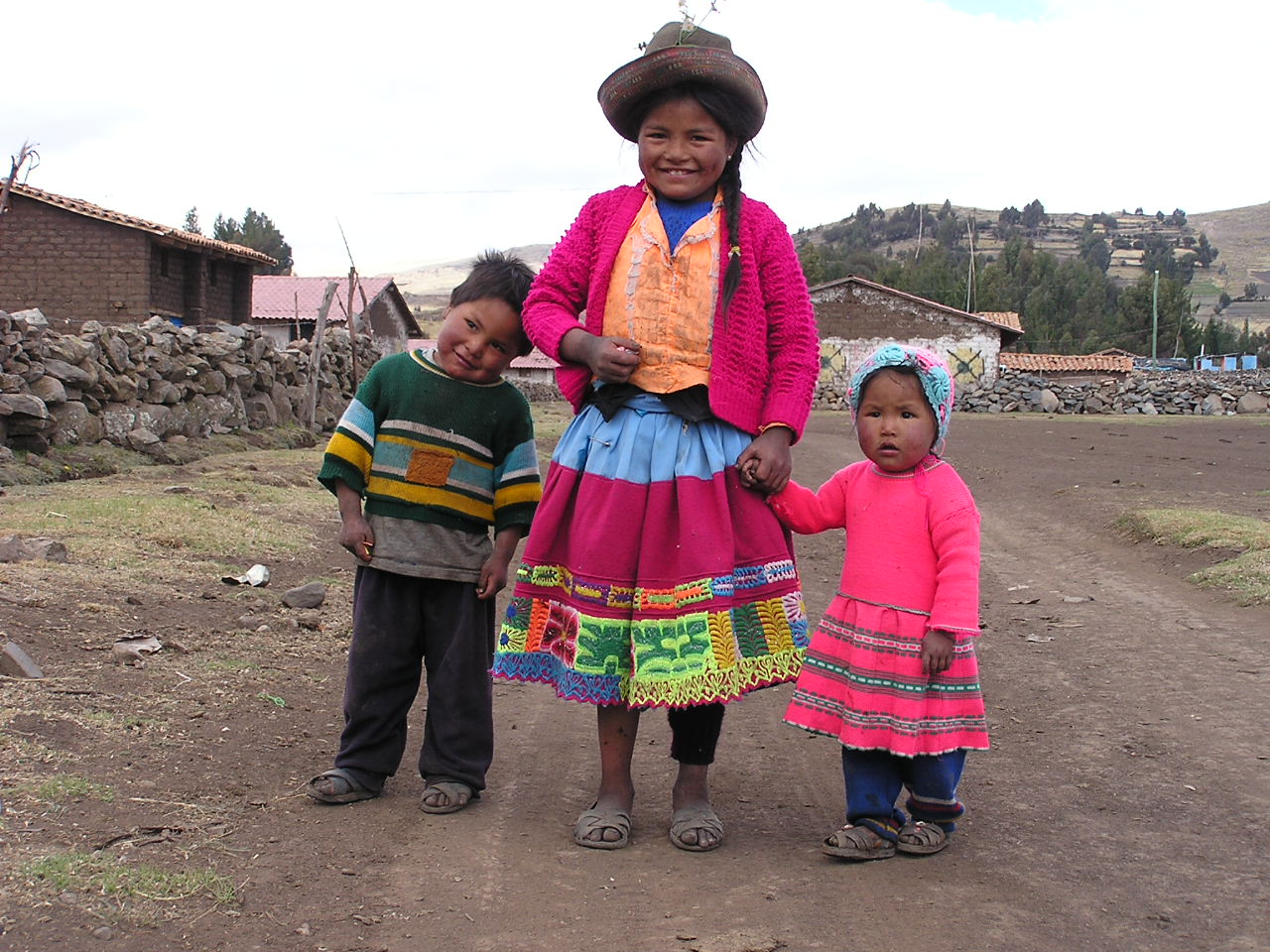
Kids in Pampamarca, Peru.  The majority
of those killed during the conflict were
from indigenous communities like this in the highlands

It was November 2002 and I was sitting in a small conference room in Lima, taking notes as a woman tearfully relayed the story of her 9 years in detention. As she spoke, low and soft, the woman (who I’ll call Lourdes) cradled a newborn baby bundled in a pink blanket.

I had left my own 9 month old baby at home to lead a volunteer team on a one week trip to Peru to monitor the work of that country’s Truth and Reconciliation Commission (Comisión de la Verdad y Reconciliación or CVR). I had just recently returned to work after an extended maternity leave and, I have to say, I count those months of being at home with a potty-training toddler and a nocturnal infant as some of the toughest of my life.

Our team was interviewing Lourdes and several other inocentes or “innocents”. Between 1980 and 2000, the conflict between the Peruvian government and the Sendero Luminoso (Shining Path) and Tupac Amaru Revolutionary Movement (MRTA) rebel groups resulted in approximately 69,000 people killed and disappeared. As many as 600,000 were internally displaced; I remember seeing the tent cities on the outskirts of Lima where thousands of people who had fled the political violence in the highlands had lived for twenty years.

Lourdes was one of more than 14,000 Peruvians who were detained, tortured, and denied a fair trial under 1992 anti-terrorism decrees. She told us about the day she was arrested in early 1993. She and her husband were students. They had a three-and-a-half year old son who had health problems, so she had left the house before daybreak to get medicine for him. As she was returning to her house, she was stopped and arrested by the National Directorate Against Terrorism. It turns out that the Shining Path had bombed a nearby part of Lima. Lourdes and four other women who also happened to be out early that morning were arrested, blindfolded and interrogated. “One police officer told us that all of us would die,” she said quietly. Two hours after they were arrested, they were exhibited to the media at a press conference. The arrest was presented as a triumph over terrorism.

For the first several months, Lourdes was detained on a military base. The conditions were very bad and she was tortured. She didn’t go into the details and we didn’t ask her to tell us more. I remember her saying that she was allowed to use the bathroom only once a day – with 3-4 soldiers pointing their rifles at her. She was only allowed to bathe once a week. Lourdes was later moved to a prison, which she described as looking “like a paradise” compared to the military base.

Lourdes’ husband, who we also interviewed that day, had been arrested a month later. His father had to go to the police station to recover their little son, who was cared for by relatives for the next 9 years. Six months later, one of Peru’s “faceless” courts (called that because a one-way mirror concealed the identity of the prosecutors and judges) found Lourdes and her husband guilty of treason and sentenced them to life in prison.

Lourdes and her husband were not allowed to see each other during their detention and their letters to each other were read. For one whole year during her detention, after her sentence was reduced to 30 years, she was not allowed to have visits from anyone. Eventually, Lourdes and her husband were able to submit their cases to a Presidential pardons panel. She was pardoned in 2001, just a few weeks before the ninth anniversary of her arrest.

The interviews went on for more than six hours, but either Lourdes or her husband held that baby for the entire time. They didn’t put her in her carrier or pass her to the others who offered to hold her. They just took turns holding her close. I remember Lourdes saying to me afterwards, “We lost so much time with our son. Now he is a teenager and we’re strangers to him.”

Lourdes’ story highlights some of the problems of a government response to terrorism that doesn’t provide adequate protections for due process and other rights in the administration of justice. The Peruvian experience with terrorism seemed strikingly relevant back in 2002, when the US human rights community was very concerned about just how far the War on Terror might go. But I also learned an important personal lesson that day.

My friend Jim once had to share an office with an extremely annoying coworker. My friend kept a yellow post-it note stuck under his desk that said, “IGNORE ANTHONY”. Whenever the guy was bugging him, he would stick his head under the desk and read that post-it note. I don’t have a post-it note, but I do have a strong visual image of interviewing Lourdes that day in Lima. Whenever I feel that parenthood is more than I bargained for (which, frankly, was twice yesterday), I pluck that image from my garden of memories and think to myself: “REMEMBER LOURDES”.

If you’d like to learn more:

  • To see photos of life in Peru, go to the photo gallery on The Advocates for Human Rights website (click here.)
  • Some background on the anti-terrorism laws and why the system produced so many inocentes (click here.)
  • There is a 9-minute video summary of the Peruvian CVR’s findings related to the inocentes and human rights abuses in the 1990s: CVR Final Report: Fujimori and the Destruction of Democracy  It provides a good overview, but be advised that it does contain some graphic images.