Pete Seeger & Rise Up Singing!

I can’t remember a time before I knew his voice.  Pete Seeger’s songs are part of the soundtrack of my childhood.  When my own children were young, we sang together his songs “Goodnight, Irene” and “We Shall Overcome” and  “If I Had a Hammer.  Yet, in spite of the fact that Pete Seeger gave thousands of performances, I only saw him in person one time.   He was not on a stage.  He was not with a crowd.  Pete Seeger was standing alone in the rain on the side of the highway near his home in New York’s Hudson River Valley.   Pete Seeger was holding neither a banjo nor a guitar, but instead a large sign protesting the Iraq War.   As we drove by, I noticed that his mouth was open and moving.  “Hey, I think that’s Pete Seeger!”  I said, turning in my seat to continue watching him through the foggy car window.

And I realized that his mouth was moving because – alone in the rain, on the side of a highway – Pete Seeger was singing.  He was singing his heart out for peace in our world.

What I saw that day made me especially thankful to Pete Seeger, not only for his music and his activism, but for his courage and conviction. Pete Seeger is someone who really does make me believe, deep in my heart, that we SHALL  overcome one day.

For Pete Seeger (May 13, 1919 – January 27, 2014)

Rise Up Singing!

(Originally published on October 14, 2011 and updated on January 28, 2014)

History shows the incredible power of music to inspire and influence, to energize and heal.  The power of song can be seen in its impact on movement-building,  from the anti-slavery and  labor union movements in the 1800s to the civil rights and anti-war movements in the 1960s.  Liberation music has been important throughout the world, including songs of resistance during the anti-Apartheid struggle in South Africa.  Most recently, music has been part of this year’s Arab Spring.  In protests against Hosni Mubarak in Egypt, for example, music was a powerful way to convey the voice of the people.  (NPR story did a great story on The Songs of The Egyptian Protest)

I absolutely love Rise Up Singing, the folk music group singing songbook.  The book contains the chords and lyrics to more than the 1200 songs.  When you flip through it, you get a sense of how many songs there are out there that speak to such a wide variety of social justice issues.  Rise Up Singing grew out of Peoples Songs, Inc., Sing Out! The Folk Song Magazine and the post-World War II American folk song movement led by Pete Seeger and Woody Guthrie, and many others who sought to combine political activism with music.

But music that inspires me to stand up for human rights is not just about protest songs or folk music.  Music speaks to the individual. Inspiration is personal.   In 2006, I was in Geneva with representatives from dozens of U.S. human rights groups to participate in the UN’s review of  US compliance with the International Covenant on Civil and Political Rights.  We were all working on different issues and we came from all over the country, from Florida to Hawaii.

As an icebreaker at our first meeting, we were asked, “What is your favorite human rights song?”  I remember being amazed as we went around the room at the tremendous variety in terms of songs, genres, languages, meanings that had inspired this group of activists.   I told the group that my song was “If I Had a Hammer”.  (My kids were still quite young at the time and we were listening to a lot of Pete Seeger, who is my own personal antidote to Barney.)
Since then, I’ve been making a mental playlist of the songs that have inspired me over the years.   My list of songs is actually long enough for several playlists, but I decided to pull out just a few songs from each of the eras of my life so far.  This was a real challenge and there are a lot of obvious omissions.  Maybe I’ll just have to do another playlist someday.  In the meantime, I’ve got the HUMAN RIGHTS WARRIOR PLAYLIST for you on YouTube.  You can also link to each song individually below.   Enjoy!

From My Childhood

  1. If I Had a HammerPete Seeger      (See above. Pete >Barney.)
  2. Free to Be You and Me   – Marlo Thomas & Friends     In my opinion, one of the best things about being a kid in the 70s.
  3. The PreambleSchoolhouse Rock      Did you know that the U.S. Constitution is one of the first documents to establish universal principles of human rights?
  4. Star Wars Main Title/Rebel Blockade Runner – John Williams   People say Star Wars was a Western set in space, but I saw the Empire for the police state that it was. Extrajudicial execution of Luke’s family,  arbitrary detention of Han Solo et al. Not to mention the genocide on Alderaan.
  5. FreedomRichie Havens         My parents had the Woodstock album.  I think I know this and every other song on it by heart.
From My Youth 
  1.  Sunday Bloody SundayU2       I first heard this on my high school radio station WBRH. I went right to the library and looked up the 1972 Bloody Sunday Massacre in Northern Ireland. (Yes, I’m a nerd. I know.)
  2. Holiday in CambodiaDead Kennedys      I went through a big DK phase in high school.  Also, I knew a family that had fled the Pol Pot regime.  I still think of them when I hear this song.
  3. Talkin’ Bout a Revolution Tracy Chapman    Growing up in Louisiana, I had seen poverty.   But it didn’t prepare me for the mid-80s urban poverty I saw when I went to college in New Haven.  This song still rings true 25 years later.
  4. Tell Me Why  – Bronski Beat      I remember this as the first song I heard that directly addressed prejudice against homosexuals. Rock on!
  5. Waiting for the Great Leap ForwardBilly Bragg     The lyrics have changed since I first bought Worker’s Playtime (on cassette!) in college, but I think it is possible that I have listened it to 1,000,000 times.
From My Adulthood
  1. All You Facists (Are Going to Lose) – Lyrics by Woody Guthrie, Music by Billy Bragg & Wilco     From the Mermaid Avenue album.  Yes, the Facists are bound to lose some day.
  2. HurricaneBob Dylan       Rubin “Hurricane” Carter did an event for us to help raise money for our Death Penalty project.   If anyone ever wants to make a movie about your life, he highly recommends that you ask that they get Denzel Washington to play you.
  3. Living Like a Refugee –  Sierra Leone’s Refugee All Star Band                     I spent the first 5 years of my career working with asylum seekers.   This song captures many of the things I heard about their experiences.
  4. Face Down  – Red Jumpsuit Apparatus     Violence against women is the most common human rights violation in the world – 1 in 3 women will experience abuse in her lifetime.   In the US, a woman is beaten or assaulted every 9 seconds.  Kudos to these guys for singing about it.
  5. MinorityGreen Day      Sometimes I have to remind myself that not everyone thinks the way I do about human rights – yet.
  6. Sons & DaughtersThe Decemberists        This is kind of where I am right now.  With sons and daughter.  Hoping to “Hear all the bombs fade away.”
How Do You Define Family?

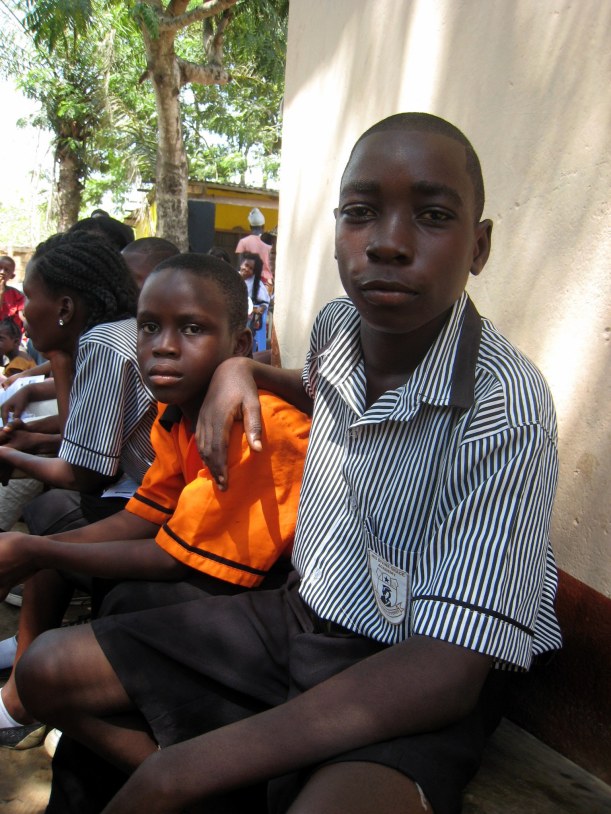
Liberian brothers at the Buduburam Refugee Settlement in Ghana.

A Few Reflections On How We Define “Family”

We had just dropped off my old friend Erik and his unwieldy crew at the airport, when my daughter Eliza let out a dramatic sigh from the back of the minivan.

“It’s pretty much BORING without our cousins!”

Curious, I launched into a lengthy cross-examination to determine why she thought they were our blood relations. She went along with the questioning for a while, mumbling one syllable responses out of the corner of her mouth as she gazed morosely out the window at a long, undulating line of sunflowers. Some kind person, in the interest of beauty, had planted them along the highway.  Now they were more than six feet tall, so large that you could almost see the Fibonacci sequences in their bright spirals. Even from a minivan with a six-year-old pouting in her booster seat in the back.

After several miles of this, Eliza suddenly sucked in air until her cheeks were full.  She then blew it all out, frustration personified.  I watched her in the rearview mirror as she put everything in her small, defiant being into these words:

 “Because!  I just FEEL like they are.”

How do you define family?  Is it common ancestry? Shared experiences?  Mutual commitment? Living in the same household? Common values?  The people you know you can count on for support? The people you know you can get into a knock-down-drag-out fight with but they’ll still love you?  People who you feel deeply connected to even though you rarely see them?  All of the above?  Or none of them at all?

The boys in the photo above are brothers I met at the Buduburam Refugee Settlement in Ghana.   Their mother Kebbeh considers them her sons, although only the oldest is her biological son.   The younger boy and his little brother (not pictured) are her neighbor’s sons.   The neighbor had gone back to Liberia with the first wave of resettled refugees, with the promise  to send for the boys after she got settled. They never heard from her again.   Post-conflict Liberia was dangerous, so they fear the worst.  But they really don’t know what happened to her.   So Kebbeh is raising the boys as her own, feeding and caring for them, sending them to school.  They are family.

When I was in Buduburam, I met a woman called Ma Fatu who ran a cook shop on the main thoroughfare of the camp where many of the refugee-owned businesses were.   The street had no name, of course, but the Liberian refugees called it “Wall Street” because so many financial transactions were made there.  Ma Fatu has a feisty personality.   I think she would have  been equally at home as the proprietor of a saloon in the Wild West or a grogshop in Regency England.  She took a lot of pride in her cooking and in knowing her customers.  She’d eye me critically as I tucked into my jollof rice and say, “I know what you white people like to eat.” Then, the next day, she would dish me up a heaping serving of jollof vermicelli.

I had noticed that there were several young people helping in the cook shop, washing dishes, waiting tables, whatever needed to be done.  It was only on my second trip to Buduburam that someone told me that they were not actually her children.  During the war in Liberia, her husband and her biological children – her entire family – had been killed.  Over the years at Budububuram, she had taken in several young people who had also lost everyone.   In the face of all this loss, Ma Fatu had created a new family.  In a refugee camp – miles from home and without even the possibility of legal recognition – she had forged familial bonds of love and support.

Like every parent, I’ve got a stockpile of my kids’ drawings of our family – stick figures showing Mom and Dad, Brother and Sister.  Sometimes Grandma and Grandpa and/or Cat and Hamster.

When you are young, the definition of family is very narrow and also very immediate.  But as you get older, you develop deeper relationships with people who are not related by blood.  In many ways, you create your own family of the people who give you what you need to flourish.  Like the heliotropic sunflowers, you turn to the light, needing full sun to thrive.  If you don’t, you wither away.

 I’ve had this discussion about the definition of family with a number of my former asylum clients.  Under U.S. immigration law, your family is defined as your spouse (only one – your first spouse), your children by birth or legal adoption, and your parents.  Of course, many people in the world use a broader definition, with half-siblings, cousins, and children adopted without legal recognition counting as immediate family members.

One of my asylum clients once said to me,

“I feel so sorry for you Americans.  Your families are so very small!”

I had never really thought about it that way before.  But I could see her point.

Article 16(3) of the Universal Declaration of Human Rights states that,

“The family is the natural and fundamental unit of society and is entitled to protection by society and the State.”

Back when the UDHR was adopted in 1948, it is doubtful that the drafters envisioned even biracial marriage, much less same-sex marriage and the multiple forms of family that exist today.

But the bigger point, I think, is that no matter how you define “marriage”, the push for the changes in the legal definition has happened because of thousands – maybe millions – of personal decisions by individuals to define their closest relationships as “family”.  The reality is that there is a very human need to live in a family social structure – the natural and fundamental group unit of society.  The law can better accommodate that reality but regardless of what the law says, people – like Kebbeh and Ma Fatu – will create their own families.

Maybe my young  daughter is right. The true definition of family is a very personal one, self-defined by each of us.  The definition of family maybe really IS the people who you feel like are your family.

So I think the real questions for each of us then become:

How do you define your family?

What does your family mean to you? and

Wouldn’t we all be better off if society and the State protected and supported all of our families?

Morocco: Human Rights Violations Under Article 475

Originally published on The Advocates Post

In Morocco, a 15 year old girl experienced constant harassment and threats from a 35 year old man in her town.  He waited for her each day outside of her school and on several occasions told her, “I will force you to marry me.”  One day, he abducted and raped her at knifepoint.  The victim made a complaint to the gendarmes, who arrested the man.  In his statement to the police, the rapist admitted his crime, declaring that he did it “because it was the only way I would be able to marry her.”  In order to avoid scandal, the victim dropped out of school and married him.  “I am raped now every day,” she told members of the local association that works with women survivors of domestic violence.

This tragic story is one of many included in a joint submission The Advocates for Human Rights and our Moroccan partner Mobilising for Rights Associates (MRA) made recently to the United Nations’ Committee on the Rights of the Child.  The submission  draws attention to the serious human rights violations resulting from the application of Article 475 of the Moroccan Penal Code, which  provides that whoever “abducts or deceives” a minor, without using violence, threat or fraud, can escape prosecution and imprisonment if (i) the abductor marries the victim, and (ii) those persons who have a right to request annulment of the marriage do not file a complaint.[1]

Organizations and news reports from Morocco indicate that Article 475 has been applied in cases of sexual abuse of minors in order to preserve the “honor” of the victim and her family.  Notably, this issue has received widespread coverage following the 2012 suicide of Amina Filali, a sixteen year-old girl who killed herself after being forced to marry a man – ten years older than her – who had raped her.[2] Additional news reports confirm that the use of Article 475 continues.[3]  Further, associations working at the local level in Morocco report that girls married under Article 475 continue to suffer rape and domestic violence after the marriage.

Information from our Moroccan partners illustrates the extent of the problems with the application of Article 475. One local association that works with women reported that, of 11 cases involving rape of a minor that they handled in 2013, Article 475 was raised in 6 cases; the age of the victims ranged from 14-17, while the age of the rapists ranged from 23-28.[4]  In one case, a 14 year old girl was raped by her 28 year old cousin, and she became pregnant as a result.  She sought help from the association to file a criminal complaint, and there were several court hearings.  DNA testing established that the accused was the rapist.  Under Article 475, the two families agreed on a temporary marriage between the rapist and the victim to avoid shame, with a predetermined divorce date after one month of marriage.[5]

Associations working at the local level in Morocco report that the young victims experience tremendous pressure to abandon criminal prosecution and agree to the application of Article 475  from law enforcement, justice system personnel, as well as the families of the perpetrators. Even their own families pressure them to agree to marriage under Article 475 in order to avoid shame. Because all sexual relations outside of marriage are illegal under the Moroccan Penal Code,[6] victims also fear prosecution and imprisonment under Penal Code Article 490.[7] In fact, one Moroccan association reported several cases of rape victims who filed complaints to initiate criminal prosecution but were prosecuted themselves under Article 490.[8]

In one instance, a 15 year old girl was raped by a 25 year old man.  She became pregnant as a result of the rape, which is considered proof of illicit sexual relations.  She did not want to file a criminal complaint because she feared prosecution under Article 490, so she fled her home and sought shelter through a local Moroccan association.  The rapist’s family made threats against the victim’s mother, however, and she was pressured to not file a criminal complaint and to marry the rapist under Article 475 instead.[9]

Article 475 must be understood in the context of early marriage in Morocco.  While the legal age of marriage for both men and women is now 18 in Morocco,[10]the Family Code allows the marriage of minors when “justified” and after substantial control by the Family Affairs judge.[11]Both the number of petitions for authorization to marry minors and the approval rate are high and increasing.  In 2007, 10.03% of marriages were of minors, and 86.8% of the 33,596 petitions were authorized.[12]  In 2011, the rate had risen to 11.99% of all marriages and 89.56% of 46,927 petitions for authorization to marry a minor were granted.  33.58% of petitions in 2011 were for minors ages 14-16[13].  The overwhelming majority of the minor spouses, 99.31%, were girls.[14] The Family Code provides no threshold minimum age below which authorization to marry may never be granted.  Local NGOs report marriages of girls as young as thirteen, fourteen and fifteen.[15]

In practice, judges often issue authorizations based on their own cursory visual examination of the minor girl’s physical appearance and determination that she is capable of assuming “marital responsibilities,” rather than resorting to the required expertise.[16]  Reasons advanced by judges for authorizing underage marriage include saving family honor, avoiding scandal, protecting the girl’s chastity and preventing her from debauchery.  Some even cite marriage as a solution to poverty.  At times judges do not even substantiate their decisions in writing.  Corruption among public actors and the ease by which medical certificates attesting to the minor girl’s “maturity” can be obtained are also factors allowing circumvention of the law.[17]

In spite of the reality of early and forced marriage for young Moroccan girls, the Moroccan Government made statements in recent United Nations submissions that Article 475 does not apply to, and has not been applied in, cases of sexual abuse of minors.  For example, in response to the most recent concluding observations of the Committee Against Torture, the Moroccan Government stated that Article 475 does not apply in cases of sexual abuse and that there is no statutory text in Morocco that exempts the “perpetrator of child rape from punishment when he makes the child concerned his wife, because anyone who commits rape is punished in all instances, even when he marries the victim of rape.”[19]  The Moroccan Government further stated that Article 475 “is not applicable to rape but rather to the crime of the abduction of a minor who leaves the parental home to be with someone and agrees to marry him.”[20]

In other words, in the Moroccan Government’s view and in contrast to the many reports originating from Morocco, Article 475 is intended to address situations involving marriage without the consent of the family where the prosecution for abduction of a minor can be dropped if the victim’s family withdraws the complaint to “maintain good family relations and to protect the make-up of the family if arresting the husband could lead his minor wife to lose any chance of a normal life.”[21]

On January 22, 2014, Morocco’s Parliament voted to abolish paragraph 2 of Art. 475.  While this is a positive step, and certainly a victory to be celebrated, the bill that was approved unanimously this week only abrogates the exoneration through marriage provision.   It does not change the rest of Art. 475 which provides that a man convicted of statutory rape in Morocco is still only subject to a few years in prison and a small fine.   It does nothing to impact the larger problems faced by minor girls who experience sexual abuse or early marriage in Morocco.

The Moroccan government must go further to protect the rights of women and girls.   Given the factual situation on the ground in Morocco and the clear violations of Morocco’s obligations under the Convention on the Rights of the Child, the Moroccan government must:

  • Amend Morocco’s Penal Code and Penal Procedure Code to facilitate procedures for bringing sexual abuse and rape of minors cases, including eliminating discriminatory legal provisions that require proof of actual physical injury and place heavy burdens of proof solely on the victim.
  • Amend Morocco’s Penal Code to abolish criminal prosecutions under Article 490 for “illicit sexual relations.”
  • Develop and implement a plan for educating the judiciary and public that criminal proceedings against rapists will not be terminated if they marry their victims and that Article 475 is not to be applied in cases of sexual abuse and rape of minors.
  • Penalize all acts to encourage, pressure, or threaten minors to marry, whether by public or private actors.
  • Amend Morocco’s Family Code to establish clear and objective criteria under which judicial authorizations for the marriage of minors may be granted in only exceptional cases, and in all events establish a threshold minimum age under which authorization to marry may never be granted.

Related post:  Amina Filali and Violence Against Women in Morocco


[1]Dahir n° 1-59-413 du 28 joumada II 1382 (26 novembre 1962) portant approbation du texte du code pénal, as amended, (« Penal Code »), Art. 475: 1) Quiconque, sans violences, menaces ou fraudes, enlève ou détourne, ou tente d’enlever ou de détourner, un mineur de moins de dix-huit ans (Article modifié par l’article premier de la loi n° 24-03 modifiant et complétant le code pénal, précitée), est puni de l’emprisonnement d’un à cinq ans et d’une amende de 200 (cf. supra note correspondant à l’article 111)  à 500 dirhams. 2) Lorsqu’une mineure nubile ainsi enlevée ou détournée a épousé son ravisseur, celui-ci ne peut être poursuivi que sur la plainte des personnes ayant qualité pour demander l’annulation du mariage et ne peut être condamné qu’après que cette annulation du mariage a été prononcée.

available at http://adala.justice.gov.ma/FR/Legislation/TextesJuridiques.aspx.

[3]See, e.g.,http://www.illionweb.com/larticle-475-tue-toujours/, http://www.illionweb.com/bouchra-victime-gang/, and http://www.yabiladi.com/articles/details/21035/tetouan-fille-suicide-apres-avoir.html.  In addition, one association working with MRA reported that their region of Morocco alone, three girls married under Art. 475 had recently tried to kill themselves. Written Communications to MRA and The Advocates for Human Rights from Moroccan NGOs (5 December 2013).

[4]Written Communications to MRA and The Advocates for Human Rights from Moroccan NGOs (5 December 2013).  In the same Written Communications, another association from a different region reported that Article 475 was raised in 3 of 5 rape cases that they handled where the victim was a minor.  A third association reported their experience that in 6 cases where Article 475 was raised since 2011, the average age difference between the victim and the rapist was 10 years (with victims ranging in age from 14-17 and rapists from 23-28). Id.

[5]Id.

[6]Dahir n° 1-59-413 du 28 joumada II 1382 (26 novembre 1962) portant approbation du texte du code pénal, as amended, (« Penal Code »)art. 490.

[7]Written Communications to MRA and The Advocates for Human Rights from Moroccan NGOs (5 December 2013).

[8]Id.

[9]Id.

[10] Dahir n° 1-04-22 du 12 hija 1424 (3 février 2004) portant promulgation de la loi n° 70-03 portant Code de la Famille («Family Code ») art. 19.

[11] The authorization is not subject to appeal. Id. art. 20.  Article 21 also requires the legal tutor’s (guardian’s) consent.Id. art. 21.

[13]Id.  Note that these numbers are consistent with information from the local level.  One local association that works with MRA reported that from January to November 2013, the First Instance Court in Khemisset granted 325 of 442 petitions for authorization to marry minors.  Written Communications to MRA and The Advocates for Human Rights from Moroccan NGOs (5 December 2013).

[15]Ligue démocratique de défense des droits des femmes (LDDF), Droits des femmes et code de la famille après 4 ans d’application(2007).

[16]Interviews with Local Morocco NGOs, (May 2012 – December 2013).

[17]Abdellah Ounnir, Les justiciables dans le circuit judiciaire relatif au contentieux de la famille, inLe Code de la famille: Perceptions et pratique judiciaire, pp. 89-139 (Morocco: Friedrich Ebert Stiftung, 2007);Démocratique des Femmes du Maroc(ADFM), Implementation of the CEDAW Convention: Non-Governmental Organisations’ Shadow Report to the Third and the Fourth Periodic Report of the Moroccan Government(Nov. 2007).

[18]In January 2013, the Justice Minister made a statement to the effect that he would not oppose proposed modifications to 475. A bill (sponsored by MPs) to modify and complete article 475 was adopted by the Council of the 2nd Chamber of Parliament and  transferred to the relevant Committee on legislation within that Chamber for review on January 29, 2013.  This bill would increase the penalties, eliminate the 2nd paragraph of 475, and reinforces the link between 475 and the later sexual abuse of minors articles in the Penal Code.  A second bill (sponsored by MPs) presented in the 1st Chamber would eliminate the 2nd paragraph of 475 (among other modifications to the articles on sexual abuse), but the version adopted by the legislation committee had eliminated these reforms.  Another bill (sponsored by MPs) for a VAW law in 1st chamber that would cancel 475 among its 35 articles was transferred for review to the legislation committee in February 2013.  The current status of these three bills is unknown and it is unclear what subsequent steps if any have been taken on these three bills.  A proposed VAW bill submitted by the Family Minister to the Government Council (and tabled) did not contain any modifications to Article 475. See http://www.medias24.com/POLITIQUE/5975-Benkirane-desavoue-Bassima-Hakkaoui.html.  Most recently, on January 8, 2014, the Committee on Justice, Legislation and Human Rights in on of the Parliament’s chambers voted to abolish paragraph 2 of Art. 475.  See http://www.aujourdhui.ma/maroc-actualite/societe/viol-des-mineures-au-maroc-une-loi-debattue-au-parlement-107202.html www.yabiladi.com%2Farticles%2Fdetails%2F22289%2Fviols-mineures-deputes-annulent-l-alinea.html&h=1AQFFOSTM

[19]U.N. Committee Against Torture, Consideration of Reports Submitted by States Parties Under Article 19 of the Convention, Information Received From the Government of Morocco in Response to the Concluding Observations of the Committee Against Torture, para. 111, CAT/C/MAR/CO/4/Add.1(9 September 2013).

[20]Idpara. 112.

[21]U.N. Committee Against Torture, Consideration of Reports Submitted by States Parties Under Article 19 of the Convention, Information Received From the Government of Morocco in Response to the Concluding Observations of the Committee Against Torture, para. 112, CAT/C/MAR/CO/4/Add.1(9 September 2013).

12 1/2 Clichés I Want My Kids to Live By

IMG_2110

You’ve heard ’em all before. Clichés are a popular form of expression used throughout the world.  There are many sayings that are so overused that we barely even notice them anymore.  I started to think about clichés recently because of The Loud Talking Salesman guy who works in the office next to mine.  He seems to speak entirely in clichés. The wall must be thin, because all day long I hear him on the phone with clients telling them that “at the end of the day” “it’s a win-win situation” etc etc.   (I’ve never met him, but if I ever do, I’ve already planned what I’m going to say:  “Working hard?”  To which he will most certainly reply, “Hardly working!”)

Once I started actually paying attention clichés, I noticed that we are not only constantly verbally but also visually blasted with them.  Clichés are plastered all over the place, on everything from bumper stickers to throw pillows to Pintrest. Some clichés are silly or sappy or just plan wrong.  But if you stop and think about it, some of them make a whole lot of sense.

Many clichés are, in fact, the moral equivalent of Tootsie Pops – they have a sweet, chewy truth at their center.  Some of them are actually pithy, shorthand statements of deep wisdom.   Some clichés embody true lessons about living an ethical, fulfilling, righteous and joyful life in community with other humans.  In some ways, these clichés are shorthand for the life lessons that I am trying to teach my children so that they will grow up to be citizens of the world, fully empowered to exercise both their rights and their responsibilities.

So on the theory that “The way we talk to our children becomes their inner voice,” I decided to write down some of the clichés that I want my kids to actually remember and use when I’m no longer around to nag them.

“From those to whom much is given, much is expected.” 

One of the most misquoted sayings of all time, I’ve seen this clichés attributed to everyone from Voltaire to Bill Gates’s mom.  While  John F. Kennedy did say,  “For of those to whom much is given, much is required,” the saying actually comes from the Parable of the Faithful Servant (Luke 12:48) in the Bible.  “To whomever much is given, of him will much be required; and to whom much was entrusted, of him more will be asked.”

The point for my children is this – you have been blessed with intelligence, a loving family, comfortable home, health and so much more.  You each have different talents and strengths.  It is your responsibility to use  your gifts not just for your own benefit, but also to help others.

“You are what you eat.”

If you eat garbage, you feel like garbage.  I’m serious – eat your fruits and veggies, kids!

IMG_0475

“Think before you speak.”

Or send an email or post something through social media.  Count to 10 in your mind before you open your mouth.   Write it out, but wait until the morning to send that email.  Hurtful words, once said, are hard to take back.  Of course, the corollaries to this cliché are:

“If you can’t say something nice about someone, don’t say anything at all.”

and  

“If you are thinking something nice about someone, go ahead and say it.”

OK, that last one is technically not a cliché since it is not overused.  I count it as half cliché since I made it up myself when I was 18.  I was a camp counselor and I lived in a cabin with another counselor that I didn’t get along with particularly well.  But one day, when I was brushing my teeth, I heard her singing in the shower.  She had a beautiful voice that I had never noticed.  As I brushed my teeth, I remember thinking that I should just tell her.  Why keep those nice thoughts to myself just because I we didn’t like each other?  It was hard for me, but I did tell her.  I was surprised how appreciative she was at the compliment.  And while we never became friends, we did get along fine for the rest of the summer.

“Be the change you want to see in the world.”  

Don’t just sit around wishing or waiting for things to change things.  YOU can create change yourself through your own actions.  (This quote is usually attributed to Mahatma Gandhi, although there is no reliable evidence that he actually  said it.  Gandhi did say “If we could change ourselves, the tendencies in the world would also change. As a man changes his own nature, so does the attitude of the world change towards him. … We need not wait to see what others do.”)

It’s worth pointing out that Dr. Seuss wrote the same thing more directly in The Lorax: “Unless someone like you cares a whole awful lot, Nothing is going to get better. It’s not.”

“Don’t Postpone Joy”  

No, I don’t mean the “go ahead and buy those really expensive shoes to make yourself happy” kind of joy (although it is important to treat yourself somtimes.  I mean the “Daddy quit his job and moved to Minneapolis to be with me”  kind of joy.   Because your Daddy did do that.  He didn’t have a dramatic boombox scene like Lloyd Dobler in Say Anything, but it was the same kind of going after love and joy thing. (This reminds me to add Say Anything to my list of Movies I Want My Kids to See.)

And while we are on the subject:

‘Tis better to have loved and lost, Than never to have loved at all.  

I know that this one is often up for debate, but I think it is true.  Even if your heart ends up getting broken in the end, the experience of loving another is worth it.  It is worth taking a risk.

IMG_2117

“The best way out is always through.”

Robert Frost is credited with this one.  Rather than avoiding a problem,  it is always best to confront it directly.  You can spend more energy fretting about it than it would take to just deal with it.  In the long run, it is less painful to just do what you need to do to get through it.

“A good laugh and a long sleep are the two best cures for anything.”

I don’t have much to say about this one other than I believe it in, deep down in my bones.  The same goes the the next one:

“Speak the truth, even if your voice shakes.”

speak

“Better late than never.”

It’s never to late to fix past wrongs.  Remember Darth Vader and what happens at the end of Star Wars Episode VI?  Redemption.  But it is also never to late to go down a different path.  Every day has the potential to be a fresh start.  As George Eliot wrote,  “It is never too late to be what you might have been.”

“Always look on the bright side of life.”

It’s been my experience that a positive attitude really does help you in life.  Everyone gets down and has rough patches; that’s perfectly understandable.  You don’t have to be cheerful all the time.  But in the macro sense, try to be an optimist.  It’s a worldview that will get your farther in the long run.  As Sir Winston Churchill once said, “A pessimist sees the difficulty in every opportunity.  An optimist sees the opportunity in every difficulty.

 TO BE CONTINUED …

I’ve got more clichés I want my kids to live by, but I’d love to hear from others about clichés that hold important life lessons for them.   I will end with, not a cliché, but a quote from A. A. Milne.  Christopher Robin is talking to Winnie-the-Pooh and he says (in your mother’s voice):

“Promise me you’ll always remember:

You’re braver than you believe,

and stronger than you seem,

and smarter than you think.

P.S. Also remember:

IMG_2113

Rainbow Looming Our Way To Gender Equality

IMG_0820

There are little plastic rubber bands all over our house.  On my way upstairs this morning, I noticed them strewn on the stair treads like colorful flower petals after a spring storm.  That’s because my 11 year-old son spent more than an hour yesterday at the top of the stairs, “where the light is good”, perfecting his starburst bracelet on the Rainbow Loom.   Technically, it’s his 8 year-old sister’s, but his Rainbow Loom will be arriving tomorrow via Amazon Prime.  He used some of his Christmas money to buy one for himself.

Anyone with kids in elementary or middle school will understand what I’m talking about, but this is something worth talking about even if you don’t have kids.   The Rainbow Loom has been popular for months. What is striking for me as a parent, however, is that this is a toy that is equally popular with both boys and girls.  Of the more than $3 million in sales since August, almost half of the Rainbow Looms reportedly were purchased for boys.

I first noticed the Rainbow Loom’s gender-neutral popularity last month at a PeeWee hockey tournament.  Since the tournament was out-of-town, the team and their families were all staying at the same hotel.  I noticed that all of the younger siblings – especially the boys – were prodigious Rainbow Loomers.   A group of younger brothers, all 9 and 10, were Rainbow Looming by the pool.  Later that night, they were Rainbow Looming at the rink before the game.

“Do the guys on your team like to Rainbow Loom, too?”  I asked my son.  He’s one of the youngest on his PeeWee team; most of the boys are already 12.

“Sure,” he said.  “But we didn’t have much time for it this weekend. You know, because we had to focus on hockey.”

Before my oldest son was born 14 years ago, I thought I could raise my kids in a gender-neutral way.  I had a wide range of toys on hand for him to choose from, including a baby doll.  But he and his younger brother showed no interest at all in playing with dolls or stuffed animals or Barbies or anything like that. When I caught them drop-kicking the doll, I finally gave it away to a more loving home.   By the time our daughter was born, we had no toys left that could be characterized as stereotypically female.   That is, until the day that I found her cradling a Darth Vader action figure.  She was kneeling next to a bowling pin that she had put to bed with a Kleenex for a blanket.   The premise of my nurture v. nature theory having been blown out of the water, I took her to Target and let her pick out a baby doll.  At eight, she is still taking excellent care of her “family”.

The bigger lesson for me was that kids will choose to play with what is interesting to them.   My kids inherited a substantial Hotwheels collection from my brother, but the boys never played with them much.   My daughter has always enjoyed playing with the cars, although she often plays with them differently.   Sometimes I’ll find them all lined up by color, for example.  Instead of making car noises like “Vroom! Vroom!”, the conversations I’ve overheard coming out her room are about relationships.  “Oh, Baby car!  Are you lonely? Do you want to park by Mommy car?”

Toy choice is the single most sex-typed behavior that children display.   Sure, my daughter chooses the stereotypical feminine toy most of the time.But the point is that she should be able to play with any toy and in any way that she wants to, regardless of what our society traditionally dictates as the appropriate gender-based toys.  And that goes for her brothers, too.

This holiday season, my daughter and I talked a lot about the gender-based marketing of toys.  It’s especially noticeable in the toy section – some stores even have aisles blatantly identified with pink for girls and blue for boys.   On the same toy aisle where she picked out her first baby doll, we noticed a ultra-pink display for “Lego Friends”.  My daughter, unimpressed at this new line of Legos marketed to girls, observed that,  “I don’t get it. It seems like they should just sell all the Legos in the same aisle.”

Which brings me back to the Rainbow Loom, a toy that has grown tremendously popular without much marketing at all. Rainbow Loom is popular because of word of mouth and YouTube.  Kids decided it is cool and fun to Rainbow Loom, and they shared that information (along with the colorful, plastic bracelets) with each other.

I witnessed something similar last summer when my son and the other boys at camp were obsessed with fingerweaving.  I have a mental picture of a group of them, all 11 and 12 years old, sitting around and fingerweaving during their free time.  In the middle of the circle was a huge mound – yards and yards and yards – of their collective fingerweaving.  Every once in a while, someone would call out, “I need more yarn!” and someone else would make a run for the craft room.  Fingerweaving was cool and fun in their social context and everyone, regardless of sex, was doing it.

I see the same phenomenon with the Rainbow Loom.  When tween boys are making jewelry at the hockey rink, you know it is not a popularity bogged down by gender-stereotypes.

“Why do you like to make things on your Rainbow Loom?”  I asked my daughter.   “Because it is creative and fun!” she replied.

When I asked my son the same question, he replied,  “Because it’s fun.  And creative.”

That pretty much says it all.   In a gender-biased world, they found a gender-neutral toy that they both love for the same reasons.   So I ordered them each a new package of 1800 colorful little rubber bands.  I won’t even mind picking them up off the floor.

The Rainbow Loom – and the kids that have made it wildly popular – give me hope.  Hope that this generation will keep our society moving, slowly but surely,  towards gender equality.

Repeat The Sounding Joy

20131225-202103.jpg

Human Rights Day Activities To Do With Your Kids

This post was originally written for World Moms Blog.

IMG_1800Every December 10, people around the world celebrate Human Rights Day.  The date was chosen to honor the United Nations General Assembly‘s adoption on 10 December 1948 of the Universal Declaration of Human Rights (UDHR), the first global statement of international human rights principles.  As we have done on World Moms Blog before (see 10 Things to Do With Your Kids on Human Rights Day), we’re sharing some ideas for simple yet meaningful ways for your family to celebrate the rights and responsibilities that we all share as human beings.

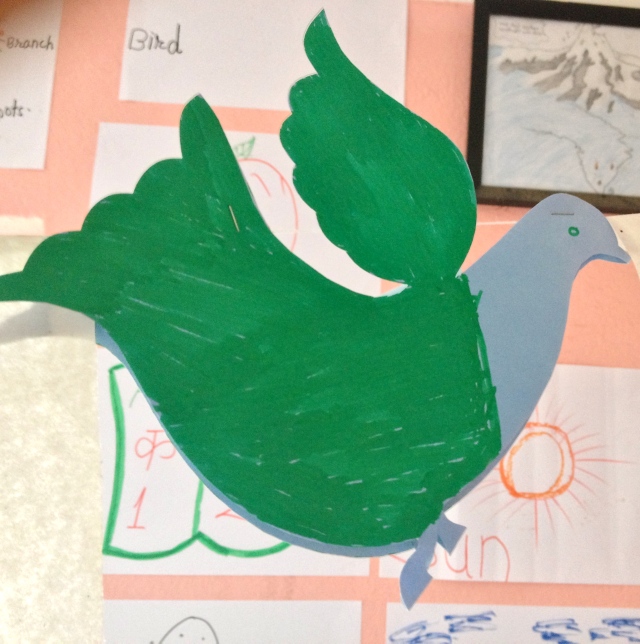
1.  Make a World Wishes Dove with your family.  Cut feathers from white paper or colored construction paper.  Have everyone in the family decorate and write their wish for the world on a feather.    Cut out the body of a dove or other bird and glue all the feathers on it.  Once decorated, your bird will be a beautiful and hopeful expression of your family’s hopes for our world.

Template for a doveImage Source
Template for a dove
Image Source
2.  Play a game that helps kids understand human rights.  Blind Trust (from ABC – Teaching Human Rights):  In pairs, have one child blindfold the other and have the sighted member of the pair lead the “blind” one about for a few minutes. Make sure the leading child is not abusing the power to lead, since the idea is to nurture trust, not to destroy it. The “leader” of the pair should try to provide as wide a variety of experiences as possible, such as hav- ing the “blind” partner feel things with his or her feet or fingers, leading with vocal directions or even playing a game. After a few minutes have the children reverse the roles and repeat the process so that the “leader” is now the led, and the “blind” partner is now the sighted one.

Once the activity is over, allow the children to talk about what happened. Discuss how they felt – not just as “blind” partners but their feelings of responsibility as “leaders” too. This can lead not only to a greater awareness of what life is like for people with sight (or hearing) disabilities, but to a discussion of the importance of trust in the whole community. This can lead in turn to a discussion of world society, how it works and how it can fail to work too.  (teaches about Universal Declaration of Human Rights article 28; Convention on the Rights of the Child articles 3, 23)

3.  Learn about how children live in other countries.  For example, you can learn what kinds of food children in East Africa grow and eat from the Lessons from Africa resource created by the British non-governmental organization Send A Cow (also check out their website http://www.cowforce.com).  You can download the  powerpoint  about typical East African food.   You can also print out some of the recipes for things like chapatis and pepper soup to make and try for yourself.

4.  Find out what kids and teens can do to help stop child labor.  The ILO’s Youth in Action against Child Labour campaign has ideas, information,  videos and other resources to help young people take action to end child labor.

5.  Play Human Rights Twister to teach about cooperation, respect and inclusion.   Make a “Twister” game in which kids spell out key human rights words using their feet and hands.  Draw a grid with 6 columns and 5 rows with marker on a  large piece of cloth (like an old sheet) or plastic (like a plastic tablecloth). You can also use chalk to draw it on the ground. Write the following letters in the grid:

(blank) W X Y Z(blank)


Q R S T U V

K L M N O P

E F G H I J

(blank space)A B C D(blank)

Ask the children to name some rights and list them on a large piece of paper or whiteboard. Underline a key word in each right from this list of rights in one word:

Dignity            Education            Equality             Food            Freedom            Home            Love (from parents)            Name

Nationality          Opinion          Participation (in decisions that affect us)          Play          Protection          Religion

When you have listed at least 3 or 4 rights, have the children spell out the key word in the human right from the list by placing their hands and feet on the  appropriate letters of the “Twister” game.  When 1 child’s hands and feet are in place and the word is not yet completed, ask another child to join in  to complete the word. If the hand or foot of another  child already covers a letter, the player just has to touch the child that is on that letter.  When a letter is too far to reach, invite another child to join in.  (This activity and dozens of others to teach about human rights values and peaceful conflict resolution are available for free download in the Canadian organization EquitasPlay It Fair Toolkit. )

6.  Make toys and play games that children play in other countries.  Many kids throughout the world live in poverty and don’t have money to buy toys and games.  They make their own toys out of recycled materials that they find.  Your kids can try making a football (soccer ball) out of recycled plastic bags or a toy car made from a plastic bottle.

http://vimeo.com/39763894

You can also  make and play the Sudanese game “Dala” (the Cow Herder Game).  In many parts of the world, games mimic everyday life; this game mimics the Sudanese practice of bull herding.  Sudanese people play it on the ground, using sticks to make the lines and pebbles or seeds as “bulls”.

7.  Ask the question “What Does a Child Need?”  Have your child lie down on a large piece of paper and trace their outline on the paper.  Ask your child(ren) to name this paper child. Discuss and decide on the mental, physical, spiritual and character qualities they want this ideal child to have as an adult (e.g. good health, sense of humour, kindness) and write these qualities inside the outline. They might also make symbols on or around the child to represent these ideal qualities (e.g. books to represent education). Talk about what human and material resources the child will need to achieve these qualities (e.g. if the child is to be healthy, it will need food and health care); write them down on the paper outside of the outline.  You can also read a simplified version of the Convention on the Rights of the Child (available in English, French, Spanish, Russian, German, etc.)  When children hear an article that guarantees a child each of the needs they have listed, they can write the number of the articles next to that item. Circle any needs identified but not covered by the Convention.

DSC_0599


8.  Read some books with strong female characters.   Non-discrimination and equality are key concepts in international human rights law.  Yet girls and women are generally not been portrayed as equals to boys and men in literature.  A Mighty Girl has compiled several great lists of girl-empowering books, including Top Read Aloud Books Starring Mighty Girls,  Top 100 Mighty Girl Picture BooksTop Graphic Novels Starring Mighty Girls, and Top Mighty Girl Books & Films on Women’s History.

9.   Get creative and enter your work in a contest with a human rights theme.   Local, regional or international contests are powerful activities for getting youth involved and learning about human rights.  Take action by entering some of the contests listed here on the Youth For Human Rights website.  (You can also learn more on the website about their educational programs, projects, awareness campaigns and human rights outreach campaigns.)

10.  Make a Human Rights Day card.  You can give the card to a friend or member of your family.  Or you can make multiple cards to decorate your house.   My eight year old daughter (that’s her self-portrait in the background) made this card for all the children of the world.

IMG_1502


ADDITIONAL RESOURCES:  You’re on your way to a great Human Rights Day!  If you are a classroom teacher or homeschooling your kids (or if you just want to dig deeper), you can find tons more ideas through the following resources:

My past posts on Human Rights Day activities:

United Nations Cyber Schoolbus – human rights activities and information about the United Nations’ work

ABC – Teaching Human Rights – practical activities in English, French, Russian, Arabic, Chinese, and Spanish from the UN Office of the High Commissioner for Human Rights

The Advocates for Human Rights’ Discover Human Rights Institute – human rights education lesson plans and curriculum

Human Rights Here and Now  – human rights lesson plans and resources

Raising Children With Roots, Rights and Responsibilities – activities for preschool and young elementary children

UNRIC’s Human Rights Education website –  great source for multimedia on human rights!

The Meaning of Mandela

Mandela memorial painted on a building in Capetown, South Africa
Mandela memorial painted on a building in Cape Town, South Africa

When Nelson Mandela died last week, I was struck by the somewhat impersonal nature of the “continuous live” media coverage.  In the United States, I heard interviews with reactions from world leaders, I saw billboards with quotes from Oprah Winfrey and Maya Angelou about what Mandela meant to them.  We now, apparently, memorialize our greatest heroes in memes, soundbites on photos which we share and share again.    But what I really wanted to know was this:

“What are the people of South Africa feeling right now? How are they mourning the loss of the father of their nation?”

As it turns out,  my brother Jeremy is in Cape Town, South Africa.  He started sending back photos of the makeshift memorials that were springing up around the city. Touching tributes, both large and small, that showed the genuine love and respect felt for this man.   Jeremy is a professor of African history, so I asked him to share his thoughts about Nelson Mandela along with his photos.  

Rocked our World
Madiba You Rocked Our World

The Meaning of Mandela

by Jeremy Prestholdt

I arrived in South Africa a few hours after Nelson Mandela’s passing. The nation had only just begun mourning, but the way in which the former president had touched the lives of all South Africans was plain. From Soweto to Sandton, Cape Town, and Qunu, the outpouring of grief and appreciation was unlike anything I’d seen. While I knew that Mandela was revered, the deep respect for him that I’ve witnessed over the past days suggests that he was far more than a popular leader: he personified the myriad aspirations of South Africans.

Nobel Peace Prize
Nobel Peace Prize

As a professor of African history I often tell Mandela’s story. For decades Mandela was vilified as a terrorist. After he traveled to Algeria for military training, many in South Africa called for his execution. Rather than hanging Mandela, the Apartheid government tried to make him irrelevant by condemning him to a life of hard labor. During his nearly three decades in prison he became an icon in the struggle against white minority rule in Africa.

Mandela’s release from prison in 1990 was a watershed in the fight against Apartheid. Yet, it was his adroitness in navigating the path to national freedom that cemented his place in the hearts of all South Africans. Unlike most political leaders, Mandela had an extraordinary ability to balance justice with reconciliation. By drawing on this skill he accomplished what many deemed impossible: he steered a deeply divided and unequal society towards peace and greater freedom. For this Mandela earned universal appreciation as well as the title Tata (father of the nation), a word now on everyone’s lips in South Africa. It’s this deep appreciation for the father of the nation that is so evident here.

Mandela Flag

Though I’ve recounted Mandela’s history many times, joining South Africans during this period of mourning and remembrance has made me rethink the conclusion to the story that I will tell in future. The new ending will not be Mandela’s presidency or his death. Rather, it will be a reflection on what Mandela means to us now. South Africans–and mourners around the world–have demonstrated that, perhaps more than any other figure of our time, Mandela represents our collective aspirations for freedom, justice, and equality. In this he is more than a South African icon. He is a global symbol of human possibility.

Cards

All photo credits to Jeremy Prestholdt

Thank you so much, Jeremy, for writing this guest post!

Long Walk to Freedom

20131206-105208.jpg

“No one is born hating another person because of the color of his skin, or his background, or his religion. People must learn to hate, and if they can learn to hate, they can be taught to love, for love comes more naturally to the human heart than its opposite…

Man’s goodness is a flame that can be hidden but never explained.”

 (From Long Walk to Freedom, 1995)

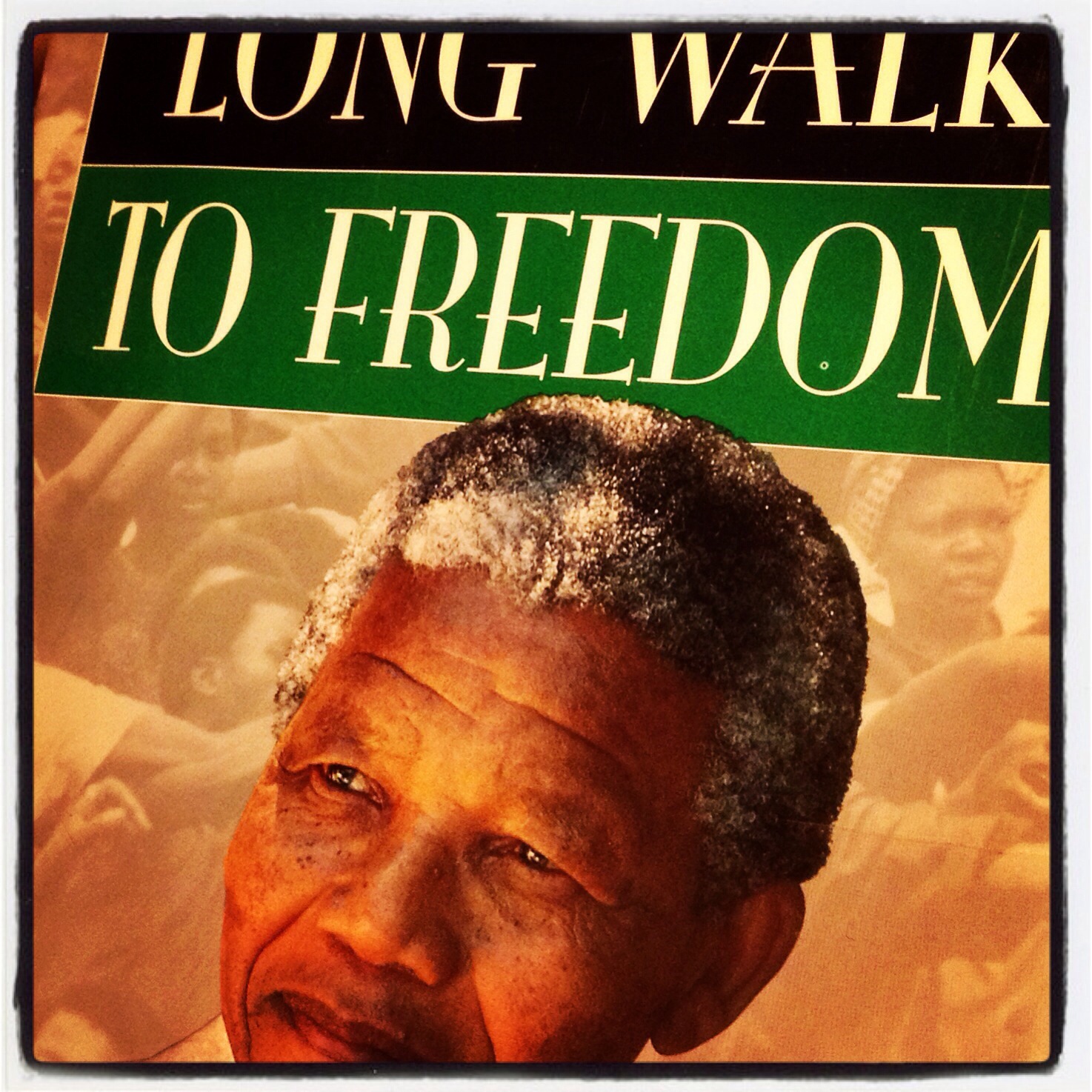
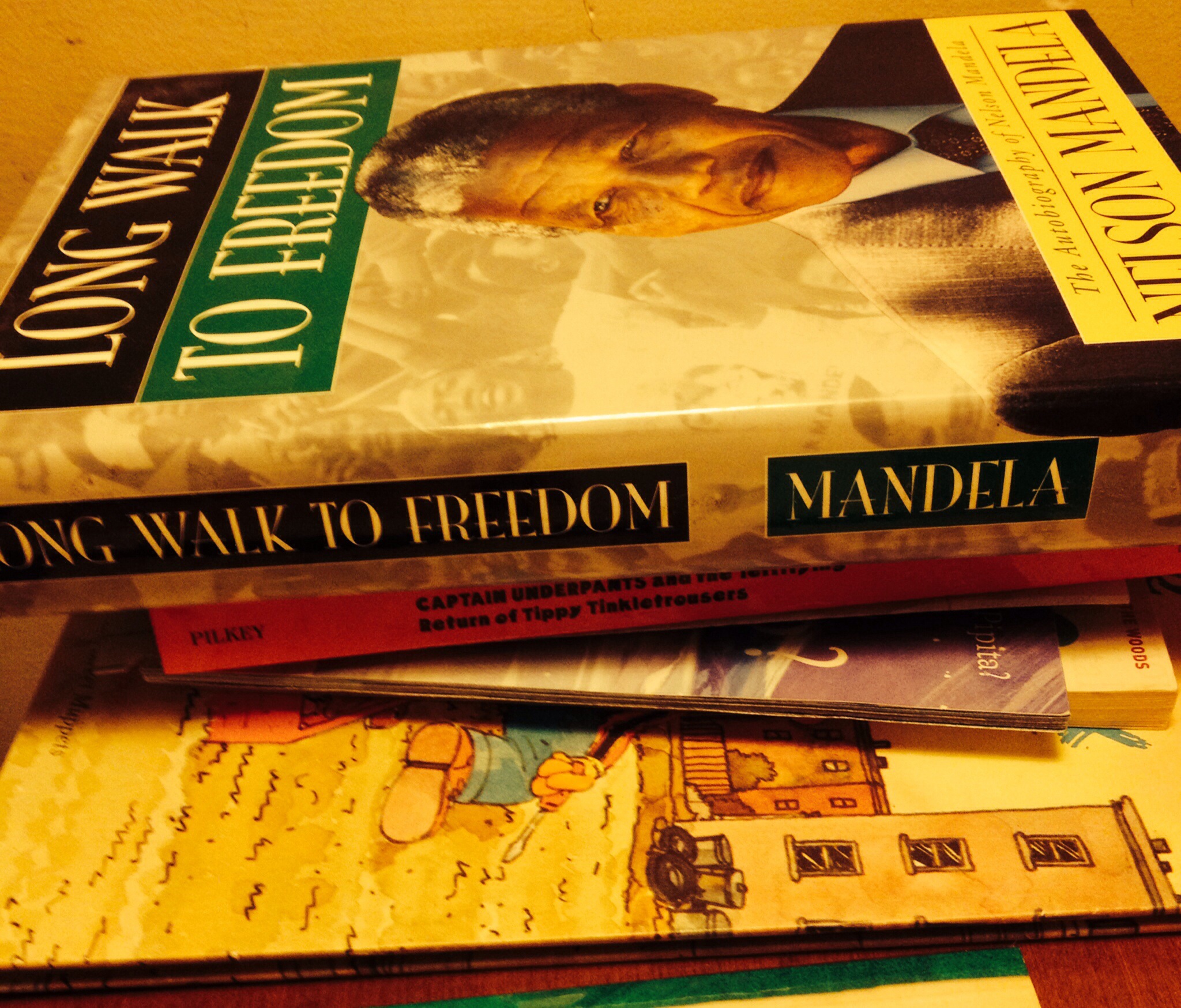
For many years, I have kept a copy of Nelson Mandela’s autobiography Long Walk to Freedom on my bedside table.  I don’t keep it there because I am in the process of reading it (I have read it twice), but because I keep the words of this great human rights hero in my heart.   I like waking up in the morning and knowing that it  is there.   Sometimes I just lay there and look at the title on the binding for a few seconds.  It helps me remember the good in this world.

Long Walk to Freedom was published in 1995, just a few years after Nelson Mandela was released from his nearly three decades of imprisonment on Robben Island and Pollsmoor Prison for leading the ANC.    I was in law school at the time.  I think that when  I first read it, I was especially looking for information from his early years about how and why he became a human rights warrior.  (Yes, Nelson Mandela was a lawyer, too.)   I love that as a child, he was called  “Rolihlahla” , which means “pulling the branch of a tree ” (i.e. “troublemaker”).

Here are a few of the things that he wrote in the book that rang true for me.

“I had no epiphany, no singular revelation, no moment of truth, but a steady accumulation of a thousand slights, a thousand indignities and a thousand unremembered moments produced in me an anger, a rebelliousness, a desire to fight the system that imprisoned my people. There was no particular day on which I said, Henceforth I will devote myself to the liberation of my people; instead, I simply found myself doing so, and could not do otherwise.”

and

“I have never cared very much for personal prizes. A person does not become a freedom fighter in the hope of winning awards.”

and

“I am fundamentally an optimist. Whether that comes from nature or nurture, I cannot say. Part of being optimistic is keeping one’s head pointed toward the sun, one’s feet moving forward. There were many dark moments when my faith in humanity was sorely tested, but I would not and could not give myself up to despair. That way lays defeat and death.”

Tonight, when I heard the news that Nelson Mandela had died, I was not surprised.   Nelson Mandela was 95 years old and had been ill for a long time.  His human body had become a painful prison from which his soul deserved freedom.    I remembered that he had written about freedom in his autobiography.  I don’t know which parts of  Long Walk to Freedom were written clandestinely on Robben Island and which were written after his release, but long-term detention must have had an impact on his views of freedom.  When Nelson Mandela talked about freedom, it was not limited to his own person.  Rather, for Nelson Mandela, freedom was inextricably linked to the freedom of other human beings.

“For to be free is not merely to cast off one’s chains, but to live in a way that respects and enhances the freedom of others.”

and

“Freedom is indivisible; the chains on any one of my people were the chains on all of them, the chains on all of my people were the chains on me.”

Freedom from imprisonment was not the end of the story for Nelson Mandela.  It was only the beginning of his work in leading South Africa towards a new, post-apartheid era.  What he says about leadership  in Long Walk to Freedom is also instructive.

“A leader. . .is like a shepherd. He stays behind the flock, letting the most nimble go out ahead, whereupon the others follow, not realizing that all along they are being directed from behind.”

and

“A Nation should not be judged by how it treats its highest citizens, but it’s lowest ones”

When Nelson Mandela wrote his autobiography, he still had many years left in his long life and many miles yet to walk.

“I can rest only for a moment, for with freedom come responsibilities, and I dare not linger, for my long walk is not yet ended.”

Your long walk is ended now and the world is a better place because of it.    Rest well, Rolihlahla!  I will keep your words in my heart and –  on my bedside table.

  While I understand that a movie based on the autobiography has just been released, I hope that others will take the time to read Long Walk to Freedom.   Nothing can inspire admiration of this great human rights leader than the words written by Nelson Mandela himself.

20131206-105223.jpg


Haikus With My Daughter III: Girls Rights

My heart yearns for you

To live – equal – to your full

human potential.

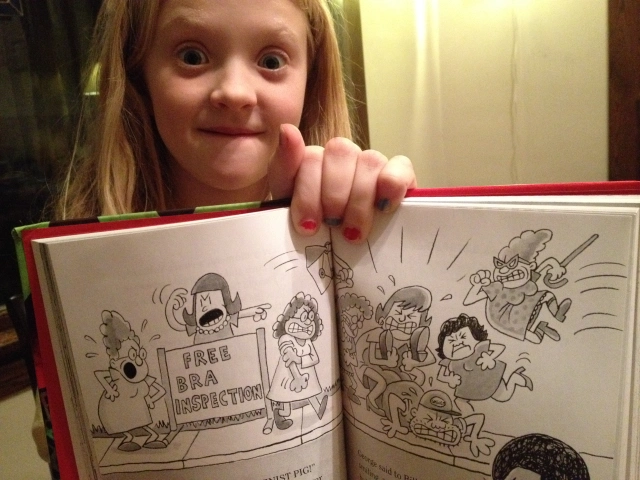
It’s a challenge to raise a daughter in a society that innundates us with countless hidden messages about how girls should look and act, who they should be.    My daughter and I have been talking about this a lot lately, with the holiday marketing of “girls toys” and “boys toys” so in our faces.   So I was pleasantly surprised this week when she found a women’s rights message hidden in Captain Underpants and The Terrifying Return of Tippy Tinkletrousers.

IMG_1964

Captain Underpants.

The bully battle begins!

(Secret feminism.)

You go, girl! You just go and go and GO!

This post, Haikus With My Daughter , Haikus With My Daughter II  and Thanksgiving are a response to the WordPress Weekly Writing Challenge.