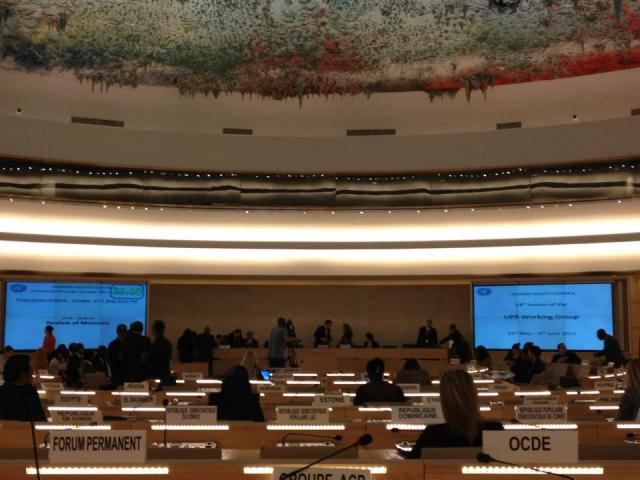
Inaugurated on 18 November, 2008 in honor of the 60th anniversary of the Universal Declaration of Human Rights, the “Human Rights and Alliance of Civilizations” room (better known as Room XX) is the home of the United Nations Human Rights Council at the Palais des Nations in Geneva. Part of my work involves advocacy at the United Nations’ human rights mechanisms, so Room XX is a place I visit regularly. (Photos are not allowed, but I snuck these photos with my phone anyway.)
At the UN Human Rights Council in Geneva, Switzerland
Spanish abstract artist Miquel Barceló created a a massive work of art for the ceiling of the room with paint composed of pigments from around the world. More than 30 tons of paint were sprayed on the 1,500-square-meter dome ceiling, with the many layers of paint creating a textured rainbow of stalactites. Depending on where you are in the room, the colors of the stalactites change based on perspective.
Barceló describes his work in this way:
“All of it is a sea upside down, but it is also a cave.
The complete union of opposites,the ocean surface of the Earth and its most concealed cavities.”
There are few voices that embed themselves in your heart and brain and deep-down soul like the voice of Maya Angelou. Of all her poems, the one that has embedded itself most deeply in my soul is the one that this grand dame of literature wrote for the fiftieth anniversary of the United Nations. The first stanza incorporates language from the United Nations Charter. The rest is pure Maya Angelou – the gorgeous description, the unwillingness to shy away from the ugliness that was part of her life and remains part of all human existence.
She was so brilliant! She will be missed, but we are better for her time – and her words – on this small and lonely planet.
A Brave and Startling Truth
by Maya Angelou
We, this people, on a small and lonely planet.
Traveling through casual space
Past aloof stars, across the way of indifferent suns
To a destination where all signs tell us
It is possible and imperative that we learn
A brave and startling truth.
And when we come to it
To the day of peacemaking
When we release our fingers
From fists of hostility
And allow the pure air to cool our palms.
When we come to it
When the curtain falls on the minstrel show of hate
And faces sooted with scorn are scrubbed clean
When battlefields and coliseum
No longer rake our unique and particular sons and daughters
Up with the bruised and bloody grass
To lie in identical plots in foreign soil.
When the rapacious storming of the churches
The screaming racket in the temples have ceased
When the pennants are waving gaily
When the banners of the world tremble
Stoutly in the good, clean breeze.
When we come to it
When we let the rifles fall from our shoulders
And children dress their dolls in flags of truce
When land mines of death have been removed
And the aged can walk into evenings of peace
When religious ritual is not perfumed
By the incense of burning flesh
And childhood dreams are not kicked awake
By nightmares of abuse.
When we come to it
Then we will confess that not the Pyramids
With their stones set in mysterious perfection
Nor the Gardens of Babylon
Hanging as eternal beauty
In our collective memory
Not the Grand Canyon
Kindled into delicious color
By Western sunsets.
Nor the Danube, flowing its blue soul into Europe
Not the sacred peak of Mount Fuji
Stretching to the Rising Sun
Neither Father Amazon nor Mother Mississippi who, without favor,
Nurture all creatures in the depths and on the shores
These are not the only wonders of the world.
When we come to it
We, this people, on this minuscule and kithless globe
Who reach daily for the bomb, the blade and the dagger
Yet who petition in the dark for tokens of peace
We, this people on this mote of matter
In whose mouths abide cankerous words
Which challenge our very existence
Yet out of those same mouths
Come songs of such exquisite sweetness
That the heart falters in its labor
And the body is quieted into awe.
We, this people, on this small and drifting planet
Whose hands can strike with such abandon
That in a twinkling, life is sapped from the living
Yet those same hands can touch with such healing, irresistible tenderness
That the haughty neck is happy to bow
And the proud back is glad to bend
Out of such chaos, of such contradiction
We learn that we are neither devils nor divines.
When we come to it
We, this people, on this wayward, floating body
Created on this earth, of this earth
Have the power to fashion for this earth
A climate where every man and every woman
Can live freely without sanctimonious piety
Without crippling fear.
When we come to it
We must confess that we are the possible
We are the miraculous, the true wonder of this world
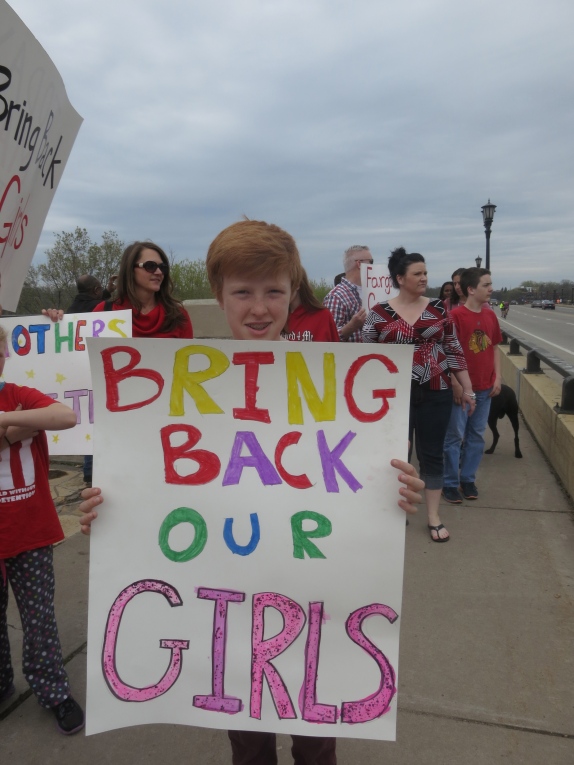
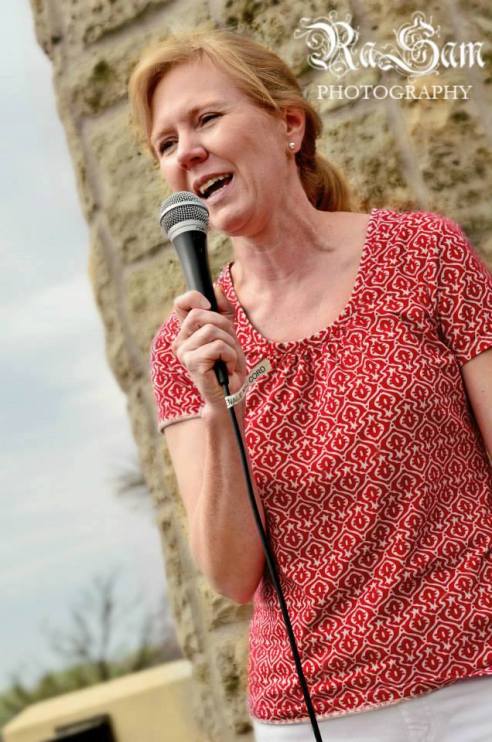
On Mother’s Day, I spoke at a local march and rally to show support for the nearly 300 school girls abducted a month ago in Nigeria.
Here’s what I said:
Bring Back Our Girls Twin Cities March
May 11, 2014
Thanks to organizers and to all of you for being here.
I’m here as a lawyer and Deputy Director of The Advocates for Human Rights, a non-profit based in Minneapolis that works on human rights issues around the world.
But I’m also here as a mother. My kids Simon and Eliza are here today as well to stand in honor of the nearly 300 girls abducted simply because they were pursuing their human right to education. I think that’s pretty much the best Mother’s Day gift they could give me.
There are a lot of things that we don’t know about the situation in Nigeria. We don’t know where the girls are or what is happening to them. We don’t even know the exact number abducted and we only know a few of their names. We can only imagine the agony their families are going through.
But the tragedy of the nearly 300 girls in Chibok shines a spotlight on the systemic human rights abuses against faced by women and girls worldwide.
And there are many things we do know about violations of the rights of girls and women:
We know that girls around the world lack equal access to basic education (in the NE region of Nigeria where these girls lived, girl enrollment is the lowest in the country – only 22%. In part, they were targeted because they were seeking an education that would change their lives.
We know that girls and women are not valued equally as boys and men in many parts of the world. The Nigerian government’s lack of action both before and after certainly makes it seem that these girls were not deemed worthy of protection.
We know that when these girls are found and hopefully rescued, they will need support in the form of psychosocial and health care. Women’s access to health care is woefully limited.
We know that 1 in 3 girls under age 18 are still being forced into marriage too early. By some estimates, that’s about 14 million girls a year. Too many girls still endure harmful traditional cultural practices such as FGM.
We know that girls and women suffer the most in times of conflict. What these girls have experienced is likely a war crime. Trafficking remains a huge problem around the world and in our own community.
We know that 1 in 3 of the world’s women experience violence, including domestic violence (The Advocates for Human Rights works on domestic violence legal reform around the world);
And we know that these are all things that have to change.
We need to do more to push our governments to make this change a priority. We can’t stop with just these 276 girls.
Now these are human rights abuses that may seem intractable. It may seem like you are powerless to make a difference. But you can:
Support the NGOs that work on issues you care about. No amount is too small – a little money really does go a long way in this area.
Write to our members of Congress and the President to encourage support for women’s rights as a critical part of our US foreign policy.
For those of you with young people in your lives, teach them about the world around them so that they will grow up to continue the fight to ensure that every child, wherever he or she lives in the world, has the chance to live in safety and dignity and to achieve their greatest human potential.
For those of you doubting whether sharing this story on social media really makes a difference, I’d like to share a message I got on my blog from a woman named Winnie in Nigeria:
we here in nigeria are so angry and feel very helpless, the government and opposition leaders have politicized this, while our daughters are still in captivity. the government officials do not want to listen to ‘ordinary’ people. and word has it that the Nigerian press have been ordered to kill the story (as the have killed other stories in the past). pls this is a passionate plea to the international community to keep this story alive until our girls are returned home safely.
Here in the Twin Cities and all around the world, we are working to keep this story alive until our girls are returned home safely.
And after our girls come home, I hope we can keep working together for a future where all girls around the world can go to school in safety and grow up to reach their full human potential.
Image used with permission of RaSam Photography. Thank you!
While unconfirmed, these reports are a chilling reminder of the threat of sexual violence faced by women and girls in conflict zones.
The girls who were abducted were targeted simply because they were exercising their right to go to school, out of the ordinary for a girl in Nigeria. Access to basic education for girls has remained low, particularly in the northern region which has the lowest girl child enrollment in Nigeria —in 2008 the net enrollment rate for girls into secondary school was only 22 percent. The girls (who were both Christian and Muslim) at the Government Girls Secondary School in Chibok must each have been determined to get an education in spite of tremendous odds. The fact that these girls were also risking violence to be in school illustrates how important the right to education was to each of them.
Boko Haram also has a history of taking hostages as “slaves.” In May 2013, Boko Haram leader Abubakar Sheku released a video saying that Boko Haram had taken women and children, including teenage girls, as hostages as part of its latest campaign. These hostages would be treated as “slaves,” he said. This has raised concern among the family members of those abducted that “Boko Haram is adhering to the ancient Islamic belief that women captured during war are slaves with whom their ‘masters’ can have sex. Regardless of alleged rationale, enslavement, imprisonment, forced labor, rape and sexual slavery are all serious violations of international law. They are defined by the Rome Statute of the International Criminal Court as crimes against humanity.
The mass kidnapping in April was unprecedented and shocking. Even more shocking – after more than two weeks, the Nigerian government has done very little to find and rescue the girls.
The lack of government response has provoked outrage in Nigeria. On Wednesday, several hundred participated in a “million-woman protest march” in Abuja, Nigeria’s capital to demand that more resources be put toward finding and securing the kidnapped girls. The protesters in Nigeria are joined on Twitter with a growing movement under the hashtags #BringBackOurGirls, #BringBackOurDaughters and #234Girls. There is also a Change.org petition to Nigeria’s President Goodluck Jonathan asking him to do more to save the abducted girls and ensure that schools in Nigeria are safe.
One man, whose daughter was abducted along with his two nieces, said his wife has hardly slept since the attack. She lies awake at night “thinking about our daughter”. As the mother of a young school girl myself, I feel deeply for her. The continuing tragedy of these young Nigerian school girls is every parent’s worst nightmare.
It’s time for world to wake up to the escalating violence in Nigeria, as well as the Nigerian government’s lack of response.
Some people are already asking why in the world we need a day to celebrate happiness. What could an international day and a celebrity singing an upbeat song possibly do to make an impact on serious global problems?
Personally, however, I am looking forward to International Happiness Day. The way I see it, we already have more than enough aspects of our human nature to divide us. When people focus on what makes us different – our religion, our ethnicity, our skin color – it often leads to violence and conflict. Lives are shattered in big ways and small. But every human has a very basic need, not to mention a strong desire, for something very simple. We all want to be happy. We all want to see that our children and the others who who we care about have the opportunity that they deserve to be happy.
Our human capacity to feel happiness is a basic characteristic that we all share, regardless of our differences.
In my line of work, I deal with a lot of human unhappiness. So I think about these things all the time. You would expect that it would make me cynical about people in general – and particularly about something like an international day of happiness, complete with a celebrity and an upbeat hit song.
But I strongly believe that our human capacity for happiness is a strength, and one that should be nurtured and celebrated in the midst of all that is dark and dangerous and painful in our world.
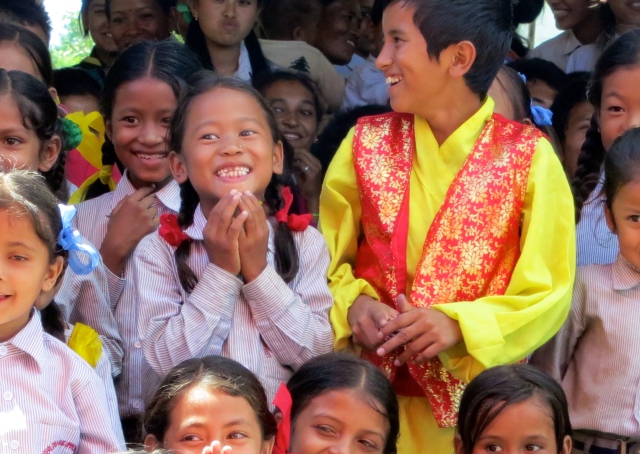
I took the photo above the last time I was in Nepal. I keep it as my screensaver to remind me every day of the simple fact that we humans all have the potential to experience intense joy. It makes me believe that our human capacity for happiness must one day trump our human proclivity to hurt each one another. And this photo reminds me every day that everyone – every single person, regardless of who they are or where they live in world – should have the opportunity to feel happiness in the way that these kids in Nepal were so clearly feeling it.
International Happy Day is also a call to action. It is a reminder that there is more that each of us can do to ensure that everyone is able to live their lives to their fullest human potential in safety, dignity, freedom, and equality. For all of us, these are the basic human prerequisites to happiness. We need to keep moving towards the concept that none of us can be truly happy, until all of us have an equally fair shot at being happy.
There are a few things in this world that are truly global: One of them is that people want to be happy. Thursday, March 20 is the International Day of Happiness, and the United Nations Foundation and Grammy Award-winning musician Pharrell Williams have teamed up to encourage people to take action to support the UN and to create a happier world for people everywhere. – See more at: http://unfoundationblog.org/international-day-of-happiness-2014/#sthash.CuzHI1xW.dpuf
So go ahead and celebrate International Happiness Day. In the United States, you don’t even have to wait until March 20. Thanks to the international time difference, #Happy Day starts in just a few hours. (And #HappyDay is already going strong on Twitter!) You can catch it all on the website 24 Hours of Happiness.com Since March 10, people around the world have been posting YouTube videos of themselves “demonstrating their happiness” to Pharrell William’s track with the hashtag #HAPPYDAY and submitting it to the website. On March 20th, Pharrell will spotlight the best submissions at noon in each time zone.
Here is the first one – from New Zealand!
See additional ways to participate here. And whatever else you do on March 20, be sure to have a
Human rights advocacy takes many forms, and human rights activists can be found in every corner of the world. Tremendous advancements in technology and communication have allowed activists to form strong international networks and to share emerging information about human rights abuses almost as soon as they happen. These advancements have fundamentally changed the way human rights organizations work, including how they engage in human rights advocacy with broader communities beyond a country’s borders.
Yet the unique role diaspora communities can play in improving human rights around the world has largely been overlooked in the human rights field. It’s time for that to change.
Diaspora: The Migration Policy Institute defines the term “diaspora” as “emigrants and their descendants who live outside the country of their birth or ancestry . . . yet still maintain . . . ties to their countries of origin.”
Members of diaspora communities play an increasingly important global role and can be a bridge between individuals, governments, and international legal and political mechanisms. Diaspora communities are a critical link in changing social institutions and structures to hold governments accountable. Many migrants – refugees and asylum seekers in particular – leave their homes because of human rights abuses. Many were political and human rights activists in their home countries and they bring their experiences with them. In some countries with repressive governments, security concerns mean that diasporans must take the lead in speaking out. From their new home base, they can bring change in their countries of origin.
Members of diaspora communities agree. Chanravy Proeung, a member of the Cambodian diaspora and Co-Director of the Providence Youth Student Movement, said:
“We have the privilege to see those countries from a different perspective. We need to have the people who are the most marginalized and affected by issues at the forefront of creating change not only here in the United States, but having influence in their countries of origin, too.”
For more than 30 years, The Advocates for Human Rights has witnessed the powerful role that diaspora civil society organizations play in documenting human rights abuses, influencing policy, and advocating on behalf of victims of human rights violations in their countries of origin.
As a legal service provider, The Advocates is often the first connection that asylum seekers have to their new community in the United States. Because of this special relationship, diasporans from dozens of countries have requested assistance from The Advocates in documenting human rights violations “back home.” With diaspora communities, The Advocates has conducted groundbreaking work, such as the Liberian Truth and Reconciliation Commission Diaspora Project,ensuring that public hearing testimony and the statements of 1,200 Liberians living outside of Liberia were included in the formal history of the conflict.
The report, Human Rights in Ethiopia: Through the Eyes of the Oromo Diaspora, proved the significance of involving individuals who have left a country in work to hold governments accountable and affect human rights in their home countries. The Advocates has also collaborated with the Indian American Muslim Council on advocacy on issues concerning religious minorities at the both the U.S. Congress and the United Nations, demonstrating that diaspora voices can have an impact on human rights in India.
This manual, available for download at no cost, provides a full menu strategies and resources designed to empower diaspora communities to be more effective advocates for human rights in their countries of origin.
With practical tools and step-by-step guidance shaped by input from multiple diaspora communities, Paving Pathways can be used to help individuals and organizations to:
monitor and document human rights abuses;
advocate for change in their country of origin and country of residence, as well as at international and regional human rights mechanisms;
address impunity and hold governments accountable using national and international law; and
build their capacity to improve human rights conditions.
While the tools and resources presented in this manual were specifically created for use by diaspora communities, this manual can also benefit and be used by human rights defenders and civil society organizations throughout the world.
The international community needs to do more to recognize the unique contributions that diaspora communities can make to building respect for human rights around the world. Rather than treating diasporans solely as economic sources of remittances, investment, and philanthropy, countries of origin and countries of residence should facilitate engagement in long-term social change. With this new resource, The Advocates is taking an important step in supporting diaspora communities in their efforts to improve human rights around the world.
[1] International Organization for Migration and Migration Policy Institute, Developing a Roadmap for Engaging Diasporas in Development (Washington DC and Geneva: IOM and MPI, 2012), 15. Also available online at http://www.migrationpolicy.org/pubs/thediasporahandbook.pdf.
I have a complicated relationship with International Women’s Day (IWD). On the one hand, it vexes me greatly that we have only one day a year – designated by the United Nations General Assembly in 1977 as March 8 – to celebrate the many contributions of women around the world. On the other hand, we still need to focus attention on the fact that women, who make up half of the world’s population, still face almost incomprehensible inequality in societies throughout the world. Not just inequality, but inexcusable pain and violence.
One in three women in the world still experience violence (including rape and marital rape, spousal abuse, and child abuse) in their lifetime. The numbers are closer to one in four in the West – numbers that are still shockingly high.
Even before birth, preference for male children leads to feticide and infanticide in many parts of the world. Millions of girls and women around the world face obstacles to education, access to health, freedom of choice in marriage and divorce, land ownership and political participation. Even in the West, women continue to face inequality, including professional obstacles.
The UN theme for IWD 2014 is “equality for women is progress for all”. And there is no question that that statement is true. As UN Secretary-General Ban Ki-moon said in a statement for IWD 2014:
“Countries with more gender equality have better economic growth. Companies with more women leaders perform better. Peace agreements that include women are more durable. Parliaments with more women enact more legislation on key social issues such as health, education, anti-discrimination and child support. The evidence is clear: equality for women means progress for all.”
IWD means different things to different people around the world. For some, it is a day to celebrate the strength of personal relationships with mothers, grandmothers, daughters and friends. Some choose to celebrate the overall contributions of women; in 2014, I noticed a particular interest in celebrating the “bad ass” women in our collective history (which I do applaud). For others, it is the opportunity to highlight all that still remains to be done.
For me, IWD is all these things. It is also about wanting a world where my daughter and my sons are treated equally without thought or legal requirement. It is about teaching them that this is what they – both boys and girl – should expect in their future. But it is also about celebrating the strong community of women that has brought us this far.
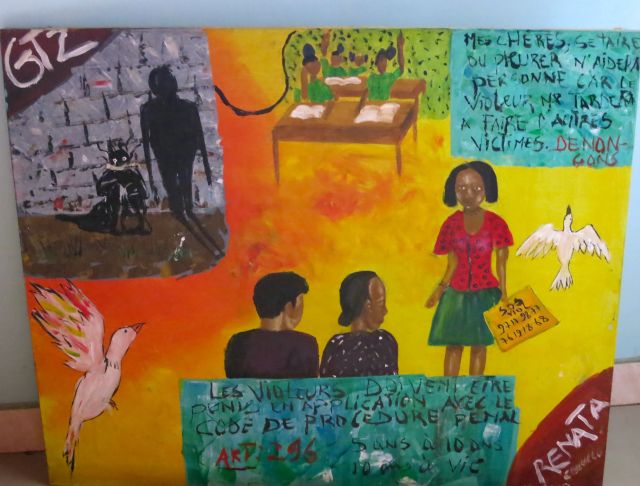
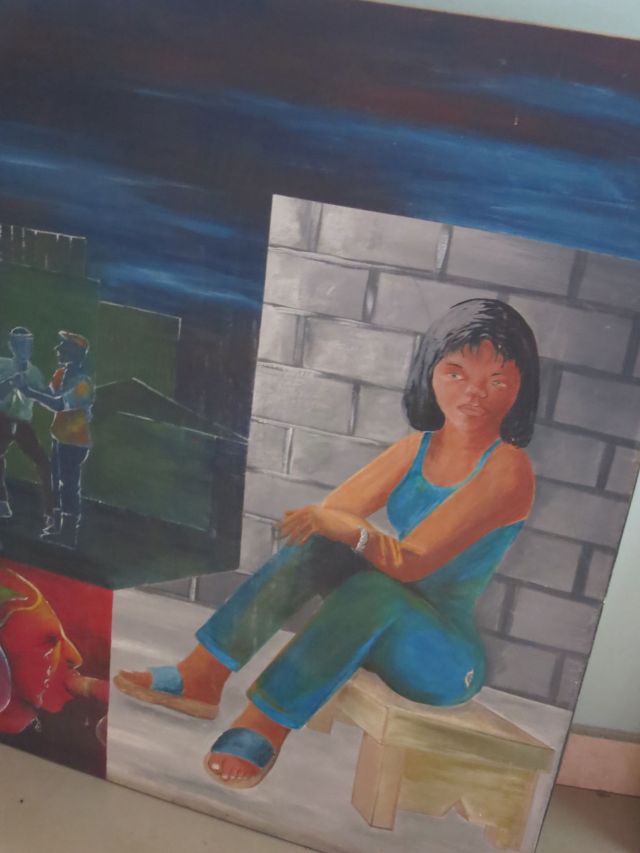
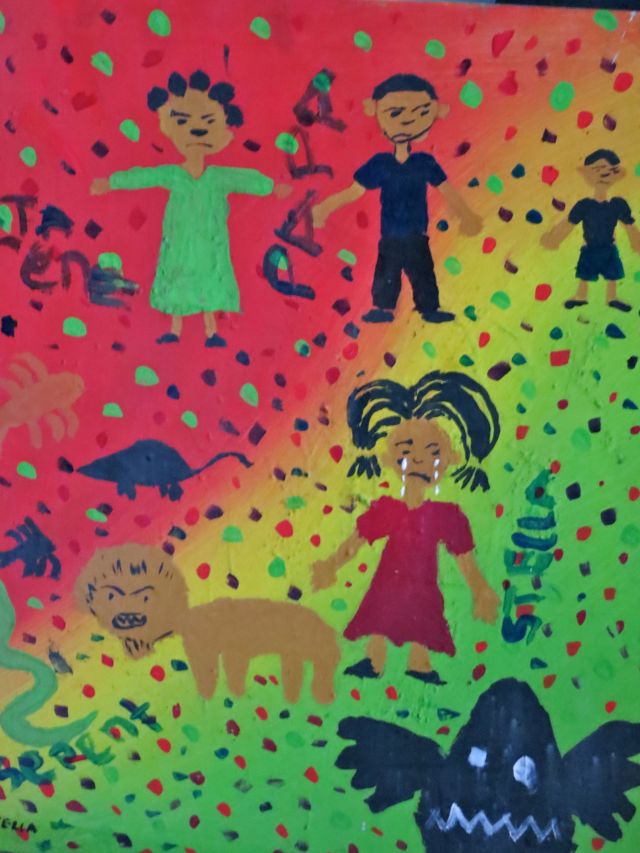
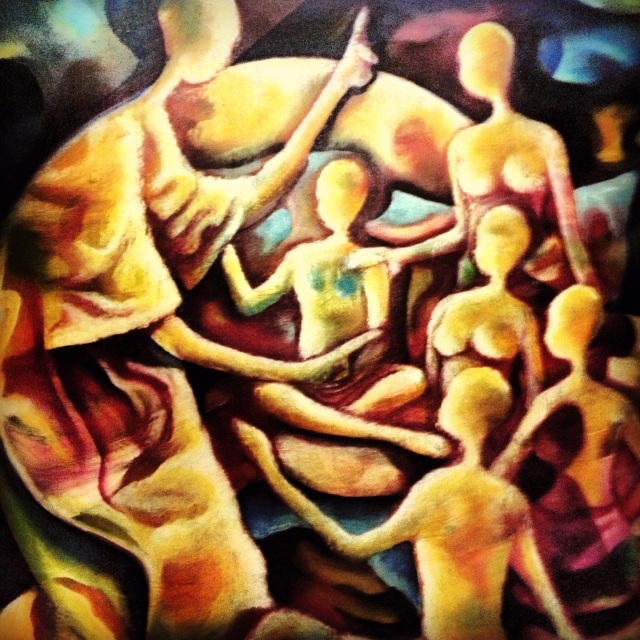
I took this photo of a painting that hung in the stairwell of a hotel I stayed in last year in Yaounde. It was dark in the stairwell, but I paused every time I passed it. The painting appeared original, but there was no name given to it. No artist was listed. But for me, it captures the spirit of International Women’s Day. We still have a ways to go, but we are together in this effort. We learn from each other and we support each other. Here is my perspective on International Women’s Day 2014:
It may take us time, but when women work together, nothing can stop us.




 The Human Rights Warrior
You must be logged in to post a comment.