House of Wonders and Stone Town waterfront, Zanzibar
A little more than 10 years ago, I had a rare moment of clarity. I was sitting with my second child, who was 9 months old, on my lap while my 2-year-old danced and swayed around me. Everyone else in the Mommy and Me class was singing – with gusto – the Barney song “I Love You”. Glancing at the clock, I realized that the week before – at exactly this time – I was being interviewed live on national TV in Peru about that country’s truth and reconciliation commission.
The stark contrast made me realize that I had chosen a life in which there might never really be a “typical” day. Setting aside the insipidity of Barney, I realized that these small moments with my young sons were as important and valuable as the other, more high-profile moments of my career, which often takes me to exotic locales. I learned not to compare my days. Not to sift through the experiences of each day and measure the worth of one against another, but to see them all as a whole. To acknowledge that each endeavor for work and for family gives me strength for the other. To realize that I am fortunate to have these varied experiences, which, woven together form the rich tapestry of my life.
So for the Weekly Photo Challenge: A Day in the Life, I am choosing to share one day that I recently spent in Zanzibar for work. As I write this, my daughter is sitting beside me, looking at the photos and talking about them with me. One day in Zanzibar, one day of spring break at home. Days and experiences, knitted together – so many days to be thankful for!
Sunrise in Dar es Salaam
St. Joseph Cathedral, on the waterfront in Dar es Salaam
View from my in Dar es Salaam
On the ferry, waiting for it to leave Zanzibar Gate
Birds over the harbor
Commuters at the Kigamboni Ferry Terminal
Early March – on the brink of rainy season – brings sudden, dramatic rain that quickly ends.
Rainbow over Dar es Salaam Bay
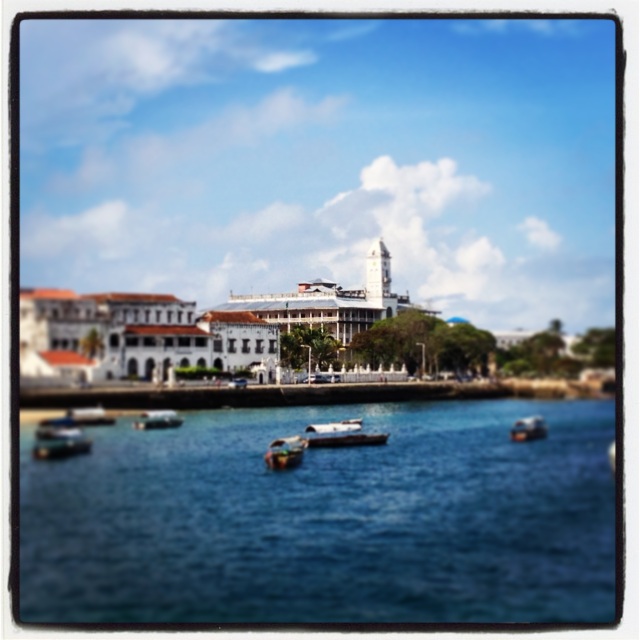
Stone Town waterfront
View of Stone Town harbor from hotel terrace.
On the ferry to Zanzibar
Stone Town rooftops
Looking down on the roofs of Stone Town, Zanzibar
Old Fort in Stone Town, a World Heritage Site
Stone Town, Zanzibar
On the way to Zanzibar Town, the capital of Zanzibar.
Zanzibar is a semi-autonomous part of Tanzania with its own government – known as the Revolutionary Government of Zanzibar. A proposal to amend Zanzibar’s constitution to allow rival parties to form governments of national unity was adopted by 66.2 percent of voters on 31 July 2010.
Interviews with non-governmental organizations (NGOs)
This poster is part of a campaign to end Violence Against Women in Zanzibar
Coconut tree at the office of an NGO in Zanzibar Town
Children’s rights
Back to Stone Town
Lunch. A new discovery – Stoney Tangawizi, a most delicious East African ginger beer!
Photo by my colleague Rosalyn Park, taken during our trip to Sierra Leone in 2004
Nelson Mandela read Chinua Achebe when he was in prison and reportedly described him as a writer “in whose company the prison walls fell down.” I read Chinua Achebe’s Things Fall Apart in college, three decades after it was written, required reading on a syllabus that only included one African author. I read his other books later, as well as some of his essays. The obituaries describe him as an African Literary Titan and a “towering man of letters”. True words, but he was more than that. Much has and will be written about Chinua Achebe as the writer that wrested writing about Africa – that vast and varied Africa, as if one writer could ever represent it – back from the West.
There is one poem by Chinua Achebe that has stayed with me for many years, not because it captures the global themes of colonialism or tradition v. Western values, but because it captures so perfectly the small moments of heartbreak and love that I myself have seen in the refugee camps I have visited in Sierra Leone and Ghana. That Chinua Achebe could capture the small moments of human connection along with the global themes was a mark of his genius. Upon reading the news of Chinua Achebe’s passing today, I read A Mother In A Refugee Camp again. I share it now, my own way of saying thank you, “like putting flowers on a tiny grave”.
A Mother In A Refugee Camp
No Madonna and Child could touch
Her tenderness for a son
She soon would have to forget. . . .
The air was heavy with odors of diarrhea,
Of unwashed children with washed-out ribs
And dried-up bottoms waddling in labored steps
Behind blown-empty bellies. Other mothers there
Had long ceased to care, but not this one:
She held a ghost-smile between her teeth,
And in her eyes the memory
Of a mother’s pride. . . . She had bathed him
And rubbed him down with bare palms.
She took from their bundle of possessions
A broken comb and combed
The rust-colored hair left on his skull
And then—humming in her eyes—began carefully to part it.
In their former life this was perhaps
A little daily act of no consequence
Before his breakfast and school; now she did it
Like putting flowers on a tiny grave.
There is no guidebook to Morocco, and no way of knowing, once one has left Tangier behind, where the long trail over the Rif is going to land one, in the sense understood by any one accustomed to European certainties. The air of the unforeseen blows on one from the roadless passes of the Atlas.
I recently visited the Kingdom of Morocco for the first time. Looking for reading material before my trip, I discovered a book about Morocco by Edith Wharton. This came as a deep surprise to me, a longtime Wharton fan. I thought that I had read every Edith Wharton publication in print, from her ghost stories right down to her interior design book (I wrote a paper on that one in college). I knew, of course, that she had written some travel books; I had even read some of them. But until I saw it listed as a free title on Kindle, I had never heard of In Morocco.
Published in 1920 (the same year as Age of Innocence), In Morocco is widely considered the first travel guide to Morocco. (Wharton certainly thought so, as she states, “Having begun my book with the statement that Morocco still lacks a guide-book, I should have wished to take a first step toward remedying that deficiency.”)
I’ve always admired Wharton’s highly descriptive style, which lends itself exceptionally well to travel writing. In Morocco is the account of Wharton’s motor trip across Morocco in the fall of 1917, at the tail end of the First World War. Much of Morocco had become a French protectorate in 1912, so she made the trip at the invitation of the French Resident-GeneralHubert Lyautey. It is no secret that Wharton was a committed supporter of French imperialism (she described herself as a “rabid imperialist”) and this comes across strongly in In Morocco. (Unless you want read a love letter to colonialism, skip the chapter on Gen. Lyautey’s Work In Morocco.) Equally hard to take is her paternalistic attitude towards and use of racist terminology to describe Moroccans and their culture.
In spite of this, I enjoyed the historical perspective provided by In Morocco. More than anything, In Morocco is a series of sketches of a place where past and present are intermingled, at a moment when the country was on the verge of change. Wharton was very cognisant of the fact that post-war tourism would alter Morocco forever.
Morocco is too curious, too beautiful, too rich in landscape and architecture, and above all too much of a novelty, not to attract one of the main streams of spring travel as soon as Mediterranean passenger traffic is resumed.
Visiting Morocco nearly 100 years after Wharton, I found it interesting to read her admiring documentation of this specific moment in time, which she has preserved in prose as solidly as if in amber.
To see Morocco during the war was therefore to see it in the last phase of its curiously abrupt transition from remoteness and danger to security and accessibility …
Yet I also found the Morocco of 2013 to be a place where the boundaries between past and present are still slightly blurred. Visiting many of the same places that Wharton had visited nearly a century before, I discovered that her descriptions were, in many cases, still brilliantly apt. The following photographs were taken by me but the words were written by Edith Wharton.
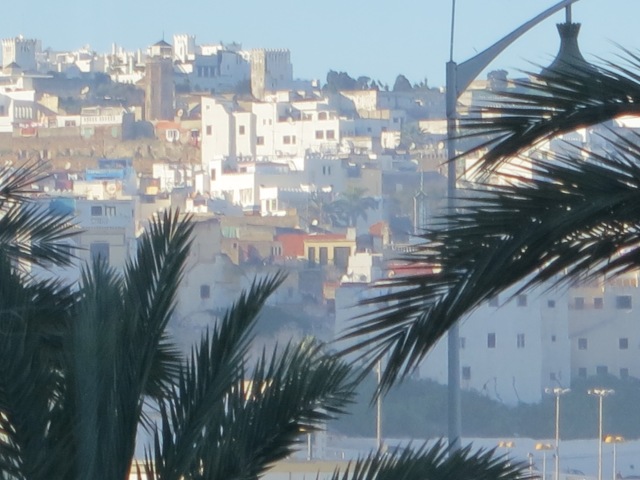
Tangier
View of the Medina in Tangier
This feeling of adventure is heightened by the contrast between Tangier – cosmopolitan, frowsy, familiar Tangier, that every tourist has visited for the last forty years – and the vast unknown just beyond.
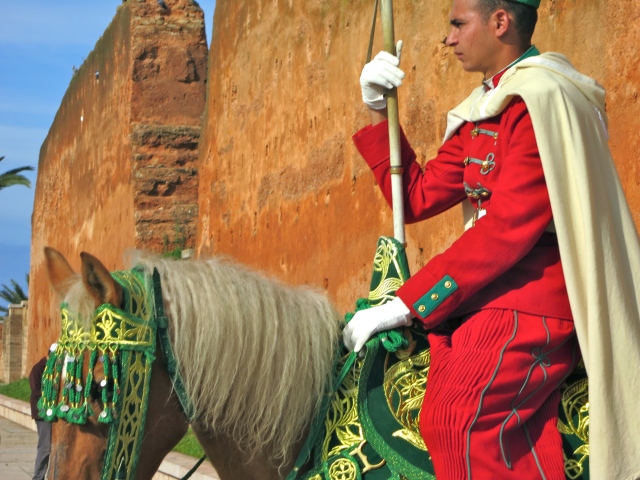
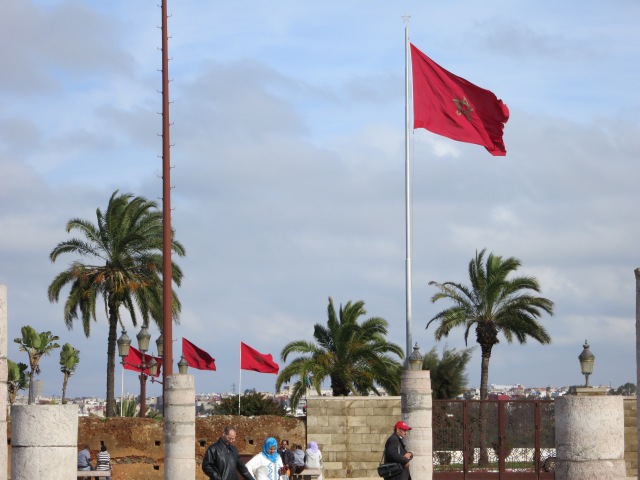
Rabat
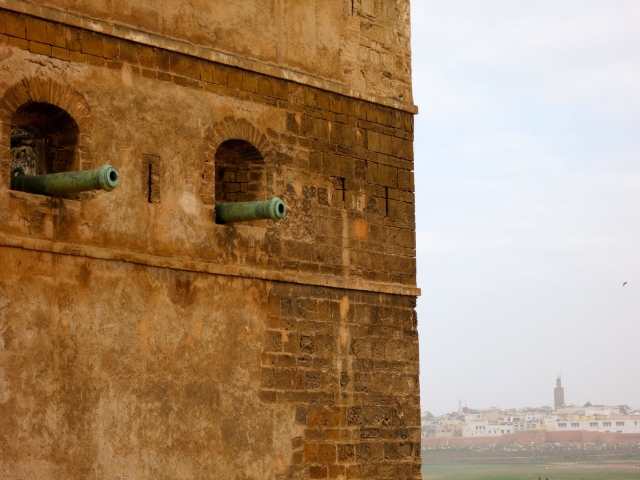
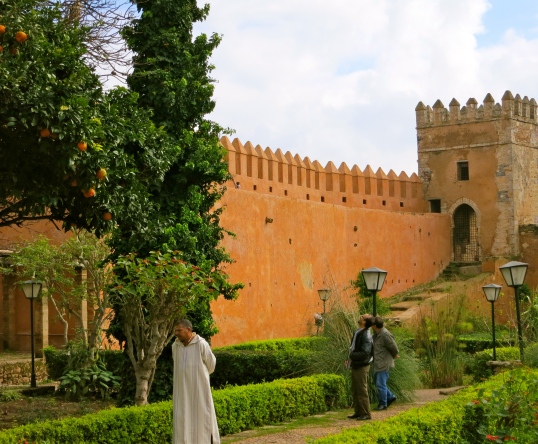
The European town of Rabat, a rapidly developing community, lies almost wholly outside of the walls of the old Arab city. The latter, founded in the twelfth century by the great Almohad conqueror of Spain, Yacoub-el-Mansour, stretches its mighty walls to the river’s mouth. Thence they climb the cliff to enclose the Kasbah of the Oudayas…. Great crenallated ramparts, cyclopean, superb, follow the curve of the cliff.
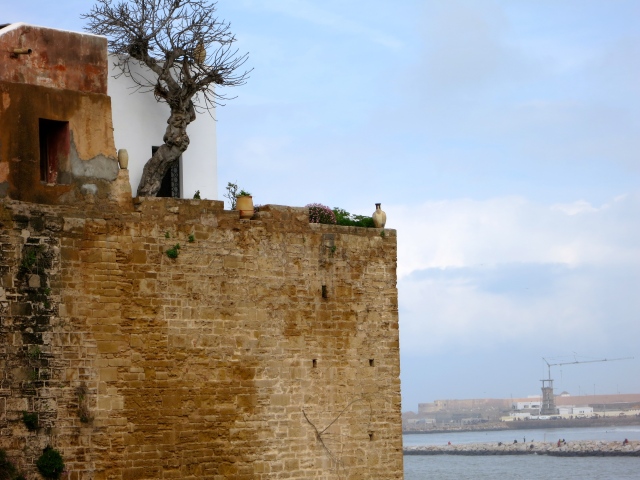
Kasbah of Rabat
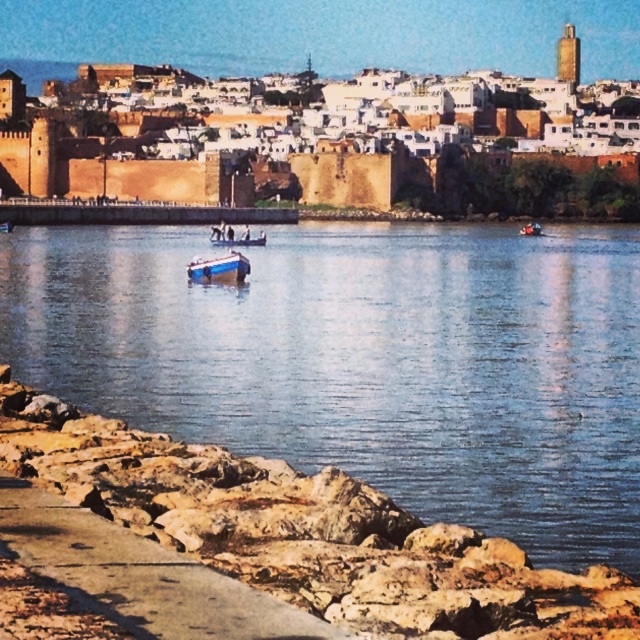
Salé the white and Rabat the red frown at each other over the foaming bar of the Bou-Regreg, each walled, terraced, minareted, and presenting a singularly complete picture of the two types of Moroccan town, the snowy and the tawny. To the gates of both, the Atlantic breakers roll in with the boom of northern seas, and under a misty northern sky.
View of Salé from the Kasbah in Rabat
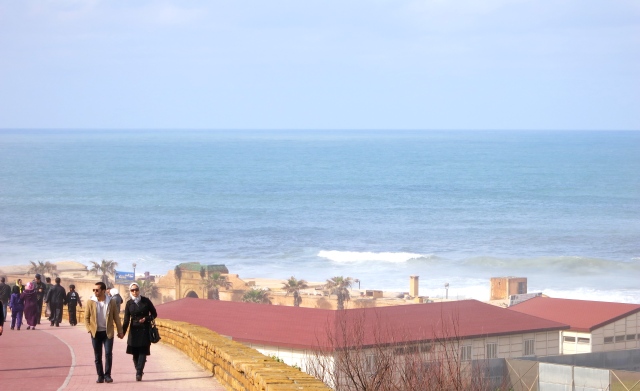
It is one of the surprises of Morocco to find the familiar African pictures bathed in this unfamiliar haze. Even the fierce midday sun does not wholly dispel it – the air remains thick, opalescent, like water slightly clouded by milk.
Seawalk in Rabat
Kasbah of the Oudayas
Inside the gate of the Kasbah one comes on more waste land and on other walls – for all Moroccan towns are enclosed in circuit within circuit of battlemented masonry. Then, unexpectedly, a gate in one of the inner walls lets one into a tiled court enclosed in a traciered clositer and overlooking an orange-grove that rises out of a carpet of roses. This peaceful and well-ordered place is the interior of the Medersa (the college) of the Oudayas.
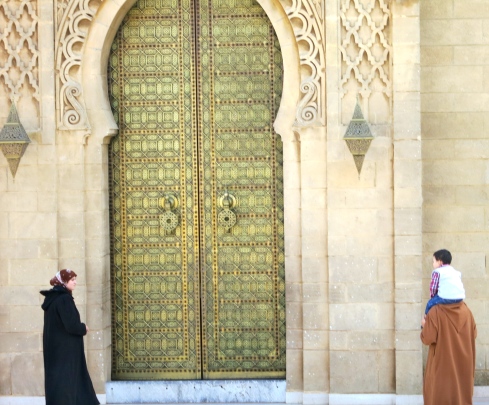
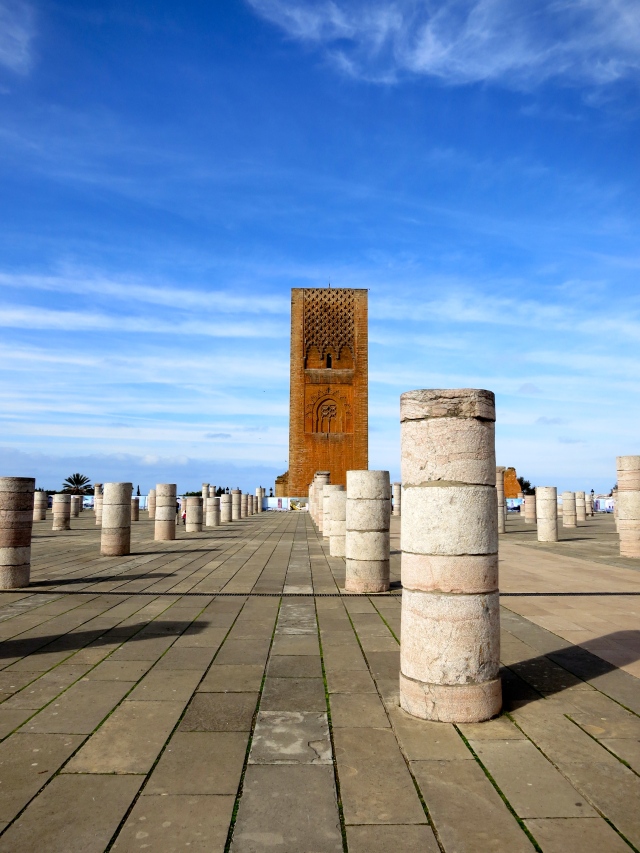
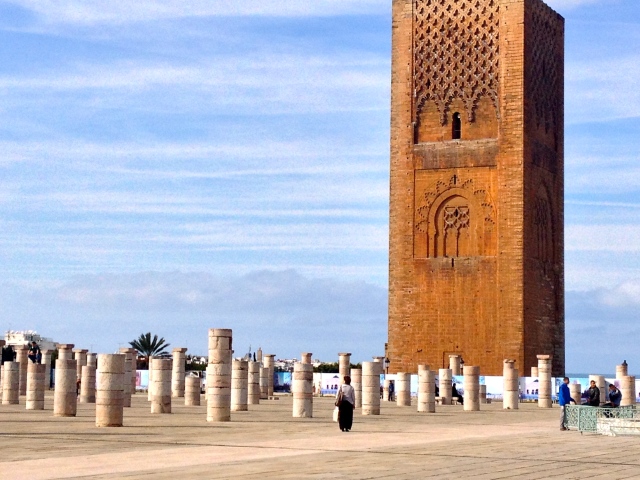
The Tower of Hassan
Tower of Hassan, Rabat
The “Tower of Hassan,” as the Sultan’s tower is called, rised from the plateau above old Rabat, overlooking the steep cliff that drops down to the last winding of the Bou-Regreg. Truncated at half its height, it stand on the edge of a cliff, a far-off beacon to travellers by land and sea. It is one of the world’s great monuments, so sufficient in strength and majesty that until one its fellow, the Koutoubya of Marrakech, one wonders if the genius of the builder could have carried such perfect balance of massive wall-spaces and traceried openings to a triumphant conclusion.
Near the tower, the red-brown walls and huge piers of the mosque built at the same time stretch their roofless alignment beneath the sky. This mosque, before it was destroyed, must have been one of the finest monuments of Almohad architecture in Morocco: now, with its tumbled red masses of masonry and vast cisterns overhung by clumps of blue aloes, it still forms a ruin of Roman grandeur.
The founder of Rabat, the great Yacoub-el-Mansour, called it, in memory of the battle of Alarcos, “The Camp of Victory” (Ribat-el-Path), and the monuments he bestowed on it justified the name in another sense, by giving it the beauty that lives when battles are forgotten.
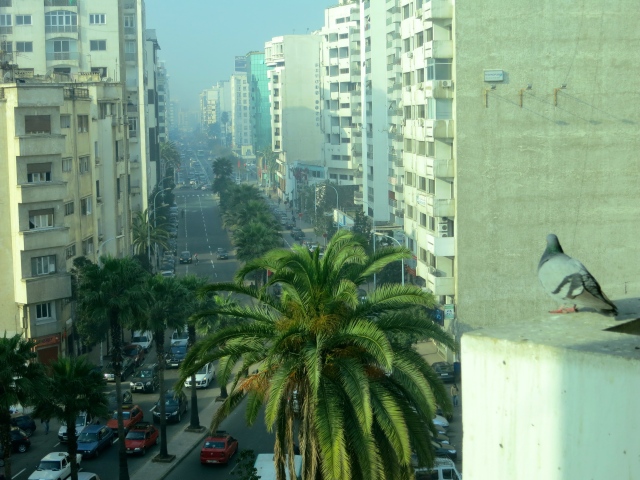
Casablanca
On the west coast, especially, where the Mediterranean peoples, from the Phenicians to the Portuguese, have had trading-ports for over two thousand years, the harm done to such seaboard towns as Tangier, Rabat and Casablanca is hard to estimate. The modern European colonist apparently imagined that to plant his warehouses, cafes, and cinema-palaces within the walls which for so long had fiercely excluded him was the most impressive way of proclaiming his domination.
Casablanca
These are just a few of the words and images I found on my recent trip to Morocco. I was in Morocco for work, however, so my own version of In Morocco will not be a guidebook or travelogue. My version of In Morocco will be a series of sketches, too, but it will the stories of people who are working to improve human rights in their country. I am not a writer with Edith Wharton’s powers of description, but these are stories that can and should be told.
The way a crow
Shook down on me
The dust of snow
From a hemlock tree
Has given my heart
A change of mood
And saved some part
Of a day I had rued.
I was hurrying to work this morning, thinking about all the deadlines crashing down upon me, when I was stopped in my tracks by a shower of snow. The first snowstorm of the year dumped 10 inches of snow on us last Sunday, blanketing the city, making everything pure and white and still. Now rising temperatures are causing the heavy snow to melt.
Such a minor thing – wet snow falling from a tree in a downtown parking lot – but it reminded me of this poem by Robert Frost. With this morning’s beautiful Dust of Snow, my day fell suddenly into perspective.
Onward and upward!
Change your perspective – let a little Dust of Snow fall on you today as well.
Some mornings, I wake up with an image or a poem in my head. Sometimes, a song. I do my best thinking in the morning, too. These Morning Musings are a new (and irregular) feature here on the Human Rights Warrior.
My daughter and son in Oslo’s Frogner Park, at the end of a rain storm.
April Rain Song
Let the rain kiss you
Let the rain beat upon your head with silver liquid drops
Let the rain sing you a lullaby
The rain makes still pools on the sidewalk
The rain makes running pools in the gutter
The rain plays a little sleep song on our roof at night
And I love the rain.
Langston Hughes
Some mornings, I wake up with an image or a poem in my head. Sometimes, a song. The other day, it was this picture; today it was this poem. As winter arrives, the world around me is beginning to slowly freeze. Liquids are becoming solids, their molecules sluggish in the cold. Soon everything will be still, sleeping until the April Rain Song returns. Run with joy while you may, and let the rain kiss you!
As a new (and irregular) feature, I plan to start posting some of these morning musings here.
The photo also fits this week’s Travel Theme: Liquid on Where’s My Backpack. To see more responses, click here.
This is a letter I wrote home from Kathmandu in January. It gives an interesting perspective on life in Nepal – a splash of local color – so I thought I would share it on the Human Rights Warrior.
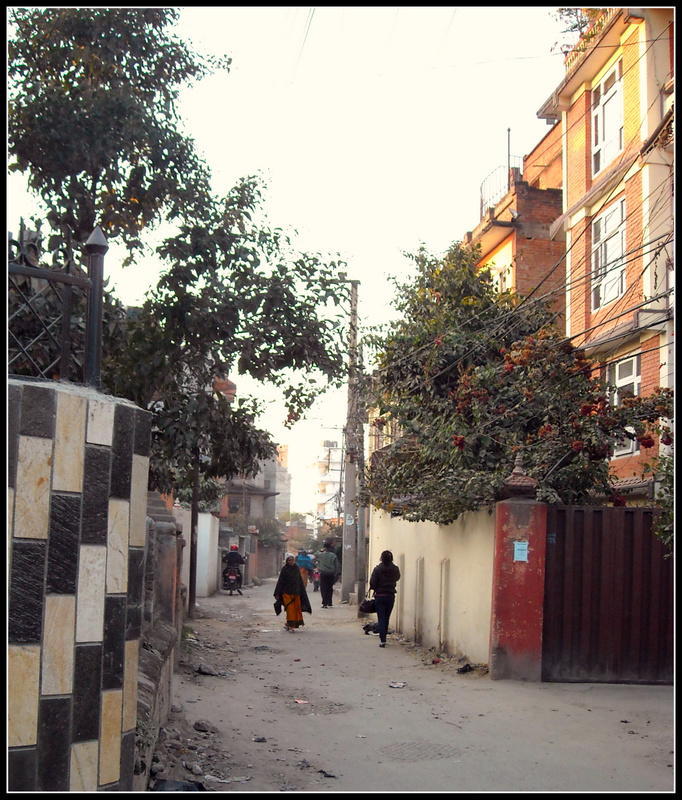
Usually, when I travel for work, I stay in a hotel. It’s different when I travel to Nepal. Here, I stay with a family at their home in Kathmandu. I could never give you directions to their house on the unnamed street in the warren of hundreds of small streets and alleys in the Battisputali neighborhood. But I could show you how to get there.
Morning noises. I lie in my bed on the third floor and listen as the house wakes up. Doors of wood and metal creak and slam. Outside, I hear the sounds of chickens, dogs, some kind of hoarse-cawing bird. Women speaking in Nepali in the kitchen building below my window at the back of the house. A man sings off-key at the top of his lungs as water sluices into his bucket from the water tap next door. Someone is whistling loudly, someone else is hawking and spitting. No need to modulate your voice – everyone here rises at dawn. All this before the rooster crows. Tinny Nepali music is playing on a transistor radio. There’s a knock on my door, followed by a cheerful “Namaste!” The tea tray is set on my bedside table. I have the first of many, many cups of tea in bed. This is how the day begins in this home in Kathmandu.
Can you see my alarm clock in this picture?
Some things have changed since I was last here in March. There is a new security gate with a buzzer, as well as a flat screen TV. Crime is a growing concern in some neighborhoods in Kathmandu.
The biggest news is the daughter has married. Like most marriages in Nepal (but unlike her parents, who made a love match), this one was arranged. Her new husband is in the Army, so the wedding procession was especially grand with a military band and an antique Nepali horse-drawn carriage. Someone told me that the only horses in Nepal are in the Army cavalry, so the only people who know how to ride are in the Army. The polo grounds in the park in central Kathmandu are, therefore, de facto used only by the cavalry. The daughter is 23 and has just finished university. Her mother thought maybe she should go to graduate school first, but she was ready to get married. Her green wedding garland, stitched in red and covered with spangles, is on the wall on the stairway to my room. It has been framed, with a wedding picture in the middle. The wedding couple wore their garlands during the three days of ceremonies. She first met her future husband about two months before the wedding. They come over for dinner and I meet her new husband. She seems happy.
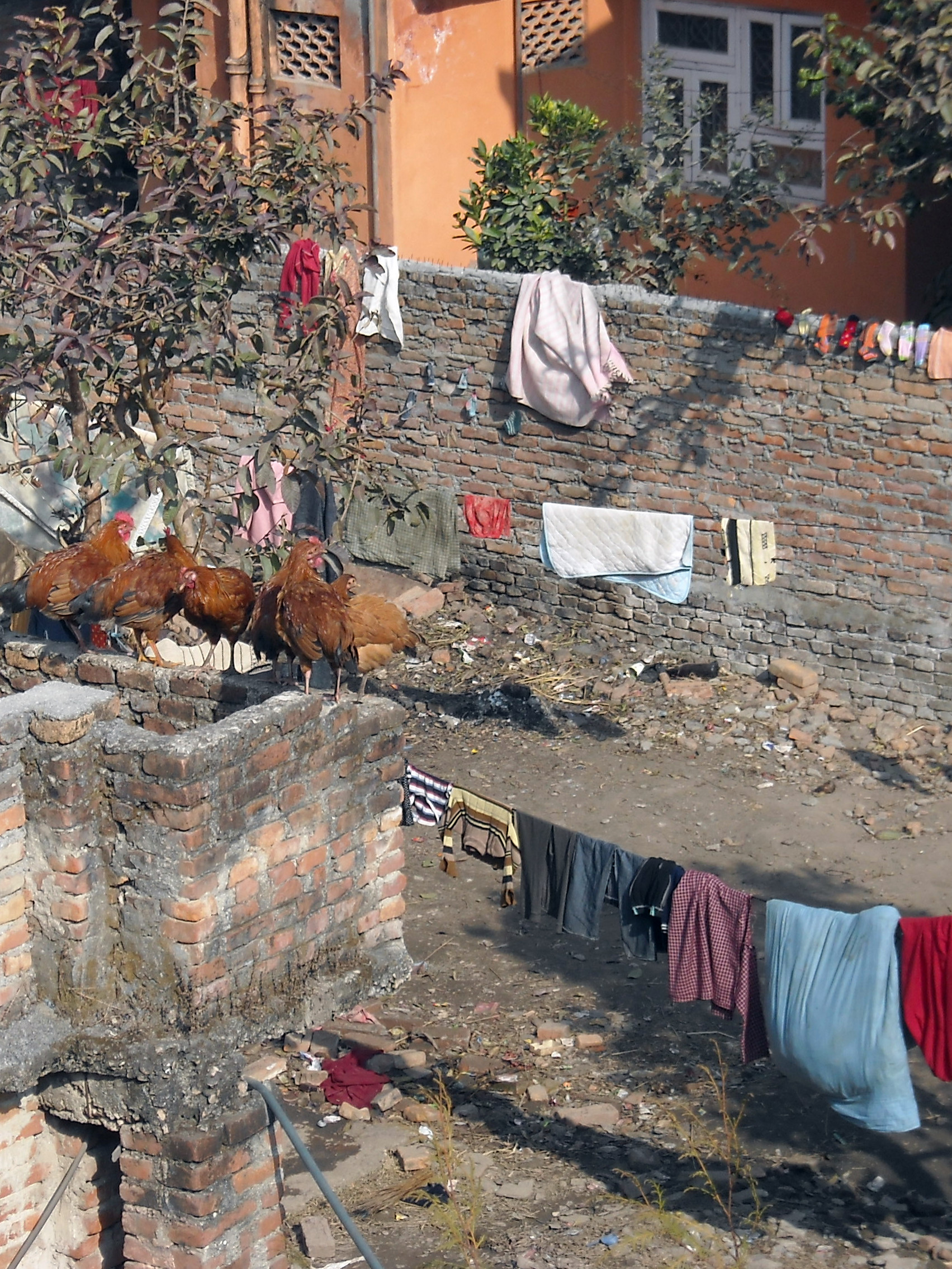
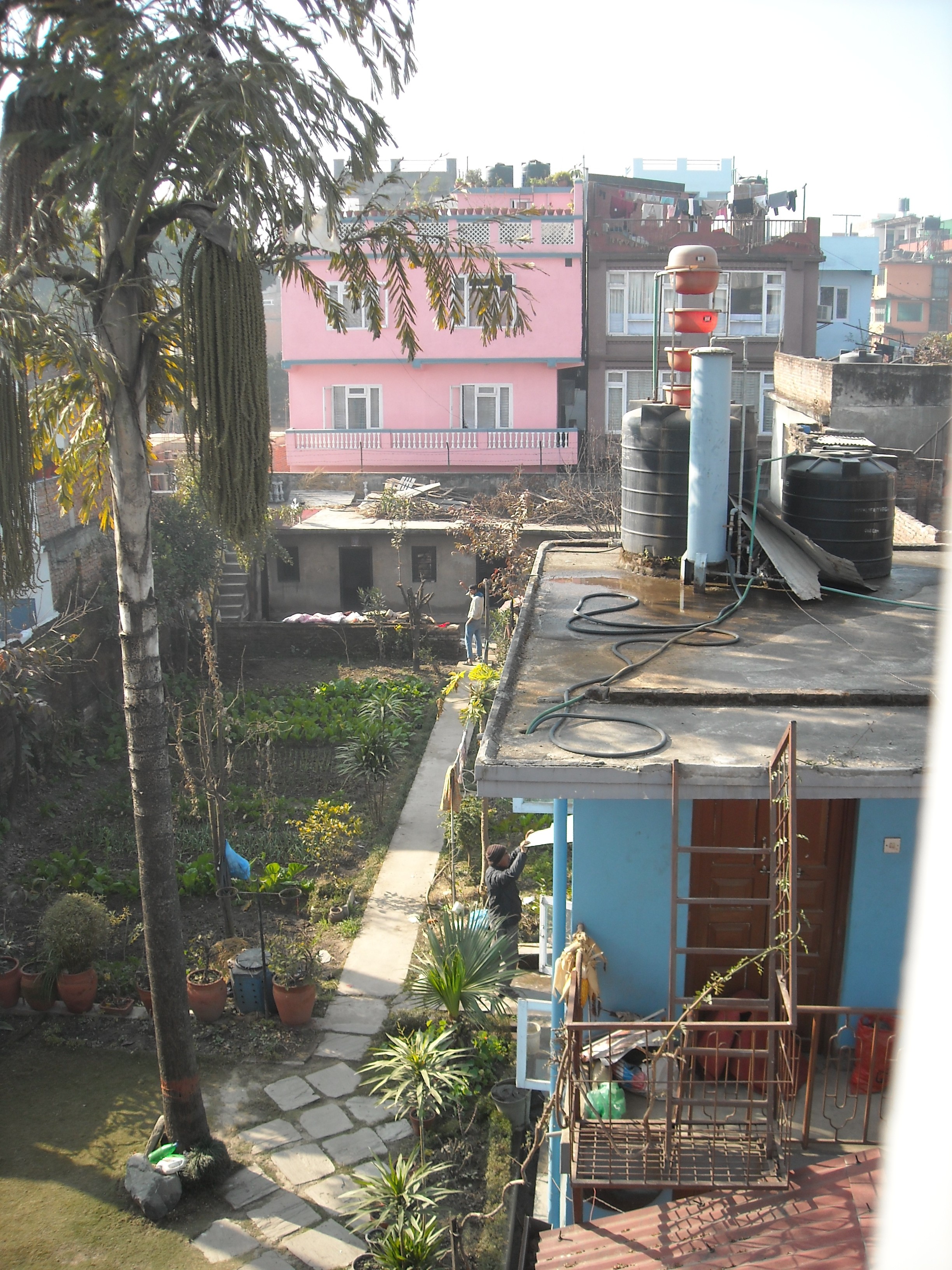
The daughter has now gone to live with her husband’s family. The family I stay with also has two adult sons who are close to my own age. They live here with their parents and their own families. The oldest son just finished building a big, new house in front of the family home. The younger son and his family live in the parents’ house, which he will inherit. Property in Kathmandu is expensive, so it is better to divide what is already in the family. There is a driveway and small courtyard in the front. In the back is a kitchen garden, flowers and fruit trees. It is a small green oasis in a dirty, dusty city.
Niches in the courtyard wall are home to animal sculptures
Three grandchildren live here, too. In the big new house, there is a grandson who is in 12th grade. His classes in college (upper secondary school) go from 6:30 to 11 am. The granddaughter, like my middle son, is in fourth grade and “running 9” (when she turns 10, she will be “9 complete”). Unlike my son, though, she spends 2 to 4 hours a night doing homework. The Nepali is very rigorous and the examinations are taken seriously. The secondary schools post billboards with pictures of their students and their scores on the national standardized exams. Another change since my last visit – the granddaughter is starting to help her mother and grandmother with cooking and serving meals. She shows me some of her sketches – Krishna and Disney Princesses – and gifts me with a sketch of Minnie Mouse.
Her little brother goes to preschool. He speaks Nepali, but understands English and also Hindi from watching Indian cartoons. Nepalis have an interesting relationship with India. In addition to enjoying Indian serials and Bollywood movies, they take the short flight to India if they need a vacation or an operation. Yet they set their clocks 15 minutes off Indian time so they don’t have to be on the same time zone as their much larger neighbor.
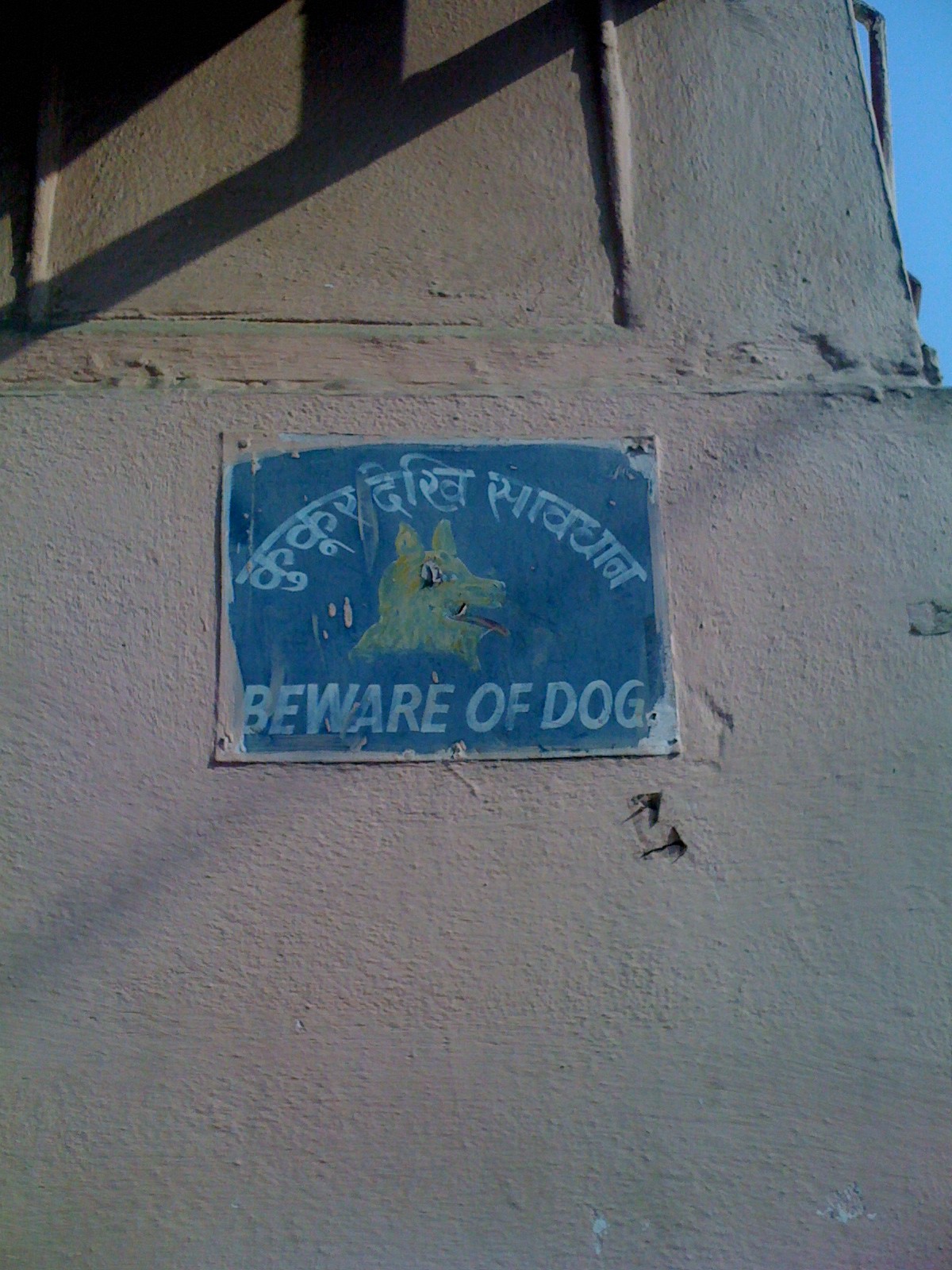
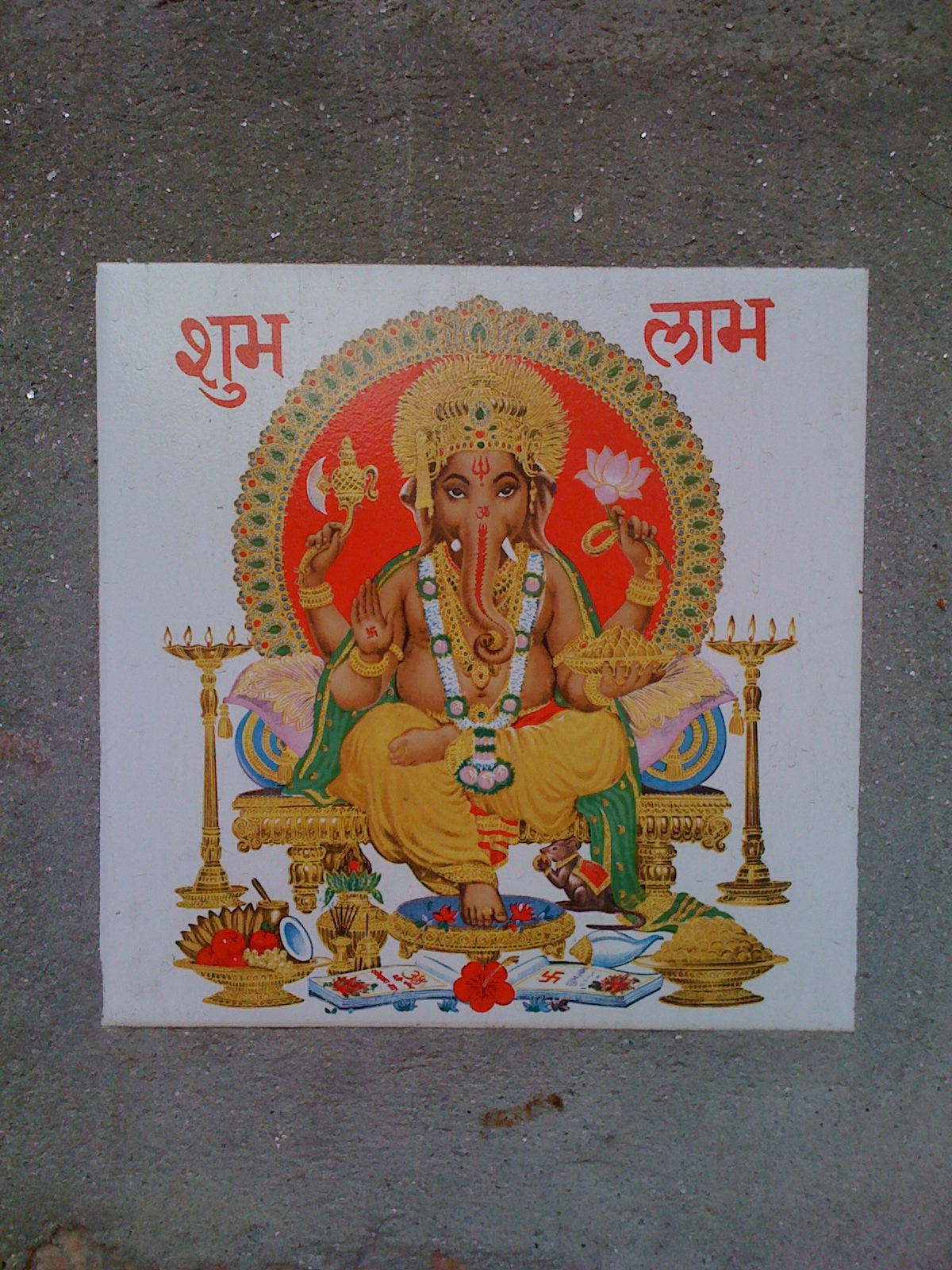
Image from a compound wall in the neighborhood.
There are others who live in this household, helping with the household chores, meal preparation, laundry, washing the cars, minding the kids. There are eight people employed on this compound by my count, but there could be more or less. People come and go in a constant swirl of activity.
The water in the house is city water, but the water for drinking and cooking is delivered by tanker truck and pumped into the polytank on top of the kitchen building. It runs through a filtration system of three plastic basins – one with pebbles, one with sand and one with charcoal.
View of the kitchen garden and the water filtration system on the kitchen roof.
After a sunny day, there will be hot water because the water for showers is heated by solar panels. As your plane makes the approach to land in Kathmandu, you can see the sun winking off the solar panels on every roof. If the day has been overcast, though, you are out of luck and have to ask for someone to bring up a bucket of hot water for bathing.
The shortage of electricity in Nepal has resulted in load sharing in Kathmandu. Each district has electricity for 4-5 hours at a time, usually twice a day. The schedule changes every day, so you may have power from 4-8 am and 7-11 pm one day but 10 am- 1 pm and 1 – 4 am the next. The week’s schedule is on a government website somewhere, but I never know what it is. Twice already during my stay, a fluorescent light in my room has buzzed to light in the middle of the night. Our house has a backup battery, but that means that there are only lights in 4 rooms in the house. Supposedly, there are hydro-electric plants being built with the help of international community. Once these are completed, Kathmandu will have more regular electricity. Hopefully.
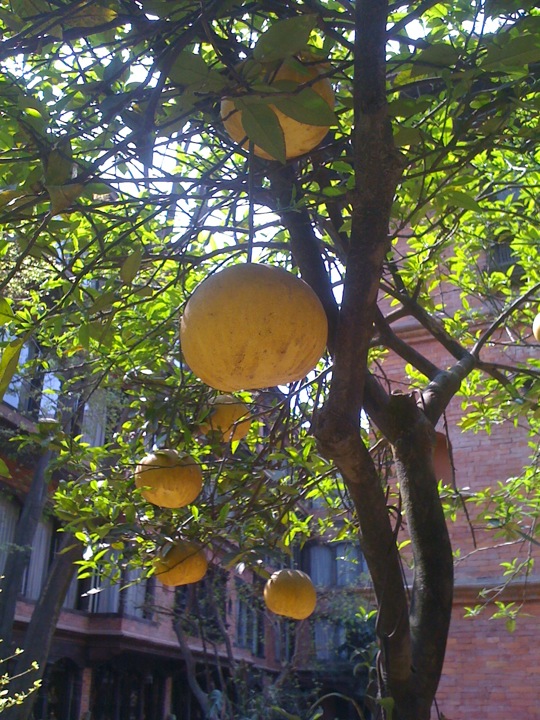
The power situation makes cooking difficult, but the women of the house, who share the cooking duties, somehow manage. For Nepalis, a typical meal involves dal (lentil “soup”), bhat (rice) and tarkari (vegetable curry). We usually also have at least two kinds of tarkari and sag (greens), as well as aloo (potatoes, usually fried). Often, there is also chicken but served on the side. Like my own family, this family has both vegetarians and meat-lovers in residence. I have never eaten so well. For dinner, I eat a healthy dal seasoned with turmeric and ginger that is served to women after childbirth. Punctuated by bright green scallions float, it contains fried chickpea lentils that give it a surprising crunch. At breakfast, I eat papaya from the tree in the backyard. I see grapefruits the size of my head growing there, too.
Here in Nepal, people often greet each other by asking, “Bhaat khanu bhayo?” Literally, this means, “Have you eaten rice?” but in practice it means “Have you had your meal?” Babies eat rice as their first solid food during their first rice feeding ceremony at age 5 months for girls, 6 for boys. They will eat rice just about every day of their lives.
It is winter, so the days are short in the Kathmandu Valley. Offices and schools are on winter hours, opening a little later – 10:30 instead of 10 – and closing a little earlier so people can be home by dark. There is not much nightlife in Kathmandu. During the day, if there is sun, it warms up nicely but at night it is cold. I sleep under a cotton comforter as thick as a mattress. Buildings are not insulated and floors are often marble or tile. I notice that people working in offices and stores are often wearing their coats.
Traffic is a huge problem in Kathmandu. The population grew during the conflict as internally displaced persons fled the Maoists in the countryside. Now the Maoists are in a power-sharing coalition government. The violence has ended but the coalition government is gridlocked. Nepalis have been waiting three years for a new constitution. In the newspaper today, the government promises a completion of the process within the next four months but people are skeptical. When the committee drafting the constitution gets paid by the month, where is the incentive to finish the job?
The Kathmandu population has continued to grow due to the country’s high unemployment. People come to the capital looking for work. There are now 3 million people living in the Kathmandu valley, driving too many cars and motorcycles on streets that were designed for oxcarts. The air is polluted and many people wear masks over their lower faces. Many Nepalis have gone abroad to study in India, the UK or the US or work in Malaysia and the Middle East. Every Nepali I meet has a relative somewhere in the diaspora.
Right now, in January of 2012, there is a scarcity of petrol in Nepal. I see long queues for gas and hear stories of people waiting 12-14 hours a day and still not getting to the front of the line. The government recently hiked the price of petroleum, resulting in student protests. The protesters, who are members of different political parties, called a nationwide bandh for today. Bandh, the Nepali word for “closed”, is a form of protest requiring the closing of markets and schools. It was a Maoist tactic during the conflict. Now they are in the government, but the practice continues. The headline in one newspaper is “Maoists reap the bandhs they sowed.”
No driving is allowed today. The Nepali Police, as well as the Armed Forces Police, are out in full riot gear today, but the bandh is enforced by the protesters themselves. It is strange to walk in the middle of the street, with no cars and motorcycles. There is a holiday mood, more so than yesterday – an actual public holiday. People mill around, chat, play badminton in the street. Most people support the protesters and their criticism of the government for the rising prices.
When I get back to the house, my friend waves from the second floor balcony. When we arrived last week, she was the one who opened the door and said, “Welcome home!”
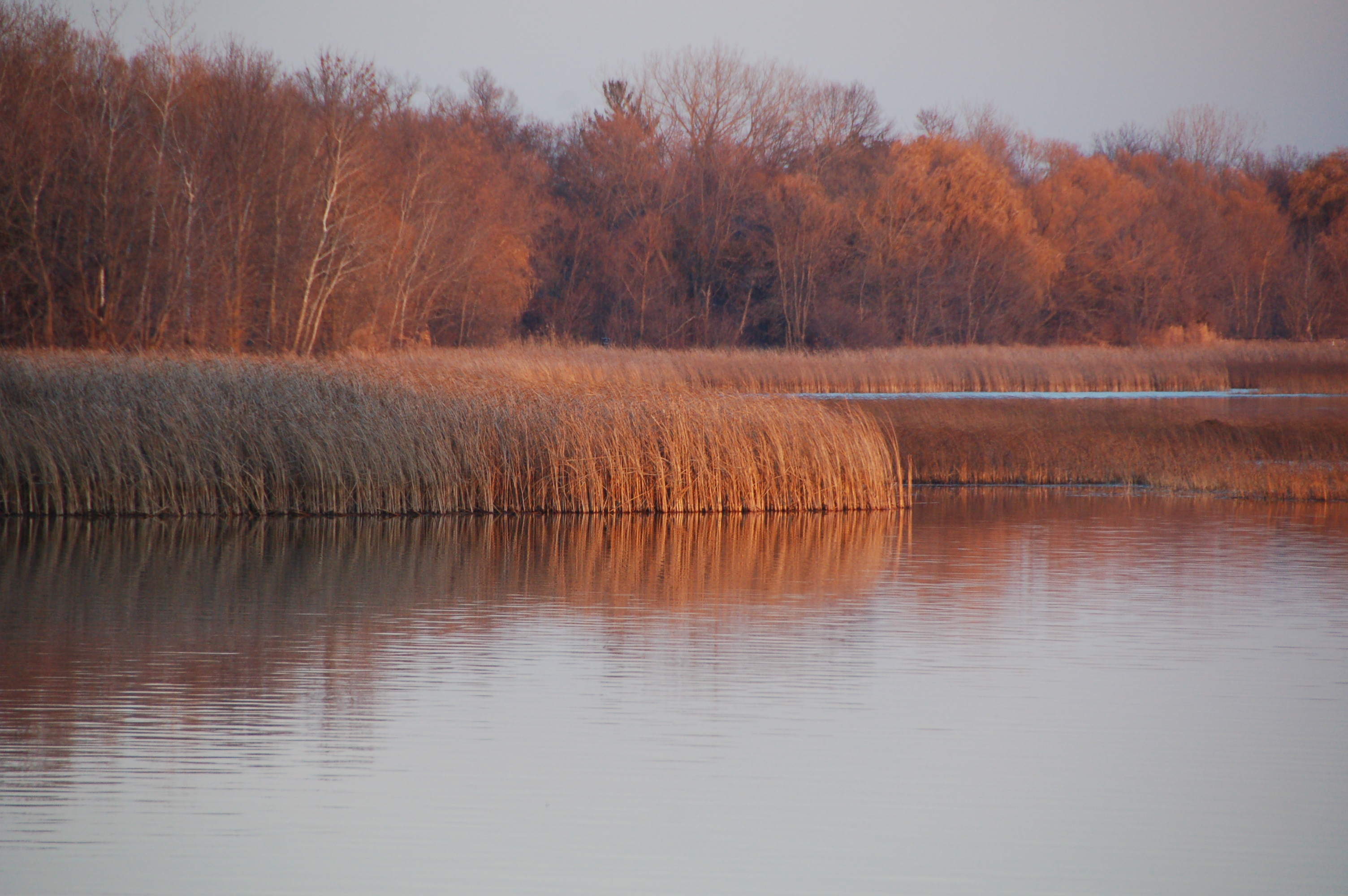
The sunset lasts approximately four minutes this time of year in these northern climes. I was reminded of that – and the transient and precious nature of our lives here – tonight on my run around Lake Harriet. Ask for help if you need it. Help if you see a need. Best wishes for peace, love and joy in 2012!
This time of year always reminds me of George Winston’s December. I used to listen to it in college, when I was studying for finals. I’d play it on my cassette deck, rewind, then press play again. But the music often made me visualize things that weren’t on the pages I was supposed to be reading.
George Winston’s December set the perfect tone for studying. Calm and clear, but with the slight urgency of Night: Part II Midnight. It also carried a hopeful hint of the excitement of the holidays to come. The album actually came out several years before I went to college, but I discovered it my freshman year. Snow was new to me, too. I grew up in Louisiana, where once or twice I remember them calling off school because the temperature was below freezing.
The first time I really experienced snow was in December of 1985. It started snowing late one night during Reading Period and Yale’s entire freshman class seemed to erupt onto Old Campus. Huge, wet snowflakes drifted down and coated the lawn or swirled sideways and up, as if in a snowglobe. Someone put their speakers in an open common room window, Winter from Vivaldi’s Four Seasons blasting from the stereo. I still think of that night and the laughing, shadowy figures dancing in the softly falling snow. It was magical – the kind of night where you would kiss a stranger out of sheer joy and beauty.
A massive snowball fight erupted before long. Having never made a snowball before, I was at a distinct disadvantage. I took a direct hit eventually and had to go inside to melt the packed snow from my ear canal. “Probably for the best,” I thought. “Finals are starting soon.”
So, as musical commentary on the seasons, I think George Winston wins hands down over Vivaldi. When I listen to George Winston’s December, I’ve always pictured scenes from nature and – oddly enough – happy children. This year, in honor of the 30th anniversary of the release of George Winston’s December, I decided to document the waning of autumn and waxing of winter with photographs. In some ways, George Winston’s December is also a theme for me in doing human rights work. We are moving forward, calm and clear, with a slight sense of urgency but with hopeful hints of the future.
Pete Seeger died yesterday at the age of 94. I can’t remember a time before I knew his voice; his songs are part of the soundtrack of my childhood. I began listening to Pete Seeger’s music again more recently, when my own children were young. Together, we sang his songs “Goodnight, Irene” and “We Shall Overcome” and “If I Had a Hammer. Yet, in spite of the fact that Pete Seeger gave thousands of performances during my lifetime, I only saw him in person once. He was not on a stage. Pete Seeger was standing alone in the rain on the side of the highway near his home in New York’s Hudson Valley. He was holding not a banjo or guitar, but a sign protesting the Iraq War. As we drove by, I noticed that his mouth was open and moving. “Hey, I think that’s Pete Seeger!” I said, turning in my seat to continue watching him.
And I realized that his mouth was moving because – alone in the rain, on the side of a highway- Pete Seeger was singing his heart out for peace.
I’m thankful to Pete Seeger for his music and his activism – and for being someone who who really does make me believe, deep in my heart, that “We Shall Overcome” one day.
Rise Up Singing!
(Originally published on October 14, 2011 and updated on January 28, 2014)
History shows the incredible power of music to inspire and influence, to energize and heal. The power of song can be seen in its impact on movement-building, from the anti-slavery and labor union movements in the 1800s to the civil rights and anti-war movements in the 1960s. Liberation music has been important throughout the world, including songs of resistance during the anti-Apartheid struggle in South Africa. Most recently, music has been part of this year’s Arab Spring. In protests against Hosni Mubarak in Egypt, for example, music was a powerful way to convey the voice of the people. (NPR story did a great story on The Songs of The Egyptian Protest)
I absolutely love Rise Up Singing, the folk music group singing songbook. The book contains the chords and lyrics to more than the 1200 songs. When you flip through it, you get a sense of how many songs there are out there that speak to such a wide variety of social justice issues. Rise Up Singing grew out of Peoples Songs, Inc., Sing Out! The Folk Song Magazine and the post-World War II American folk song movement led by Pete Seeger and Woody Guthrie, and many others who sought to combine political activism with music.
But music that inspires me to stand up for human rights is not just about protest songs or folk music. Music speaks to the individual. Inspiration is personal. In 2006, I was in Geneva with representatives from dozens of U.S. human rights groups to participate in the UN’s review of US compliance with the International Covenant on Civil and Political Rights. We were all working on different issues and we came from all over the country, from Florida to Hawaii.
As an icebreaker at our first meeting, we were asked, “What is your favorite human rights song?” I remember being amazed as we went around the room at the tremendous variety in terms of songs, genres, languages, meanings that had inspired this group of activists. I told the group that my song was “If I Had a Hammer”. (My kids were still quite young at the time and we were listening to a lot of Pete Seeger, who is my own personal antidote to Barney.)
Since then, I’ve been making a mental playlist of the songs that have inspired me over the years. My list of songs is actually long enough for several playlists, but I decided to pull out just a few songs from each of the eras of my life so far. This was a real challenge and there are a lot of obvious omissions. Maybe I’ll just have to do another playlist someday.
In the meantime, I’ve got the HUMAN RIGHTS WARRIOR PLAYLIST for you on YouTube. You can also link to each song individually below. Enjoy!
Free to Be You and Me – Marlo Thomas & Friends In my opinion, one of the best things about being a kid in the 70s.
The Preamble – Schoolhouse Rock Did you know that the U.S. Constitution is one of the first documents to establish universal principles of human rights?
Star Wars Main Title/Rebel Blockade Runner– John Williams People say Star Wars was a Western set in space, but I saw the Empire for the police state that it was. Extrajudicial execution of Luke’s family, arbitrary detention of Han Solo et al. Not to mention the genocide on Alderaan.
Freedom – Richie Havens My parents had the Woodstock album. I think I know this and every other song on it by heart.
From My Youth
Sunday Bloody Sunday – U2 I first heard this on my high school radio station WBRH. I went right to the library and looked up the 1972 Bloody Sunday Massacre in Northern Ireland. (Yes, I’m a nerd. I know.)
Holiday in Cambodia – Dead Kennedys I went through a big DK phase in high school. Also, I knew a family that had fled the Pol Pot regime. I still think of them when I hear this song.
Talkin’ Bout a Revolution– Tracy Chapman Growing up in Louisiana, I had seen poverty. But it didn’t prepare me for the mid-80s urban poverty I saw when I went to college in New Haven. This song still rings true 25 years later.
Tell Me Why – Bronski Beat I remember this as the first song I heard that directly addressed prejudice against LGBT persons. Rock on!
Waiting for the Great Leap Forward – Billy Bragg The lyrics have changed since I first bought Worker’s Playtime (on cassette!) in college, but I think it is possible that I have listened it to 1,000,000 times.
From My Adulthood
All You Facists (Are Going to Lose) – Lyrics by Woody Guthrie, Music by Billy Bragg & Wilco From the Mermaid Avenue album. Yes, the Facists are bound to lose some day.
Hurricane – Bob DylanRubin “Hurricane” Carter did an event for us to help raise money for our Death Penalty project. If anyone ever wants to make a movie about your life, he highly recommends that you ask that they get Denzel Washington to play you.
Living Like a Refugee – Sierra Leone’s Refugee All Star Band I spent the first 5 years of my career working with asylum seekers. This song captures many of the things I heard about their experiences.
Face Down – Red Jumpsuit Apparatus Violence against women is the most common human rights violation in the world – 1 in 3 women will experience abuse in her lifetime. In the US, a woman is beaten or assaulted every 9 seconds. Kudos to these guys for singing about it.
Minority – Green Day Sometimes I have to remind myself that not everyone thinks the way I do about human rights – yet.
Sons & Daughters – The Decemberists This is kind of where I am right now. With sons and daughter. Hoping to “Hear all the bombs fade away.”
I’ve often been asked how I ended up as a human rights lawyer. It would be inaccurate to say that any one event made me decide to go into the human rights field. Many little, meandering creeks had to come together to make this river flow. Without a doubt, though, one reason for my career choice was my longstanding interest in all things international. That interest was nurtured during my childhood summers in northern Minnesota at Skogfjorden, the Concordia Language Villages’ Norwegian language camp. It would be hard to deny that the Concordia Language Villages, the mission of which “is to prepare young people for responsible citizenship in our global community,” had a big impact on my life. (For more on the Concordia Language Villages, check out www.concordialanguagevillages.org)
Here is something that I wrote last year when I went back on staff after 22 years of life in the “real world”. I’m reposting on this blog as Sevrin, Simon and I are leaving shortly for two weeks at the Skog, but also because one of the things that I have learned from doing human rights work is that I am so incredibly lucky. I am lucky to have my health, my family, my home. I have plenty of food to eat and good healthcare. I am lucky to be able to say whatever I want and associate with whomever I want without fear of arrest and imprisonment. Even though I am a woman, I had the opportunity to get a good education and to make my own decisions about my career. Nothing reminds you of how lucky you are like spending time with people who don’t have these rights and opportunities. And I feel so privileged and lucky to be able to do the work that I do.
Så Heldig Jeg Er
When I hung up my stabsjakke (staff jacket) for the last time in 1988, I fully expected to someday drive up Thorsenveien with a minivan full of kids bound for Skofjorden. I never imagined that I would park that minivan and spend two weeks here WITH my kids. But here I am, wearing a navnskilt (nametag), living with the girls in Tromsø, and sharing the Skogfjorden experience with my 10 and 8 year old sons.
There have been some changes in the 22 years since I was last on staff. The first thing I noticed was how much taller the trees are in front of Utgard. The circular staircases are gone, as are the woodburning, metal mid-century modern fireplaces in the hytter (cabins). There are new places – Fagertun, Låven, Mine’s Brønn – as well as some new names for old places. There are new hand movements for songs I once knew and a whole lot of new songs. The schedule has changed a bit, so sometimes I feel like a villager myself, “What happens next? Where am I supposed to be now?”
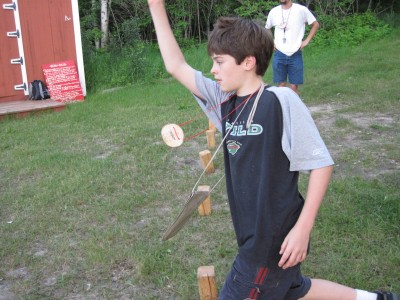
Sev playing kubb (that’s a navnskilt/nametag)
As a parent, I can say that I feel that Skogfjorden is even better than when I was a villager or on staff. It’s a safer place, both in terms of physical plant and safety policies, and staff members receive better and more comprehensive training. I see every day how hard the lederer (counselors) here work, with patience and good humor, to give our kids the best possible experience. More than ever, this is a place that supports and encourages all levels of learning and abilities. Staff are as creative and energetic as they were in my day, but they do a better job of making this a total Norwegian immersion experience.
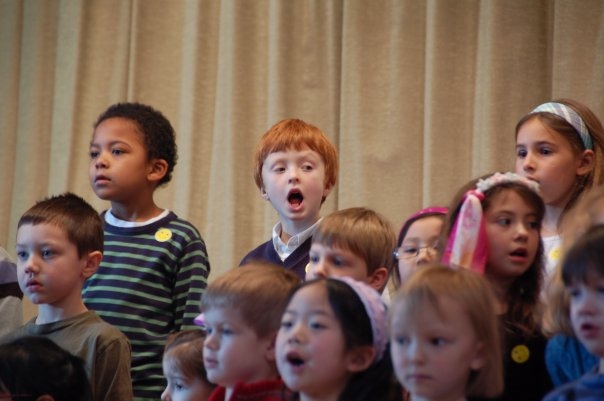
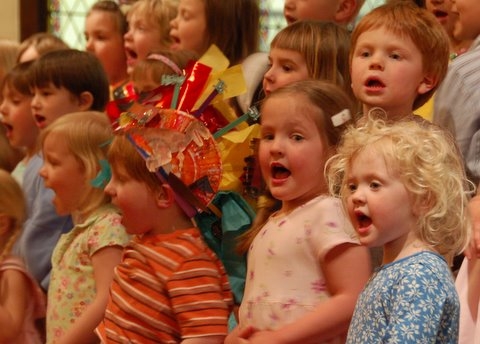
One thing that has not changed is that Skogfjorden is a place where kids learn and grow and have fun. LOTS of fun. It’s a joy to watch my kids singing their hearts out at allsang (singing) and to eat middag (lunch) with them and hear about what they did during kretser (an activity that was new for me, too).
One of the new songs that I learned this week captures my feelings about this session exactly. The refrain of the song is, “Å så heldig jeg er, som kan være her med deg.” “Oh, so lucky I am to be here with you.” Å så heldig we parents are to be able to give our children the Skogfjorden experience.


















 The Human Rights Warrior
You must be logged in to post a comment.