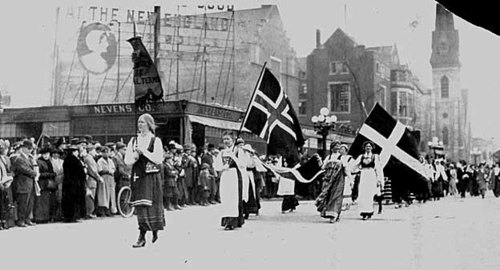
Suffrage procession in Minneapolis on May 2, 1914
From the collections of the Minnesota Historical Society
Source: thomaslowrysghost.tumblr.com
Election Day is coming up Tuesday and you can be damn sure that I am going to cast my vote.
I’m doing it for my Grandma Lillian and all the inspirational people that I’ve met over the years who have risked everything to secure their right to participate in government.
My Grandma Lillian was raised by her grandmother, Thorina Melquist. Thorina was an immigrant from Norway whose oldest daughter (my great-grandmother) died of typhoid fever just weeks after she gave birth to my grandmother. Thorina’s youngest child was only nine months older than my grandmother. She weaned him in order to nurse my newborn grandmother, who had also contracted typhoid but somehow – miraculously – survived. (And, yes, “Thorina” is the female version of the name of the Norse god of thunder.)
In addition to farmwork and child-rearing, Thorina was a dedicated suffragist. She believed strongly in equal voting rights for women and she often participated in demonstrations advocating for the right to vote for women. Women received full suffrage rights in Norway in 1913, so Norwegian immigrant women (along with their Finnish, Swedish and Danish counterparts) played a notable role in the suffrage movement at the local level in Minnesota and other states with large Scandinavian immigrant populations. The photo at left shows women from several Scandinavian countries in traditional dress marching against inequality and for universal women’s suffrage on Hennepin Avenue in downtown Minneapolis.
My Grandma Lillian grew up as a suffragist. She was still pretty young in 1919 when the Nineteenth Amendment was passed by Congress and ratified by Minnesota. Women’s suffrage became national law on August 18, 1920 when Tennessee became the 36th state to ratify the Constitutional amendment.In some ways, it is surprising to think that less than 100 years ago, women in America could not vote. I was a toddler in Louisiana when that state ratified the 19th Amendment in 1970 – 50 years after initially rejecting it. And Mississippi didn’t ratify the 19th Amendment until 1984!
Now the right to participate in government is one that we Americans take for granted – so much so that less than half of the population votes unless it is a Presidential election year. In 2008, the voter turnout was 63%, a high water mark that is low in comparison with most countries. In U.S. local elections, the voter turnout is even lower. Many of the mayors of major U.S. cities are elected with single-digit turnout. That’s just shameful.
I love to vote. In fact, I vote every chance that I can – legally at least. I always try to bring my kids with me when I vote, so they can see that having a voice in the democratic process is something both important and valuable.
But when I’m standing in the voting booth, I feel like there are others there in the voting booth with me. They are some of the inspirational people that I’ve met over the years who have risked everything to secure their right to participate in government.
Standing with me is the young Haitian asylum seeker who was beaten by police at a polling place in order to discourage him from voting for Jean-Bertrand Aristide in 1990. He held his own, though, and stood there bleeding and bandaged for several hours before he finally had the opportunity to put his check next to Aristide’s rooster symbol on the ballot. It was the first time he had ever voted – and it was a remarkable act of courage and endurance. In telling me about it, he summed it up by saying,
“I voted! It was a very good day.”
In the voting booth with me are also many of the amputees in Sierra Leone in 2004. It was common practice during the conflict there for members of the Revolutionary United Front (RUF) to hack off the hands or arms of people with machetes. Some of them had been targeted during elections so that they couldn’t vote by leaving their fingerprint mark on the paper ballot. I also heard that the RUF brutally amputated hands during one election because the government’s slogan was that,”The power is in the hands of the people.”
I visited Sierra Leone in 2004, after the conflict had ended and just prior to the first post-conflict elections. As I traveled through the countryside, I saw people coming together for meetings to discuss the upcoming elections. In spite of the horrors that they had endured, they were coming together in villages big and small, to exercise their right to participate in their government. Here is a photo I took of a gathering in a village far out in the bush in the Kono district, an area that endured particularly brutal human rights abuses. Yet now, as the country was slowly emerging from the conflict, the villagers were coming together to discuss the upcoming local election process.
Although my grandmother gained the right to vote, she was never able to go to college. She was certainly smart enough, but her family couldn’t see the point in wasting good money on educating a girl. Grandma Lillian never expressed bitterness about this to me. But one afternoon when I was in high school, I stopped by to say hello and to get her thoughts on my top college picks. I remember sitting in my grandparents’ darkened living room. A mantel clock ticked and the air conditioner hummed. It now seems impossibly calm and quiet, so different from my current raucous and messy living room. My Grandma Lillian told me that the most important thing was to follow my dreams.
“You can do whatever you want to with your life. Be what you want to be.
But never forget those of us who weren’t able to follow our dreams.
Follow your dreams for us.”
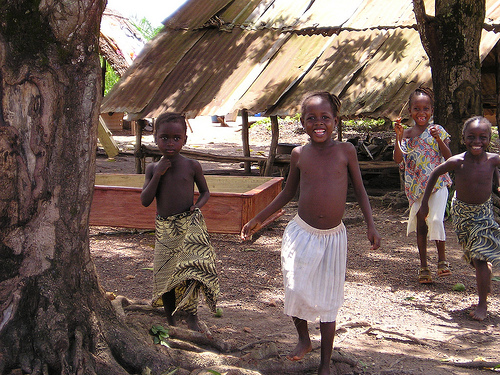
Upcountry girls in Sierra Leone. Photo by my colleague Rosalyn Park.
So that’s why I never miss the chance to vote. I’m doing it for my Grandma Lillian. And for everyone else who can’t follow their dreams.
Every election day is an opportunity. An opportunity to have a say in the decisions, big and small, that impact the lives of you and everyone around you. Don’t make excuses, don’t be discouraged. This is a right that is too valuable to waste. On Tuesday, please get out there and VOTE! If you need help finding your polling place, go here:
The photo at the top is of the Scandinavian Women’s Suffrage Association marching in a parade in Minneapolis in 1914.
I keep it in my office in honor of my Grandma Lillian.
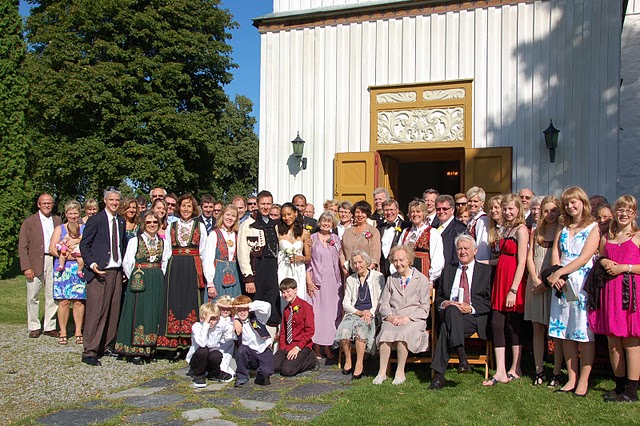
Extended family from 3 continents at my brother’s wedding (Nes kirke, Norway, August 2010)
I’ve been thinking a lot about family recently. We had just dropped off my old friend Erik and his “unwieldy crew” at the airport, when my daughter Eliza sighed, “It’s pretty much BORING without our cousins.” Knowing there was no actual blood relation, I cross-examined her on why she thought they were our cousins. (It must sometimes stink to have a lawyer for a mom.) Finally she said in frustration, “Because, I just FEEL like they are.”
How do you define family? Is it common ancestry? Shared experiences? Mutual commitment? Living in the same household? Common values? The people you know you can count on for support? The people you know you can get into a knock-down-drag-out fight with but they’ll still love you? People who you feel deeply connected to even though you rarely see them? All of the above? Or none of them at all?
When I was at the Buduburam Refugee Settlement in Ghana, I met a woman who runs a cook shop there. Called Ma Fatu, her feisty personality would have been equally at home as the proprietor of a saloon in the Wild West or of an inn in medieval England. She took a lot of pride in her cooking and in knowing her customers. She’d eye me critically as I tucked into my jollof rice and say, “I know what you white people like to eat.” Then, the next day, she would serve me up a heaping serving of jollof vermicelli.
I had noticed that there were several young people helping in the cook shop, washing dishes, waiting tables, whatever needed to be done. It was only on my second trip to Buduburam that someone told me that they were not actually her children. During the war in Liberia, her husband and children – her entire family – had been killed. Over the years at Budububuram, she had taken in several young people who had also lost everyone. In the face of all this loss, Ma Fatu had created a new family. In a refugee camp – miles from home and without even the possibility of legal recognition – she had forged familial bonds of love and support.
Like every parent, I’ve got a stockpile of my kids’ drawings of our family – stick figures showing Mom and Dad, Brother and Sister. Sometimes Grandma and Grandpa and/or Cat and Hamster. When you are young, the definition of family is very narrow and also very immediate. But as you get older, you develop deeper relationships with people who are not related by blood. In many ways, you create your own family of the people who give you what you need to flourish.
I’ve had this discussion about the definition of family with a number of asylum clients. Under U.S. immigration law, your family is defined as your spouse (only one – your first spouse), your children by birth or legal adoption, and your parents. Of course, many people in the world use a broader definition, with half-siblings, cousins, and children adopted without legal recognition counting as immediate family members. I once had a client say to me, “I feel so sorry for you Americans. Your families are so very small!”
Article 16(3) of the Universal Declaration of Human Rights states that, “The family is the natural and fundamental unit of society and is entitled to protection by society and the State.” Back when the UDHR was written in 1948, it is doubtful that the drafters envisioned even biracial marriage, much less the multiple forms of family that exist today.
Now, I am a strong supporter of same-sex marriage. I also believe that the equal rights of LGBT persons to marry, file joint taxes, visit partners in hospital, raise children, etc. will be guaranteed by law sooner rather than later. But the bigger point I’d like to make is that, no matter how you define “marriage”, the push for the change in law happened because of thousands – maybe millions – of personal decisions by individuals to define themselves as “family”. The reality is that there is a very human need to live in a family social structure – the natural and fundamental group unit of society. The law can better accommodate that reality but regardless of what the law says, people –like Ma Fatu – will create their own families.
Maybe my six-year-old Eliza is right – the true definition of family is a very personal one, self-defined by each of us. The definition of family maybe IS really the people who you feel like are your family. And if that is so, wouldn’t we all be better off if society and the State protected our families?
So I think the real questions are: How do you define your family? What does your family mean to you? And what could our society and State do better to support YOUR family?
I’ve often been asked how I ended up as a human rights lawyer. It would be inaccurate to say that any one event made me decide to go into the human rights field. Many little, meandering creeks had to come together to make this river flow. Without a doubt, though, one reason for my career choice was my longstanding interest in all things international. That interest was nurtured during my childhood summers in northern Minnesota at Skogfjorden, the Concordia Language Villages’ Norwegian language camp. It would be hard to deny that the Concordia Language Villages, the mission of which “is to prepare young people for responsible citizenship in our global community,” had a big impact on my life. (For more on the Concordia Language Villages, check out www.concordialanguagevillages.org)
Here is something that I wrote last year when I went back on staff after 22 years of life in the “real world”. I’m reposting on this blog as Sevrin, Simon and I are leaving shortly for two weeks at the Skog, but also because one of the things that I have learned from doing human rights work is that I am so incredibly lucky. I am lucky to have my health, my family, my home. I have plenty of food to eat and good healthcare. I am lucky to be able to say whatever I want and associate with whomever I want without fear of arrest and imprisonment. Even though I am a woman, I had the opportunity to get a good education and to make my own decisions about my career. Nothing reminds you of how lucky you are like spending time with people who don’t have these rights and opportunities. And I feel so privileged and lucky to be able to do the work that I do.
Så Heldig Jeg Er
When I hung up my stabsjakke (staff jacket) for the last time in 1988, I fully expected to someday drive up Thorsenveien with a minivan full of kids bound for Skofjorden. I never imagined that I would park that minivan and spend two weeks here WITH my kids. But here I am, wearing a navnskilt (nametag), living with the girls in Tromsø, and sharing the Skogfjorden experience with my 10 and 8 year old sons.
There have been some changes in the 22 years since I was last on staff. The first thing I noticed was how much taller the trees are in front of Utgard. The circular staircases are gone, as are the woodburning, metal mid-century modern fireplaces in the hytter (cabins). There are new places – Fagertun, Låven, Mine’s Brønn – as well as some new names for old places. There are new hand movements for songs I once knew and a whole lot of new songs. The schedule has changed a bit, so sometimes I feel like a villager myself, “What happens next? Where am I supposed to be now?”
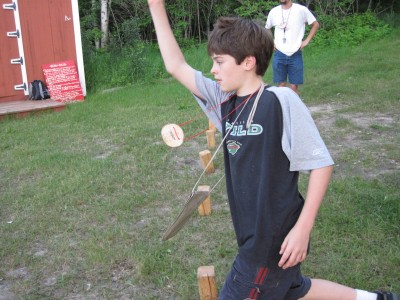
Sev playing kubb (that’s a navnskilt/nametag)
As a parent, I can say that I feel that Skogfjorden is even better than when I was a villager or on staff. It’s a safer place, both in terms of physical plant and safety policies, and staff members receive better and more comprehensive training. I see every day how hard the lederer (counselors) here work, with patience and good humor, to give our kids the best possible experience. More than ever, this is a place that supports and encourages all levels of learning and abilities. Staff are as creative and energetic as they were in my day, but they do a better job of making this a total Norwegian immersion experience.
One thing that has not changed is that Skogfjorden is a place where kids learn and grow and have fun. LOTS of fun. It’s a joy to watch my kids singing their hearts out at allsang (singing) and to eat middag (lunch) with them and hear about what they did during kretser (an activity that was new for me, too).
One of the new songs that I learned this week captures my feelings about this session exactly. The refrain of the song is, “Å så heldig jeg er, som kan være her med deg.” “Oh, so lucky I am to be here with you.” Å så heldig we parents are to be able to give our children the Skogfjorden experience.
I am just about the last person who should be lecturing on the subject of forgiveness. I’ve always tended to savor the little niggling injustices in my life, holding onto them and working them over the way you worry a sore spot in your mouth with your tongue.
I’ve noticed that my children are constantly denying responsibility for wrongdoings. Or, to state it more accurately, they are always claiming innocence and then laying the blame on someone else. All three of them will pipe up with “I didn’t do it! It was (fill in the blank)!” in response to questions about who left the door open, who spilled the milk, who left gum on the floor, who threw that bread at me (just to give some examples from the last 20 minutes).
That says something to me about human nature. Our first instinct is to shift the blame, deny responsibility. Admitting you are wrong is one of the most difficult things you can do. It’s so much easier to deny or make excuses or pretend like you didn’t know what was going on. And while it takes a lot to acknowledge blame, it takes even more to ask for forgiveness.
What does it take to really, truly grant forgiveness to someone who did something that hurt you? My son came home from Sunday School with one of those sheets where you have to decode the hidden message, which turned out to be Colossians 3:13 “If someone does wrong to you, then forgive him. Forgive each other because the Lord forgave you.” “So you should forgive your brother for eating your candy, right?” I said. “It’s not that easy,” he replied.
Houses at the Buduburam Refugee Settlement
No, forgiveness is NOT that easy. But when we were working with the Truth and Reconciliation Commission of Liberia back in 2007 and 2008, I interviewed a surprising number of people who said that they had forgiven the people who had hurt them and killed their loved ones. We made two trips to Buduburam Refugee Settlement in Ghana to take statements. At the time, there 38,000 refugees living there, some of whom had been there for almost twenty years. The conditions on the camp were very difficult. It was hot and crowded, with inadequate sanitation and electricity. All the water for drinking and washing had to be purchased; most people didn’t have enough money to do both and a lot of people only ate one meal a day. There weren’t a lot of job opportunities in Ghana, so most of the refugees relied on remittances from relatives in the U.S. or Europe. Educational opportunities were also limited.
Also, as in many refugee situations, there were ex-combatants and perpetrators living there along with the victims of human rights abuses. Many of the people we talked to had encountered the perpetrator their on the camp. One woman I interviewed told me that she saw the men who had raped her every single day. In spite of the harsh conditions of daily life at Buduburam, however, I saw firsthand not only the possibility of forgiveness, but the necessity of forgiveness.
A kindergarten class at Buduburam
The TRC asked us to gather information about how statement givers felt about reconciliation so, unlike most of my work in documenting human rights abuses, I was asking questions about forgiveness in addition to questions about what happened. Not everyone was ready to forgive and only a handful were willing to meet with the perpetrators, but many said that they had in their hearts already forgiven the perpetrators. As one woman told me, “I had to forgive him, once I realized that if I didn’t, I would never move on with my life.”
Forgiveness does not in any way minimize the gravity of the wrong that was done. It does not mean forgetting what happened or ignoring the need for justice. Archbishop Desmond Tutu said, “Forgiving means abandoning your right to pay back the perpetrator in his own coin, but it is a loss that liberates the victim.” Forgiveness, at its core, is a choice to take action. It is something that you do for yourself, because you cannot be happy and healthy if you hold on to the anger and bitterness. It’s kind of like eating your vegetables – sometimes you have to force yourself to do it, but you know that you are better off in the long run if you do. Forgiveness doesn’t happen overnight. It is a process, but it is a process of change that takes you out of the role of victim and puts you in control.
Listening to refugees tell their stories at
a skills training school at Buduburam
Recently, a woman told me this story about forgiveness. During the war in Liberia, she witnessed the killing of her – by a neighbor who they had known for many years. She had so much anger for him for long, long time. Years later, after much praying, she decided that she needed to try to forgive him. Eventually, again with much praying, she began to feel as if she really had truly forgiven him.
Last year she returned to Liberia for the first time. She wasn’t sure how she would feel if she actually saw the man, but when she did, she went right up to him. This is how I recall her describing what happened next:
“I gave him a big smile and I said, ‘Mr. ___, do you remember me?’ I want you to know that I saw what you did to my father. But I forgive you for it. I forgive you and I’m praying for you.’ He didn’t know what to do, he couldn’t look me in the eye! After that, if he saw me coming, he would avoid me. Imagine that! An old man running away from me. But now I’m out of it. It is between him and God now.”
If you knew me in my twenties, you probably remember me as a KOW (Knitting Obsessed Woman). I didn’t learn how to knit until I was 19, but after that I was rarely without a pair of knitting needles in my hands. My PR is knitting a pair of mittens in 5 hours the night before Valentine’s Day as a gift for my future (and current) husband. Because I learned to knit as an adult, I distinctly remember how difficult it is. You feel awkward as you struggle to make the needles do what you need them to do. It’s difficult to make sense of the stitches and frustrating to decipher the patterns, which seem to be written in secret code. If you make a mistake, you have to rip out your work and start over. But what I absolutely love about knitting is the satisfaction that comes from taking what is basically a couple of sticks and a ball of string and, through sheer effort and determination, turning a bunch of knots into something that is beautiful and useful. You are making something out of nothing.
I haven’t done much knitting in the past decade. There are several half-finished projects at the back of my closet, hidden behind my boots so I can’t see them and feel guilty about them. But last weekend my friend Amy showed me some mittens that she is making for her son. They are My Neighbor Totoro mittens and they seriously could not be cuter. I saw them and my fingers started itching – literally – to knit them. You can find the pattern for Totoro Mittens on Ravelry.com or by clicking on this pdf. (Special thanks to brella for allowing me use both the image and the pattern in this blog!)
For the first seven years of my career, I represented people who were fleeing persecution and seeking asylum in the U.S. Though I may not have seen them for years, I often think about my former clients. On the day that Amy showed me the My Neighbor Totoro mittens, I happened to think of James and Julia (not their real names). James and Julia were politically active in their native Kenya, speaking out against an oppressive government. They had a little boy who I’ll call William. When the police came to their house to arrest Julia, a police dog had bitten William on the head. You could still see the wound a year later when, having left everything they owned behind to escape Kenya, they were seeking legal assistance with their asylum claim in the U.S. In police custody, Julia had been brutally and repeatedly raped. Only a few times have I seen an asylum officer (specially trained federal officials who make decisions about asylum cases based on a written application and an in-person interview) actually cry during an an asylum interview. Julia testified about her experiences in a straightforward manner and in excruciating detail, but with such poise and dignity that both the asylum officer and I were in tears. I remember well how James sat next to her, utterly still. Anguish is the only word that could possibly describe the look on his face as he listened to her testimony.
Years later, after they got their citizenship, James and Julia had a party to say thank you to all of the people who had helped them. In addition to their attorneys, there were people from their church and other members of the Kenyan community. They now lived in a big, new house out in the suburbs. Julia was close to graduation from nursing school William, who I hadn’t seen since he was three, was now in middle school. He was a straight-A student and talented musician who had just gotten braces. They had had another child, too – a daughter born here in America. It had taken a lot of hard work for James and Julia to get to where they were. I’m sure that they were frustrated at times with life in this strange, new country. But they persisted and, through sheer effort and determination, made a new life for themselves and their family. In some ways, they had even followed a pattern – the American Dream. It wasn’t easy, but James and Julia had done it. They had made something out of nothing.
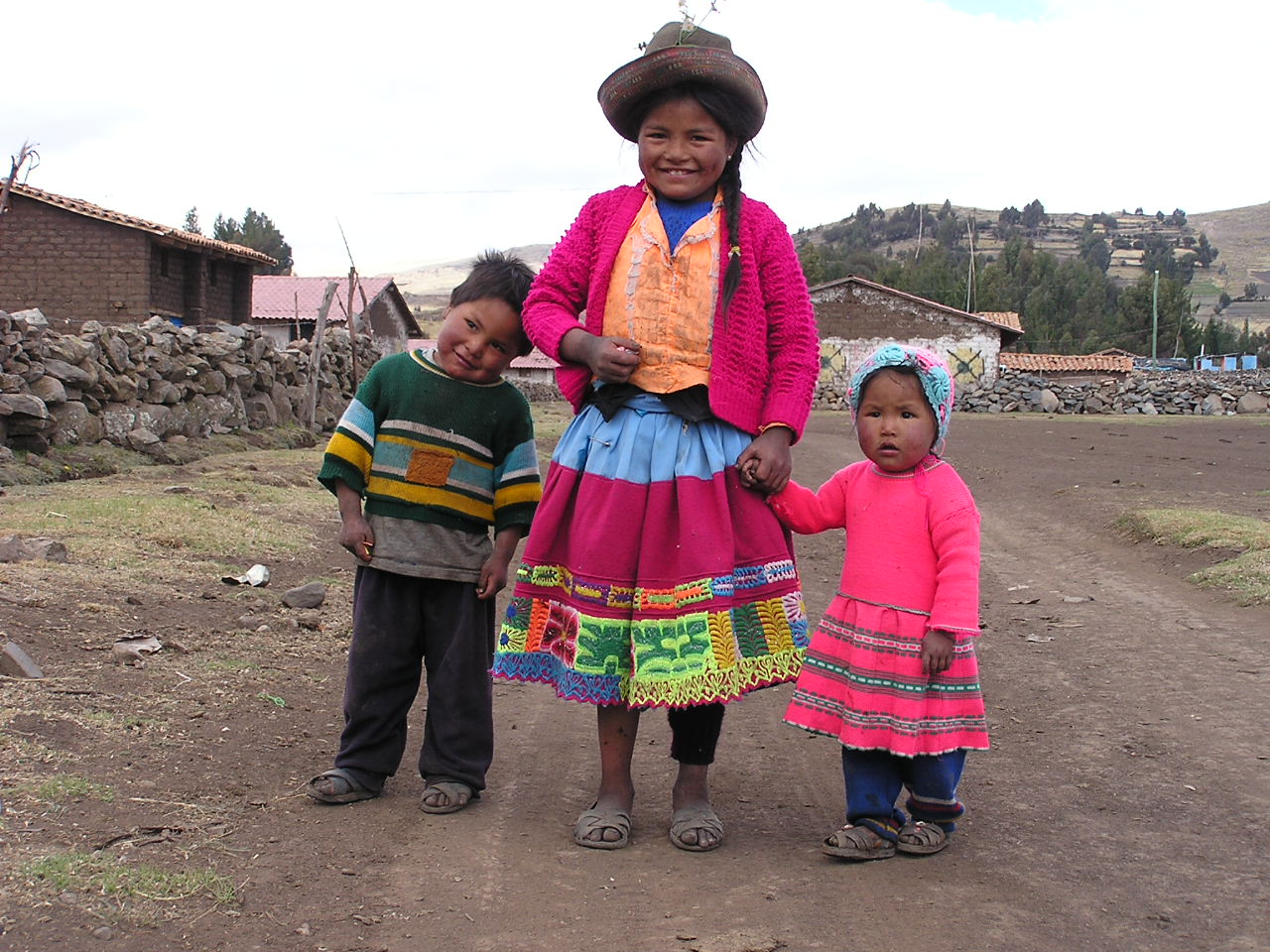
Kids in Pampamarca, Peru. The majority
of those killed during the conflict were
from indigenous communities like this in the highlands
It was November 2002 and I was sitting in a small conference room in Lima, taking notes as a woman tearfully relayed the story of her 9 years in detention. As she spoke, low and soft, the woman (who I’ll call Lourdes) cradled a newborn baby bundled in a pink blanket.
I had left my own 9 month old baby at home to lead a volunteer team on a one week trip to Peru to monitor the work of that country’s Truth and Reconciliation Commission (Comisión de la Verdad y Reconciliación or CVR). I had just recently returned to work after an extended maternity leave and, I have to say, I count those months of being at home with a potty-training toddler and a nocturnal infant as some of the toughest of my life.
Our team was interviewing Lourdes and several other inocentes or “innocents”. Between 1980 and 2000, the conflict between the Peruvian government and the Sendero Luminoso (Shining Path) and Tupac Amaru Revolutionary Movement (MRTA) rebel groups resulted in approximately 69,000 people killed and disappeared. As many as 600,000 were internally displaced; I remember seeing the tent cities on the outskirts of Lima where thousands of people who had fled the political violence in the highlands had lived for twenty years.
Lourdes was one of more than 14,000 Peruvians who were detained, tortured, and denied a fair trial under 1992 anti-terrorism decrees. She told us about the day she was arrested in early 1993. She and her husband were students. They had a three-and-a-half year old son who had health problems, so she had left the house before daybreak to get medicine for him. As she was returning to her house, she was stopped and arrested by the National Directorate Against Terrorism. It turns out that the Shining Path had bombed a nearby part of Lima. Lourdes and four other women who also happened to be out early that morning were arrested, blindfolded and interrogated. “One police officer told us that all of us would die,” she said quietly. Two hours after they were arrested, they were exhibited to the media at a press conference. The arrest was presented as a triumph over terrorism.
For the first several months, Lourdes was detained on a military base. The conditions were very bad and she was tortured. She didn’t go into the details and we didn’t ask her to tell us more. I remember her saying that she was allowed to use the bathroom only once a day – with 3-4 soldiers pointing their rifles at her. She was only allowed to bathe once a week. Lourdes was later moved to a prison, which she described as looking “like a paradise” compared to the military base.
Lourdes’ husband, who we also interviewed that day, had been arrested a month later. His father had to go to the police station to recover their little son, who was cared for by relatives for the next 9 years. Six months later, one of Peru’s “faceless” courts (called that because a one-way mirror concealed the identity of the prosecutors and judges) found Lourdes and her husband guilty of treason and sentenced them to life in prison.
Lourdes and her husband were not allowed to see each other during their detention and their letters to each other were read. For one whole year during her detention, after her sentence was reduced to 30 years, she was not allowed to have visits from anyone. Eventually, Lourdes and her husband were able to submit their cases to a Presidential pardons panel. She was pardoned in 2001, just a few weeks before the ninth anniversary of her arrest.
The interviews went on for more than six hours, but either Lourdes or her husband held that baby for the entire time. They didn’t put her in her carrier or pass her to the others who offered to hold her. They just took turns holding her close. I remember Lourdes saying to me afterwards, “We lost so much time with our son. Now he is a teenager and we’re strangers to him.”
Lourdes’ story highlights some of the problems of a government response to terrorism that doesn’t provide adequate protections for due process and other rights in the administration of justice. The Peruvian experience with terrorism seemed strikingly relevant back in 2002, when the US human rights community was very concerned about just how far the War on Terror might go. But I also learned an important personal lesson that day.
My friend Jim once had to share an office with an extremely annoying coworker. My friend kept a yellow post-it note stuck under his desk that said, “IGNORE ANTHONY”. Whenever the guy was bugging him, he would stick his head under the desk and read that post-it note. I don’t have a post-it note, but I do have a strong visual image of interviewing Lourdes that day in Lima. Whenever I feel that parenthood is more than I bargained for (which, frankly, was twice yesterday), I pluck that image from my garden of memories and think to myself: “REMEMBER LOURDES”.
If you’d like to learn more:
To see photos of life in Peru, go to the photo gallery on The Advocates for Human Rights website (click here.)
Some background on the anti-terrorism laws and why the system produced so many inocentes (click here.)
There is a 9-minute video summary of the Peruvian CVR’s findings related to the inocentes and human rights abuses in the 1990s: CVR Final Report: Fujimori and the Destruction of Democracy It provides a good overview, but be advised that it does contain some graphic images.






 The Human Rights Warrior
You must be logged in to post a comment.