Art Therapy in Cameroon


IMG_0195

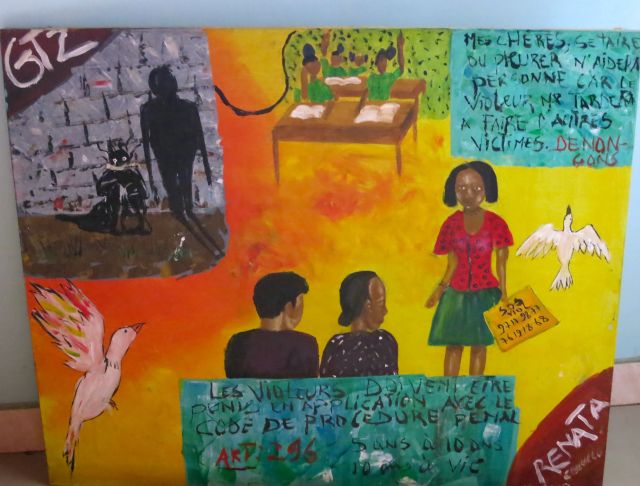
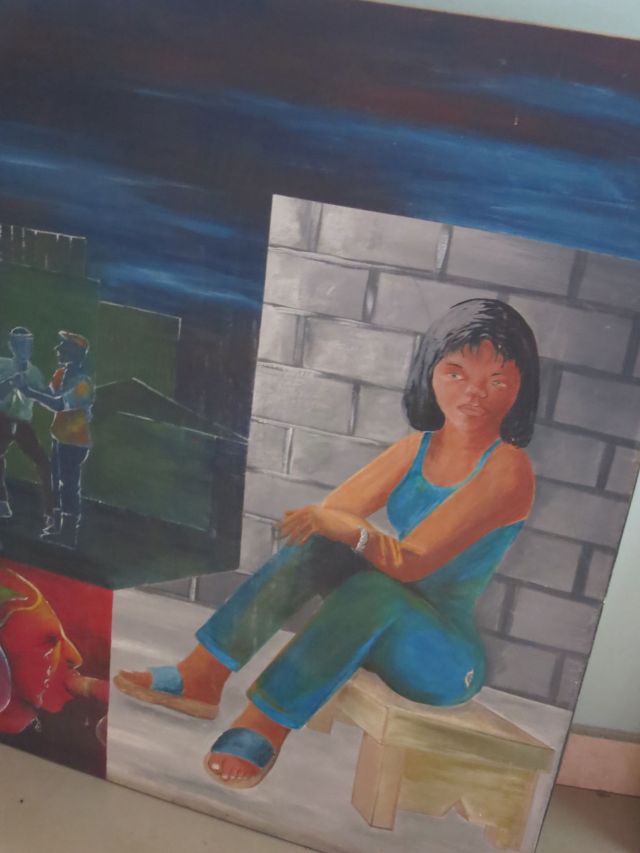
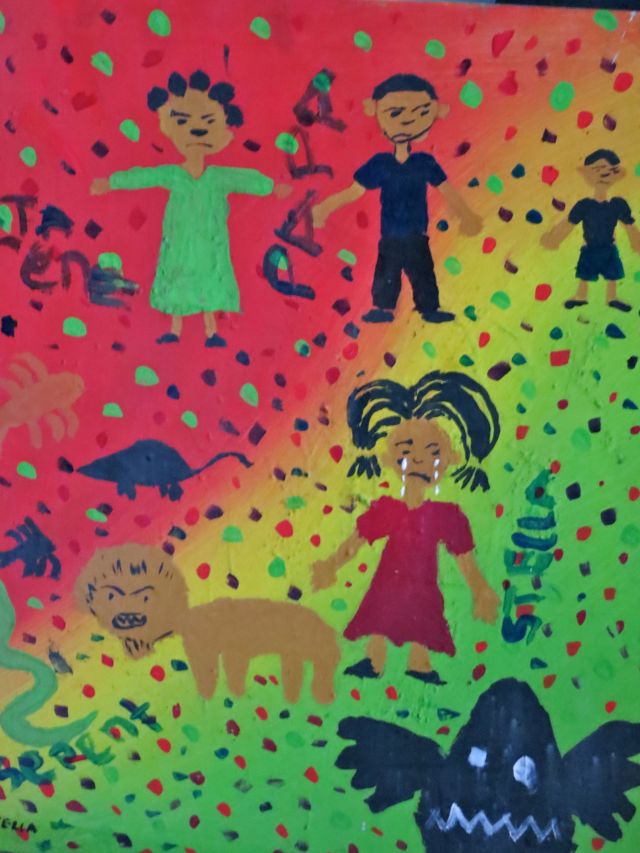
In Cameroon, an NGO called RENATA (Reseau National des Associations des Tantines)

encourages women and girls who have experienced violence to use art therapy in their healing process.

IMG_0196


These are just a few of the works of art that I had the privilege of seeing when I visited the RENATA office in Yaounde.

While I found these works of art profoundly sad,

I also saw them as bold statements of empowerment by the survivors who painted them.

IMG_0197

And so, while these works of art may never hang in a gallery, to me they are inspirational.


This post is a response to the Weekly Photo Challenge:  Work of Art.  Click on the link to see more responses.

Raising My Voice To #BringBackOurGirls

IMG_0849
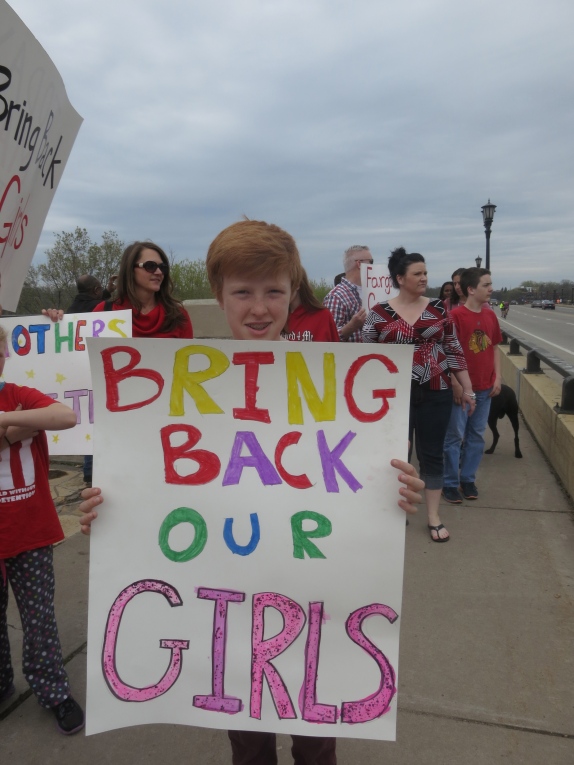
My son in a local march to Bring Back Our Girls

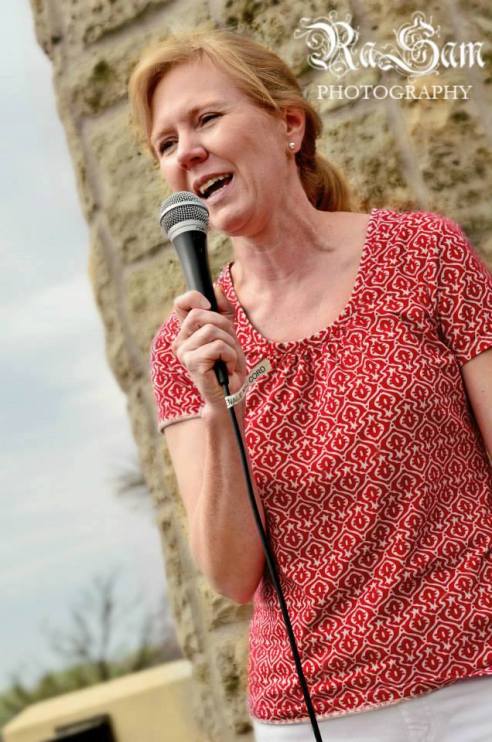
On Mother’s Day, I spoke at a local march and rally to show support for the nearly 300 school girls abducted a month ago in Nigeria.

IMG_0856

Here’s what I said:

Bring Back Our Girls Twin Cities March

May 11, 2014

Thanks to organizers and to all of you for being here.

I’m here as a lawyer and Deputy Director of The Advocates for Human Rights, a non-profit based in Minneapolis that works on human rights issues around the world.

But I’m also here as a mother.  My kids Simon and Eliza are here today as well to stand in honor of the nearly 300 girls abducted simply because they were pursuing their human right to education.  I think that’s pretty much the best Mother’s Day gift they could give me.

There are a lot of things that we don’t know about the situation in Nigeria.  We don’t know where the girls are or what is happening to them.  We don’t even know the exact number abducted and we only know a few of their names.  We can only imagine the agony their families are going through.

But the tragedy of the nearly 300 girls in Chibok shines a spotlight on the systemic human rights abuses against faced by women and girls worldwide.

And there are many things we do know about violations of the rights of girls and women:

  • We know that girls around the world lack equal access to basic education  (in the NE region of Nigeria where these girls lived, girl enrollment is the lowest in the country –  only 22%.  In part, they were targeted because they were seeking an education that would change their lives.
  • Educating girls, we know, is one of the strongest ways to improve gender equality.  It is also one the best ways to reduce poverty and promote economic growth and development
  • We know that girls and women are not valued equally as boys and men in many parts of the world.  The Nigerian government’s lack of action both before and after certainly makes it seem that these girls were not deemed worthy of protection.
  • We know that when these girls are found and hopefully rescued, they will need support in the form of psychosocial and health care.  Women’s access to health care is woefully limited.
  • We know that 1 in 3 girls under age 18 are still being forced into marriage too early.  By some estimates, that’s about 14 million girls a year. Too many girls still endure harmful traditional cultural practices such as FGM.
  • We know that girls and women suffer the most in times of conflict.  What these girls have experienced is likely a war crime.  Trafficking remains a huge problem around the world and in our own community.
  • We know that 1 in 3 of the world’s women experience violence, including domestic violence (The Advocates for Human Rights works on domestic violence legal reform around the world);

And we know that these are all things that have to change.

We need to do more to push our governments to make this change a priority.  We can’t stop with just these 276 girls.

Now these are human rights abuses that may seem intractable.  It may seem like you are powerless to make a difference.  But you can:

  • Continue to educate yourself about girls and women’s rights.  Here in the Twin Cities, there are many opportunities.   Through The Advocates for Human Rights alone, you can attend the free St. Paul Public Library Women’s Rights Film series, learn more about the issues on www.StopVAW.org, or participate in our Human Rights Book Club.
  • Support the NGOs that work on issues you care about. No amount is too small – a little money really does go a long way in this area.
  • Write to our members of Congress and the President to encourage support for women’s rights as a critical part of our US foreign policy.
  • For those of you with young people in your lives, teach them about the world around them so that they will grow up to continue the fight to ensure that every child, wherever he or she lives in the world, has the chance to live in safety and dignity and to achieve their greatest human potential.

For those of you doubting whether sharing this story on social media really makes a difference, I’d like to share a message I got on my blog from a woman named Winnie in Nigeria:

we here in nigeria are so angry and feel very helpless, the government and opposition leaders have politicized this, while our daughters are still in captivity. the government officials do not want to listen to ‘ordinary’ people. and word  has it that the Nigerian press have been ordered to kill the story (as the have killed other stories in the past).  pls this is a passionate plea to the international community to keep this story alive until our girls are returned home safely.

Here in the Twin Cities and all around the world, we are working to keep this story alive until our girls are returned home safely.

And after our girls come home, I hope we can keep working together for a future where all girls around the world can go to school in safety and grow up to reach their full human potential.

10288798_10203311603978274_2795202505824041415_n
Image used with permission of RaSam Photography. Thank you!


See also:  Nightmare For Nigeria’s School Girls   originally published on The Advocates Post.

Happy Spring!

20140504-095633.jpg

20140504-095759.jpg

20140504-095852.jpg

20140504-095921.jpg

This post is a response to the Weekly Photo Challenge: Spring. To see more entries, click here.

Nightmare for Nigeria’s School Girls

On the night of April 14, dozens of armed men showed up at the dormitory of the Government Girls Secondary school in Chibok in northeastern Nigeria.  Dressed in Nigerian military uniforms, they told the girls that they were there to take them to safety and herded the girls into trucks and onto motorcycles.  At first, the girls believed them. But when the men started shooting their guns into the air and shouting, “Allahu Akbar,”  they realized that the men were militants from Boko Haram and that they were in serious danger.

Forty-three girls managed to escape by running away or jumping out of the trucks. But as many as 234 school girls between the ages of 12 and 17 were kidnapped, disappearing into the night without a trace. (Update 5/4/14: it is now believed that as many at 276 girls were abducted.) Two weeks later, their parents still have no idea where they are. And yesterday, village elders from Chibok told reporters that they had received information that the abducted girls were taken across the borders to Chad and Cameroon and sold as brides to Islamist militants for 2,000 naira (about $12).

While unconfirmed, these reports are a chilling reminder of the threat of sexual violence faced by women and girls in conflict zones. 

The girls who were abducted were targeted simply because they were exercising their right to go to school, out of the ordinary for a girl in Nigeria. Access to basic education for girls has remained low, particularly in the northern region which has the  lowest girl child enrollment in Nigeria —in 2008 the net enrollment rate for girls into secondary school was only 22 percent.  The girls (who were both Christian and Muslim) at the Government Girls Secondary School in Chibok must each have been determined to get an education in spite of tremendous odds.  The fact that these girls were also risking violence to be in school illustrates how important the right to education was to each of them.

How could this happen? And why?
Boko Haram is a violent insurgent group that has killed thousands of people since 2009, purportedly in an attempt to establish an Islamist state in northern Nigeria. Although the Nigerian government has issued a state of emergency in three northern states, attacks on villages in northern Nigeria have displaced more than 470,000 people—mostly women and children, according to the UN High Commissioner for RefugeesSince early 2014, Boko Haram’s attacks have been increasingly violent, targeting remote villages, markets, hospitals, and schools.  Boko Haramis responsible for at least 1500 deaths so far in 2014.

Boko Haram also has a history of taking hostages as “slaves.” In May 2013, Boko Haram leader Abubakar Sheku released a video saying that Boko Haram had taken women and children, including teenage girls, as hostages as part of its latest campaign. These hostages would be treated as “slaves,” he said.  This has raised concern among the family members of those abducted that “Boko Haram is adhering to the ancient Islamic belief that women captured during war are slaves with whom their ‘masters’ can have sex.  Regardless of alleged rationale, enslavement, imprisonment, forced labor, rape and sexual slavery are all serious violations of international law.  They are defined by the Rome Statute of the International Criminal Court as crimes against humanity.

The group has repeatedly attacked schools in northern Nigeria. Boko Haram means “Western education is forbidden”  in the Hausa language. Boko Haram has set schools on fire and detonated bombs at university campus churches. In early February, armed gunmen abducted 20 female students at Goverment Girls Science College in the village of Konduga. On February 24, 2014, members of Boko Haram attacked and killed more than 40 male students at Federal Government College in Buni Yadi village and abducted an unknown number of female students. After these attacks, many schools in northeastern Nigeria were closed. The school where the abductions took place was closed as well, but local education officials decided to briefly reopen the Chibok school to allow the girls to take their exams.  

The mass kidnapping  in April was unprecedented and shocking. Even more shocking – after more than two weeks, the Nigerian government has done very little to find and rescue the girls.

The lack of government response has provoked outrage in Nigeria. On Wednesday, several hundred participated in a “million-woman protest march” in Abuja, Nigeria’s capital to demand that more resources be put toward finding and securing the kidnapped girls. The protesters in Nigeria are joined on Twitter with a growing movement under the hashtags #BringBackOurGirls, #BringBackOurDaughters and #234Girls. There is also a Change.org petition to Nigeria’s President Goodluck Jonathan asking him to do more to save the abducted girls and ensure that schools in Nigeria are safe.

One man, whose daughter was abducted along with his two nieces, said his wife has hardly slept since the attack. She lies awake at night “thinking about our daughter”.  As the mother of a young school girl myself, I feel deeply for her. The continuing tragedy of these young Nigerian school girls is every parent’s worst nightmare.

It’s time for world to wake up to the escalating violence in Nigeria, as well as the Nigerian government’s lack of response.

Originally published on The Advocates Post.

Injustice Anywhere Is A Threat To Justice Everywhere

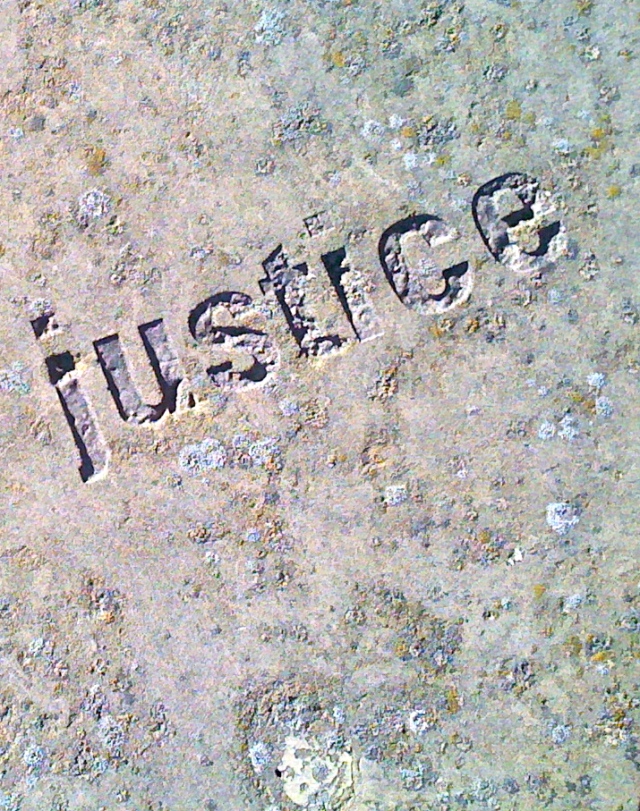
justice

As the Rev. Martin Luther King, Jr. once said,

“Injustice anywhere is a threat to justice everywhere.”


Use your voice.

Say it loud.

speak


This post is a response to the Weekly Photo Challenge:  Letters.  Click here to read more entries.

For another post that is not new but meets the same challenge, see Weekly Photo Challenge: The Sign Says. 


Swayambhunath: Nepal’s Monkey Temple

Swayambhunath Temple
The stupa at Swayambhunath seemed aglow on the rainy afternoon that I visited in September 2012.

Located at the top of a hill overlooking the city of Kathmandu, Swayambhunath (स्वयम्भूनाथ स्तुप) is among the oldest and most important religious sites in Nepal. The Swayambhunath complex consists of a domed stupa and a variety of shrines and temples that date back to the 5th century.  Each temple is extremely ornate and richly decorated with gold.  The complex also includes a Tibetan monastery, museum, library, and hostels for religious pilgrims.

Prayer flags flutter in the breeze, while prayer wheels in graduated sizes turn almost silently as pilgrims circle the stupa in prayer.

cropped-img_0728.jpg

This sacred pilgrimage site is also known as the Monkey Temple because it is home to HUNDREDS (maybe thousands!) of monkeys. According to legend, Manjushree, the bodhisattva of wisdom, was in the process of raising the temple hill when he let his short hair grow out and he got lice.  The lice in his hair transformed into these monkeys.

Looking down on Kathmandu, Nepla

Although it is primarily an important Buddhist site, Swayambhunath (which means “Self-Created” or “Self-Arisen”) is also considered important to Hindus.  To get to the main site of Swaymbhunath, you have to climb a looooong stairway – 365 steps!  Pratap Malla, the powerful Hindu king of Kathmandu, was responsible for the construction of this eastern stairway in the 17th century

It is definitely worth the climb, however.  Swayambhunath is perhaps the oldest Buddhist monument and well worth the trip!

This post is a response to the Weekly Photo Challenge: Monument.


Weekly Photo Challenge: Street Life

IMG_0343

Street scene in a town near Yaounde in Cameroon

For more responses to the Weekly Photo Challenge: Street Life, click here.


Get Ready For International Happiness Day!

Nepal
Happiness in Nepal

Wondering why there are so many videos of people singing Pharrell Williams’   “Happy”  going viral this week?  Here’s the answer:

March 20 is the second annual International Day of Happiness!

The United Nations General Assembly passed a resolution in 2012 recognizing March 20 as a day to acknowledge that “the pursuit of happiness is a fundamental human goal” and recognize “the need for a more inclusive, equitable and balanced approach to economic growth that promotes sustainable development, poverty eradication, happiness and the well-being of all peoples”. This year, the United Nations Foundation and Pharrell Williams are teaming up to encourage people to support the United Nations’ efforts  to create a happier world for people everywhere.

Some people are already asking why in the world we need a day to celebrate happiness.  What could an international day and a celebrity singing an upbeat song possibly do to make an impact on serious global problems?

Personally, however, I am looking forward to International Happiness Day.  The way I see it, we already have more than enough aspects of our human nature to divide us.  When people focus on what makes us different – our religion, our ethnicity, our skin color –  it  often leads to violence and conflict. Lives are shattered in big ways and small.  But every human has a very basic need, not to mention a strong desire, for something very simple.  We all want to be happy. We all want to see that our children and the others who who we care about have the opportunity that they deserve to be happy.

Our human capacity to feel happiness is a basic characteristic that we all share, regardless of our differences. 

In my line of work, I deal with a lot of human unhappiness.  So I think about these things all the time.  You would expect that it would make me cynical about people in general  – and particularly about something like an international day of happiness, complete with a celebrity  and an upbeat hit song.

But I strongly believe that our human capacity for happiness is a strength, and one that should be nurtured and celebrated in the midst of all that is dark and dangerous and painful in our world.

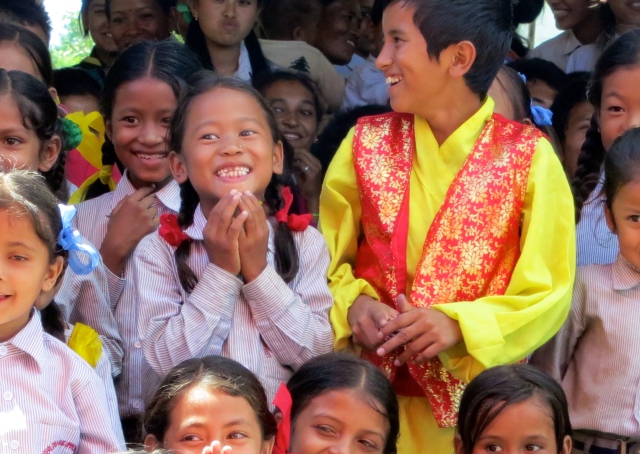
I took the photo above the last time I was in Nepal.  I keep it as my screensaver to remind me every day of the simple fact that we humans all have the potential to experience intense joy.  It makes me believe that our human capacity for happiness must one day trump our human proclivity to hurt each one another.  And this photo reminds me every day that everyone – every single person, regardless of who they are or where they live in world – should have the opportunity to feel happiness in the way that these kids in Nepal were so clearly feeling it.

International Happy Day is also a call to action.  It is a reminder that there is more that each of us can do to ensure that everyone is able to live their lives to their fullest human potential  in safety, dignity, freedom, and equality.   For all of us, these are the basic human prerequisites to happiness.  We need to keep moving towards the concept that none of us can be truly happy, until all of us have an equally fair shot at being happy.

There are a few things in this world that are truly global: One of them is that people want to be happy. Thursday, March 20 is the International Day of Happiness, and the United Nations Foundation and Grammy Award-winning musician Pharrell Williams have teamed up to encourage people to take action to support the UN and to create a happier world for people everywhere. – See more at: http://unfoundationblog.org/international-day-of-happiness-2014/#sthash.CuzHI1xW.dpuf
hursday, March 20 is the International Day of Happiness, and the United Nations Foundation and Grammy Award-winning musician Pharrell Williams have teamed up to encourage people to take action to support the UN and to create a happier world for people everywhere. – See more at: http://unfoundationblog.org/international-day-of-happiness-2014/#sthash.CuzHI1xW.dpufhttp://youtu.be/8bhfu1KnKjM

So go ahead and celebrate International Happiness Day.  In the United States, you don’t even have to wait until March 20.  Thanks to the international time difference, #Happy Day starts in just a few hours.   (And #HappyDay is already going strong on Twitter!) You can catch it all on the website 24 Hours of Happiness.com   Since March 10, people around the world have been posting YouTube videos of themselves “demonstrating their happiness” to Pharrell William’s track with the hashtag #HAPPYDAY and submitting it to the website.   On March 20th, Pharrell will spotlight the best submissions at noon in each time zone.

Here is the first one – from New Zealand!

See additional ways to participate here.   And whatever else you do on March 20, be sure to have a

Paving Pathways for Justice & Accountability: New Tools for Diaspora Communities

House party_HighRes-2

This post originally appeared on The Advocates Post.

Human rights advocacy takes many forms, and human rights activists can be found in every corner of the world.  Tremendous advancements in technology and communication have allowed activists to form strong international networks and to share emerging information about human rights abuses almost as soon as they happen.  These advancements have fundamentally changed the way human rights organizations work, including how they engage in human rights advocacy with broader communities beyond a country’s borders.

Yet the unique role diaspora communities can play in improving human rights around the world has largely been overlooked in the human rights field. It’s time for that to change.  

Diaspora: The Migration Policy Institute defines the term “diaspora” as “emigrants and their descendants who live outside the country of their birth or ancestry . . . yet still maintain . . . ties to their countries of origin.”

Members of diaspora communities play an increasingly important global role and can be a bridge between individuals, governments, and international legal and political mechanisms.  Diaspora communities are a critical link in changing social institutions and structures to hold governments accountable.   Many migrants – refugees and asylum seekers in particular – leave their homes because of human rights abuses.  Many were political and human rights activists in their home countries and they bring their experiences with them.  In some countries with repressive governments, security concerns mean that diasporans must take the lead in speaking out.  From their new home base, they can bring change in their countries of origin.

Members of diaspora communities agree.  Chanravy Proeung, a member of the Cambodian diaspora and Co-Director of the Providence Youth Student Movement, said:

“We have the privilege to see those countries from a different perspective. We need to have the people who are the most marginalized and affected by issues at the forefront of creating change not only here in the United States, but having influence in their countries of origin, too.”

For more than 30 years, The Advocates for Human Rights has witnessed the powerful role that diaspora civil society organizations play in documenting human rights abuses, influencing policy, and advocating on behalf of victims of human rights violations in their countries of origin.

As a legal service provider, The Advocates is often the first connection that asylum seekers have to their new community in the United States.  Because of this special relationship, diasporans from dozens of countries have requested assistance from The Advocates in documenting human rights violations “back home.”  With diaspora communities, The Advocates has conducted groundbreaking work, such as the Liberian Truth and Reconciliation Commission Diaspora Project, ensuring that public hearing testimony and the statements of 1,200 Liberians living outside of Liberia were included in the formal history of the conflict.

The report,  Human Rights in Ethiopia: Through the Eyes of the Oromo Diasporaproved the significance of involving individuals who have left a country in work to hold governments accountable and affect human rights in their home countries.  The Advocates has also collaborated with the Indian American Muslim Council on advocacy on issues concerning religious minorities at the both the U.S. Congress and the United Nations, demonstrating that diaspora voices can have an impact on human rights in India.

The Advocates recently completed a two-year project to identify needs and create tools to help tap the underexplored resources of diaspora involvement in human rights.  The result is a groundbreaking resource called Paving Pathways for Justice & Accountability: Human Rights Tools for Diaspora Communities.

diaspora-cover-final

This manual, available for download at no cost, provides a full menu strategies and resources designed to empower diaspora communities to be more effective advocates for human rights in their countries of origin.

With practical tools and step-by-step guidance shaped by input from multiple diaspora communities, Paving Pathways can be used to help individuals and organizations to:

  • monitor and document human rights abuses;
  • advocate for change in their country of origin and country of residence, as well as at international and regional human rights mechanisms;
  • address impunity and hold governments accountable using national and international law; and
  • build their capacity to improve human rights conditions.

While the tools and resources presented in this manual were specifically created for use by diaspora communities, this manual can also benefit and be used by human rights defenders and civil society organizations throughout the world.

The international community needs to do more to recognize the unique contributions that diaspora communities can make to building respect for human rights around the world.  Rather than treating diasporans solely as economic sources of remittances,  investment, and philanthropy, countries of origin and countries of residence should  facilitate engagement in long-term social change.  With this new resource, The Advocates is taking an important step in supporting diaspora communities in their efforts to improve human rights around the world.

Download your free copy at: TheAdvocatesForHumanRights.org/pathways  

Individual chapters can also be downloaded for free.

Don’t know where to start?Quick Reference Guide cropped

Use our Quick Reference Guide!


[1] International Organization for Migration and Migration Policy Institute, Developing a Roadmap for Engaging Diasporas in Development (Washington DC and Geneva: IOM and MPI, 2012), 15. Also available online at http://www.migrationpolicy.org/pubs/thediasporahandbook.pdf.

By:  Jennifer Prestholdt, Deputy Director and Director of  the International Justice Program at The Advocates for Human Rights


Inside the Apostle Islands Ice Caves

IMG_2258

My oldest son went on a school trip a few weeks ago.  The main purpose was to participate in the Barnebirkie, the children’s version of the largest cross-country ski race in North America.  It takes place in northern Wisconsin every February.   This is the twentieth year that the school has done this trip with middle grade students, so they have become experts at making it an enriching experience.  In addition to skiing in the race with more than 1,000 other kids, they spend some time doing joint educational programming at the local middle school (this year, there was some kind of amazing science theme) and have a traditional meal with a Native American tribe.  They also somehow fit swimming at the local community center into the packed agenda.

A week before the trip, a note came home in my son’s backpack that there would be a slight alternation to the schedule.  The group would be able to visit the ice caves on Lake Superior’s Apostle Islands.  For those not familiar with the Upper Midwest, the Apostle Islands National Lakeshore in northern Wisconsin is a true gem of a national park.   There are 21 islands, windswept beaches, rocky cliffs, and lighthouses.  In the summer, you can hike the 12 miles of lakeshore wilderness and paddle or boat around the islands. You can even camp on 18 of the islands, which are only accessible by water.    You can even explore by kayak the  amazing sea caves at the western end of the mainland part of the park.

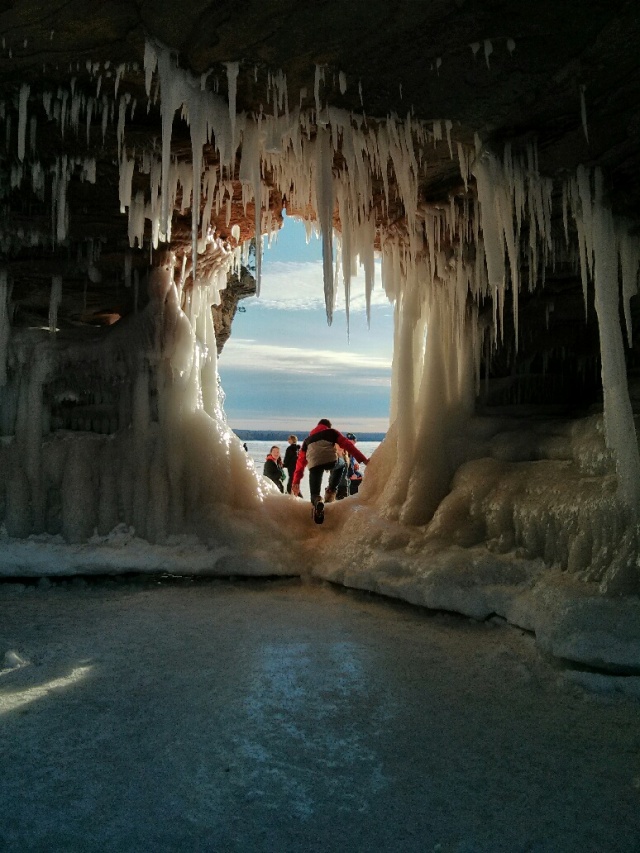
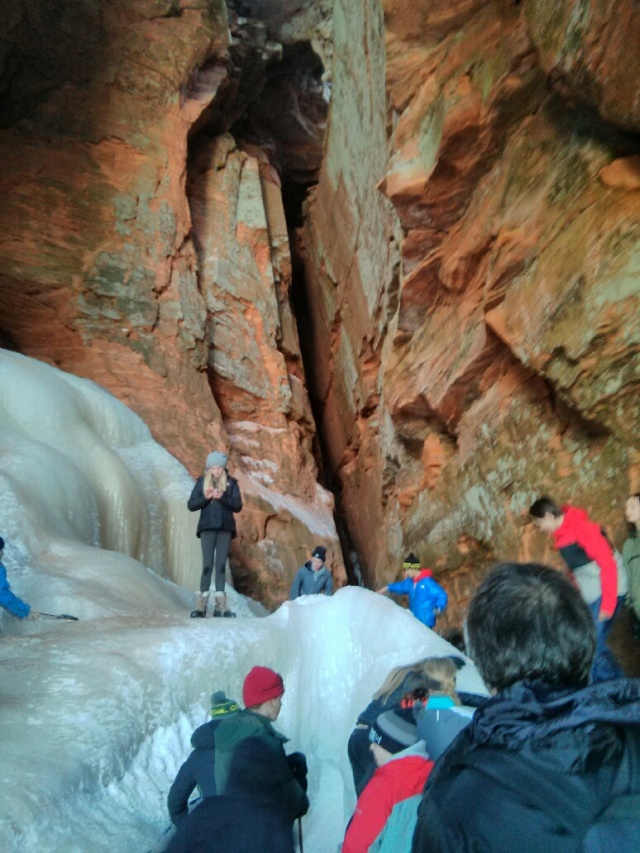
In winter, the sea caves become ice caves.  And in extremely cold winters, when Lake Superior freezes over, the national park service allows people to walk out over the ice and experience the ice caves from the inside.

IMG_2256

As I have never been to the Apostle Island ice caves, I was excited that my son had this opportunity to visit them.   It has been five years since the ice caves were last open to the public.  One of the impacts of climate change has been that Lake Superior hasn’t been frozen enough to make access possible.   Since the ice caves opened to the public on January 15, more than 125,000 people have made the two mile roundtrip trek over frozen Lake Superior to experience the  ice caves.

My son sent took these pictures of his visit and texted them to me.

IMG_2259

It’s an odd feeling – usually I’m the one who is traveling and sending the pictures back home to the rest of the family. But I really appreciated his willingness to share the experience of being inside the Apostle Islands ice caves with me.

IMG_2260

With warmer weather, the ice is degrading and it is becoming unsafe to be on the lake.   The National Park Service plans to close the Apostle Island ice caves to the public by 12:01 am on Monday, March 17.


IMG_2257

With special thanks to my son Sevrin for the photos!

For more responses to the Weekly Photo Challenge: Inside, click here.